

A tenant submits a maintenance request at 11 PM on Saturday. It sits in an inbox, unread, until Monday morning. By then, the tenant has already left a frustrated review, and the property manager is now dealing with a small plumbing issue that’s turned into water damage.
This scenario repeats itself thousands of times a week across property management companies, brokerages, and real estate portfolios — not because teams don’t care, but because manual processes simply can’t keep pace with the volume of tasks modern real estate operations demand. Rent reminders, lease renewals, maintenance tickets, document approvals, tenant screening, follow-ups — each one small on its own, but collectively enough to bury even a well-staffed team.
This is exactly the problem real estate workflow automation software is built to solve. Instead of relying on someone to manually notice, remember, and act on every task, automation software handles the repetitive, time-sensitive work in the background — instantly, consistently, and without human delay.
At Digitechzo, we’ve helped property management firms and real estate teams replace exactly these kinds of manual bottlenecks with automated systems — and the results are consistent: fewer missed tasks, faster response times, and teams that finally have bandwidth to focus on growth instead of firefighting. This guide covers exactly how real estate workflow automation software works, where AI fits in, and how to implement it without wasting money on the wrong tools.
Quick Answer
Real estate workflow automation software uses rule-based triggers and AI to automatically handle repetitive property management tasks — like maintenance routing, rent reminders, lease renewals, and tenant communication — eliminating manual follow-up and reducing response times from days to minutes. Teams using it typically cut administrative workload by 30–50% while improving tenant and client satisfaction.
What Is Real Estate Workflow Automation Software?
Real estate workflow automation software is a system that automatically triggers actions — notifications, task assignments, document generation, follow-ups — based on predefined rules or AI-driven logic, removing the need for staff to manually track and execute repetitive property management tasks.
Instead of a property manager remembering to send a rent reminder on the 1st of every month, the software sends it automatically. Instead of a maintenance request sitting in an inbox, it’s instantly routed to the right vendor or technician based on issue type and location.
In simple terms: real estate workflow automation software replaces “someone has to remember to do this” with “this happens automatically, every time, without fail.”
This distinguishes it from general real estate operations software, which focuses more broadly on pipeline and deal management — automation software specifically targets the repetitive, rule-based tasks that consume the most staff hours.
\Why Manual Property Management Doesn’t Scale
Manual processes work fine at small scale — a handful of properties, a handful of tenants. But growth exposes the cracks fast:
- Volume outpaces attention span. One property manager can realistically track maybe 20–30 active items manually before things start slipping.
- Human memory isn’t a reliable system. Even the best staff forget renewal dates, follow-up windows, or pending approvals during busy weeks.
- After-hours requests go unanswered. Maintenance issues and tenant queries don’t stop at 6 PM, but manual response often does.
- Reporting becomes reactive instead of proactive. Without automated tracking, problems (like a spike in late payments) are often noticed only after they’ve already caused damage.
Research on property management operations consistently points to administrative overhead — not sourcing new clients or units — as the biggest constraint on portfolio growth. Real estate workflow automation software directly targets this constraint by removing the dependency on manual memory and manual execution.
\How AI Powers Real Estate Workflow Automation Software
Basic automation follows fixed rules: “if X happens, do Y.” AI-powered real estate workflow automation software goes further by adding judgment and prediction into the process.
1. Predictive Maintenance Flagging
AI analyzes historical maintenance data to flag units likely to need repairs soon — for example, identifying HVAC systems statistically due for failure based on age and past service tickets — before the tenant even reports an issue.
2. Smart Lead and Tenant Prioritization
Instead of treating every inquiry equally, AI scores leads and tenant requests based on urgency, sentiment, and likelihood to convert or churn, helping staff focus on what matters most first.
3. Natural Language Processing for Communication
AI can read incoming tenant messages or emails, categorize the issue (plumbing, electrical, noise complaint, billing question), and route it automatically — without a human needing to read and manually sort every message.
4. Dynamic Document Generation
AI-assisted automation can generate lease renewals, notices, or compliance documents pre-filled with the correct tenant and property data, cutting document prep time from hours to minutes.
H3: Example Scenario
A property management company managing 300+ units previously had one staff member spend nearly 15 hours a week manually sorting maintenance requests by urgency and vendor type. After implementing AI-driven real estate workflow automation software, that sorting became instant and automatic — reallocating those 15 hours toward tenant retention efforts instead.
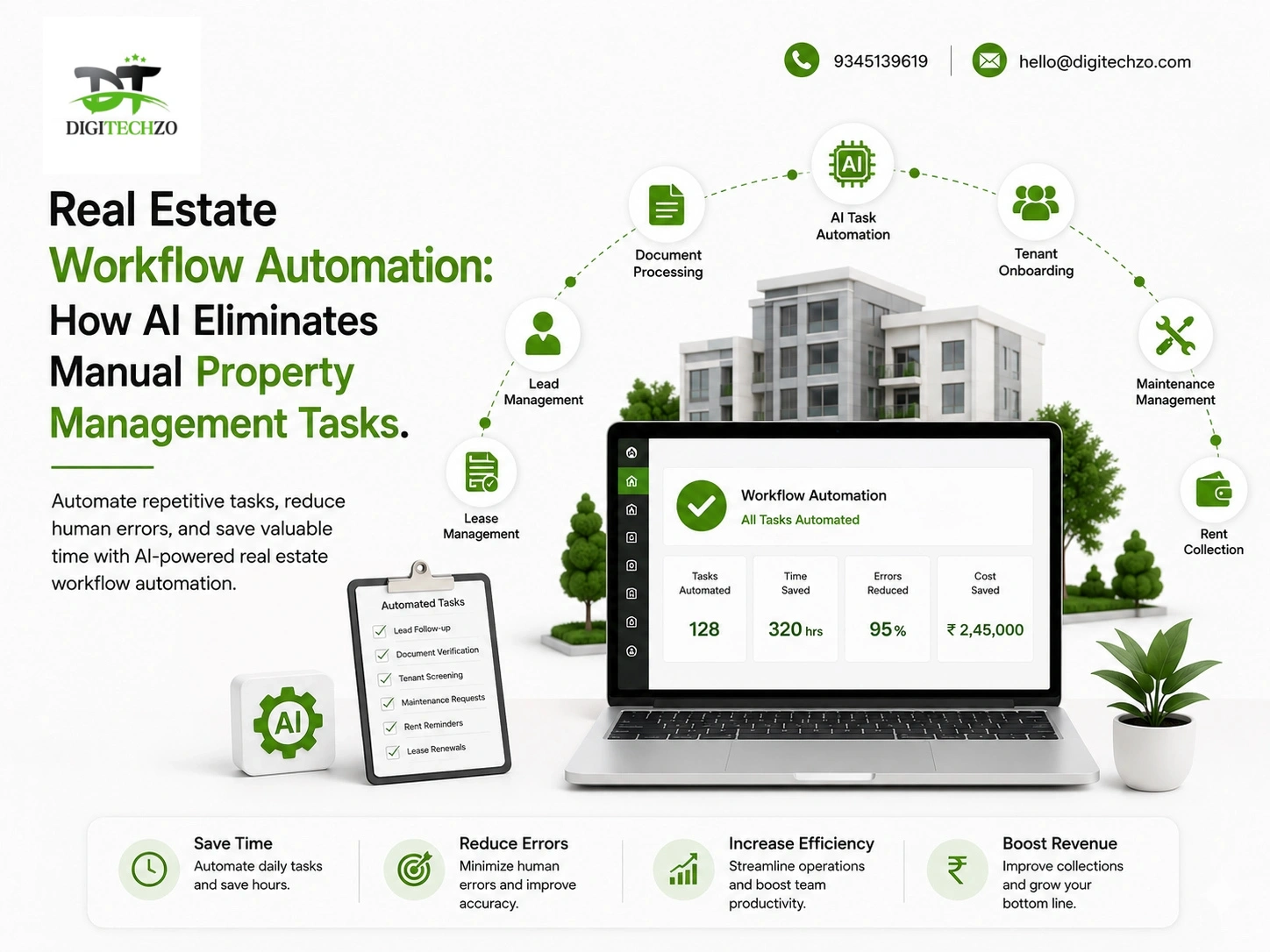
Core Manual Tasks Real Estate Workflow Automation Software Eliminates
- Rent reminders and late payment notices — sent automatically based on due dates
- Maintenance request routing — auto-assigned to the correct vendor or technician
- Lease renewal notifications — triggered a set number of days before expiration
- Document generation — leases, notices, and compliance forms auto-populated
- Tenant screening follow-ups — automated status updates during application review
- Move-in/move-out checklists — automatically assigned and tracked
- Vendor payment scheduling — recurring payments triggered without manual entry
- Client and owner reporting — automated monthly performance summaries
Featured Snippet Answer: The most time-consuming manual task that real estate workflow automation software eliminates is maintenance request routing — manually reading, categorizing, and assigning tenant maintenance issues to the right vendor, which automation handles instantly and consistently.
\Rule-Based Automation vs AI-Driven Automation
Not all real estate workflow automation software works the same way. Understanding the difference helps you choose correctly.
Rule-Based Automation:
- Executes fixed “if-this-then-that” logic
- Predictable and easy to configure
- Cannot adapt to unusual or unstructured input
- Best for: reminders, scheduled notifications, recurring tasks
AI-Driven Automation:
- Learns from historical data and patterns
- Can interpret unstructured input (like free-text tenant messages)
- Improves accuracy over time
- Best for: prioritization, predictive maintenance, communication sorting
Pros of combining both:
- Rule-based handles the predictable 80% of tasks reliably
- AI handles the more nuanced 20% that requires judgment
- Together, they create a system that’s both consistent and intelligent
Cons to watch for:
- Pure rule-based systems can feel rigid and miss edge cases
- Pure AI-only systems can be harder to audit and explain
- The best real estate workflow automation software blends both approaches rather than relying on just one
Real-World Use Case Scenarios
Scenario 1: Multi-Property Landlord Managing 50+ Units Solo Automated rent reminders and late-fee notices remove the need to manually track 50 different due dates, while automated maintenance routing means issues get to vendors even when the landlord is unavailable.
Scenario 2: Property Management Firm With High Tenant Turnover Automated move-in/move-out checklists ensure nothing is missed during unit turnover — a common source of deposit disputes — while automated lease renewal reminders reduce unexpected vacancies.
Scenario 3: Brokerage Handling High Volume of Tenant Screening AI-driven prioritization flags applications likely to qualify quickly, letting agents focus their time on the strongest candidates instead of processing every application in the order it arrived.
How to Choose the Right Real Estate Workflow Automation Software
When evaluating platforms, prioritize:
- Trigger flexibility — can workflows be customized to your specific processes, not just generic templates?
- AI capability for unstructured data — can it read and categorize free-text tenant communication?
- Integration with existing tools — CRM, accounting software, and communication channels
- Audit trail and transparency — can you see why the system made a specific automated decision?
- Scalability — does it remain effective as unit count or client volume grows significantly?
- Mobile accessibility — for on-site staff and field technicians
Common Mistakes When Implementing Real Estate Workflow Automation Software
- Automating a broken process — automation speeds up whatever process you already have; if that process is flawed, automation just creates errors faster.
- Setting overly rigid rules — workflows that don’t account for exceptions frustrate both staff and tenants.
- Skipping a pilot phase — rolling out automation across an entire portfolio at once makes it hard to identify what’s misconfigured.
- Ignoring change management — staff who don’t understand why automation was introduced often work around it instead of adopting it.
- Not monitoring AI decisions early on — AI-driven prioritization needs review in the first few weeks to confirm it’s making sensible calls.
- Underestimating data migration — historical tenant and property data needs to be clean and structured for automation to work reliably from day one.
Expert Tips for Maximizing ROI
- Start with the highest-volume repetitive task first — usually maintenance routing or rent reminders — to prove value quickly before expanding automation further.
- Keep a human review step for exceptions. Full automation without an escape hatch for unusual cases creates tenant frustration.
- Track time saved, not just tasks automated. The real ROI metric is hours reallocated to higher-value work, not the number of workflows running.
- Revisit automation rules every quarter. Property portfolios and tenant needs change; static rules become outdated faster than most teams expect.
- Use AI suggestions as a starting point, not a final decision — especially for tenant screening or maintenance prioritization, where context still matters.
Frequently Asked Questions
Q1: What is real estate workflow automation software?
It’s software that automatically triggers property management tasks — like maintenance routing, rent reminders, and lease renewals — based on rules or AI logic, removing the need for manual tracking and follow-up.
Q2: How does AI improve real estate workflow automation software?
AI adds predictive and interpretive capability, allowing the software to flag likely maintenance issues in advance, prioritize urgent tenant requests, and read unstructured messages — something basic rule-based automation cannot do.
Q3: Is real estate workflow automation software only useful for large property portfolios?
No. Even landlords or managers with a small number of units benefit significantly, since manual tracking of due dates, renewals, and maintenance becomes error-prone even at modest scale.
Q4: What tasks should be automated first?
Start with the highest-frequency, most time-consuming manual tasks — typically rent reminders and maintenance request routing — since these show measurable time savings fastest.
Q5: Does automation replace property managers?
No. Real estate workflow automation software removes repetitive administrative work, freeing property managers to focus on tenant relationships, vendor negotiations, and strategic decisions that still require human judgment.
Conclusion: Stop Managing Properties Manually — Start Managing Them Intelligently
Manual property management doesn’t fail because teams aren’t capable — it fails because human memory and manual follow-up simply can’t keep pace with the volume of repetitive tasks real estate operations generate every single day. Real estate workflow automation software closes that gap by handling the predictable, repetitive work instantly and consistently, while AI adds the judgment needed to prioritize what actually matters.
The property managers and brokerages winning right now aren’t working harder — they’re automating the repetitive 80% so their teams can focus on the 20% that actually requires human expertise.
If you’re ready to stop losing hours to manual maintenance routing, rent reminders, and follow-ups, Digitechzo helps real estate and property management teams implement workflow automation built around how their operations actually run — not a generic template.
Want to see exactly which of your manual tasks could be automated today? Reach out to Digitechzo for a free workflow assessment and start reclaiming your team’s time.
About The Author