

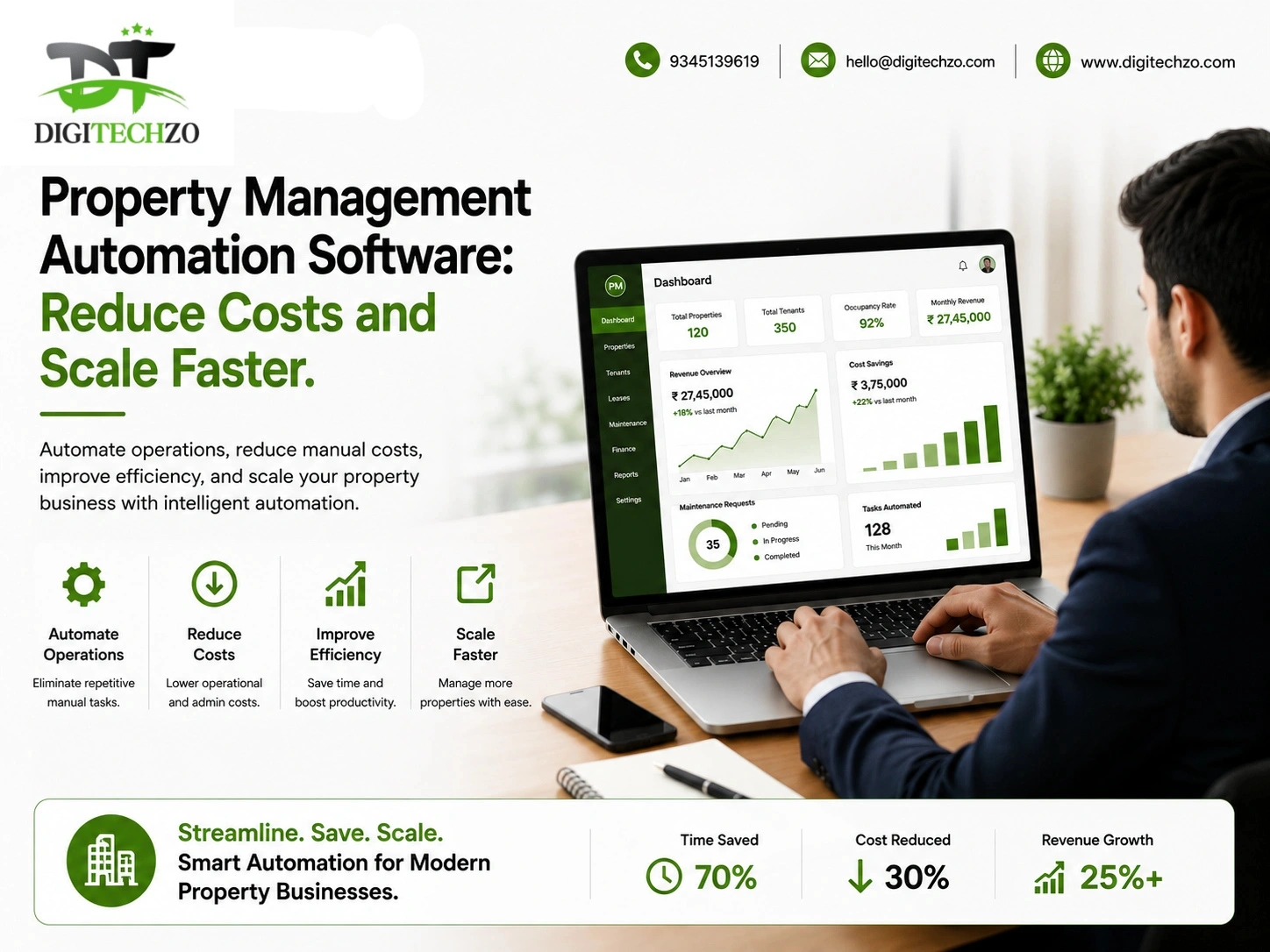
A property management company hits 150 units and suddenly the math stops working. Payroll goes up because two more coordinators are needed just to keep up with maintenance calls and rent collection. Yet margins don’t improve — they shrink. Owners start asking why growth is costing more than it’s earning.
This is the exact point where most property management companies either stall out or make the wrong fix: hiring more people to do the same manual work faster, instead of removing the manual work itself. The real lever for scaling profitably isn’t headcount — it’s property management automation software.
Property management automation software replaces the assumption that growth requires proportional staffing with a different model entirely: one where rent collection, maintenance coordination, tenant communication, and reporting scale without a matching increase in payroll. It’s the difference between a company that adds costs every time it adds units, and one that adds margin.
At Digitechzo, we’ve worked with property management companies specifically at this scaling inflection point — the 100–500 unit range where manual processes become the biggest cost center in the business. This guide breaks down exactly how property management automation software reduces costs, where the real savings come from (not just the obvious ones), and how to scale a portfolio without scaling headcount at the same rate.
Quick Answer
Property management automation software reduces operational costs by automating rent collection, maintenance coordination, tenant communication, and reporting — cutting per-unit administrative costs so portfolios can grow without proportional headcount increases. Companies typically reduce administrative overhead by 20–40% per unit while improving tenant retention and response times.
What Is Property Management Automation Software?
Property management automation software is a platform that automates the recurring operational tasks of managing rental properties — rent collection, maintenance requests, lease renewals, tenant screening, vendor payments, and owner reporting — reducing the manual labor typically required per unit managed.
The key distinction from general property management software is the automation-first design: instead of digitizing tasks for a human to still perform manually (like a digital form someone still has to read and act on), automation software executes the task itself — sending the reminder, routing the request, generating the report — without waiting for a person to trigger it.
In simple terms: if standard software helps your team work faster, property management automation software lets your team handle more units without growing proportionally at all.
This is precisely why cost reduction and scalability, rather than convenience alone, have become the primary reasons companies invest in property management automation software.
The Real Cost of Manual Property Management
Most companies underestimate what manual processes actually cost because the expenses are hidden inside salaries rather than showing up as a line item. Consider where the money actually goes:
- Coordinator time on rent collection — chasing late payments, manually reconciling bank deposits, sending reminders one by one.
- Maintenance coordination overhead — reading requests, calling vendors, confirming scheduling, following up on completion.
- Owner and client reporting — manually compiling occupancy, income, and expense reports every month.
- Tenant turnover admin — move-in/move-out paperwork, deposit reconciliation, unit inspection scheduling.
- Compliance and renewal tracking — manually monitoring lease expiration dates and required notices across dozens or hundreds of units.
Industry benchmarks commonly cite administrative labor as one of the largest controllable cost categories in property management — often exceeding marketing and even maintenance material costs when properly accounted for. The problem isn’t that any single task is expensive. It’s that dozens of small manual tasks, multiplied across every unit, quietly become the largest cost center in the business.
How Property Management Automation Software Reduces Costs
1. Reduces Labor Cost Per Unit, Not Just Total Labor Cost
The real metric that matters isn’t total staff cost — it’s cost per unit managed. Property management automation software lets one coordinator effectively manage significantly more units by removing manual, repetitive steps from their workload.
2. Cuts Late Payment Losses Through Automated Collection
Automated rent reminders, late fee notices, and payment tracking reduce the percentage of rent collected late — directly improving cash flow without adding collections staff.
3. Lowers Maintenance Costs Through Faster Vendor Routing
When maintenance requests are automatically routed to the right vendor immediately, minor issues get resolved before they escalate into expensive repairs — a leak caught in hours costs far less than one caught after days of manual delay.
4. Reduces Turnover-Related Costs
Faster, more consistent tenant communication through automation improves satisfaction and retention. Since tenant turnover is one of the most expensive events in property management — covering vacancy loss, marketing, and unit turnover costs — even a modest retention improvement produces meaningful savings.
5. Eliminates Reporting Labor
Automated owner and financial reporting removes hours of manual spreadsheet work every single month across every property in the portfolio.
H3: Example Scenario
A property management company managing 220 units previously required four full-time coordinators primarily focused on rent tracking, maintenance calls, and reporting. After implementing property management automation software, the same output was maintained with three coordinators — with the fourth role reallocated to business development instead of being cut, directly contributing to portfolio growth rather than just administrative overhead.
The Cost-Per-Unit Framework: A Better Way to Measure ROI
Most companies evaluate software cost against subscription price alone. That’s the wrong comparison. The framework that actually matters:
Cost Per Unit Managed = Total Operational Labor Cost ÷ Number of Units Managed
Before automation, this number typically increases as a portfolio grows past certain thresholds, because manual processes require proportional staffing increases. After implementing property management automation software, cost per unit should decrease as the portfolio scales, because automation absorbs the additional volume without proportional labor growth.
Featured Snippet Answer: The most accurate way to measure ROI from property management automation software is cost per unit managed — calculated as total operational labor cost divided by number of units — because it reveals whether growth is becoming more efficient or more expensive over time.
If your cost per unit isn’t declining as your portfolio grows, that’s a signal your operations aren’t actually scaling — they’re just getting more expensive at a slower rate.
How Property Management Automation Software Enables Faster Scaling
Growth in property management has traditionally been staffing-constrained: to manage more units, you need more coordinators, which takes time to hire, train, and onboard. Automation removes this constraint in several ways:
- New units can be onboarded without proportional hiring, since automated workflows already exist and simply extend to new properties.
- Response times stay consistent regardless of volume, since automated routing doesn’t slow down as request volume increases the way manual processes do.
- Reporting scales instantly, since automated reports generate the same way whether covering 50 units or 500.
- Institutional knowledge stops depending on individual staff members, since workflows are built into the system rather than existing only in one coordinator’s head.
This is the core reason growth-focused property management companies increasingly treat property management automation software as a scaling infrastructure decision, not just an efficiency upgrade.
Build vs Buy vs Hire: A Cost Comparison
When companies hit the scaling wall, they typically consider three paths. Here’s how they actually compare:
Option 1: Hire More Staff
- Pros: Familiar approach, no new technology to learn
- Cons: Costs scale linearly with growth, onboarding takes months, doesn’t fix root inefficiency
Option 2: Build Custom Software In-House
- Pros: Fully tailored to specific workflows
- Cons: High upfront development cost, ongoing maintenance burden, slow time-to-value
Option 3: Implement Property Management Automation Software
- Pros: Fast implementation, costs scale sub-linearly with unit growth, proven workflows already built
- Cons: Requires proper configuration and change management to realize full value
For most companies below enterprise scale, purchasing established property management automation software delivers the fastest path to reduced cost per unit — without the multi-year investment custom development requires.
Real-World Use Case Scenarios
Scenario 1: Growing Portfolio Facing a Staffing Bottleneck A management company adding 50 new units can’t justify hiring another full-time coordinator for the increase. Automation absorbs the additional rent reminders, maintenance routing, and reporting without added headcount.
Scenario 2: Owner-Operator Managing Properties Part-Time An independent landlord managing a growing number of units alongside another job relies on automation to handle rent collection and maintenance routing consistently — something manual tracking simply can’t sustain part-time.
Scenario 3: Company Preparing for Investor or Acquisition Review Automated reporting and cost-per-unit tracking give management companies clean, defensible financial data — increasingly important when demonstrating operational efficiency during fundraising or acquisition due diligence.
Core Features That Actually Drive Savings
Not every feature contributes equally to cost reduction. Prioritize:
- Automated rent collection and late payment workflows
- Maintenance request routing with vendor assignment logic
- Automated owner and financial reporting
- Lease renewal and compliance tracking
- Tenant communication automation (reducing manual call/email volume)
- Cost-per-unit and portfolio performance analytics
- Integration with accounting software to avoid duplicate manual entry
Common Mistakes When Adopting Property Management Automation Software
- Measuring ROI by subscription cost alone instead of cost per unit managed, which misses the real savings.
- Automating without first fixing broken workflows — automation accelerates whatever process already exists, including inefficient ones.
- Underinvesting in onboarding and training, leading to partial adoption where staff revert to manual habits.
- Ignoring the accounting integration, forcing staff to manually re-enter data that should sync automatically.
- Expecting immediate headcount reduction rather than reallocating freed capacity toward growth activities.
- Not tracking baseline metrics before implementation, making it impossible to prove cost savings afterward.
Expert Tips for Maximizing Cost Savings
- Calculate your current cost per unit before implementation so you have a real baseline to measure improvement against.
- Automate collections and maintenance routing first — these two areas typically show the fastest, most measurable cost impact.
- Reallocate freed staff time toward retention and growth, not just cost cutting — the biggest long-term ROI often comes from improved tenant retention, not headcount reduction.
- Review cost-per-unit trends quarterly, not just at implementation, to confirm savings are holding as the portfolio grows.
- Negotiate software pricing based on per-unit cost, not flat fees, when portfolios are actively growing or shrinking seasonally.
Frequently Asked Questions
Q1: What is property management automation software?
It’s software that automates recurring property management tasks — rent collection, maintenance routing, reporting, and lease tracking — reducing the manual labor required per unit managed and lowering overall operational costs.
Q2: How much can property management automation software actually save?
Companies typically see a 20–40% reduction in administrative cost per unit, primarily through reduced manual labor in rent collection, maintenance coordination, and reporting.
Q3: Does property management automation software replace staff?
Not typically. It usually reallocates staff time from repetitive administrative work toward higher-value activities like tenant retention, business development, and vendor relationship management.
Q4: What’s the best way to measure ROI from property management automation software?
The most accurate measure is cost per unit managed — total operational labor cost divided by number of units — which shows whether the business is scaling efficiently or simply growing more expensive.
Q5: Is property management automation software worth it for smaller portfolios?
Yes, particularly for portfolios approaching 100+ units, where manual processes typically start requiring disproportionate staffing increases relative to unit growth.
Conclusion: Scale Units, Not Overhead
The companies that scale profitably in property management aren’t the ones hiring the fastest — they’re the ones whose cost per unit goes down as their portfolio grows up. That only happens when repetitive administrative work is automated instead of absorbed through additional headcount. Property management automation software is what makes that possible, turning growth from a cost problem into a margin opportunity.
If your portfolio is approaching the point where manual processes are starting to cost more than they save, Digitechzo helps property management companies implement automation built around real cost-per-unit outcomes — not just feature checklists.
Want to know your actual cost per unit — and how much automation could save you? Reach out to Digitechzo for a free cost audit and see exactly where your operations are leaking margin.
About The Author