

It’s 6:45 PM on a Friday. A broker is scrolling through six different WhatsApp threads trying to figure out which agent last followed up with a hot lead. A property manager is manually updating a maintenance spreadsheet while three tenants wait on hold. Meanwhile, a listing that should have gone live three days ago is still sitting in someone’s inbox because the approval never got confirmed.
This isn’t a bad week. For most real estate businesses, this is the week.
The uncomfortable truth is that real estate teams don’t usually lose deals because they lack leads or listings — they lose them because of broken internal operations: missed follow-ups, disconnected teams, manual paperwork, and zero visibility into what’s actually happening across the pipeline. Real estate operations software exists precisely to fix this operational chaos, and the businesses that adopt it early are pulling ahead of competitors who are still managing multimillion-dollar portfolios through email chains and Excel sheets.
At Digitechzo, we’ve worked with brokerages, property management firms, and real estate developers to digitize exactly these kinds of operational bottlenecks — and the pattern is always the same: once real estate operations software is implemented correctly, productivity gains show up within weeks, not months. This guide breaks down exactly how that happens, what to look for, and how to avoid the common traps that make businesses regret their software investment.
Quick Answer
Real estate operations software improves productivity and revenue by centralizing lead management, automating repetitive admin tasks, and giving teams real-time visibility into deals, listings, and tenant operations. Businesses using it typically see faster response times, fewer missed follow-ups, and 15–30% more closed deals per agent — because the software removes friction, not because it adds more work.
What Is Real Estate Operations Software?
Real estate operations software is a centralized digital platform that manages the day-to-day workflows of a real estate business — lead handling, listing management, deal pipelines, tenant communication, document approvals, maintenance scheduling, and team coordination — all in one system instead of scattered across spreadsheets, emails, and messaging apps.
Unlike a basic CRM that only tracks contacts, real estate operations software is built around the entire operational lifecycle of a property or deal — from the first inquiry to the final signed agreement, and often into post-sale property management.
In simple terms: if a CRM tells you who your leads are, real estate operations software tells you what’s happening to them right now, who owns the next step, and where the bottleneck is.
Why Real Estate Teams Struggle Without It
Before diagnosing the fix, it helps to understand the disease. Most real estate businesses hit an operational ceiling for the same core reasons:
- Data lives in silos — leads in one app, listings in another, tenant complaints in email, contracts in a shared drive.
- No single source of truth — two agents might be working the same lead without knowing it.
- Manual reporting — managers spend hours each week building performance reports instead of coaching agents.
- Approval delays — listings, discounts, or contracts stall because approvals require someone physically checking messages.
- Poor handoffs — when a lead moves from a sales agent to a relationship manager, context gets lost.
Industry data consistently shows that real estate professionals spend a significant share of their week on administrative tasks rather than revenue-generating activity — often estimated at 20–30% of total working hours. That’s roughly one full workday every week lost to manual coordination instead of closing deals.
This is exactly the gap real estate operations software is designed to close.
How Real Estate Operations Software Improves Productivity
1. Centralizes Every Lead, Listing, and Deal in One Place
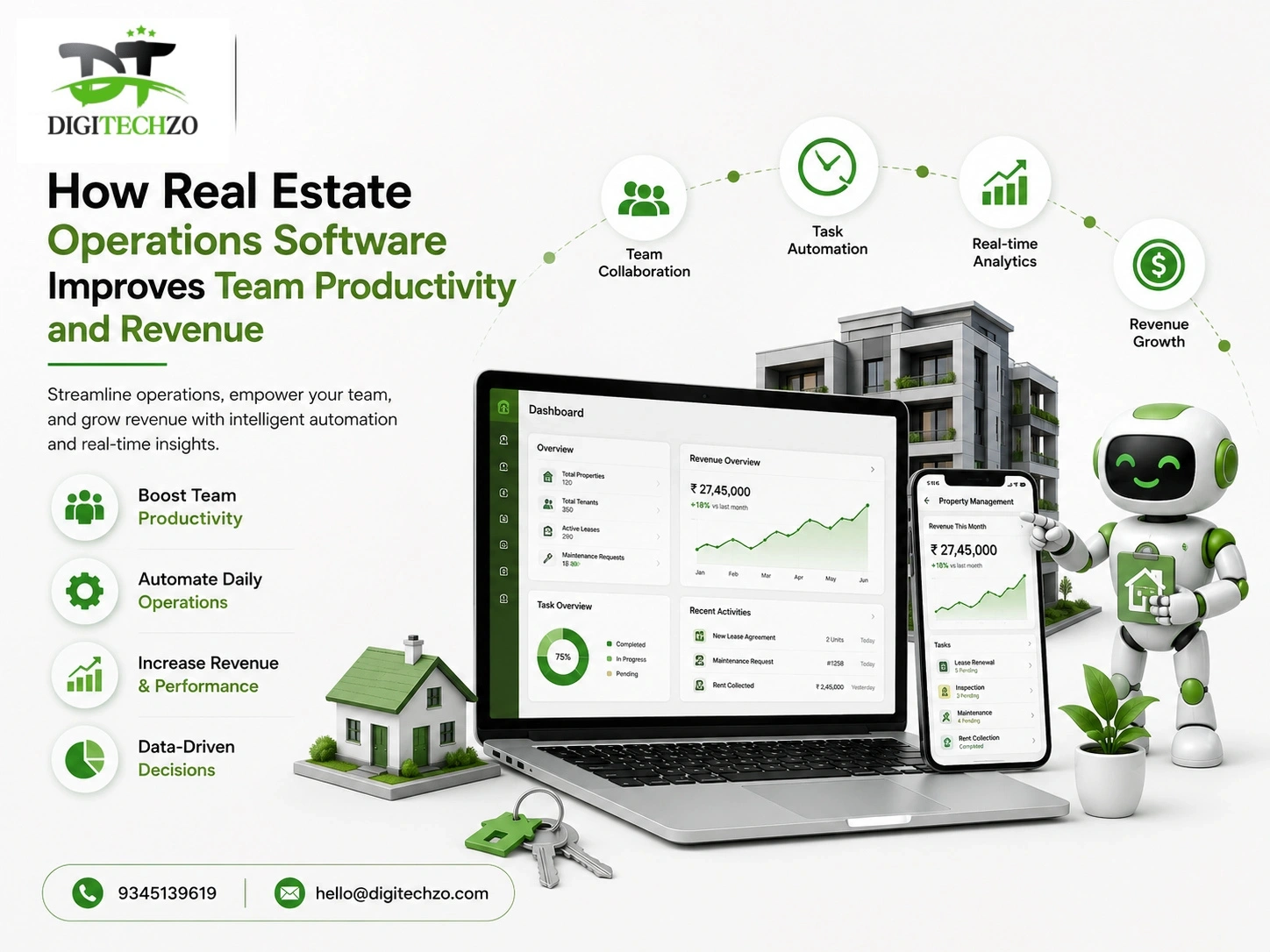
When every agent, manager, and support staff member works from the same dashboard, there’s no more “I thought someone else followed up.” Real estate operations software gives every team member real-time visibility into deal status, next actions, and ownership.
2. Automates Repetitive Manual Work
Tasks like sending follow-up reminders, updating deal stages, generating listing reports, or notifying tenants about maintenance status can be automated. This alone frequently frees up several hours per agent per week.
3. Speeds Up Lead Response Time
Studies on lead conversion consistently show that responding within the first 5 minutes dramatically increases the odds of conversion compared to waiting even 30 minutes. Real estate operations software with instant lead routing and alerts ensures no lead sits untouched.
4. Improves Internal Communication
Instead of chasing updates across WhatsApp, email, and phone calls, teams get structured, trackable communication threads tied directly to the deal or property record.
5. Gives Managers Real-Time Performance Visibility
Managers no longer need to manually compile weekly reports. Real estate operations software provides live dashboards showing agent activity, conversion rates, and pipeline health — enabling faster coaching decisions.
H3: Example Scenario
A mid-sized brokerage handling 40+ active listings previously required two admin staff just to track document approvals and follow-ups manually. After implementing real estate operations software, that entire workflow was reduced to a single automated pipeline — freeing both staff members to take on client-facing roles instead.
How It Directly Impacts Revenue
Productivity gains are meaningful, but the real business case for real estate operations software is revenue impact. Here’s how the connection plays out in practice:
| Operational Improvement | Revenue Impact |
|---|---|
| Faster lead response | Higher conversion rate per lead |
| Centralized pipeline visibility | Fewer deals falling through the cracks |
| Automated follow-ups | More consistent nurturing → more closed deals |
| Reduced admin workload | More agent hours spent selling, not typing |
| Accurate reporting | Better decision-making on marketing spend |
When agents spend less time on admin and more time on actual client conversations, the natural result is more deals closed per agent, per month — without hiring additional headcount. This is why real estate operations software is increasingly treated as a revenue tool, not just an efficiency tool, by growth-focused brokerages and property management firms.
Core Features to Look For in Real Estate Operations Software
Not all platforms are built equally. When evaluating real estate operations software, prioritize:
- Lead management with automated routing and scoring
- Deal pipeline visualization (stage-by-stage tracking)
- Document and e-signature workflows
- Tenant/property management modules (for rental or leasing operations)
- Role-based dashboards for agents, managers, and admins
- Integration capabilities with marketing tools, WhatsApp, and email
- Mobile access for on-site agents and property managers
- Custom reporting and analytics
Featured Snippet Answer: The most important feature of real estate operations software is centralized pipeline visibility — the ability to see every lead, listing, and deal stage in one live dashboard, so nothing gets missed and every team member knows the next required action.
Real Estate Operations Software vs Traditional CRM
A common point of confusion is assuming a standard CRM is enough. Here’s the difference:
Traditional CRM:
- Focused mainly on contact and lead tracking
- Limited support for property-specific workflows
- Rarely integrates tenant management or maintenance tracking
- Reporting is often generic, not real-estate-specific
Real Estate Operations Software:
- Built around property, listing, and deal lifecycles
- Includes tenant, lease, and maintenance modules
- Supports document approvals and compliance workflows
- Provides real-estate-specific reporting (occupancy, conversion by property type, agent productivity)
Pros of dedicated real estate operations software:
- Purpose-built for the industry’s actual workflows
- Reduces the need for multiple disconnected tools
- Better long-term scalability for growing portfolios
Cons to consider:
- Slightly steeper learning curve than a simple CRM
- Requires proper onboarding and configuration to see full ROI
- Initial data migration can take time if switching from spreadsheets
Real-World Use Case Scenarios
Scenario 1: Brokerage Scaling Beyond 20 Agents As agent count grows, manual lead assignment becomes unmanageable. Real estate operations software automates lead distribution based on agent availability and specialization, preventing both lead hoarding and lead neglect.
Scenario 2: Property Management Firm Handling Tenant Requests Instead of maintenance requests getting buried in email, tenants submit requests through a portal that automatically assigns and tracks resolution — improving tenant satisfaction and retention.
Scenario 3: Developer Managing Pre-Launch Bookings For large residential projects, real estate operations software tracks unit-level inventory in real time, preventing the classic (and costly) mistake of double-booking the same unit to two different buyers.
Common Mistakes When Adopting Real Estate Operations Software
- Choosing software based on price alone — the cheapest tool often lacks real-estate-specific workflows, forcing teams back into spreadsheets within months.
- Skipping proper onboarding — teams that aren’t trained properly underuse the platform and blame the software instead of the rollout.
- Not migrating historical data — losing past client and deal history creates blind spots in reporting.
- Failing to define clear ownership rules — automation only works if lead assignment and escalation rules are configured correctly from day one.
- Ignoring mobile usability — field agents and property managers need mobile access; desktop-only tools quickly become shelfware.
- Not reviewing analytics regularly — the software generates valuable data, but it only helps if managers actually act on it weekly.
Expert Tips for Getting Maximum ROI
- Start with one workflow, not everything at once. Roll out lead management first, then expand to listings and tenant modules once the team is comfortable.
- Set measurable benchmarks before launch — average response time, deals per agent, and admin hours saved — so you can prove ROI with real numbers, not assumptions.
- Assign an internal champion who owns adoption and answers day-to-day questions, rather than relying solely on vendor support.
- Review dashboards weekly, not monthly — real estate operations software loses value if insights sit unused.
- Revisit automation rules quarterly as team size and processes evolve; static automation becomes a bottleneck itself if never updated.
Frequently Asked Questions
Q1: What is the main benefit of real estate operations software?
The main benefit is centralizing lead, listing, and deal data into one system, which reduces missed follow-ups and gives teams real-time visibility — directly improving both productivity and closed deals.
Q2: Is real estate operations software only for large brokerages?
No. Small and mid-sized teams often see faster ROI because manual processes break down sooner as they scale, and automation prevents that breakdown from happening at all.
Q3: How is real estate operations software different from a regular CRM?
A CRM tracks contacts and basic sales stages. Real estate operations software is built specifically around property, listing, tenant, and deal workflows unique to the real estate industry.
Q4: How long does it take to see productivity improvements after implementation?
Most teams see measurable improvements — such as faster lead response and reduced admin time — within 2 to 6 weeks, assuming proper onboarding and clear workflow configuration.
Q5: Does real estate operations software help with property management, not just sales?
Yes. Many platforms include dedicated modules for tenant communication, maintenance requests, and lease tracking, making them useful for both sales-focused and rental/management-focused businesses.
Conclusion: Operational Efficiency Is the Real Growth Lever
Real estate businesses rarely lose because of a lack of ambition — they lose because operations quietly break down behind the scenes: slow follow-ups, disconnected teams, and no visibility into where deals actually stand. Real estate operations software fixes exactly this, turning scattered, manual processes into a connected system that saves time and directly drives revenue.
The businesses winning in today’s competitive real estate market aren’t necessarily the ones with the biggest ad budgets — they’re the ones with the tightest operations. Real estate operations software is how that operational advantage gets built.
If you’re evaluating how to bring this kind of structure into your own team, Digitechzo works with brokerages, property managers, and developers to implement real estate operations software tailored to how their teams actually work — not a generic one-size-fits-all setup.
Ready to see where your team is losing time and revenue? Reach out to Digitechzo for a workflow audit and find out exactly how much productivity you could be recovering.
About The Author