
Your Web3 payment gateway might have the fastest on-chain settlement in the category, but if a treasury manager searching “best crypto payment gateway for enterprise” never finds you on page one, none of that matters. Most Web3 payment platforms pour engineering resources into the product and treat SEO as an afterthought — then wonder why competitors with a weaker tech stack are closing bigger B2B deals.
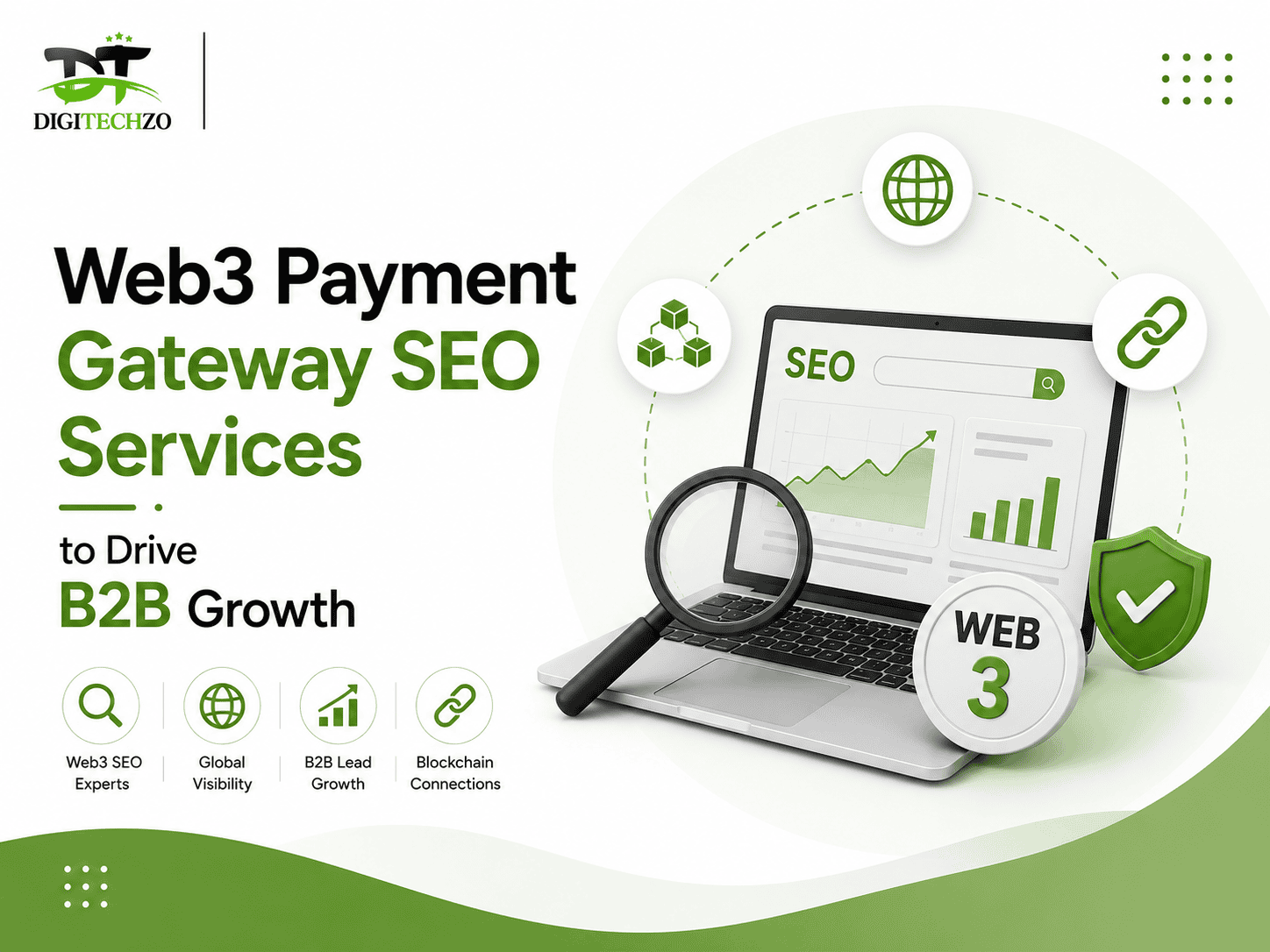
This is where dedicated Web3 Payment Gateway SEO Services change the growth trajectory. SEO for this category isn’t about stuffing “blockchain” and “crypto” into blog posts — it’s about ranking for the exact terms treasury teams, PSPs, and enterprise buyers type when they’re actively evaluating a vendor, and building the technical authority Google (and buyers) trust.
At Digitechzo, we’ve built SEO strategies specifically for Web3 payment infrastructure companies — platforms where the buyer isn’t a casual consumer but a finance or engineering decision-maker doing serious due diligence. This guide covers what actually drives qualified B2B pipeline through organic search in this category, based on patterns that hold consistently across fintech and Web3 SEO campaigns.
Quick Answer
Web3 payment gateway SEO services combine technical SEO, B2B keyword strategy, and authority-building content to help crypto payment platforms rank for high-intent commercial searches. Because buyers are enterprise decision-makers, not consumers, the strategy prioritizes depth, compliance clarity, and technical credibility over volume-driven content.
Why Web3 Payment Gateways Need a Different SEO Approach
Standard B2B SaaS SEO optimizes for feature comparisons and pricing intent. Web3 payment gateway SEO has to do that plus overcome two additional hurdles most SaaS products never face:
Trust deficit at the category level. Search behavior data consistently shows buyers researching crypto payment infrastructure spend more time on due-diligence content — security audits, compliance pages, uptime history — before ever reaching a pricing page. Ranking for the transactional keyword isn’t enough if the content doesn’t survive that scrutiny.
Rapidly evolving terminology. Search terms shift as the market matures — “crypto payment gateway,” “stablecoin payment infrastructure,” and “on-chain settlement API” often represent overlapping but distinct buyer intents, and competitors who map content to only one term leave significant search volume uncaptured.
A generalist SEO agency optimizing for volume and generic best practices will miss both of these. Web3 payment gateway SEO services are built around the reality that your organic traffic needs to convert skeptical, technically literate B2B buyers — not just rank.
What Web3 Payment Gateway SEO Services Actually Include
1. B2B-Focused Technical SEO Audit
Beyond standard crawlability and speed fixes, this includes reviewing how documentation, API references, and compliance pages are structured for both search engines and human due-diligence — since these pages often carry disproportionate weight in buyer decisions.
2. Commercial Intent Keyword Mapping
Mapping keywords not just by search volume but by buyer stage and persona — separating developer-intent searches (“Web3 payment API documentation”) from finance-buyer searches (“enterprise crypto settlement solution”) and building distinct content tracks for each.
3. Authority Content Development
Long-form guides, comparison pages, and original data-driven content (transaction cost breakdowns, settlement time benchmarks) that both rank well and function as credible reference material buyers cite internally during vendor evaluation.
4. Structured Data & Featured Snippet Optimization
Implementing schema markup for FAQs, how-to content, and comparison tables so that high-intent queries surface your content directly in Google’s featured snippets — a significant advantage in a category where buyers often do quick, comparative research.
5. Digital PR and Category Authority Building
Earning backlinks and mentions from fintech and Web3 publications, developer communities, and industry directories — signals that matter heavily for Google’s E-E-A-T evaluation of financial and payments content specifically.
6. Conversion-Aligned On-Page Optimization
Ensuring that ranking pages don’t just attract traffic but move visitors toward demo requests, API sandbox sign-ups, or sales conversations — the actual business outcome SEO investment needs to justify.
Keyword Strategy for B2B Web3 Buyers
Effective keyword strategy in this category maps across three distinct buyer intents:
Developer intent: “Web3 payment API,” “crypto payment gateway integration guide,” “stablecoin payment SDK” — content here should be documentation-adjacent, technically precise, and free of marketing fluff.
Finance/operations intent: “enterprise crypto settlement platform,” “reduce cross-border payment costs blockchain,” “crypto payment gateway compliance” — content here needs ROI framing, compliance clarity, and comparison data.
Executive/strategic intent: “Web3 payment gateway for enterprise,” “future of blockchain payments B2B” — thought-leadership content that builds category authority and often earns the highest-value backlinks.
A common gap competitors leave open: most Web3 payment platforms produce heavy developer-intent content (because their teams are engineering-led) while almost entirely ignoring finance and executive-intent content — even though those are the searches closer to a signed contract.
Technical SEO Considerations Unique to Web3 Platforms
Documentation Indexing
Many Web3 platforms host API docs on subdomains or separate developer portals that aren’t properly indexed or internally linked from the main marketing site — losing significant long-tail search value from developers actively comparing integration options.
Page Speed Under Complex Interactive Elements
Web3 sites often include live transaction trackers, wallet connect widgets, or real-time gas fee displays that can tank Core Web Vitals scores if not properly optimized — directly impacting rankings for competitive commercial terms.
International SEO for Multi-Chain, Multi-Region Platforms
Platforms supporting multiple blockchains and operating across regions need careful hreflang implementation and region-specific compliance content, since a single global page rarely satisfies search intent (or regulatory accuracy) everywhere at once.
Content That Actually Converts Enterprise Buyers
Example scenario: A mid-market e-commerce platform is evaluating Web3 payment gateways for cross-border settlement. Their search journey typically looks like:
- “what is a Web3 payment gateway” (education)
- “Web3 payment gateway vs traditional payment processor” (comparison)
- “[Category] payment gateway case study e-commerce” (validation)
- “[Vendor] pricing” or “[Vendor] demo” (decision)
Platforms that only produce content for step 1 lose the buyer at steps 2 and 3 to a competitor with better comparison and case study content — even if the underlying product is weaker. This is the single most common gap we see in Web3 payment gateway content strategy.
Link Building and Authority in the Web3 Payments Space
Google treats payments and financial content as YMYL (Your Money or Your Life) — meaning E-E-A-T signals matter disproportionately compared to lower-stakes categories. For Web3 payment gateways, that translates to concrete priorities:
- Earning links from established fintech and crypto publications, not low-quality guest post networks
- Getting listed in reputable Web3 developer tool directories and payment infrastructure comparison sites
- Publishing original research or benchmark data that naturally attracts citations
- Building author credibility through named, credentialed contributors rather than anonymous or generic bylines
Web3 SEO vs. Traditional Fintech SEO
| Factor | Traditional Fintech SEO | Web3 Payment Gateway SEO |
|---|---|---|
| Buyer trust baseline | Moderate | Lower — requires extra credibility signals |
| Terminology stability | Stable | Evolving — requires ongoing keyword research |
| Content depth needed | Standard | Higher — technical + compliance depth |
| Backlink sources | Broad fintech media | Niche Web3 + fintech crossover publications |
| YMYL sensitivity | High | Very high |
| Developer-intent content | Minor factor | Major factor |
Common Mistakes Web3 Payment Platforms Make
- Publishing only educational, top-of-funnel content. Comparison and case study content — where deals are actually influenced — gets neglected.
- Letting developer docs live outside SEO strategy. Massive long-tail search volume goes uncaptured when documentation isn’t indexed or internally linked properly.
- Ignoring Core Web Vitals on interactive pages. Live wallet widgets and transaction trackers often quietly tank page speed scores.
- Weak or missing author credibility on financial content. Anonymous blog posts underperform for YMYL categories where Google and buyers both scrutinize source credibility.
- No structured data implementation. Missing out on featured snippets for comparison and FAQ-style queries that buyers frequently search.
- Treating SEO as a traffic metric instead of a pipeline metric. Ranking #1 for a term nobody in your buyer committee searches is a wasted effort.
Expert Tips to Accelerate Organic Growth
- Build separate content tracks for developer and finance-buyer intent — don’t try to serve both audiences with the same page.
- Index and internally link your developer documentation as part of core SEO strategy, not a separate, disconnected asset.
- Publish original data — even something as simple as average settlement time benchmarks — since original data earns links that generic content never will.
- Add named author bios with real credentials to financial and compliance content to strengthen E-E-A-T signals.
- Prioritize comparison and case study content early, not after your top-of-funnel content is already built out — this is where competitors are usually weakest.
FAQs
What are Web3 payment gateway SEO services?
They’re specialized SEO strategies built for crypto and blockchain payment platforms, combining technical SEO, B2B keyword mapping across developer and finance-buyer intent, authority content, and compliance-aware optimization to rank for high-intent commercial search terms.
How is Web3 payment gateway SEO different from regular SaaS SEO?
It requires deeper technical and compliance content due to Google’s YMYL (Your Money or Your Life) standards for financial content, separate content strategies for developer versus finance-buyer search intent, and careful handling of fast-evolving Web3 terminology.
Why isn’t my Web3 payment gateway ranking despite publishing content regularly?
Common causes include unindexed developer documentation, missing comparison and case-study content that buyers search for later in their journey, weak backlink authority from credible fintech sources, and Core Web Vitals issues from unoptimized interactive elements like wallet widgets.
How long does Web3 payment gateway SEO take to show ROI?
Given longer B2B fintech sales cycles, initial keyword movement typically appears within 3-4 months, while measurable qualified lead volume usually builds over 6-12 months as authority and content depth compound.
Do I need separate SEO content for developers and finance decision-makers?
Yes. Developer-intent searches need technically precise, documentation-style content, while finance and executive-intent searches need ROI framing, compliance clarity, and comparison data — a single generic page rarely satisfies both.
Conclusion
Web3 payment gateway SEO isn’t a side project you hand to whoever writes the company blog — it’s a direct pipeline driver when done with the technical depth and buyer-intent precision this category demands. The platforms winning organic search aren’t necessarily the ones with the best product; they’re the ones whose content answers a skeptical enterprise buyer’s questions at every stage of the search journey, from first Google query to signed contract.
If your Web3 payment gateway has strong technology but underwhelming organic visibility, that gap between product quality and search performance is exactly what Digitechzo helps close for Web3 and fintech payment platforms.
Ready to turn organic search into a predictable B2B pipeline? Talk to Digitechzo about a Web3 payment gateway SEO strategy built for your buyers.
About The Author