

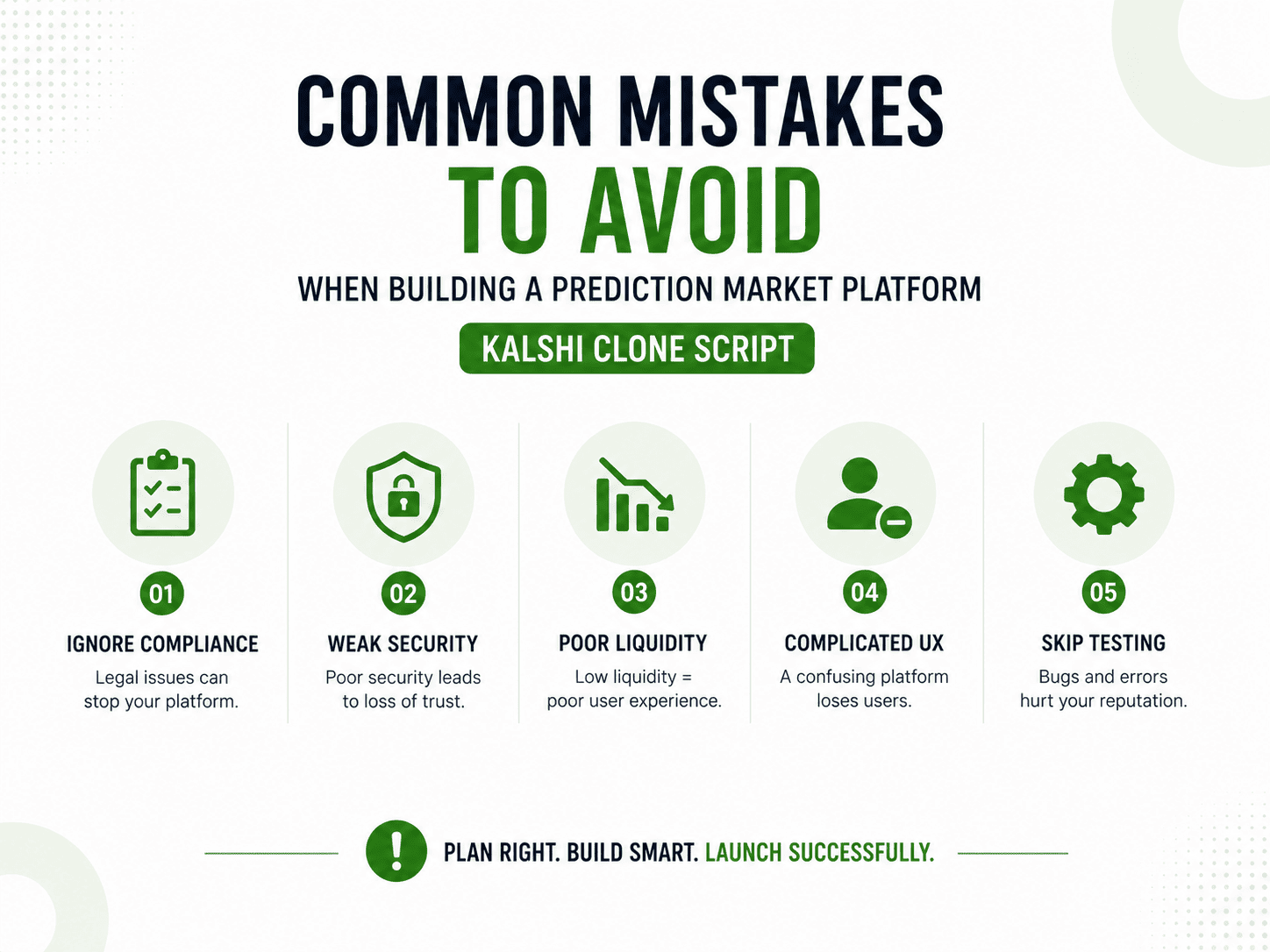
Prediction markets have moved from niche academic experiments to billion-dollar platforms trading on elections, sports, crypto prices, and even weather events. But behind every successful platform sits a graveyard of failed builds — projects that burned through six-figure budgets, launched with broken liquidity models, or collapsed under regulatory pressure within months.
If you’re planning to build a prediction market platform in 2026, the technical and strategic decisions you make in the first few weeks will determine whether you end up like Polymarket or Kalshi — or like the dozens of forgotten clones that never got past their first 100 users.
At Digitechzo, we’ve worked with fintech and Web3 founders navigating exactly this build process — from smart contract architecture to liquidity design and compliance frameworks. This guide distills the prediction market development mistakes we see repeated across the industry, so you can avoid them before they cost you time, money, or your platform’s credibility.
Quick Answer
The most common prediction market development mistakes are: launching without deep liquidity or a market-making strategy, ignoring regulatory classification of markets, using oracle systems that can be manipulated, underestimating UX complexity for non-crypto-native users, and skipping stress-testing for resolution disputes. Avoiding these five areas alone eliminates roughly 80% of platform failures.
Why Most Prediction Market Platforms Fail
Prediction markets look deceptively simple: create a market, let people bet on an outcome, resolve it, pay out winners. In reality, they sit at the intersection of market microstructure, game theory, smart contract security, and regulatory law — four disciplines most development teams don’t master simultaneously.
Industry data backs this up. Of the prediction market platforms launched between 2020 and 2024, the majority either shut down within 18 months or pivoted away from real-money markets entirely, primarily due to thin liquidity and regulatory takedowns rather than technical bugs. That distinction matters: the platforms that fail rarely fail because the code didn’t run — they fail because the market design and compliance strategy were wrong from day one.
This is why “building a prediction market” is really three separate problems stacked together:
- The financial engineering problem (how odds, liquidity, and payouts work)
- The trust problem (how outcomes get verified and disputes get settled)
- The legal problem (what counts as a security, a bet, or a derivative in your jurisdiction)
Let’s break down where teams go wrong in each area.
Mistake #1: Underestimating Liquidity Design
This is the single most common — and most fatal — mistake.
A prediction market is only useful if prices reflect real probability. That requires liquidity. Without it, a single large trade can swing “70% chance” to “40% chance” in seconds, destroying user trust instantly.
Why teams get this wrong
Founders often treat liquidity as a marketing problem (“we’ll get users, then liquidity follows”) rather than an architectural one. But liquidity has to be designed into the protocol itself, not bolted on afterward.
What actually works
- Automated Market Makers (AMMs) like LMSR (Logarithmic Market Scoring Rule) provide continuous liquidity even with few traders — this is how Polymarket and Augur bootstrap early markets.
- Hybrid order book + AMM models reduce slippage on high-volume markets while still supporting low-volume niche markets.
- Liquidity mining incentives (fee rebates, token rewards) should be modeled with real numbers before launch, not guessed at.
Example: A crypto-native founder we advised initially built a pure order-book model, assuming institutional market makers would show up organically. They didn’t. Markets sat with $0 depth for weeks. Switching to an LMSR-based AMM for smaller markets while reserving the order book for high-volume events solved the cold-start problem within a month.
Mistake #2: Weak or Manipulable Oracle Systems
Every prediction market needs a trusted source of truth to resolve outcomes. This is the oracle problem, and it’s arguably harder than the liquidity problem.
The core risk
If outcome resolution can be influenced by a single party — a centralized admin, a bribeable validator set, or an ambiguous data feed — the entire platform’s credibility collapses the first time a high-stakes market resolves incorrectly.
Common oracle mistakes
- Relying on a single centralized data source with no fallback
- Using vague market question wording that allows multiple valid interpretations
- No economic penalty (staking/slashing) for reporters who submit false outcomes
- No time buffer for challenging a proposed resolution
Better approaches
| Oracle Model | Best For | Trade-off |
|---|---|---|
| Optimistic oracles (e.g., UMA-style) | High-value, low-frequency markets | Slower resolution (dispute window) |
| Decentralized oracle networks | Objective, data-feed-based markets (prices, sports scores) | Higher infrastructure cost |
| Centralized admin resolution | MVP/testnet phase only | Trust bottleneck, not scalable |
Expert insight: Write every market question as if a lawyer will scrutinize it later — because eventually, one will. “Will Team X win the championship?” is weaker than “Will Team X be declared the official champion by [governing body] by [date], as confirmed by [source]?”
Mistake #3: Ignoring Regulatory Classification
This is where technically excellent platforms get shut down.
Prediction markets can be classified as commodity derivatives, gambling products, or securities depending on jurisdiction and market structure — and the classification changes what licenses you need, who can access the platform, and which markets are even legal to offer.
What teams get wrong
- Assuming “it’s on a blockchain” or “it’s decentralized” exempts them from regulation
- Launching election or sports markets in jurisdictions where these are explicitly restricted
- No geofencing or KYC strategy before scaling user acquisition
- Treating legal review as a post-launch task instead of a design input
A real-world signal
Regulatory bodies in multiple countries have taken increasingly active positions on event-based trading platforms in recent years, with some markets (particularly election-related contracts) facing direct enforcement action or forced restructuring. This isn’t a hypothetical risk — it has already reshaped how major platforms operate their US-facing products versus their international offerings.
Practical takeaway: Build your compliance strategy alongside your product architecture, not after your first funding round. Geofencing logic, KYC/AML integration points, and market category restrictions should exist in your system design from day one — retrofitting them later is exponentially more expensive.
Mistake #4: Overcomplicated User Experience
Prediction markets are conceptually unfamiliar to most retail users. If your platform requires understanding of implied probability, gas fees, wallet management, and order types before someone can place their first trade, you’ve already lost 90% of potential users.
Pattern we see repeatedly
Teams with strong Web3 backgrounds design for Web3-native users — assuming everyone understands wallets, slippage, and on-chain settlement. But the market that actually drives volume (sports fans, news followers, casual traders) needs an experience closer to a betting app or stock trading app than a DeFi protocol.
Fixes that move the needle
- Abstract wallet creation (embedded wallets, email/social login)
- Display prices as “chance of happening” (percentages) rather than raw token prices
- Pre-fill smart defaults for order size and slippage tolerance
- Use plain-language market questions, not jargon-heavy contract names
Pros of simplifying UX:
- Higher conversion from visitor to first trade
- Lower support burden
- Broader addressable audience beyond crypto-natives
Cons/trade-offs:
- Some UX abstraction requires custodial or semi-custodial elements, which reintroduces trust and regulatory questions
- Simplification can hide important risk information if not done carefully
Mistake #5: No Dispute Resolution Framework
Even with a good oracle system, disputes will happen. Ambiguous questions, breaking news that changes an outcome mid-resolution, or data source discrepancies are inevitable at scale.
What’s usually missing
- No formal appeal process for users who believe a market resolved incorrectly
- No transparent audit trail showing how a resolution was reached
- No defined timeline for dispute windows, leaving funds locked indefinitely
What a resilient framework looks like
- Proposed resolution posted with supporting evidence
- Challenge window (typically 24–72 hours) where users can dispute with a bond
- Escalation path to a decentralized voting mechanism or designated arbitration panel
- Public resolution log so past decisions build a precedent users can reference
This isn’t just a technical nice-to-have — it’s a trust mechanism. Platforms that resolve disputes transparently retain users; platforms that resolve them behind closed doors lose them permanently after the first controversial call.
Mistake #6: Choosing the Wrong Market Mechanism
Not every prediction market should use the same underlying mechanism. This is a strategic decision teams often skip entirely, defaulting to “whatever the most popular open-source protocol uses.”
Comparison of core mechanisms
| Mechanism | Strength | Weakness |
|---|---|---|
| CPMM (Constant Product Market Maker) | Simple, proven (Polymarket uses a variant) | Can have capital inefficiency on binary markets |
| LMSR | Great for cold-start liquidity | Requires careful subsidy budgeting |
| Parimutuel pools | Simple, no liquidity provider needed | Odds only finalize at market close, poor for active trading |
| Central limit order book | Best price discovery at scale | Needs deep liquidity to function well; bad for niche markets |
Choosing the wrong mechanism for your target use case is a structural mistake, not a bug — it can’t be patched later without rebuilding core contracts.
Mistake #7: Skipping Smart Contract Audits
If your platform involves on-chain settlement, unaudited smart contracts are one of the most expensive mistakes possible — both financially and reputationally. Prediction markets hold pooled user funds, making them high-value targets.
Minimum viable security practice
- At least one independent third-party audit before mainnet launch
- Bug bounty program active before and after launch
- Time-locked upgrade mechanisms (no instant admin overrides on live funds)
- Separate testnet period with real economic incentives to surface edge cases
Skipping this step to save time or budget is consistently one of the most costly false economies in Web3 development.
Common Mistakes Summary Table
| # | Mistake | Primary Consequence |
|---|---|---|
| 1 | Weak liquidity design | Poor price accuracy, user distrust |
| 2 | Manipulable oracles | Disputed outcomes, credibility loss |
| 3 | Ignoring regulation | Legal shutdown, market restrictions |
| 4 | Complex UX | Low user conversion |
| 5 | No dispute framework | User churn after controversial resolutions |
| 6 | Wrong market mechanism | Structural inefficiency, hard to fix later |
| 7 | Unaudited contracts | Fund loss, exploits |
Expert Tips for a Resilient Prediction Market Platform
- Start with 3–5 pilot markets, not 300. Depth beats breadth in early liquidity building.
- Model your worst-case dispute scenario before launch. If your platform can’t handle a highly contested election-style market gracefully, it’s not ready for real capital.
- Separate your compliance-sensitive markets from your general market catalog — this makes geofencing and licensing far easier to manage.
- Treat market question wording as a legal document, not marketing copy.
- Budget for liquidity subsidies in your first 90 days — organic liquidity rarely arrives before user trust does.
- Design your resolution process to be boring and predictable. Boring resolution processes build long-term trust; dramatic or opaque ones destroy it.
FAQs
What is the biggest mistake companies make when building a prediction market platform?
The most common and costly mistake is underestimating liquidity design — launching without a market-making strategy leads to inaccurate pricing and rapid user distrust, even if the underlying technology works perfectly.
Do prediction market platforms need a license to operate?
In most jurisdictions, yes — depending on how markets are structured, platforms may need commodities, gaming, or securities licensing. Regulatory classification varies by country and by market type, so legal review should happen during design, not after launch.
What’s the difference between an AMM and an order book model for prediction markets?
AMMs (like LMSR) provide continuous liquidity automatically, making them better for low-volume or new markets, while order books offer more accurate price discovery but require significant trading volume to function well.
How are disputes resolved on a prediction market platform?
Well-designed platforms use a challenge window where proposed outcomes can be disputed with an economic bond, followed by escalation to arbitration or decentralized voting if needed, with a public audit trail of the decision.
Is it better to build a prediction market on-chain or off-chain?
It depends on the target audience and jurisdiction: on-chain platforms offer transparency and censorship resistance but face more regulatory scrutiny and higher development complexity, while off-chain platforms can iterate faster but require greater trust in the operator.
Conclusion
Building a prediction market platform isn’t a smart contract exercise — it’s a discipline that blends market microstructure, trust engineering, and regulatory strategy. The platforms that win aren’t necessarily the ones with the flashiest UI or the fastest launch; they’re the ones that got liquidity, oracle design, and compliance right from the foundation up.
If you’re planning your build and want to avoid these prediction market development mistakes before they become expensive lessons, Digitechzo works with founders on exactly this kind of architecture — from market mechanism selection to oracle design and compliance-ready platform builds.
Thinking about building a prediction market platform? Get in touch with our team for a technical and regulatory readiness review before you write a single line of production code.
About The Author