
Prediction markets have moved from a niche corner of finance into mainstream conversation. Every election cycle, every Fed announcement, every major sports event now has a live market where people trade on outcomes instead of just guessing them. Kalshi turned this idea into a regulated, real-money trading platform — and its rapid growth has founders, fintech investors, and product teams asking the same question: can we build something like this ourselves?
The short answer is yes, but Kalshi Clone Development is not a copy-paste job. It’s a serious fintech engineering effort that touches trading infrastructure, regulatory compliance, payments, risk management, and real-time data systems all at once. This guide walks through exactly what it takes — technically, legally, and financially — to build a prediction market platform that can actually handle real users and real money.
This guide draws on practical, hands-on experience from teams like DigiTechzo, an AI-powered software development company that builds blockchain platforms, fintech applications, AI automation systems, and clone script solutions for founders entering high-growth markets like event trading and prediction exchanges. Whether you’re evaluating a Kalshi Clone Script or planning a fully custom prediction exchange, this guide gives you the complete roadmap.
Quick Answer
Building a Kalshi-like prediction market platform requires a matched order book or AMM-based trading engine, KYC/AML-compliant onboarding, a licensed or compliant trading structure (CFTC-regulated in the US, or offshore/DCM models elsewhere), secure wallet and payment infrastructure, and real-time market data feeds. A functional MVP typically takes 4–6 months and costs between $40,000 and $150,000+, depending on features, compliance scope, and whether you build custom or use a Kalshi Clone Script as a foundation. Custom development is recommended for teams that want regulatory flexibility and long-term scalability, while a clone script accelerates time-to-market for teams validating demand first.
What is Kalshi?
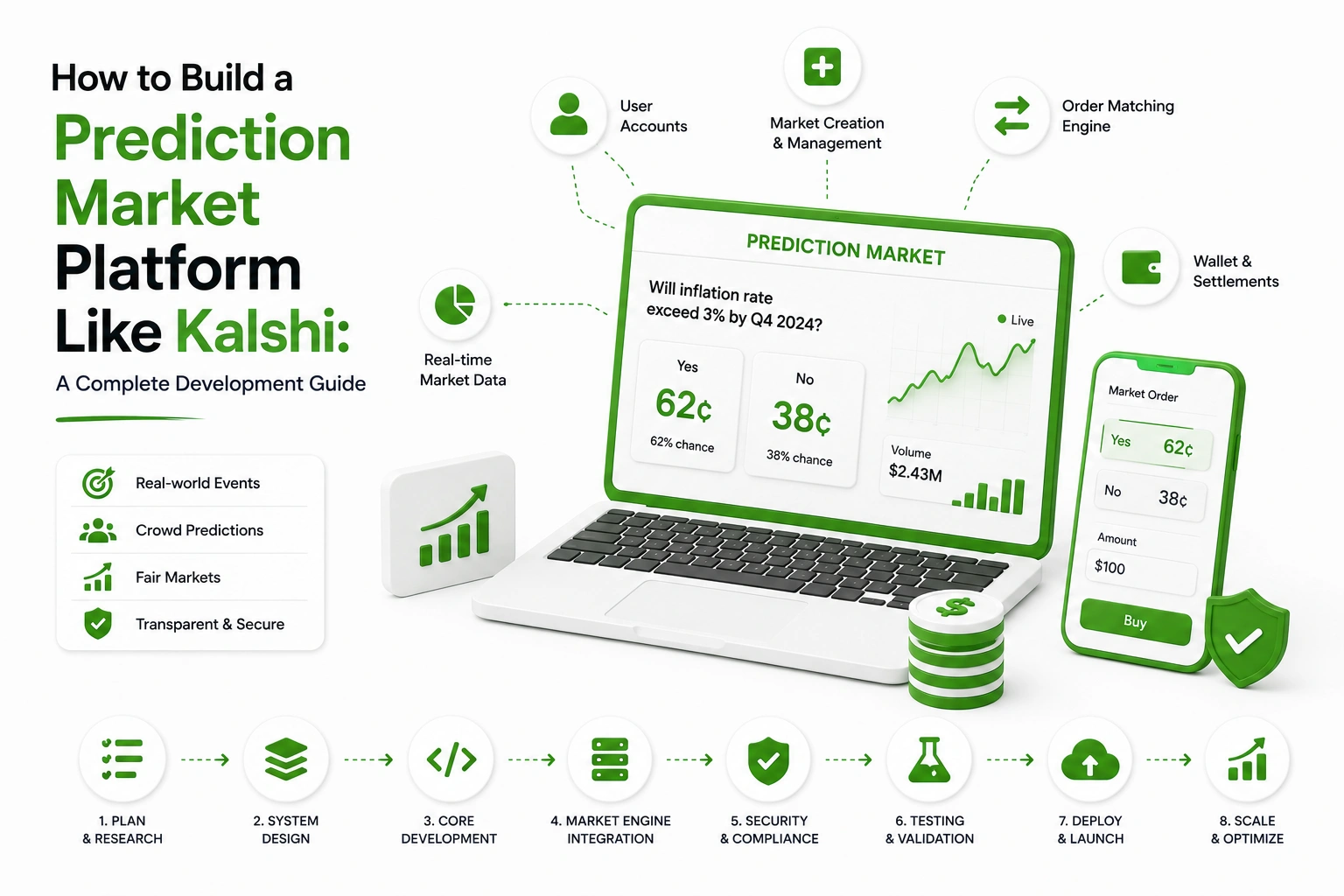
Kalshi is a U.S.-based, CFTC-regulated event contracts exchange that lets users trade on the outcomes of real-world events — economic indicators, political outcomes, weather events, and more. Instead of placing a traditional bet, users buy “Yes” or “No” contracts priced between $0.01 and $0.99, where the price reflects the market’s implied probability of an event occurring.
What makes Kalshi different from an offshore betting site is its regulatory status. It operates as a Designated Contract Market (DCM), meaning every contract is treated as a financial derivative, not a wager. This distinction is the single most important thing to understand before starting any prediction market platform development project, because it directly shapes your legal structure, target geography, and technology requirements.
What is Kalshi Clone Development?
Kalshi Clone Development refers to building a prediction market platform that replicates Kalshi’s core functionality — event-based contract trading, an order book or matching engine, real-time pricing, and settlement logic — while adapting the business model, branding, and compliance framework to your target market.
This doesn’t mean copying Kalshi’s code or design. A proper Kalshi Clone Script is a modular foundation: order matching, wallet management, KYC, and market settlement modules that a development team customizes for your niche, whether that’s sports outcomes, crypto price predictions, political events, or business forecasting.
Two paths typically fall under this umbrella:
- Kalshi Clone Script deployment — using a pre-built, customizable framework to launch faster.
- Custom Prediction Market Development — building the platform from the ground up for full control over architecture, compliance, and scalability.
We’ll compare both later in this guide.
How Prediction Markets Work
At their core, prediction markets convert forecasting into pricing. Here’s the mechanism, step by step:
- Market creation – An admin or algorithm creates a market around a specific, verifiable event (“Will the Fed cut rates in September?”).
- Contract issuance – Two outcomes are defined: Yes and No. Each contract settles at $1.00 if correct, $0.00 if wrong.
- Price discovery – As traders buy and sell, the contract price moves between $0.01–$0.99, reflecting the market’s collective probability estimate.
- Order matching – A matching engine pairs buy and sell orders in real time, similar to a stock exchange order book.
- Settlement – When the event resolves, contracts are settled automatically based on verified outcome data, and funds are distributed.
This is fundamentally different from a binary options platform in regulatory treatment, even though the payout structure looks similar. Binary options are often flagged by regulators as high-risk retail products; event contracts on a licensed exchange are treated as legitimate derivatives. That distinction matters enormously for anyone building a real money prediction app.
Why Businesses Build Prediction Market Platforms
Prediction markets aren’t just a trading novelty — they’re a genuinely useful forecasting tool, and that’s why interest in this space is accelerating.
Common business motivations:
- Niche market opportunity – Sports, crypto, entertainment, and political forecasting communities are underserved by regulated platforms.
- High engagement economics – Event trading has strong repeat-usage patterns, especially around recurring events (earnings, elections, weather cycles).
- Data monetization – Aggregated market sentiment data has value to hedge funds, media outlets, and research firms.
- B2B forecasting tools – Enterprises use internal prediction markets to forecast product launches, project timelines, and demand.
- AI-enhanced trading experiences – Combining forecasting markets with AI-driven insights creates a differentiated AI Prediction Platform that appeals to data-savvy traders.
Real-world example: Polymarket built massive traction using crypto-native, decentralized infrastructure — proving that a political prediction market can scale globally even outside traditional regulatory frameworks. Kalshi took the opposite approach, going fully regulated in the U.S. Both are valid strategies depending on your target market and risk appetite.
Key Features of a Prediction Market Platform
A production-grade event trading platform needs far more than a betting interface. Here’s what separates a functional MVP from a platform that can scale.
| Feature Category | Must-Have Components |
|---|---|
| Trading Engine | Real-time order matching, price discovery algorithm |
| Market Management | Event creation workflows, resolution sourcing, dispute handling |
| Wallets & Payments | Multi-currency wallets, fiat on/off ramps, crypto payment rails |
| Compliance | KYC/AML verification, geofencing, transaction monitoring |
| Data & Analytics | Live pricing charts, order book depth, historical data feeds |
| Security | Encryption, cold storage, fraud detection, audit logging |
| Mobile Experience | Native iOS/Android apps or PWA with push notifications |
Admin Panel Features
The admin panel is where operational control and regulatory accountability live. It needs to give operators full visibility without becoming a bottleneck.
- Market creation & configuration – Set event parameters, expiration, and settlement sources
- Manual and automated settlement tools – Resolve contracts using verified data feeds or manual review
- User management – KYC approval queues, account restrictions, tiered verification levels
- Risk & exposure dashboard – Monitor platform-wide liquidity and exposure per market
- Transaction monitoring – AML flagging, suspicious activity reports
- Fee and commission configuration – Adjust trading fees, withdrawal fees, and market-maker incentives
- Content & compliance controls – Manage disclaimers, terms updates, and regional restrictions
- Analytics & reporting – Revenue reports, active user metrics, market performance data
User Features
On the user side, simplicity and trust drive retention far more than flashy design.
- Quick onboarding with KYC verification
- Real-time market browsing with category filters (politics, crypto, sports, economics)
- Order placement – market orders, limit orders, and quick-buy Yes/No options
- Portfolio dashboard – open positions, P&L tracking, settled contracts
- Deposit/withdrawal – fiat and crypto support with transparent fee display
- Push notifications – price alerts, market resolution updates
- Social/community features – market discussion threads, leaderboard rankings
- Educational resources – how-to guides for new traders unfamiliar with forecasting market software
Revenue Model
A well-designed prediction exchange software typically monetizes through multiple layers, not a single fee source.
| Revenue Stream | Description |
|---|---|
| Trading fees | Small percentage per contract trade (typically 1–5%) |
| Withdrawal fees | Flat or percentage-based fee on cash-outs |
| Market maker spreads | Revenue from platform-provided liquidity |
| Premium features | Advanced charting, early market access, API access |
| Data licensing | Selling aggregated, anonymized market sentiment data |
| White-label licensing | Licensing your platform infrastructure to other operators |
Kalshi itself primarily earns through trading fees on contract volume, which scales naturally as user activity grows — a model worth studying closely when planning your own fee structure.
Technology Stack
Choosing the right stack determines whether your platform can handle real trading volume without downtime. Here’s a stack that reflects current best practices for prediction market platform development.
Frontend
- React.js / Next.js for web trading interface
- React Native or Flutter for mobile apps
- WebSocket integration for real-time price updates
Backend
- Node.js or Go for high-throughput API services
- Microservices architecture for trading engine isolation
- Redis for caching and session management
Trading Engine
- Custom-built matching engine (C++, Rust, or Go for low-latency matching)
- Message queues (Kafka or RabbitMQ) for order flow processing
Database
- PostgreSQL for transactional data (ACID compliance is non-negotiable for financial data)
- TimescaleDB or InfluxDB for time-series market data
- MongoDB for unstructured logs and analytics
Blockchain/Payments (optional, for crypto-enabled platforms)
- Ethereum, Polygon, or Solana for on-chain settlement
- Smart contracts for transparent, auditable settlement logic
- Stripe, Plaid, or banking APIs for fiat rails
Infrastructure
- AWS or GCP with auto-scaling
- Docker + Kubernetes for containerized deployment
- CDN for global latency reduction
Security & Compliance
- Jumio or Onfido for KYC/AML automation
- AES-256 encryption at rest, TLS 1.3 in transit
- SOC 2-aligned logging and monitoring
Development Process
A structured build process is what separates platforms that survive a security audit from those that don’t.
- Discovery & Regulatory Assessment – Define target geography, licensing path, and market categories.
- Architecture Planning – Design the trading engine, database schema, and system architecture for scale.
- UI/UX Design – Build trading interfaces that make complex data (order books, probability pricing) intuitive.
- Core Development – Build the matching engine, wallet system, and admin panel in parallel sprints.
- KYC/AML Integration – Connect verification providers and configure compliance workflows.
- Payment Gateway Integration – Set up fiat and/or crypto rails with proper reconciliation logic.
- Testing – Load testing the matching engine, security penetration testing, and compliance audits.
- Beta Launch – Controlled release to a limited user group to stress-test real trading conditions.
- Full Launch & Monitoring – Go live with real-time monitoring, incident response protocols, and analytics tracking.
Compliance & Security

This is the section most clone-script vendors gloss over — and it’s the section that determines whether your platform survives past launch.
Regulatory considerations:
- United States – Event contracts fall under CFTC jurisdiction. Operating a real-money platform without proper registration (or partnering with a licensed DCM) is a serious legal risk.
- Offshore/international models – Some platforms operate under gaming or derivatives licenses in jurisdictions like Malta, Curaçao, or the UK, with strict geofencing to exclude U.S. users.
- Decentralized models – Crypto-native platforms like Polymarket use smart contracts and geofencing to manage regulatory exposure differently than centralized exchanges.
Security best practices:
- Multi-factor authentication for all user accounts
- Cold storage for the majority of platform crypto holdings
- Regular third-party penetration testing
- Real-time fraud detection using anomaly-based transaction monitoring
- Immutable audit logs for every trade and settlement
- Rate limiting and DDoS protection on all trading APIs
Expert insight: Treat compliance as an architectural decision, not a legal afterthought. Retrofitting KYC/AML and geofencing after launch is significantly more expensive than designing for it from day one.
Challenges in Prediction Market Development
Pros and cons of entering this market:
| Pros | Cons |
|---|---|
| High user engagement and repeat trading behavior | Heavy regulatory scrutiny, especially in the U.S. |
| Multiple monetization streams | Complex matching engine requires specialized engineering talent |
| Growing category with mainstream awareness (thanks to Kalshi, Polymarket) | Liquidity bootstrapping is difficult for new markets |
| Data has resale value beyond the platform itself | Payment processors are cautious about “prediction/betting” adjacent businesses |
| AI can meaningfully improve market curation and pricing | Dispute resolution for ambiguous event outcomes is operationally hard |
Other real challenges founders underestimate:
- Liquidity cold-start – Without enough traders on both sides of a contract, spreads widen and users leave.
- Data source reliability – Settlement disputes happen when outcome data is ambiguous or delayed.
- Banking relationships – Many traditional banks decline to work with prediction/betting-adjacent businesses, requiring specialized fintech banking partners.
Cost to Build a Kalshi-Like Platform
Costs vary significantly based on scope, compliance requirements, and whether you use a Kalshi Clone Script or build fully custom.
| Development Approach | Estimated Cost Range | Timeline |
|---|---|---|
| Clone script customization (MVP) | $40,000 – $70,000 | 8–12 weeks |
| Mid-scale custom platform | $70,000 – $150,000 | 4–6 months |
| Enterprise-grade, fully regulated platform | $150,000 – $300,000+ | 6–12 months |
Cost factors that move the needle most:
- Custom matching engine vs. off-the-shelf trading logic
- Number of supported payment rails (fiat, crypto, or both)
- KYC/AML provider integration depth
- Native mobile app development (iOS + Android)
- Regulatory/legal consulting for licensing
- Ongoing infrastructure and compliance maintenance costs
Development Timeline
| Phase | Duration |
|---|---|
| Discovery & Compliance Planning | 2–3 weeks |
| UI/UX Design | 3–4 weeks |
| Core Platform Development | 8–14 weeks |
| KYC/Payment Integration | 3–5 weeks |
| Testing & Security Audits | 3–4 weeks |
| Beta Launch | 2–3 weeks |
| Total (MVP to Launch) | 4–6 months |
Why Choose Custom Development
A Kalshi Clone Script gets you to market faster, but custom Prediction Exchange Software gives you long-term control. Here’s how to decide:
Choose a clone script when:
- You need to validate demand quickly with limited budget
- Your compliance scope is narrow (single jurisdiction, simple market categories)
- Speed to launch matters more than deep customization
Choose custom development when:
- You’re targeting multiple jurisdictions with different compliance needs
- You need proprietary matching engine logic or AI-driven pricing
- You plan to scale into B2B licensing or white-label offerings
- Long-term differentiation and IP ownership matter to your investors
Most experienced teams recommend a hybrid path: start with a modular clone script framework for speed, but architect it so core components — matching engine, compliance layer, wallet system — can be swapped for custom-built modules as you scale. This avoids the common trap of over-building before product-market fit is proven.
DigiTechzo’s Development Approach
DigiTechzo approaches Custom Prediction Market Development as a fintech engineering problem first, and a product design problem second. The typical engagement follows this structure:
- Regulatory-first discovery – Mapping target jurisdictions before writing a single line of code, so architecture decisions (custody, KYC depth, settlement logic) align with legal requirements from day one.
- Modular architecture – Building the trading engine, wallet system, and compliance layer as independent services, so clients can swap payment providers or expand into new markets without rebuilding the core platform.
- AI-enhanced market intelligence – Using AI automation to improve market categorization, fraud detection, and dynamic pricing signals — turning a standard clone into a genuine AI Prediction Platform.
- Security-by-design – Penetration testing, encrypted data handling, and audit-ready logging built into the development pipeline, not added afterward.
- Post-launch scaling support – Infrastructure monitoring, liquidity tooling, and iterative feature releases based on real trading data.
This approach reflects a broader principle in fintech development: platforms that treat compliance and security as core architecture — not bolt-on features — are the ones that survive scrutiny as they scale.
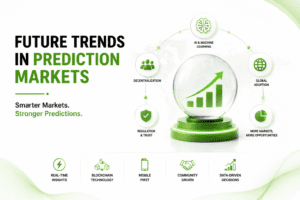
Future Trends in Prediction Markets
- AI-driven market curation – Machine learning models identifying high-interest event categories before they trend
- On-chain settlement transparency – More platforms adopting blockchain for verifiable, tamper-proof settlement
- Institutional participation – Hedge funds and research firms increasingly using prediction markets as forecasting tools, not just retail products
- Cross-platform liquidity sharing – Emerging standards for liquidity pooling across prediction exchanges
- Regulatory clarity expansion – More jurisdictions expected to formalize event-contract trading rules as the category matures
- Embedded prediction markets – Media companies and platforms embedding lightweight prediction widgets tied to live events
Common Mistakes to Avoid
- Ignoring regulatory classification early – Treating event contracts like casual betting instead of financial derivatives leads to compliance failures later.
- Underinvesting in the matching engine – A slow or buggy matching engine destroys trader trust immediately.
- Launching with too few active markets – Thin market selection kills early liquidity and engagement.
- Skipping dispute resolution design – Ambiguous event outcomes without a clear resolution process create user trust issues fast.
- Choosing the wrong payment partners – Generic payment processors often shut down betting-adjacent accounts without warning.
- Over-customizing before validating demand – Building enterprise-grade infrastructure before confirming product-market fit wastes budget.
Expert Tips
- Start with 2–3 event categories, not twenty. Depth and liquidity in a few categories beats shallow coverage across many.
- Build your KYC/AML flow to be frictionless but thorough — drop-off during onboarding is one of the biggest silent killers of prediction platforms.
- Instrument everything. Real-time dashboards for liquidity, latency, and settlement accuracy should exist before launch, not after an incident.
- Design settlement sourcing transparently. Publish your data sources for each market category so users trust the resolution process.
- Treat your matching engine as your core IP. Everything else can be outsourced or templated; this shouldn’t be.
FAQs
1. What is Kalshi Clone Development? Kalshi Clone Development is the process of building a prediction market platform that replicates Kalshi’s core trading mechanics — event contracts, real-time order matching, and automated settlement — customized for your target market, branding, and compliance requirements.
2. How much does it cost to build a Kalshi Clone Script platform? A basic MVP built on a customizable Kalshi Clone Script typically costs between $40,000 and $70,000, while a fully custom, enterprise-grade prediction exchange platform can range from $150,000 to $300,000 or more, depending on compliance scope and feature depth.
3. Is Kalshi Clone Development legal? Yes, when built and operated correctly. Legality depends on regulatory classification — in the U.S., event contract trading falls under CFTC oversight, so platforms need proper licensing, a regulated partner, or a compliant offshore/decentralized structure depending on target geography.
4. How long does it take to build a prediction market platform like Kalshi? A functional MVP typically takes 4 to 6 months, covering discovery, matching engine development, KYC/payment integration, security testing, and beta launch. Enterprise-scale platforms with multi-jurisdiction compliance can take 8–12 months.
5. What technology is used in Kalshi Clone Development? A typical stack includes React/Next.js for the frontend, Node.js or Go microservices for the backend, a custom-built low-latency matching engine, PostgreSQL and time-series databases, and KYC/AML providers like Jumio or Onfido, often paired with blockchain infrastructure for crypto-enabled settlement.
Conclusion
Building a platform like Kalshi is less about replicating a betting interface and more about engineering a real financial exchange — complete with matching logic, compliance infrastructure, and settlement accuracy that users and regulators can trust. The opportunity is real: prediction markets are moving from niche to mainstream, and the businesses that get the architecture, compliance, and user experience right early will define the category’s next phase.
Whether you start with a Kalshi Clone Script to validate your market or invest in fully Custom Prediction Market Development from day one, the fundamentals stay the same — a fast, reliable matching engine, airtight compliance, and a trading experience simple enough for everyday users to understand.
About The Author