
Launching a crypto exchange in 2026 without the right feature set is like opening a bank with no vault, no ledger, and no security guard. Founders lose weeks comparing vendors, only to discover — after paying — that the “ready-made” Binance clone script they bought is missing basic things like multi-layer KYC, cold wallet integration, or a matching engine that can actually handle volume. That gap between marketing promises and technical reality is where most exchange launches quietly fail.
This guide breaks down exactly which features separate a production-ready Binance clone script features from a shell that looks good in a demo video but collapses under real trading load. We’ve built this from hands-on evaluation of exchange architecture, liquidity integration, and compliance workflows — the same due diligence process we walk clients through at Digitechzo, where we design and deploy white-label crypto exchange platforms for founders entering the market.
Quick Answer
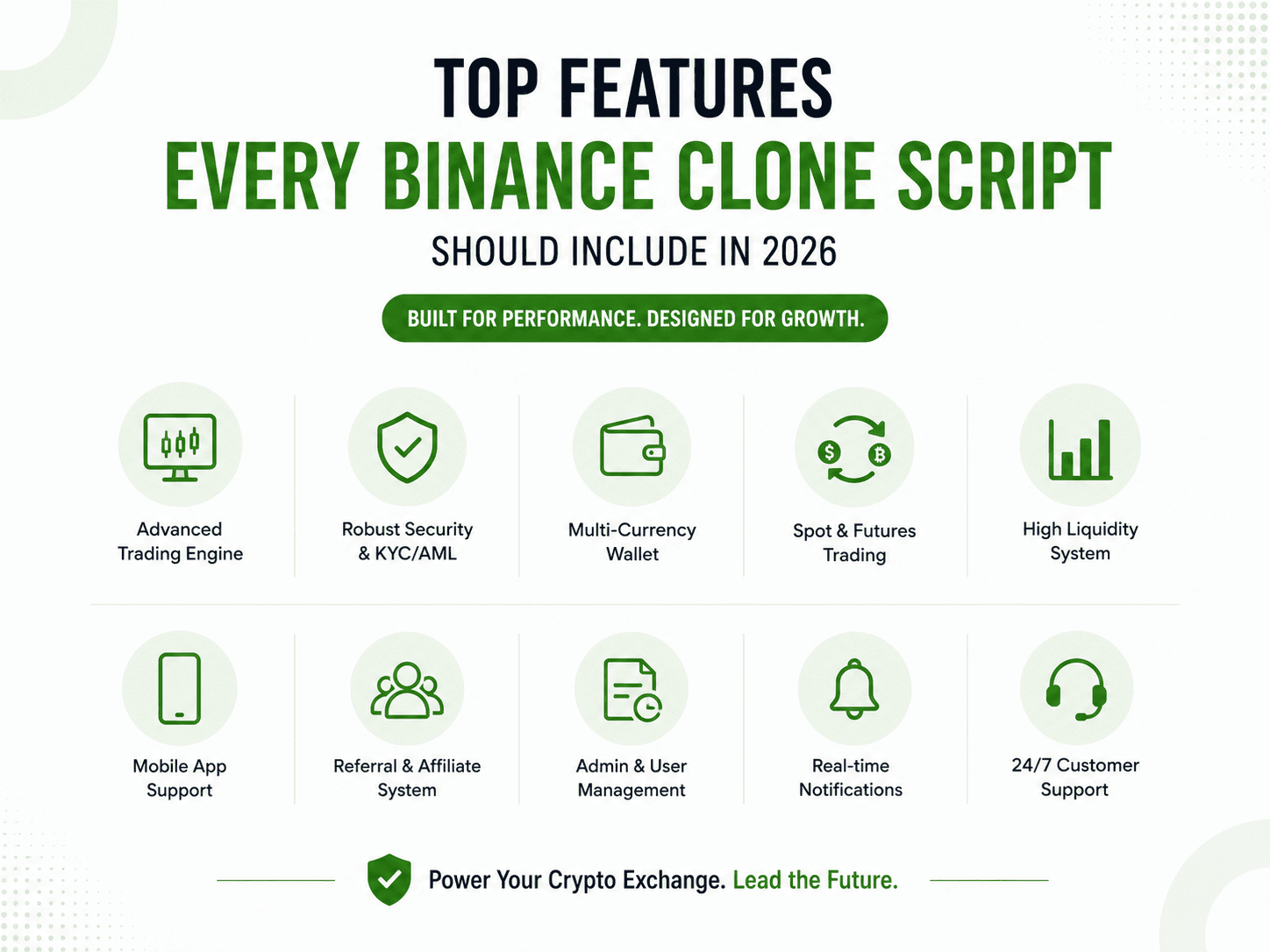
A future-proof Binance clone script in 2026 needs a high-throughput matching engine, multi-layer wallet security (hot/cold/MPC), built-in KYC/AML compliance, P2P and futures trading modules, liquidity aggregation via API, and a scalable admin dashboard. Skipping any one of these creates operational, security, or regulatory risk once your exchange goes live.
What Is a Binance Clone Script?
A Binance clone script is a pre-built, white-label software package that replicates the core functionality of Binance — order matching, wallet management, trading interface, and admin controls — so founders can launch a crypto exchange without building the entire tech stack from scratch.
The catch: not all clone scripts are built equal. Some are literally open-source templates with cosmetic changes. Others are enterprise-grade platforms with audited code, real liquidity integrations, and compliance modules baked in. The features list is what tells you which one you’re actually buying.
Why Feature Selection Matters More Than Price
Most founders shop for a Binance clone script the way they’d shop for a template — by price and visual demo. That’s a mistake. A cheap script that lacks proper wallet segregation or KYC automation will cost 5-10x more later in security breaches, regulatory fines, or emergency rebuilds.
Global crypto exchange hacks resulted in over $2.2 billion in stolen funds in 2024 alone, according to blockchain security firm Chainalysis — and weak wallet architecture was a recurring root cause. That single data point should reframe how you evaluate a clone script: security and compliance features aren’t optional add-ons, they’re the product.
Core Trading Engine Features
1. High-Frequency Matching Engine
The matching engine is the heart of any exchange. It needs to process thousands of orders per second without lag, especially during volatility spikes when trading volume can 10x within minutes.
What to look for:
- Sub-millisecond order execution
- Support for limit, market, and stop-loss orders
- Horizontal scalability (engine can handle spikes without downtime)
Real-world scenario: During a major market event (like a Fed rate announcement), exchanges with weak matching engines experience order queue delays. Users see stale prices, orders fail to execute, and trust erodes instantly. A robust engine prevents this exact failure mode.
2. Multi-Currency & Multi-Chain Support
By 2026, users expect support for Bitcoin, Ethereum, and dozens of altcoins across multiple blockchains (BEP-20, ERC-20, TRC-20, Solana, etc.). A clone script limited to one or two chains will bottleneck your token listing strategy from day one.
3. Liquidity Aggregation API
New exchanges struggle with thin order books — the classic “chicken and egg” liquidity problem. A well-built clone script should support API-based liquidity aggregation from third-party market makers or liquidity pools, so your order book looks active even before your organic user base scales.
Wallet & Security Features
4. Hot, Cold & MPC Wallet Architecture
Security architecture is the single biggest differentiator between amateur and enterprise-grade scripts.
- Hot wallets — for day-to-day withdrawals, should hold a small percentage of total funds (industry standard: under 5-10%)
- Cold wallets — offline storage for the bulk of user funds
- MPC (Multi-Party Computation) wallets — an increasingly standard 2026 requirement, splitting private key control across multiple parties to eliminate single points of failure
5. Withdrawal Whitelisting & Anti-Phishing Codes
Small features, big impact. Withdrawal address whitelisting (with a mandatory cooldown period for new addresses) and anti-phishing codes on emails are simple to implement but dramatically reduce account takeover fraud.
6. Two-Factor Authentication (2FA) + Biometric Login
By 2026, SMS-only 2FA is considered weak. Look for scripts supporting authenticator apps, hardware key support (like YubiKey), and biometric login on mobile.
Compliance & Regulatory Features
7. Built-In KYC/AML Automation
Manual KYC review doesn’t scale. A modern clone script should integrate with automated KYC/AML providers for document verification, facial recognition, and sanctions-list screening — with configurable risk tiers based on user jurisdiction.
8. Transaction Monitoring & Suspicious Activity Reporting
Regulators increasingly expect real-time transaction monitoring that flags unusual patterns (structuring, rapid fund movement, high-risk jurisdictions). This isn’t just a compliance checkbox — it’s what keeps your banking and payment partnerships intact.
9. Jurisdiction-Based Feature Restriction
A single global exchange config no longer works. Your script should let you restrict specific products (like futures or margin trading) by region, since regulatory frameworks vary sharply — the EU’s MiCA regulation, for example, imposes different requirements than jurisdictions with lighter-touch crypto rules.
User Experience & Growth Features
10. Intuitive Mobile-First Trading Interface
Over 60% of retail crypto trading activity now happens on mobile. A clone script with a desktop-only or poorly optimized mobile experience will lose users to competitors within the first session.
11. Referral & Affiliate System
Built-in multi-tier referral programs are one of the highest-ROI growth features for a new exchange, since crypto communities spread by word-of-mouth and incentivized sharing far more than paid ads.
12. TradingView Chart Integration
Serious traders expect professional charting tools, not basic candlestick widgets. TradingView API integration is now considered a baseline expectation, not a premium feature.
Admin & Backend Management Features
13. Real-Time Admin Dashboard
Your admin panel should give visibility into trading volume, user growth, wallet balances, and flagged transactions — in real time, not batch reports.
14. Fee Management & Revenue Configuration
Flexible maker-taker fee structures, VIP tier discounts, and withdrawal fee configuration directly affect your exchange’s profitability. This should be adjustable without a developer needing to touch core code.
15. Automated Customer Support Tools
Ticketing systems, live chat, and AI-assisted first-response tools reduce support overhead significantly as your user base scales past the first few thousand accounts.
Advanced Trading Modules
16. P2P Trading Module
Peer-to-peer trading is essential for exchanges targeting regions with limited banking rails (parts of Africa, South Asia, Latin America). It lets users trade directly with escrow protection, bypassing traditional payment gateway limitations.
17. Futures & Margin Trading
If you’re targeting active traders rather than casual investors, futures and margin modules with configurable leverage limits are non-negotiable. This is where most of an exchange’s trading volume — and revenue — actually comes from.
18. Staking & Earn Products
Passive income features (staking, savings, launchpad participation) increase user retention by giving traders a reason to keep funds on your platform instead of moving to cold storage.
Comparison: Basic vs Enterprise-Grade Clone Scripts
| Feature | Basic Clone Script | Enterprise-Grade Script |
|---|---|---|
| Matching Engine | Single-server, limited throughput | Horizontally scalable, sub-ms execution |
| Wallet Security | Hot wallet only | Hot + Cold + MPC architecture |
| KYC/AML | Manual or none | Automated, jurisdiction-aware |
| Trading Modules | Spot only | Spot + P2P + Futures + Staking |
| Liquidity | Organic order book only | API-based liquidity aggregation |
| Compliance Updates | Rare/manual | Ongoing regulatory patching |
| Support | Ticket-based, slow | Dedicated technical account management |
Pros of enterprise-grade scripts: stronger security posture, faster regulatory approval, better investor confidence, higher scalability ceiling. Cons: higher upfront cost, longer customization timeline.
Pros of basic scripts: low cost, fast deployment. Cons: security debt, compliance gaps, poor scalability — often requiring a costly rebuild within 12-18 months.
Common Mistakes Founders Make
- Choosing based on UI demo alone — a polished front-end says nothing about backend security or matching engine performance.
- Skipping KYC/AML until “later” — retrofitting compliance after launch is far more expensive and risks account suspension by payment processors.
- Ignoring liquidity strategy — an exchange with no trading volume dies regardless of how good the code is.
- Underestimating mobile experience — losing the majority of potential users who trade primarily on phones.
- Not verifying source code audits — deploying unaudited smart contracts or wallet modules is a direct security liability.
Expert Tips for Choosing the Right Script
- Ask vendors for a live stress-test demo, not just a UI walkthrough — request to see order execution under simulated high load.
- Request proof of third-party security audits for wallet and smart contract modules before signing any contract.
- Confirm whether compliance updates are included post-launch, since regulations shift frequently and outdated KYC logic creates real legal exposure.
- Prioritize scripts with modular architecture so you can add futures, staking, or new chains later without a full rebuild.
- Negotiate a phased payment structure tied to feature delivery milestones, not full payment upfront.
FAQs
Q1: What is the most important feature in a Binance clone script?
Wallet security architecture (hot, cold, and MPC wallet segregation) is the most critical feature, since it directly determines how vulnerable your platform is to fund theft — the single most common cause of exchange failure.
Q2: How much does a Binance clone script with full features cost?
Pricing varies widely based on customization depth, ranging from a few thousand dollars for a basic template to well into six figures for a fully audited, compliance-ready enterprise platform. Cost should be evaluated against feature completeness, not compared as a flat number.
Q3: Can a Binance clone script features be customized for a specific country’s regulations?
Yes. A well-architected script should support jurisdiction-based feature restriction, configurable KYC tiers, and localized payment gateway integration to comply with regional regulatory frameworks like MiCA in the EU.
Q4: Do I need a futures trading module for my exchange?
Only if you’re targeting active/professional traders. Futures and margin trading require stricter risk management and regulatory clearance, so early-stage exchanges targeting retail/casual users often launch spot-only and add futures later.
Q5: How long does it take to launch an exchange using a clone script?
A basic deployment can go live in 2-4 weeks, while a fully customized, compliance-integrated exchange with audited security typically takes 8-16 weeks depending on the scope of customization required.
Conclusion
A Binance clone script is only as good as the features running underneath the interface. In 2026, that means a matching engine built for real trading volume, wallet architecture that treats security as non-negotiable, compliance tools that keep you ahead of regulators instead of scrambling to catch up, and growth features that actually retain users past their first trade.
If you’re evaluating vendors, don’t just watch the demo — ask for the architecture. At Digitechzo, we help founders stress-test exactly these decisions before a single dollar is spent on development, so the exchange you launch is built to scale, not built to break.
Ready to build an exchange that can actually handle real trading volume? Get in touch with our team for a feature-by-feature technical consultation before you commit to a vendor.
About The Author