

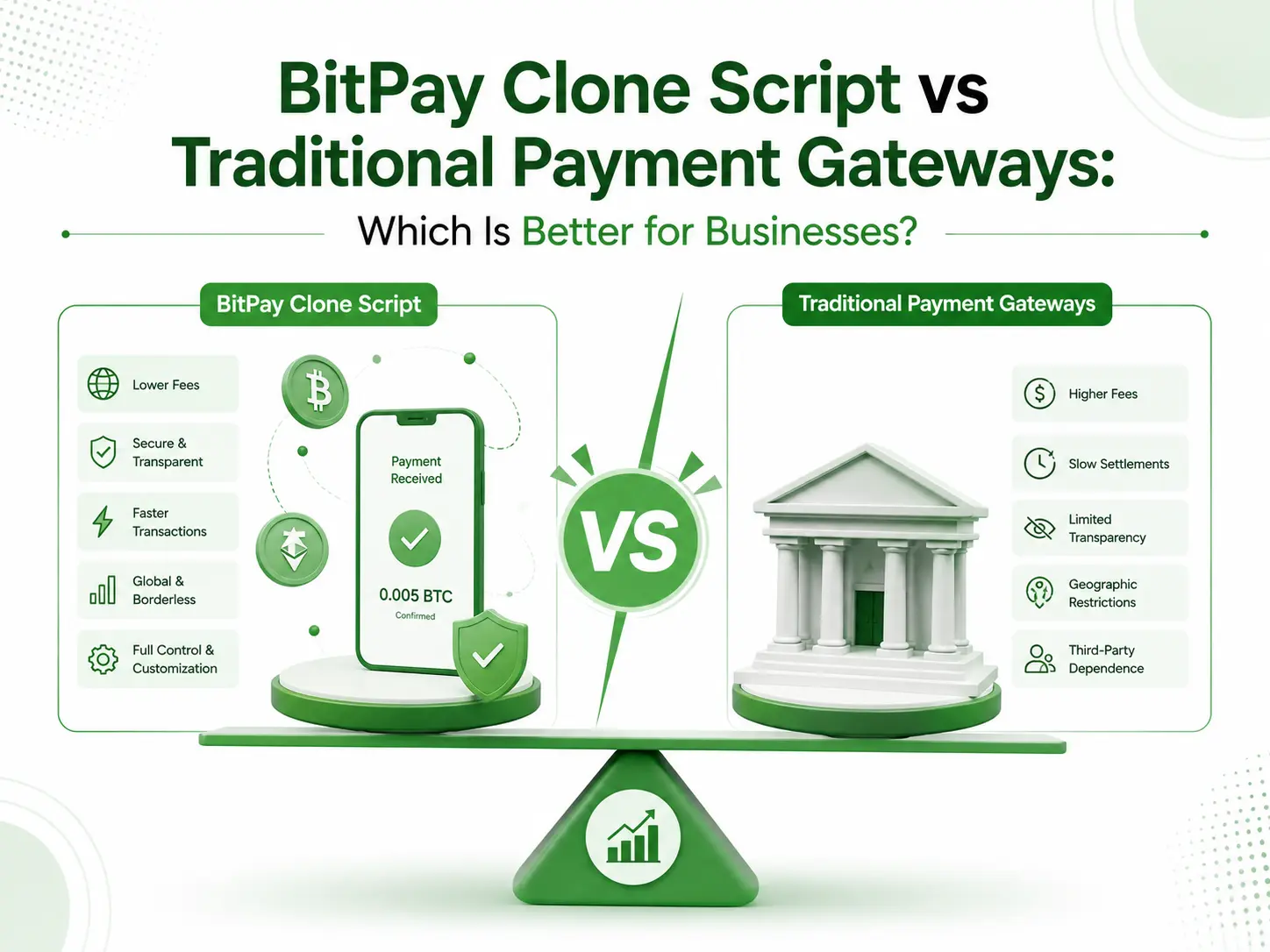
Every business that sells online eventually hits the same wall: payment fees are eating into margins, settlements take days, and international customers keep abandoning checkout because their preferred payment method isn’t supported. If you’ve been comparing a BitPay clone script vs traditional payment gateways to solve this, you’re not alone — this is one of the most common decisions founders and CTOs face in 2026 as crypto payments move from “nice to have” to “expected.”
At DigiTechzo, we’ve built and deployed white-label crypto payment platforms for merchants who outgrew traditional processors, so this comparison isn’t theoretical — it’s drawn from real client deployments, fee audits, and integration timelines we’ve run over the past few years.
This guide breaks down exactly how a BitPay clone script stacks up against traditional payment gateways like Stripe, PayPal, and Authorize.net — across cost, settlement speed, security, compliance, and long-term scalability — so you can make a decision based on data, not marketing claims.
Quick Answer
A BitPay clone script is a ready-made, white-label crypto payment gateway you own and customize, typically charging 0.4%–1% per transaction with instant, irreversible settlement and no chargebacks. Traditional payment gateways charge 2.5%–3.5% per transaction plus chargeback risk and 2–5 day settlement, but offer wider mainstream customer familiarity and simpler regulatory onboarding. Businesses with global customers, high chargeback exposure, or thin margins tend to benefit most from a crypto gateway; businesses serving mostly local, card-preferring customers may still need a traditional processor — or both, running in paralle
What Is a BitPay Clone Script?
A BitPay clone script is a pre-built, white-label software solution that replicates the core functionality of BitPay — one of the earliest and largest crypto payment processors — allowing you to launch your own branded cryptocurrency payment gateway without building the blockchain infrastructure from scratch.
In practice, it typically includes:
- Multi-currency wallet support (Bitcoin, Ethereum, stablecoins like USDT/USDC, and often Layer 2 networks such as Lightning or Polygon)
- Merchant dashboard for invoicing, payout management, and analytics
- API and plugin integrations for WooCommerce, Shopify, Magento, and custom apps
- Auto-conversion tools to settle in stablecoins or fiat, reducing volatility exposure
- White-label branding so the gateway looks and feels like your own product
Unlike subscribing to a third-party crypto processor, a clone script gives you ownership of the codebase and infrastructure. That distinction matters more than most comparison articles admit — it’s the difference between renting a payment rail and owning one.
Real-World Example
A mid-sized digital goods marketplace we worked with was losing roughly 4% of monthly revenue to combined card fees and chargeback disputes. After deploying a BitPay-style clone gateway alongside their existing checkout, crypto payments settled inside 30 minutes on average, and chargeback-related losses dropped to zero for that payment channel — because crypto transactions are irreversible by design.
What Are Traditional Payment Gateways?
Traditional payment gateways — Stripe, PayPal, Square, Authorize.net, Adyen — process payments through the existing banking rail: card networks (Visa/Mastercard), issuing banks, and acquiring banks. Every transaction passes through multiple intermediaries, each taking a cut.
Core characteristics:
- Domestic card processing typically runs 2.9% + $0.30 per transaction; international cards often run closer to 4%
- Funds settle in 2–5 business days
- Chargebacks are built into the system, and each dispute can cost $15–$100 in fees regardless of outcome
- Strong consumer trust and near-universal customer familiarity
- Mature compliance frameworks (PCI-DSS, KYC/AML already baked in by the provider)
These gateways remain the default for a reason: customers know how to use them, refunds are simple, and banks and regulators have decades of precedent to fall back on.
BitPay Clone Script vs Traditional Payment Gateways:
| Factor | BitPay Clone Script (Crypto Gateway) | Traditional Payment Gateway |
|---|---|---|
| Transaction fees | ~0.4%–1% | ~2.5%–4% |
| Settlement time | Minutes to a few hours | 2–5 business days |
| Chargebacks | None (irreversible transactions) | Common, costly |
| Ownership | You own the platform/codebase | You rent access via subscription |
| Customer reach | Crypto-holding customers, global | Mainstream customers, card holders |
| Setup complexity | Moderate (blockchain node/API setup) | Low (plug-and-play SDKs) |
| Regulatory scope | Varies by jurisdiction (VASP/MSB licensing may apply) | Established, provider-managed |
| Currency volatility | Manageable via stablecoin auto-conversion | Not applicable (fiat only) |
| Best for | High-volume, global, or high-chargeback businesses | Local, mainstream, card-first businesses |
Cost Comparison: Real Numbers
Numbers make this comparison concrete. Take a merchant processing $100,000 in monthly revenue:
Traditional payment gateway (card processing at ~2.9%–4%, plus chargebacks):
- Estimated monthly cost: $2,000–$7,000
- Add chargeback fees on disputed orders, and annual costs can climb well past $40,000 for businesses with above-average dispute rates
BitPay-style crypto gateway (clone script, ~0.4%–1% platform fee):
- Estimated monthly cost: $400–$2,000
- Because transactions are irreversible, chargeback costs drop to effectively zero on the crypto channel
That gap — often $1,500–$5,000 per month on six-figure revenue — is the single biggest reason mid-market and enterprise merchants evaluate a clone script in the first place. It’s not a marginal saving; over a year, it can fund an entire hire.
Where Traditional Gateways Still Win on Cost
For very low transaction volumes, or businesses whose customers rarely dispute charges, the percentage difference matters less than the simplicity — a $0.30 flat fee on small-ticket items can sometimes beat a percentage-only crypto fee, depending on your average order value. Run both models against your actual numbers before deciding.
Settlement Speed & Cash Flow
Cash flow is where crypto gateways create the most operational advantage.
- Traditional gateways: Funds are typically held for 2–5 business days before reaching your bank account, and payout schedules can extend further for new merchant accounts or high-risk categories.
- BitPay clone scripts: Settlement often completes within minutes to an hour, and stablecoin/Lightning Network rails can bring this down to seconds with near-zero network fees.
For businesses managing tight inventory cycles, payroll timing, or working capital, faster settlement isn’t a convenience — it’s a measurable improvement in liquidity.
Security, Fraud & Chargebacks
Traditional Gateways
- Rely on PCI-DSS compliance frameworks managed largely by the provider
- Chargeback fraud (also called “friendly fraud”) costs merchants billions globally each year, and it disproportionately hits digital goods and subscription businesses
- Dispute resolution can take weeks and often favors the customer by default
BitPay Clone Scripts
- Blockchain transactions are cryptographically verified and irreversible — once confirmed, the funds are yours
- Eliminates chargeback fraud entirely on that payment channel
- Shifts the security burden to wallet management, private key custody, and smart contract auditing — areas that require real technical diligence during setup
The trade-off: you lose the “easy refund” mechanism traditional gateways offer, so refund policies need to be handled manually or through a separate process built into your clone script’s dashboard.
Compliance & Regulatory Considerations
This is the subtopic most comparison articles skip — and it’s often the deciding factor.
- Traditional payment gateways handle KYC/AML and PCI compliance on your behalf as part of the service fee.
- With a BitPay clone script, you may be responsible for compliance depending on your jurisdiction. In the US, this can mean money transmitter licensing; in the EU, payment institution authorization; in many countries, VASP (Virtual Asset Service Provider) registration.
- Some clone script providers bundle compliance tooling (KYC modules, transaction monitoring) into the platform — always confirm this before purchase, because unlicensed operation can carry real legal risk.
Expert takeaway: Owning your payment infrastructure means owning your compliance obligations too. Budget for legal counsel during setup, not after your first regulator inquiry.
Pros and Cons Side-by-Side
BitPay Clone Script
Pros:
- Significantly lower per-transaction fees
- Fast, near-instant settlement
- Zero chargeback fraud exposure
- Full platform ownership and customization
- Opens your business to a global, crypto-native customer base
Cons:
- Requires upfront technical setup (blockchain nodes, wallet infrastructure)
- You carry more compliance responsibility
- Price volatility risk unless stablecoin conversion is configured
- Smaller addressable customer base than card payments (for now)
Traditional Payment Gateway
Pros:
- Near-universal customer familiarity
- Simple, fast integration (SDKs, plug-and-play checkout)
- Built-in dispute resolution and buyer protection
- Compliance largely handled by the provider
Cons:
- Higher fees that compound at scale
- Slower settlement, tying up working capital
- Ongoing chargeback fraud exposure
- Account freezes and holds are common for high-risk categories
Which One Should Your Business Choose?
There’s no universal winner — the right choice depends on your business model:
- High-volume, global, or digital-goods businesses (SaaS, marketplaces, gaming, affiliate platforms): a BitPay clone script typically delivers the strongest ROI, thanks to lower fees and zero chargeback exposure.
- Local retail, mainstream B2C, or businesses with older/less crypto-savvy customers: a traditional gateway remains essential for now, since it’s what most customers expect at checkout.
- Growing mid-market businesses: the smartest move we see in practice is running both in parallel — traditional gateway for mainstream card customers, crypto gateway for high-ticket, international, or chargeback-prone segments. This hybrid model is exactly what we help merchants architect at Digitechzo.
Common Mistakes Businesses Make {#common-mistakes}
- Choosing based on fees alone. A cheaper transaction fee means nothing if your customers can’t or won’t pay in crypto. Match the gateway to your actual customer base first.
- Ignoring compliance until after launch. Skipping VASP/MSB registration research before going live is one of the fastest ways to trigger regulatory trouble.
- Not configuring stablecoin auto-conversion. Merchants who accept raw BTC/ETH without conversion tools expose themselves to unnecessary volatility risk on revenue they’ve already earned.
- Underestimating wallet security setup. Treating private key management casually is the crypto-equivalent of leaving your bank vault unlocked.
- Assuming a clone script is “install and forget.” Like any payment infrastructure, it needs monitoring, updates, and periodic security audits — not a one-time setup.
- Failing to offer both options. Businesses that go all-in on crypto too early sometimes alienate their existing card-paying customer base unnecessarily.
Expert Tips
- Run a 90-day pilot with the clone script alongside your existing gateway before fully committing — measure actual chargeback savings and settlement speed on your real transaction volume.
- Negotiate your traditional processor’s rate first. High-volume merchants can often talk their card processor down significantly (Interchange++ pricing models, for example, can beat flat-rate pricing at scale) — don’t assume the traditional side is fixed.
- Prioritize gateways with multi-chain and Layer 2 support (Lightning, Polygon) to keep network fees near-zero even during high traffic periods.
- Build your refund workflow before launch, not after your first customer complaint. Crypto refunds require a new transaction, not a simple reversal.
- Audit the clone script vendor’s track record. Ask for uptime data, past client deployments, and how they handle security patching — the code quality behind a “clone script” varies enormously between vendors.
FAQs
Is a BitPay clone script legal to use for my business?
Yes, in most jurisdictions, provided you comply with local money transmitter, VASP, or payment institution licensing requirements. Compliance obligations vary by country, so consult legal counsel before launch.
How much cheaper is a BitPay clone script compared to traditional gateways?
Crypto gateways typically charge 0.4%–1% per transaction versus 2.5%–4% for traditional card processing — a difference that can save six-figure-revenue businesses several thousand dollars per month, mainly from lower fees and zero chargebacks.
Can I use a BitPay clone script and a traditional payment gateway at the same time?
Yes. Many businesses run both in parallel, offering crypto as an alternative checkout option while keeping card payments for mainstream customers. This hybrid approach is one of the most common setups we deploy.
Do crypto payments have chargebacks like credit cards?
No. Blockchain transactions are irreversible once confirmed, which eliminates chargeback fraud but also removes the easy “reverse the charge” option customers expect from card payments — refunds must be processed as new transactions.
Is it expensive to build or license a BitPay clone script?
Costs vary widely based on features, blockchain support, and whether you build from scratch or license an existing white-label solution — custom development can run from the low tens of thousands upward, while licensed clone scripts are typically far more cost-effective for businesses that want to launch quickly.
Conclusion
The BitPay clone script vs traditional payment gateways decision ultimately comes down to your customer base, your margins, and your appetite for owning payment infrastructure versus renting it. Traditional gateways still win on mainstream familiarity and simplicity. Crypto gateways win decisively on fees, settlement speed, and chargeback elimination — advantages that compound fast at scale.
If you’re evaluating whether a white-label crypto payment gateway makes sense for your business, DigiTechzo builds and customizes BitPay-style clone scripts for merchants who want the cost and speed advantages of crypto payments without building blockchain infrastructure from zero. Talk to our team for a fee audit and a side-by-side breakdown based on your actual transaction volume — not industry averages.
About The Author