

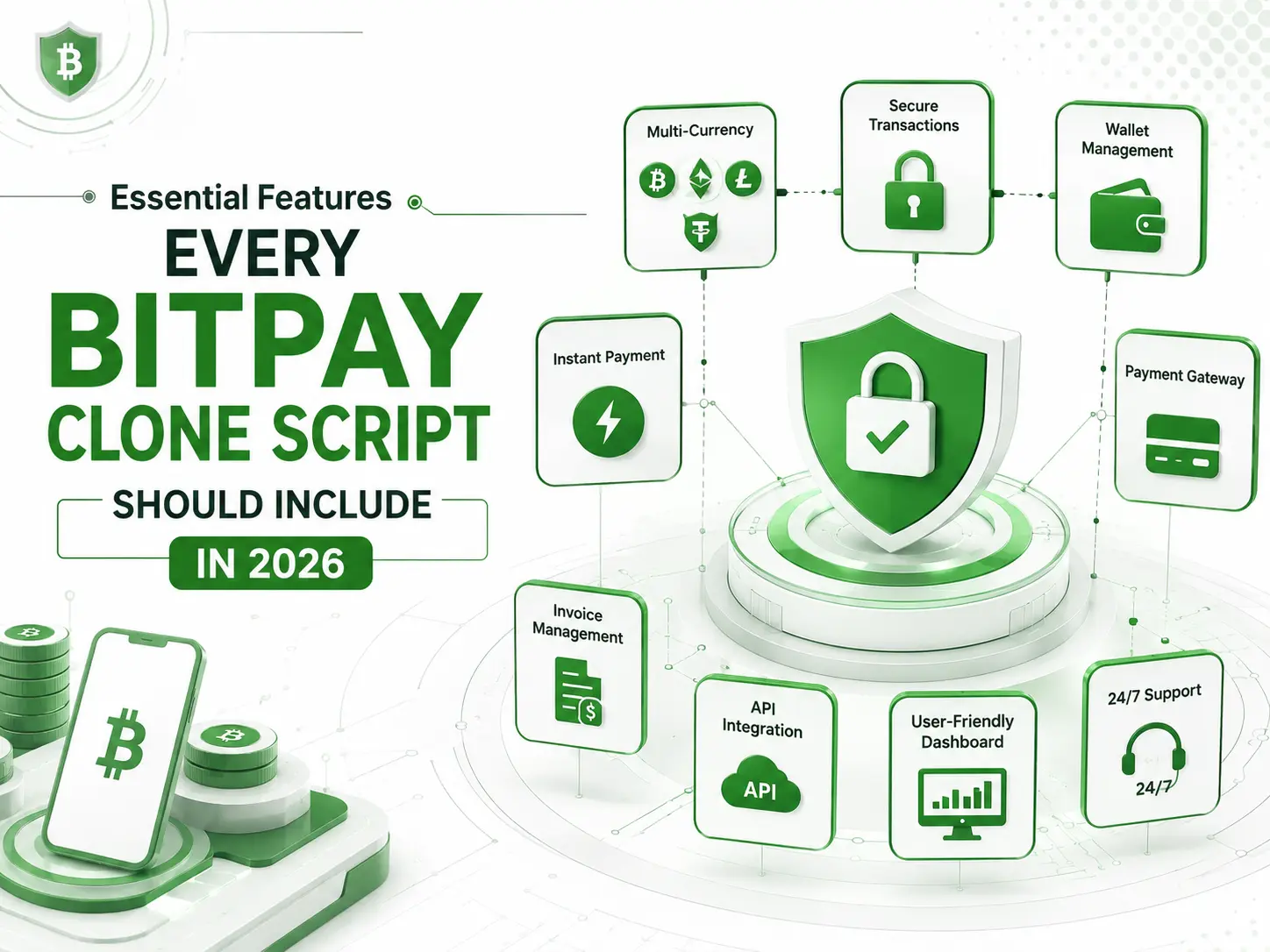
If you’re evaluating a BitPay clone script for your crypto payment gateway startup, you’ve probably already noticed a problem: most vendors show you a shiny demo, promise “100% BitPay features,” and then hand over a script that’s missing half the infrastructure you actually need to process real transactions safely. The result? Founders spend months (and tens of thousands of dollars) patching security holes, adding missing coins, and rebuilding admin panels after launch.
At DigiTechzo, we’ve spent years building and auditing crypto payment platforms for fintech clients, and we’ve seen this pattern repeat constantly. A BitPay clone script isn’t just about replicating BitPay’s checkout screen — it’s about replicating the engineering discipline behind a payment processor that handles billions in transaction volume. This guide breaks down exactly which features separate a production-ready BitPay clone script from a liability waiting to happen.
Quick Answer
A reliable BitPay clone script in 2026 must include multi-currency wallet support, non-custodial or hybrid custody options, real-time exchange rate locking, multi-chain and Layer-2 compatibility, robust KYC/AML tools, merchant/developer APIs, invoice automation, and enterprise-grade security (multi-sig, cold storage, 2FA). Anything less leaves you exposed to compliance risk, transaction failures, or fund loss.
What Is a BitPay Clone Script?
A BitPay clone script is a pre-built software solution designed to replicate the core functionality of BitPay — the crypto-to-fiat payment gateway that lets merchants accept Bitcoin, Ethereum, and other digital assets and settle in stablecoins or local currency. Instead of building a payment processor from scratch (which can take 12–18 months and a full engineering team), businesses license or customize a clone script to launch their own branded crypto payment gateway in weeks.
But here’s the nuance most buyers miss: “clone” doesn’t mean “copy.” A good clone script replicates BitPay’s architecture and feature depth, not its exact code. The goal is functional parity — supporting the same breadth of coins, security layers, and merchant tools — while giving you full ownership, white-label branding, and customization rights.
Why Feature Selection Matters More Than Price
Most buyers shop for a BitPay clone script the way they’d shop for a WordPress theme — comparing price tags and demo screenshots. That’s the wrong lens.
A payment gateway touches real money, real regulations, and real customer trust. According to Chainalysis’s annual crypto crime reports, crypto-related fraud and exploit losses have consistently run into the billions of dollars industry-wide, and a disproportionate share traces back to weak custody architecture or missing compliance controls — not exotic hacking techniques. In other words: the features you skip are usually the ones that get exploited.
When we audit clone scripts for clients at Digitechzo, we run through a checklist that goes far beyond “does it accept Bitcoin.” Here’s what that checklist actually looks like.
Core Payment Processing Features
Multi-Currency & Stablecoin Support
Your script should support, at minimum:
- Bitcoin (BTC) and Bitcoin Lightning Network
- Ethereum (ETH) and major ERC-20 tokens
- Stablecoins (USDT, USDC, DAI) across multiple chains
- At least 15–20 additional altcoins based on regional demand
Stablecoin settlement is no longer optional — merchants overwhelmingly prefer settling in USDT or USDC to avoid volatility exposure, and any script that treats stablecoins as an afterthought will lose merchant interest fast.
Real-Time Exchange Rate Locking
BitPay’s original innovation was locking the exchange rate for a fixed window (typically 15 minutes) once a customer initiates payment. This protects both merchant and buyer from price swings mid-transaction. Your clone script needs:
- A live rate-feed integration (via aggregators like CoinGecko or CoinMarketCap API)
- A countdown-based payment window
- Automatic rate refresh with clear expiry notifications
Example scenario: A merchant selling a $500 product shouldn’t receive $480 worth of crypto because BTC dropped 4% during an 8-minute checkout delay. Rate locking eliminates this friction entirely.
Instant Invoice Generation
Every transaction should generate a unique, time-stamped invoice with a QR code, wallet address, and payment status tracker (Pending → Confirming → Paid → Settled). This isn’t cosmetic — it’s what allows automated reconciliation on the merchant side.
Security Features You Cannot Skip
This is where most budget clone scripts fail — and where the financial damage happens.
Multi-Signature Wallet Architecture
A single-key wallet is a single point of failure. Look for:
- Multi-sig wallets requiring 2-of-3 or 3-of-5 approvals for large withdrawals
- Separate hot and cold wallet architecture
- Configurable withdrawal thresholds that trigger manual review
Two-Factor & Biometric Authentication
Both merchant and admin dashboards should enforce 2FA (Google Authenticator or hardware key support) as a non-negotiable default, not an optional toggle buried in settings.
Penetration-Tested Codebase
Ask any vendor directly: “Has this script undergone third-party penetration testing, and can I see a redacted report?” If they hesitate, that’s your answer. A script that hasn’t been stress-tested against SQL injection, API abuse, and wallet-drain exploits is not production-ready, regardless of how polished the UI looks.
DDoS Protection & Rate Limiting
Payment gateways are high-value DDoS targets. API rate limiting and infrastructure-level DDoS mitigation (Cloudflare or equivalent) should be built into the deployment recommendations, not left to you to figure out post-launch.
Compliance & Regulatory Features
This is the section competitors covering “BitPay clone script features” almost always skip — and it’s arguably the most important one for anyone planning to operate commercially.
KYC/AML Integration
Depending on your target jurisdictions, your script needs pluggable KYC providers (Sumsub, Onfido, or similar) with:
- Tiered verification levels based on transaction volume
- Automated sanctions and PEP (Politically Exposed Person) screening
- Suspicious activity flagging and reporting workflows
Transaction Monitoring & Audit Trails
Regulators increasingly expect immutable audit logs. Your admin system should log every wallet action, admin login, and configuration change with timestamps that can’t be edited retroactively.
Regional Licensing Flexibility
A script built only for U.S. compliance logic will struggle in the EU (MiCA regulations) or APAC markets. Look for a script architecture that separates compliance logic into a configurable module rather than hardcoding it — this saves enormous rework later.
Multi-Chain & Currency Support
By 2026, single-chain support is a dealbreaker. Your script should support:
- Layer-2 networks (Polygon, Arbitrum, Base) for lower gas fees
- Cross-chain bridging for merchants accepting assets across ecosystems
- Lightning Network for near-instant, low-fee Bitcoin micropayments
Merchants processing high transaction volumes care deeply about gas fees eating into margins — a script without Layer-2 support will quietly bleed merchant trust over time.
Merchant & Developer Tools
RESTful APIs & SDKs
A modern clone script needs well-documented APIs (REST, and ideally webhooks) so merchants can integrate payments into e-commerce platforms like Shopify, WooCommerce, and Magento without custom development.
Plugin Ecosystem
Pre-built plugins for major CMS and e-commerce platforms dramatically reduce merchant onboarding friction. If a competitor’s script requires custom coding for every integration, that’s a growth bottleneck for you as the platform owner.
Recurring Billing & Subscription Support
SaaS and subscription-based merchants need crypto recurring billing — a feature BitPay itself added after merchant demand made it clear one-time payments weren’t enough.
Admin Panel Capabilities
A strong admin dashboard should give platform owners:
- Real-time transaction monitoring and dispute management
- Configurable fee structures (flat, percentage, tiered)
- White-label branding controls (logo, domain, color scheme)
- Multi-merchant management for platform-as-a-service models
- Automated settlement scheduling (daily, weekly, on-demand)
Pros & Cons of Ready-Made Clone Scripts
| Aspect | Pros | Cons |
|---|---|---|
| Speed to Market | Launch in weeks instead of a year+ | Rushed customization can introduce bugs |
| Cost | Far cheaper than ground-up development | Cheap scripts often cut security corners |
| Feature Depth | Mature scripts include years of refinement | Low-quality vendors copy UI, not architecture |
| Customization | White-label and modular options available | Poorly documented code limits future changes |
| Compliance | Configurable modules save legal headaches | Many scripts ignore compliance entirely |
Common Mistakes When Choosing a Clone Script
- Judging by demo UI alone. A polished front end tells you nothing about wallet security or backend architecture.
- Ignoring source code ownership. Some vendors lease access rather than transfer full ownership — read the contract carefully.
- Skipping the security audit question. Always ask for penetration test documentation before purchase.
- Assuming compliance is “add later.” Retrofitting KYC/AML into a live platform is exponentially harder than building it in from day one.
- Overlooking scalability. A script that works for 100 daily transactions may collapse at 10,000 — ask about load testing benchmarks.
- No post-launch support plan. Crypto infrastructure needs ongoing patches as chains upgrade (hard forks, new token standards) — a one-time script sale with no support is a red flag.
Expert Tips Before You Buy
- Request a live sandbox, not just a demo video. Test actual transaction flows, including failure states like expired invoices and underpaid transactions.
- Verify multi-sig wallet claims independently. Ask the vendor to walk through the exact signing process on-chain.
- Check for regulatory adaptability. Ask specifically how the script handles evolving frameworks like MiCA in the EU or FinCEN guidance in the U.S.
- Prioritize vendors offering source code escrow or full ownership transfer — this protects you if the vendor shuts down or stops support.
- Budget for customization, not just licensing. Even the best base script needs adaptation to your specific market and merchant base.
FAQs
Q: What’s the difference between a BitPay clone script and building a payment gateway from scratch?
A clone script gives you a pre-built, tested framework replicating BitPay’s core features — multi-currency support, invoicing, and security — cutting development time from over a year to a few weeks, at a fraction of the cost of custom development.
Q: Is a BitPay clone script legal to use commercially?
Yes, as long as it’s an independently developed script that replicates functionality (not BitPay’s copyrighted code or trademarks) and you comply with relevant financial regulations in your operating jurisdictions.
Q: How much does a quality BitPay clone script typically cost?
Costs vary widely based on features, customization, and support included — ranging from a few thousand dollars for a basic white-label script to significantly more for enterprise-grade builds with full compliance modules and dedicated support.
Q: Does a BitPay clone script need KYC/AML built in?
If you plan to operate as a licensed payment processor rather than a purely peer-to-peer tool, yes — most jurisdictions require KYC/AML compliance for any platform facilitating fiat-crypto conversion or merchant settlement.
Q: Can a BitPay clone script support Layer-2 networks like Polygon or Lightning?
A modern, well-built script should support Layer-2 and Lightning Network integration to reduce transaction fees and confirmation times — scripts that don’t are already behind current merchant expectations.
Final Verdict
The difference between a BitPay clone script that scales into a real payment business and one that becomes a liability comes down to the features under the hood — multi-sig security, compliance flexibility, multi-chain support, and genuine developer tooling — not how good the checkout page looks in a sales demo.
If you’re serious about launching a crypto payment gateway in 2026, treat this feature checklist as your minimum bar, not your wish list. And if you’d rather skip the trial-and-error of vetting vendors alone, DigiTechzo works directly with founders to audit, customize, and deploy BitPay clone scripts built for real regulatory and security demands — not just demo-day polish. Reach out for a technical consultation before you commit to a vendor.
About The Author