Most blockchain games don’t die because the gameplay is bad. They die because nobody outside the founding team’s Telegram group ever hears about them.
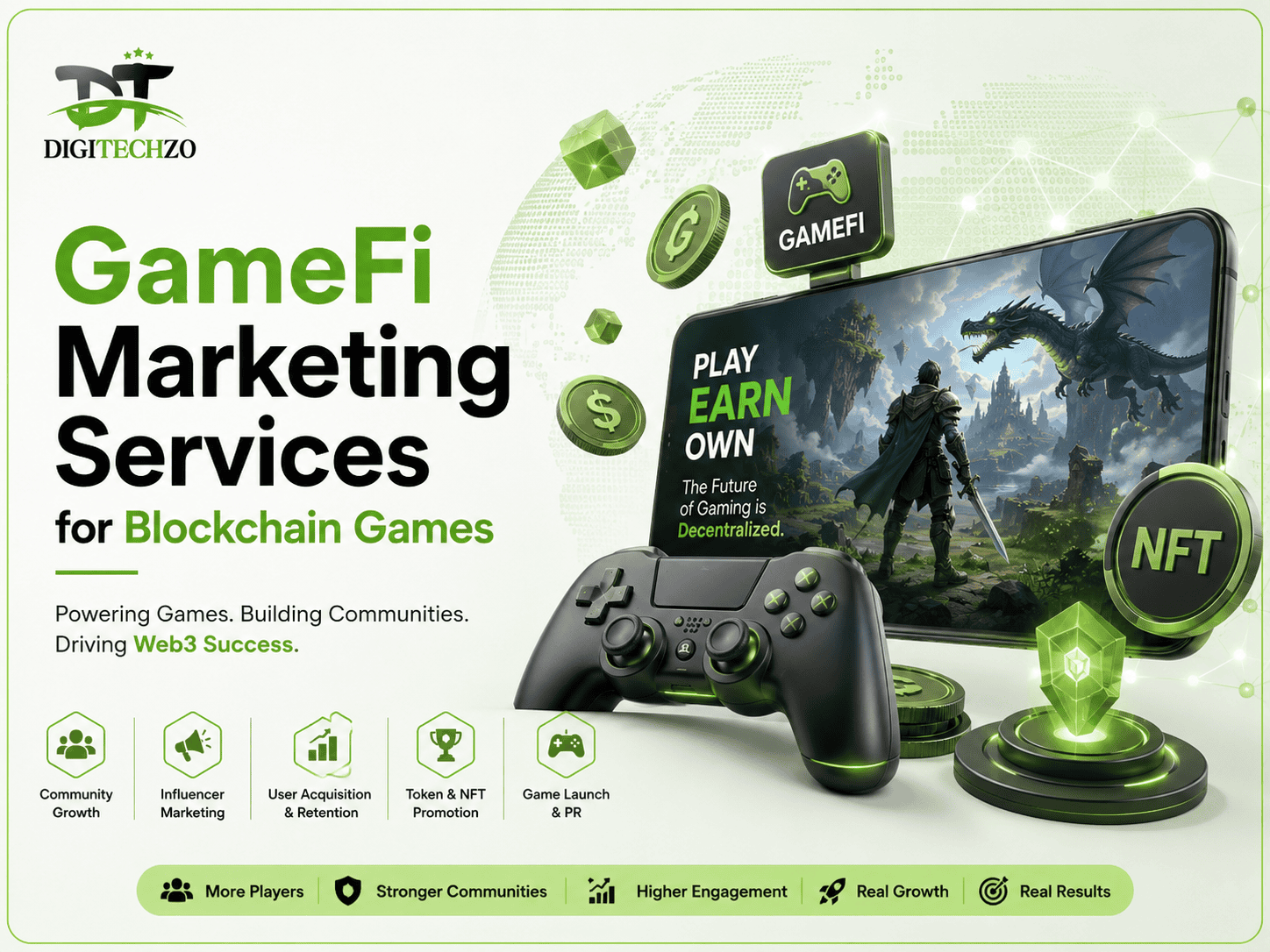
You’ve built the smart contracts. Tokenomics are audited. NFT assets are minted. And then… launch day comes, a few hundred wallets connect, volume dries up within a week, and the Discord goes quiet. If that sounds familiar, the problem usually isn’t your game — it’s that generic Web2 marketing playbooks don’t work on a Web3 audience, and generic crypto marketing agencies don’t understand game economies. That gap is exactly where GameFi marketing services earn their keep, and it’s the gap we work in every day at Digitechzo, helping blockchain gaming studios turn early builds into games with real, retained player-investors.
This guide breaks down what GameFi marketing actually involves, what separates a competent campaign from a wasted budget, and how to evaluate (or run) one without falling into the mistakes that sink most P2E launches.
Quick Answer
GameFi marketing services combine traditional game-user-acquisition tactics (ASO, influencer play-throughs, community building) with crypto-native growth levers (tokenomics communication, exchange listings, NFT drops, DAO engagement, and KOL seeding across Telegram/X/Discord). The best GameFi campaigns treat the token economy and the gameplay loop as one product, not two separate marketing tracks, because in blockchain games, trust in the economy is the retention mechanic.
What Is GameFi Marketing Exactly?
GameFi marketing is the practice of acquiring, converting, and retaining players in a blockchain-based game where in-game assets carry real financial value — usually through NFTs, fungible reward tokens, or both. It sits at the intersection of three disciplines that rarely live in one team:
- Game marketing — trailers, influencer gameplay, ASO, community events
- Crypto/Web3 marketing — token launches, exchange relations, on-chain data storytelling, DAO and governance messaging
- Financial communication — because your “players” are also investors who read tokenomics documents before they read your game trailer
Industry market research on the GameFi sector consistently shows steep growth projections through the early 2030s, with most analysts putting the current global GameFi market in the tens of billions of dollars and compound annual growth rates commonly estimated between roughly 25% and 32% depending on methodology. Estimates vary a lot between research firms, which itself tells you something important: this is still an early, fast-moving category where standardized benchmarks (the kind Web2 mobile game marketers rely on) simply don’t exist yet. That’s precisely why templated marketing doesn’t transfer well — the playbook is still being written in real time.
Why Traditional Game Marketing Falls Short for GameFi
A performance marketer who’s scaled a mobile hyper-casual title will instinctively reach for Facebook Ads, install-based bidding, and D1/D7/D30 retention curves. Those instincts aren’t wrong — they’re just incomplete.
Here’s what breaks:
- Ad platform restrictions. Meta, Google, and TikTok all have crypto-advertising policies that require pre-approval, geo-restrictions, and specific disclosures. Campaigns get shut down mid-flight if you don’t plan for this.
- CAC math changes. A player who buys a $40 NFT land parcel behaves nothing like a player who installs a free mobile game. Your acquisition funnel needs a financial-literacy layer, not just a tutorial.
- Trust is the conversion bottleneck, not curiosity. Web2 games sell fun first. GameFi has to sell fun and solvency — players want proof the token isn’t going to zero before they commit real money.
- Community is the acquisition channel. Discord, X Spaces, and Telegram AMAs often outperform paid media entirely, because GameFi audiences default to skepticism about paid ads for anything token-related.
Core GameFi Marketing Services Explained
A genuinely comprehensive GameFi marketing services provider should cover the following pillars — not just one or two of them.
1. Tokenomics & Whitepaper Positioning
Before any promotion happens, the token model needs to be explainable in one sentence. Agencies with real Web3 experience will often rework tokenomics messaging (not the mechanics themselves) so utility, sinks, and faucets are communicated clearly to a non-technical audience.
2. Community Building (Discord, Telegram, X)
This isn’t “post twice a day.” It’s structured community architecture: role-gated channels, ambassador programs, moderator training, and event cadences (AMAs, trivia, in-game tournaments) that keep a server active between content drops.
3. KOL and Influencer Seeding
Crypto-native influencers and gaming YouTubers/streamers operate under very different economics — think token allocations, affiliate codes tied to in-game purchases, or NFT gifting — rather than flat sponsorship fees alone.
4. NFT Drop Strategy & Launchpad Selection
Choosing the right launchpad, structuring whitelist mechanics, and pacing mint phases (OG, whitelist, public) directly affects both initial liquidity and long-term floor price stability.
5. Exchange & Listing PR
Getting a token in front of the right CEX/DEX audiences, timing listing announcements, and coordinating market-maker relationships with marketing pushes so volume and messaging land together.
6. Content & SEO for Organic Discovery
Blockchain game discovery increasingly happens through search — “best play to earn games 2026,” “[game name] tokenomics,” “[game name] review” — meaning organic content and app-store-style optimization for Web3 game aggregators matter as much as paid UA.
7. Performance & Paid Media (Where Policy Allows)
Programmatic and social ads still work, but campaigns must be built around approved ad accounts, compliant landing pages, and jurisdictions where crypto advertising is permitted.
8. Analytics: On-Chain + Off-Chain
Wallet-level analytics (holder retention, transaction frequency, token velocity) combined with traditional funnel analytics give a complete retention picture that neither data source alone can provide.
A Practical GameFi Go-To-Market Framework
Here’s a simplified version of the framework we walk studios through at Digitechzo before a single dollar of media spend goes out:
- Narrative lock — Define the one-sentence “why this game, why now” story that works for both gamers and investors.
- Pre-launch community seeding (6–10 weeks out) — Discord/Telegram setup, ambassador recruitment, teaser content.
- Whitelist & access mechanics — Reward early community members with tiered access, not just random giveaways.
- KOL wave 1: credibility builders — Smaller, trusted crypto-gaming voices before big-name influencers, to establish organic legitimacy first.
- Mint/launch event — Coordinated across Discord, X Spaces, and exchange partners.
- Post-launch retention loop — Seasonal content, leaderboard resets, and token utility expansion to avoid the “mint and dump” cycle.
- Continuous on-chain monitoring — Track holder behavior weekly, not just at launch, to catch early churn signals.
Featured Snippet Answer: What’s the first step in GameFi marketing?
The first step is narrative lock — clearly defining why the game exists and why its token model is sustainable, in language a non-crypto gamer can understand in under 15 seconds. Every other tactic (community, influencers, paid media) depends on this foundation being solid first.
In-House Team vs. Specialized Agency: Pros and Cons
| Factor | In-House Team | GameFi Marketing Agency |
|---|---|---|
| Web3-specific expertise | Often needs to be built from scratch | Already has playbooks across multiple launches |
| Speed to launch | Slower — hiring + onboarding | Faster — existing KOL/community networks |
| Cost structure | Fixed salaries, ongoing overhead | Often scoped by campaign or retainer |
| Cross-project pattern recognition | Limited to your own game | Sees what’s working across many titles |
| Control & brand voice | Maximum control | Requires clear briefing and oversight |
| Long-term community ownership | Naturally stronger, since it’s your team | Needs a handover plan built in from day one |
Bottom line: most successful studios use a hybrid — a small in-house community lead who owns the brand voice long-term, paired with a specialized agency for launch execution, KOL networks, and paid media compliance.
Real-World Scenarios: How This Plays Out
Scenario A — The rushed mint. A play-to-earn RPG spent 80% of its marketing budget on influencer posts in the final two weeks before mint, with almost no community-building beforehand. Mint sold out on hype, but with no engaged holder base, secondary volume collapsed within 10 days and the floor price fell below mint price. The fix would have been front-loading community trust-building months earlier.
Scenario B — The slow build. A metaverse land project spent three months running weekly community events, small-scale KOL seeding, and transparent tokenomics AMAs before opening whitelist spots. Mint sold out more slowly, but holder retention at 90 days was significantly higher, because buyers had already formed community identity before spending money.
The pattern is consistent across the sector: campaigns that treat community trust as infrastructure outperform campaigns that treat it as a launch-week checkbox.
Common Mistakes GameFi Projects Make
- Marketing the token before the game is fun. If the core loop isn’t engaging in a screen recording, no amount of KOL spend fixes that.
- Ignoring ad platform compliance until it’s too late. Getting a Meta or Google ad account banned mid-campaign can set launch timing back weeks.
- Over-indexing on mint-day hype, under-indexing on retention content. A big mint with no season-two roadmap trains your community to expect a dump-and-leave cycle.
- Treating Discord as a broadcast channel instead of a community. One-way announcement servers churn members fast; two-way engagement (polls, events, co-created content) doesn’t.
- Paying influencers only in tokens with no vesting. This creates a predictable sell-pressure event right after each sponsored post goes live.
- Skipping on-chain analytics. Relying only on Discord member counts or Twitter followers hides the real signal: wallet-level retention and repeat transaction behavior.
Expert Tips for Sustainable GameFi Growth
- Build a “trust dashboard.” Publish holder counts, treasury wallet activity, and token burn/mint events publicly and on a set cadence — transparency itself becomes a marketing asset in a market full of rug-pull skepticism.
- Stagger KOL tiers. Seed smaller, credible crypto-gaming voices first; use their organic reception as social proof before booking larger-reach influencers.
- Treat SEO as a long-term compounding channel. Reviews, tokenomics explainers, and “how to get started” guides keep bringing in organic players long after paid campaigns end — and they rank exactly where high-intent players are searching.
- Design your NFT drop mechanics around retention, not just mint revenue. Utility that unlocks over time (season passes, staking multipliers) keeps holders engaged well past week one.
- Budget for compliance from day one. Legal review of promotional claims (especially around “earning” language) protects both your ad accounts and your studio’s reputation in regulator-sensitive markets.
FAQs
Q:What makes GameFi marketing different from regular game marketing?
GameFi marketing has to build financial trust alongside gameplay excitement, because players are also functioning as investors in the token economy. This adds tokenomics communication, on-chain analytics, and crypto-compliant advertising to the standard game-marketing toolkit.
Q:How much does GameFi marketing typically cost?
Costs vary widely by scope — a focused pre-launch community campaign can run in the low five figures, while a full go-to-market including KOL networks, exchange PR, and paid media across multiple regions can reach well into six figures. Budget should scale with the complexity of the token model and the number of markets targeted.
Q:Do I need a crypto-specific agency, or can a general marketing agency handle this?
A general agency can execute individual tactics like content or paid media, but GameFi campaigns typically perform better with a team that understands wallet-level analytics, exchange listing dynamics, and crypto ad-platform compliance — skills a purely Web2 agency usually hasn’t built.
Q:When should GameFi marketing start relative to launch?
Ideally 8–12 weeks before mint or token generation, giving enough runway for community trust-building before any purchase decision is asked of players. Starting marketing only in the final two weeks is one of the most common causes of weak post-launch retention.
Q:How do you measure success in GameFi marketing beyond follower counts?
The more reliable signals are holder retention over 30/60/90 days, wallet-level transaction frequency, secondary market floor stability, and community engagement rate — not raw follower or member counts, which are easy to inflate and don’t correlate with real retention.
Final thought
GameFi marketing isn’t a bolt-on version of crypto marketing, and it isn’t a reskin of mobile game UA either — it’s its own discipline that demands fluency in both. The studios that win long-term treat their token economy and their gameplay loop as a single trust-building product, not two separate marketing tracks running in parallel.
If you’re building a blockchain game and trying to figure out whether your current marketing plan actually accounts for tokenomics communication, on-chain retention analytics, and compliant paid media — or if you’re starting that plan from scratch — Digitechzo works directly with blockchain gaming studios on exactly this kind of go-to-market strategy. Reach out for a free GameFi marketing audit of your current plan, and we’ll show you where the gaps are before you spend another dollar on media.
About The Author