

The global crypto payment market is accelerating faster than most businesses realize. With over 560 million cryptocurrency users worldwide as of 2024—and enterprise adoption growing at double-digit rates—accepting digital currencies is no longer a futuristic concept. It is a competitive necessity.
Yet most businesses hit the same wall: how do you actually integrate crypto payments without exposing your platform to fraud, compliance headaches, or technical debt that drains your dev team for months?
That is exactly where a crypto payment gateway script changes the game. Instead of building from scratch or trusting a black-box third-party SaaS, a purpose-built script gives you full control—over fees, currencies, branding, and data—while cutting your go-to-market timeline from months to days.
At DigiTechzo, we specialize in building and deploying crypto payment gateway scripts for businesses across fintech, e-commerce, gaming, and SaaS. This guide compiles everything we have learned working with real clients: what to look for, what to avoid, and how to launch securely.
|
What Is a Crypto Payment Gateway Script?
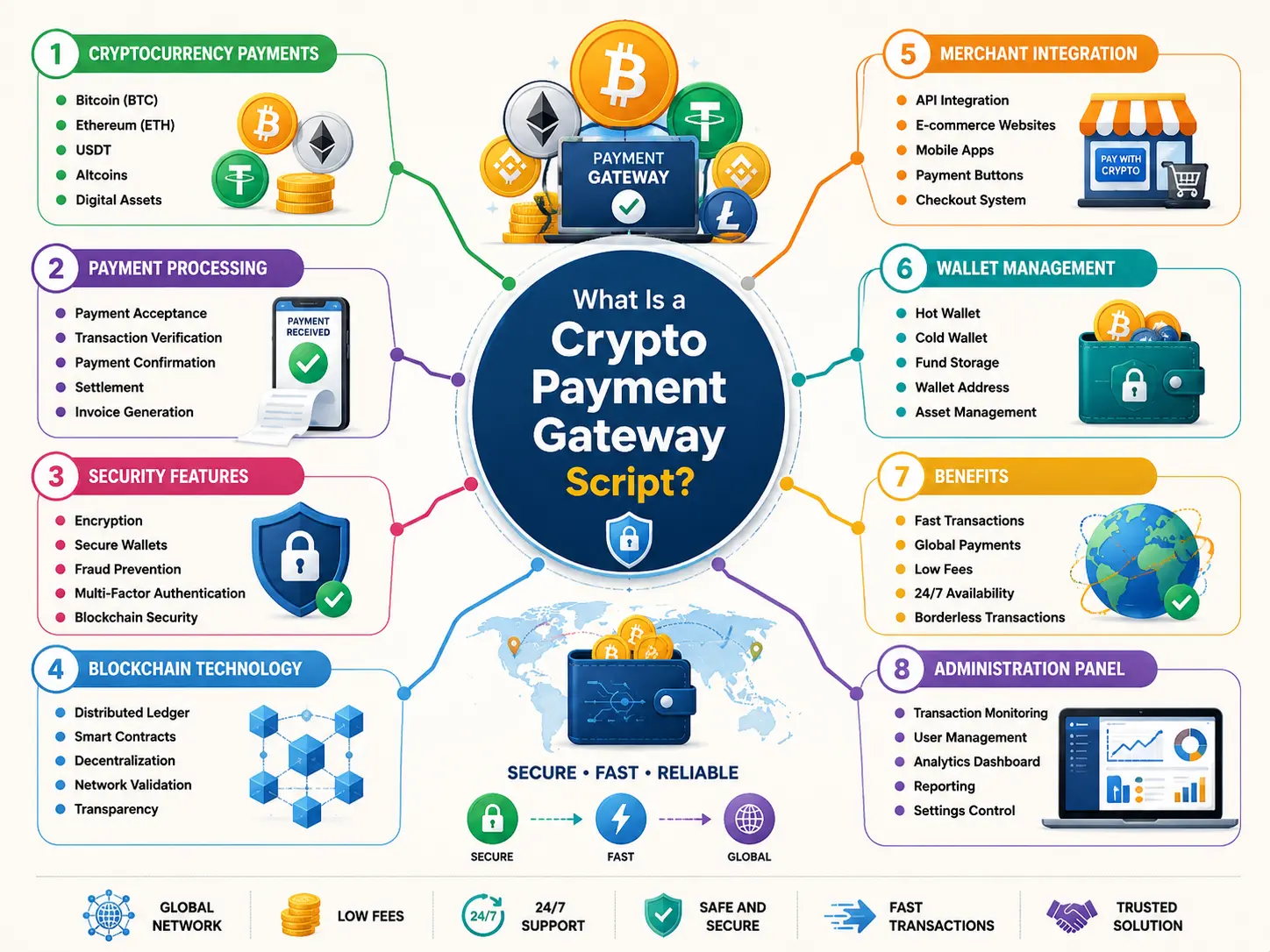
A crypto payment gateway script is a self-hosted or white-label software application that enables businesses to receive cryptocurrency payments from customers, automatically verify transactions on the blockchain, and settle funds to a designated wallet—all without relying on a centralized payment processor.
Think of it as the crypto equivalent of a Stripe or PayPal integration, except you own the infrastructure, the keys, and the transaction data. No middleman. No percentage-based fees eating into your margins. No sudden account suspensions.
 Who Uses Crypto Payment Gateway Scripts?
 Who Uses Crypto Payment Gateway Scripts?
- E-commerce stores targeting global, unbanked, or privacy-conscious customers
- Gaming and NFT platforms requiring microtransactions at scale
- SaaS companies selling internationally and avoiding currency conversion costs
- Freelance platforms and digital marketplaces enabling peer-to-peer settlements
- Financial service startups building crypto-native checkout experiences
The core value proposition is ownership. When you deploy your own crypto payment gateway script, you control the wallet logic, the UI, the supported coins, and the fee structure. That is something no third-party gateway can offer.
How a Crypto Payment Gateway Script Works
Understanding the mechanics helps you evaluate any script intelligently. Here is the step-by-step payment flow:
Customer selects crypto at checkout: The script presents a dynamic payment widget showing accepted cryptocurrencies and the real-time equivalent amount.
Unique wallet address is generated:The script generates a fresh HD wallet address per transaction—preventing address reuse and protecting privacy.
Customer sends crypto to the address: A QR code and countdown timer (usually 15–30 minutes) guide the customer through the payment.
Script monitors the blockchain: Via full node or third-party API (e.g., BlockCypher, Infura), the script watches for an incoming transaction.
Confirmation threshold is met:Configurable confirmations (e.g., 3 for Bitcoin, 12 for Ethereum) trigger payment completion.
Webhook fires & order is fulfilled: Your backend receives an HTTPS webhook with transaction data, updates the order status, and releases the product or service.
|
Key Features to Look for in a Crypto Payment Gateway Script
Not all scripts are created equal. Here is what separates production-grade solutions from hobby projects:
Non-Negotiable Core Features
- Multi-coin support – Bitcoin (BTC), Ethereum (ETH), USDT (TRC-20/ERC-20), BNB, LTC, XRP at minimum
- HD wallet generation – unique address per transaction, never reuse addresses
- Configurable confirmation thresholds – adjust per coin based on risk tolerance
- Real-time exchange rate API – auto-convert fiat prices to crypto at checkout
- Webhook/callback system – instant notification to your backend on payment events
- Admin dashboard – transaction history, settlement reports, coin management
- Under-payment & over-payment handling – partial pay detection and configurable tolerance
- QR code generation – for mobile wallet compatibility
Advanced Features Worth Prioritizing
- Automatic forwarding to cold wallet – sweep hot wallet funds to cold storage periodically
- KYC/AML hooks – optional identity verification for regulated industries
- Multi-merchant support – run a marketplace where multiple vendors each have segregated wallets
- Refund management – on-chain refund workflow with audit trail
- White-label branding – full UI customization, no third-party logos
- REST API + SDKs – PHP, Node.js, Python libraries for rapid integration
Types of Crypto Payment Gateway Scripts
|
Script Type |
Key Characteristics |
|
Self-Hosted Script |
You own the server, keys, and data. Maximum control and privacy. Requires technical setup. |
|
White-Label SaaS Script |
Cloud-hosted solution with your branding. Faster to deploy, slight dependency on the provider. |
|
Open-Source Script |
Community-maintained, free base code. Needs internal expertise to audit and secure. |
|
Custom-Built Script |
Built to spec by a development team (like DigiTechzo). Full feature ownership, timeline varies. |
For most businesses—especially those processing more than $50K/month in crypto—a self-hosted or custom-built script delivers the best long-term ROI. The upfront cost is offset within months by the elimination of per-transaction gateway fees.
Top Supported Cryptocurrencies
A production-ready crypto payment gateway script should support, at minimum:
|
Cryptocurrency |
Why It Matters for Merchants |
|
Bitcoin (BTC) |
Highest trust, longest track record. Slower confirmations. |
|
Ethereum (ETH) |
Smart contract ecosystem. ERC-20 tokens piggyback on this. |
|
USDT (TRC-20 / ERC-20) |
Stablecoin. Eliminates volatility risk for merchants. |
|
BNB (BEP-20) |
Low fees, high speed on BSC network. |
|
Litecoin (LTC) |
Faster than BTC, popular for mid-size transactions. |
|
XRP (Ripple) |
Cross-border settlement, fast finality. |
|
USDC |
Regulated stablecoin. Growing enterprise adoption. |
|
Crypto Payment Gateway Script vs. Third-Party Providers
This is the question every business eventually faces. Here is the honest breakdown:
|
Factor |
Own Script |
Third-Party (e.g., Coinbase Commerce) |
|
Transaction Fees |
0% (you keep 100%) |
0.5%–2% per transaction |
|
Setup Cost |
One-time script purchase + hosting |
Free to start, fees scale with volume |
|
Data Ownership |
100% yours |
Stored on provider’s servers |
|
Customization |
Full control |
Limited to what the API exposes |
|
Account Risk |
None |
Account can be frozen or suspended |
|
Compliance Burden |
On your team |
Provider handles most of it |
|
Time to Launch |
1–5 days (script) |
Hours (API keys) |
|
Best For |
Growing businesses, high volume |
Startups, low-volume, quick test |
The math is simple: if you process $100,000/month in crypto and a provider charges 1%, you are paying $1,000/month—$12,000/year—for a service you could own outright. Most quality crypto payment gateway scripts pay for themselves within 60–90 days for mid-volume merchants.
Security Architecture: What ‘Secure’ Really Means
Security is the word every crypto script vendor throws around. Here is what it should actually mean in practice:
Wallet Key Management
- Private keys must NEVER be stored on the web server. Use HSM (Hardware Security Module) or air-gapped cold storage for master keys.
- The script should only store public extended keys (xPub) on the server to derive receiving addresses.
- Sweeping funds from hot wallets to cold storage should be automated and time-based.
Transaction Verification
- Always verify transaction confirmation counts on-chain—never trust payment status from the payer side alone.
- Implement double-spend protection by checking transaction propagation before marking orders complete.
- Use multiple blockchain API sources as redundancy (e.g., primary: full node, fallback: Infura/Alchemy).
Application Security
- HTTPS-only communication with TLS 1.3
- HMAC-signed webhooks to prevent spoofed payment notifications
- Rate limiting on the payment API to prevent enumeration attacks
- IP whitelisting for admin dashboard access
- Audit logs for every admin action and transaction state change
|
Common Mistakes Businesses Make
Having worked with dozens of businesses deploying crypto payment infrastructure, these are the mistakes we see repeatedly:
Mistake 1: Reusing Wallet Addresses
Generating one static address for all payments is the fastest way to create privacy vulnerabilities and accounting nightmares. Always use HD wallets with per-transaction addresses.
Mistake 2: Too Few Blockchain Confirmations
Setting 0-confirmation payments (mempool-only) exposes you to double-spend attacks. For Bitcoin, 3 confirmations is the minimum for transactions under $1,000. For larger sums, use 6.
Mistake 3: Ignoring Exchange Rate Volatility Windows
If you lock the crypto amount at checkout and give customers 30 minutes to pay, a 3% BTC price swing in that window means you receive less fiat-equivalent than expected. Use a short window (10–15 minutes) or a volatility buffer in your exchange rate logic.
Mistake 4: No Refund Workflow
On-chain refunds require the customer’s wallet address—something you need to collect at the time of payment. Most scripts skip this. It creates a terrible experience when refunds are needed and may create regulatory issues in some jurisdictions.
Mistake 5: Treating Testnet Testing as Sufficient
Testnet behavior doesn’t always mirror mainnet, particularly around fee estimation and confirmation times. Always run a limited-value mainnet pilot before full launch.
Expert Tips for a Smooth Launch
-
Start with USDT on TRC-20 – It is the fastest to integrate, has near-zero fees, and eliminates volatility risk. Expand to BTC and ETH after stabilizing.
-
Run a closed beta – Invite 50–100 trusted customers to test payments before opening to the public. Real-world edge cases (wrong amount sent, partial payments, network congestion) will appear within the first 100 transactions.
-
Automate your reconciliation – Export transaction logs daily. Match every blockchain transaction ID to an internal order ID. Do not rely on manual spot-checks.
-
Set up redundant monitoring – Use a blockchain explorer API as your primary confirmation source and a full node as backup. If one goes down during a traffic spike, your payment flow must not break.
-
Document your cold wallet sweep schedule – Establish a written policy: e.g., ‘hot wallet balances above 0.5 BTC are swept to cold storage every 24 hours.’ Treat this like a financial SOP.
-
Get legal clarity in your jurisdiction – Crypto payment acceptance has varying tax and reporting implications. In many countries, receiving crypto for goods is a taxable event at the market value on the date of receipt. Consult a crypto-aware accountant before launch.
Frequently Asked Questions
Q: What is a crypto payment gateway script?
A: A crypto payment gateway script is a self-hosted software application that enables businesses to accept cryptocurrency payments directly from customers. It handles wallet address generation, blockchain transaction monitoring, confirmation verification, and webhook notifications to your backend—without requiring a third-party payment processor.
Q: How is a crypto payment gateway script different from using Coinbase Commerce or BitPay?
A: Third-party providers like Coinbase Commerce or BitPay hold your funds in their custody and charge per-transaction fees (typically 0.5%–2%). A self-hosted crypto payment gateway script eliminates those fees, gives you full custody of your crypto assets, and lets you customize every aspect of the payment flow. For businesses processing high volumes, owning the script delivers significantly better margins.
Q: What cryptocurrencies can a crypto payment gateway script support?
A: Most production-grade scripts support Bitcoin (BTC), Ethereum (ETH), USDT (TRC-20 and ERC-20), BNB (BEP-20), Litecoin (LTC), XRP, and USDC. The exact list depends on the script’s blockchain node integrations. High-quality scripts are modular—you can add new coins by integrating additional node connections.
Q: Is it safe to accept crypto payments with a self-hosted script?
A: Yes, if security best practices are followed. This means using HD wallets with per-transaction addresses, storing private keys off the server (ideally in cold storage), implementing HMAC-signed webhooks, requiring multiple blockchain confirmations before order fulfillment, and running regular security audits. The biggest risks are at the application layer, not the blockchain layer.
Q: How long does it take to deploy a crypto payment gateway script?
A: A pre-built, well-documented script can be deployed in 1–3 days by an experienced developer. Custom builds with specific feature requirements typically take 2–6 weeks depending on scope. The integration effort on your platform (connecting the webhook to your order management system) often takes longer than the script deployment itself.
Conclusion: Take Control of Your Crypto Payment Infrastructure
The shift toward cryptocurrency payments is not a trend to wait out. Businesses that build the infrastructure now—with solid, secure, and scalable crypto payment gateway scripts—will have a compounding advantage as adoption accelerates.
The choice is not whether to accept crypto. The real decision is whether you want to own that infrastructure or rent it indefinitely from a third party while they hold your funds and extract a percentage of every transaction.
A well-built crypto payment gateway script gives you the best of both worlds: blockchain-native payment acceptance with the control, branding, and economics of owning your own payment stack.
At DigiTechzo, we build and deploy custom crypto payment gateway scripts tailored to your business model—whether you are an e-commerce platform, a gaming company, or a B2B SaaS operation. Our scripts are production-tested, security-audited, and designed to scale.
About The Author