
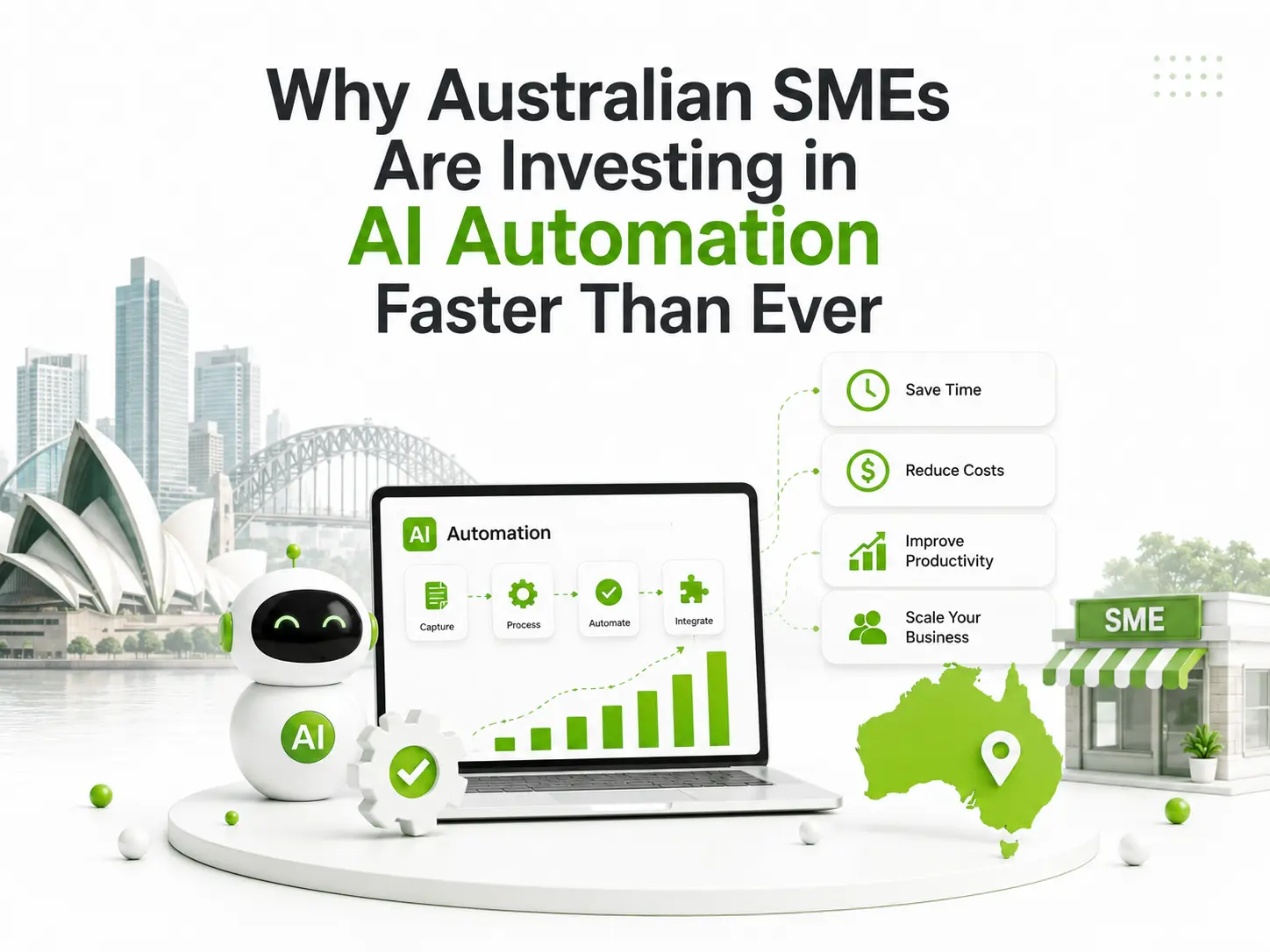
Why Australian SMEs Are Investing in AI Automation Faster Than Ever
|
The last two years have rewritten the rules of business efficiency in Australia. AI automation — once the exclusive domain of enterprise giants like Telstra and Commonwealth Bank — has crossed the threshold into mainstream SME territory. The tools are cheaper, smarter, and more accessible than ever. And Australian business owners are taking notice.
At digiTechzo, we work directly with Australian SMEs across retail, professional services, logistics, and healthcare to implement practical AI automation systems. What we’re seeing on the ground tells a clearer story than any government report: business owners who once said ‘we’ll wait and see’ are now asking ‘how fast can we start?’
This guide breaks down exactly why AI automation Australia adoption is accelerating, which sectors are leading, what the real-world benefits look like, and how your business can avoid the common pitfalls that trip up early adopters.
|
The Australian SME Landscape: Why Now?
Australia has approximately 2.5 million small and medium-sized businesses. They employ nearly 7.4 million people and contribute almost 57% of total industry value added to the economy. Yet for decades, SMEs operated with one persistent disadvantage: they couldn’t afford the technology infrastructure that large enterprises used to scale.
That changed around 2022–2023. The convergence of three major forces created a perfect storm:
- Labour costs surged — Australia’s wage price index hit multi-decade highs, squeezing margins.
- AI tools became subscription-based — No more six-figure implementation budgets. Monthly SaaS pricing put powerful tools within reach.
- The skills shortage deepened — Finding and retaining staff became harder. Automation stopped being optional.
The result? AI automation adoption among Australian SMEs has jumped significantly, with SME technology spending on AI and automation tools increasing across virtually every sector. The question is no longer whether to automate — it’s where to start.
What is AI Automation? (Plain English for SME Owners)
AI automation is the use of artificial intelligence to perform business tasks that previously required human input — repeatedly, consistently, and at scale.
It is NOT replacing your entire team with robots. It IS eliminating the repetitive, low-value work that drains your team’s time and energy.
|
Traditional Automation |
AI Automation |
|
Follows fixed rules (if X then Y) |
Learns patterns and adapts over time |
|
Breaks when inputs change |
Handles variation and ambiguity |
|
Example: auto-send invoice after payment |
Example: draft invoice AND predict late payers |
|
Limited to structured data |
Works with emails, documents, voice, images |
For an Australian SME, AI automation typically looks like: a customer inquiry chatbot that escalates real problems to staff, automated bookkeeping that flags anomalies, or a marketing system that drafts and schedules social content based on your calendar.
Top 5 Reasons SMEs Are Accelerating AI Automation in Australia
Reason 1: Labour Costs Are Unsustainable
The Fair Work Commission’s annual wage increases — combined with superannuation rate rises now at 11.5% — mean that Australian businesses pay among the highest employment costs per worker in the Asia-Pacific region. For a 10-person SME, the difference between a manual and automated workflow can equate to one full-time salary annually.
AI automation doesn’t call in sick. It doesn’t take leave. And it doesn’t need a laptop upgrade.
Reason 2: Affordable, No-Code AI Tools Now Exist
The arrival of platforms like Zapier AI, Make.com, Microsoft Copilot, and industry-specific tools means that an SME owner with zero coding knowledge can connect their CRM, accounting system, and email marketing platform in an afternoon. The average monthly cost for a functional automation stack is now under $500 — a fraction of what it cost 5 years ago.
Reason 3: Customer Expectations Have Shifted
Post-pandemic Australian consumers expect fast, personalised responses. A 2024 Salesforce survey found that 73% of Australian customers say one extraordinary experience raises their expectations of all other companies. SMEs that can’t respond to enquiries within hours are losing to those that can — and AI automation is how you compete at speed without adding headcount.
Reason 4: Government Incentives and Digital Adoption Programs
The Australian Government’s Small Business Digital Champions program and various state-level digital transformation grants have provided financial incentives for SMEs to adopt technology. The ATO’s own push toward Single Touch Payroll and electronic invoicing has also created a compliance-driven nudge toward digital systems — which naturally integrates with AI automation tools.
Reason 5: Competitive Pressure From Early Adopters
In almost every industry sector, there are now Australian SMEs who implemented AI automation 18–24 months ago. They’ve reduced their cost-per-acquisition, improved customer response times, and freed their teams for higher-value work. Their competitors are watching — and reacting. This competitive pressure is accelerating adoption even among traditionally cautious business owners.
Which Industries Are Leading AI Automation Adoption in Australia?
AI automation is not a one-size-fits-all solution, but certain sectors have emerged as clear early adopters:
|
Industry |
Key AI Use Cases |
Typical Efficiency Gain |
|
Professional Services (Accounting, Legal) |
Document review, contract drafting, client intake forms |
25–35% |
|
Retail & eCommerce |
Inventory forecasting, customer service bots, personalised email |
20–40% |
|
Logistics & Transport |
Route optimisation, delivery notifications, freight quoting |
30–45% |
|
Healthcare & Allied Health |
Appointment scheduling, patient reminders, billing |
20–30% |
|
Construction & Trades |
Quote generation, compliance document management, scheduling |
15–25% |
|
Hospitality |
Reservation management, menu pricing, staff rostering |
20–30% |
Professional services firms — particularly bookkeeping and accounting practices — have led the charge, largely because the repetitive, data-heavy nature of their work makes it ideal for automation. But hospitality and trades businesses are catching up fast, driven by chronic staffing shortages.
Real-World Examples: AI Automation in Australian SMEs
Case Study: A Sydney-Based Bookkeeping Firm
A 6-person bookkeeping practice in Sydney implemented an AI document processing tool to handle receipt scanning, categorisation, and bank reconciliation for their 80+ clients. Before automation, their team spent approximately 3 hours per client per month on manual data entry. After implementation, this dropped to under 30 minutes.
The result: the firm took on 40% more clients with the same team size, increasing revenue without a single new hire.
Case Study: Brisbane eCommerce Retailer
A Brisbane-based fashion retailer with an online store of approximately 3,000 SKUs deployed AI-driven inventory forecasting and automated email marketing. The system analysed buying patterns, seasonal trends, and browse behaviour to send personalised product recommendations.
Within 6 months: cart abandonment emails drove a 22% recovery rate (industry average is 8–15%), and overstock situations reduced by 34% due to smarter purchasing decisions.
Case Study: Melbourne Allied Health Practice
A physiotherapy clinic with 4 practitioners implemented an AI scheduling assistant and automated appointment reminder system. Previously, their admin staff spent 2 hours daily on phone calls for bookings and reminders. Post-automation, no-show rates dropped from 14% to 6%, and admin time fell by 70%.
Pros and Cons of AI Automation for Australian SMEs
Pros
- Significant labour cost reduction — automate repetitive tasks without headcount increases
- 24/7 operation — customer enquiries, order processing, and data tasks run outside business hours
- Scalability — handle 10x the volume with the same team once systems are in place
- Consistency — no human error in data entry, invoicing, or compliance document generation
- Data-driven decisions — AI surfaces patterns your team doesn’t have time to find
- Competitive advantage — speed of response and personalisation at scale
Cons
- Upfront time investment — setup and testing requires genuine commitment, often 4–12 weeks for meaningful results
- Change management — teams resist automation when they fear job replacement; requires communication
- Integration complexity — older systems (legacy POS, outdated accounting software) may not integrate cleanly
- Ongoing oversight — AI systems need human review, especially in early stages
- Risk of over-automation — automating customer-facing interactions poorly damages trust and reputation
How to Get Started: A Practical Framework
Most SMEs that fail with AI automation make the same mistake: they start with the technology and work backward. The businesses that succeed start with the problem.
The digitechzo 4-Step AI Automation Framework
- Audit your time leaks — Identify the top 3 tasks your team repeats most often. These are your first automation candidates.
- Map the process end-to-end — Document every step, decision point, and tool involved. Automation needs a clear map before it can follow the route.
- Start with one workflow — Resist the urge to automate everything at once. Win quickly with a single, high-impact process. Build confidence before expanding.
- Measure and iterate — Define your success metric (time saved, error rate, customer response time) before you start, then track it religiously for 60 days.
|
Common Mistakes SMEs Make with AI Automation
Mistake 1: Automating a Broken Process
AI automation amplifies what’s already there. If your quoting process is chaotic, automating it creates faster chaos. Fix the process first, then automate it.
Mistake 2: Choosing Tools Before Defining Problems
Many SME owners buy a shiny automation tool because they heard about it at a conference, then search for a use case. This almost always fails. Define the problem, then find the tool that solves it.
Mistake 3: Ignoring Staff Buy-In
Teams that feel threatened by automation will actively or passively resist it. The SMEs that succeed make automation a team initiative — framing it as ‘freeing you from the boring stuff’ rather than ‘replacing you.’
Mistake 4: Setting and Forgetting
AI systems — especially those dealing with customer communications — need regular review. Language models drift, edge cases emerge, and business rules change. Schedule a monthly automation audit from day one.
Mistake 5: Underestimating Integration Time
Connecting your CRM to your accounting system to your email platform sounds simple but often surfaces compatibility issues, data format mismatches, and permission problems. Always budget 2x your estimated integration time.
Expert Tips from the Field
After implementing AI automation for dozens of Australian SMEs, here’s what separates the businesses that see transformative results from those that abandon the effort:
- Tip 1: Start with internal processes, not customer-facing ones. Automate your operations before you automate your conversations. A bad customer experience from a glitchy chatbot costs more than it saves.
- Tip 2: Your data quality determines your AI quality. If your CRM has inconsistent contact records and your spreadsheets have merged cells and manual overrides, your automation will fail. Clean data first.
- Tip 3: Hire a local implementation partner for complex builds. Tools like Zapier and Make.com have thousands of freelancers globally, but Australian-based partners understand GST, local compliance requirements, and AEST business hours.
- Tip 4: Run a pilot with real data, not test data. Test environments hide the messy reality of your actual business. Pilot your automation on a real subset of transactions or clients.
- Tip 5: Track time saved as a primary metric. Revenue impact takes months to surface. Time saved per week is visible immediately and keeps your team motivated to refine and expand.
Frequently Asked Questions (FAQs)
What is AI automation and how does it work for Australian SMEs?
AI automation uses artificial intelligence to perform repetitive business tasks — such as data entry, customer communications, scheduling, and reporting — without human intervention. For Australian SMEs, it typically involves connecting existing software tools (like Xero, HubSpot, or Shopify) through platforms such as Zapier or Make.com, combined with AI models that can read, write, and make decisions based on your business rules.
How much does AI automation cost for a small business in Australia?
Costs vary significantly based on complexity. A basic automation stack (using tools like Zapier, ChatGPT API, and a chatbot platform) typically ranges from $200–$800 per month in software subscriptions. Custom builds involving developer time or specialist partners range from $5,000–$30,000+ for initial setup. Most SMEs achieve positive ROI within 3–6 months.
Which Australian industries benefit most from AI automation?
Professional services (accounting, legal, consulting), retail and eCommerce, logistics and transport, healthcare, and construction have seen the highest adoption and strongest results. However, virtually any industry with repetitive, rule-based processes — from hospitality to real estate — can achieve meaningful efficiency gains.
Is AI automation safe for handling sensitive customer data in Australia?
Data privacy is a genuine concern and must be addressed properly. Any AI automation solution handling personal information must comply with the Australian Privacy Act 1988 and the Australian Privacy Principles (APPs). Ensure your automation vendor stores data within Australian or approved jurisdictions, uses encrypted connections, and provides clear data processing agreements.
How long does it take to implement AI automation in an SME?
A single, well-defined automation workflow (for example, automating your customer inquiry response process) can be set up and tested in 2–4 weeks. More complex, multi-system implementations typically take 2–4 months. Full business transformation — automating 5–10 core workflows — is realistically a 6–12 month journey.
Conclusion: The Window to Move First is Open — But Not Forever
The acceleration of AI automation adoption among Australian SMEs isn’t a trend — it’s a structural shift in how competitive businesses operate. Labour costs are not going down. Customer expectations are not going backward. And the gap between businesses that have automated their operations and those that haven’t is widening every quarter.
The good news: the tools are mature, the costs are accessible, and the path is well-worn by thousands of Australian businesses that have gone before you. The risk is no longer in adopting AI automation. The risk is in waiting.
Whether you’re a sole trader in Perth trying to reclaim your weekends, or a 50-person logistics firm in Melbourne trying to scale without doubling headcount — AI automation offers a concrete, measurable path forward.
About The Author