
Polymarket Clone Script – Develop a Decentralized Prediction Market
Polymarket turned the ancient idea of betting on outcomes into a sophisticated, blockchain-powered platform that handled over $8 billion in trading volume during the 2024 US election cycle alone. It proved something the prediction market space had been trying to demonstrate for a decade: when you combine real-money stakes, transparent smart contracts, and genuinely useful market data, people show up at scale. The platform didn’t just attract gamblers; it attracted institutional analysts, political researchers, and media outlets treating its prices as leading indicators.
That success has created a clear commercial opportunity. A Polymarket clone script gives entrepreneurs, Web3 startups, and established businesses a faster, cheaper path to launching their own decentralized prediction market platform — with the same core architecture and UX patterns that drove Polymarket’s adoption, but customised for a specific niche, jurisdiction, or audience. Whether the goal is a sports prediction market, an election-focused political prediction platform, a crypto event market, or a corporate forecasting tool, a Polymarket clone script is the starting point that avoids rebuilding the foundational blockchain architecture from scratch.
At Digitechzo, we build Polymarket clone scripts and custom prediction market platforms for clients who understand the opportunity in this space. This guide covers exactly what a Polymarket clone script includes, the technical architecture behind it, what customisation looks like in practice, what it costs to build or buy, the regulatory considerations that most guides skip, and how to choose the right development approach for your specific market.
Quick Answer
“A Polymarket clone script is a pre-built, customisable software solution that replicates the core functionality of Polymarket — on-chain prediction markets, automated market makers (AMM), smart contract settlement, and a user-facing trading interface — allowing entrepreneurs to launch their own decentralized prediction market platform faster and at lower cost than building from scratch. Development of a full-featured Polymarket clone script with custom branding and blockchain integration typically takes 10–20 weeks and costs $30,000–$120,000 depending on scope.”
What Is a Polymarket Clone Script?
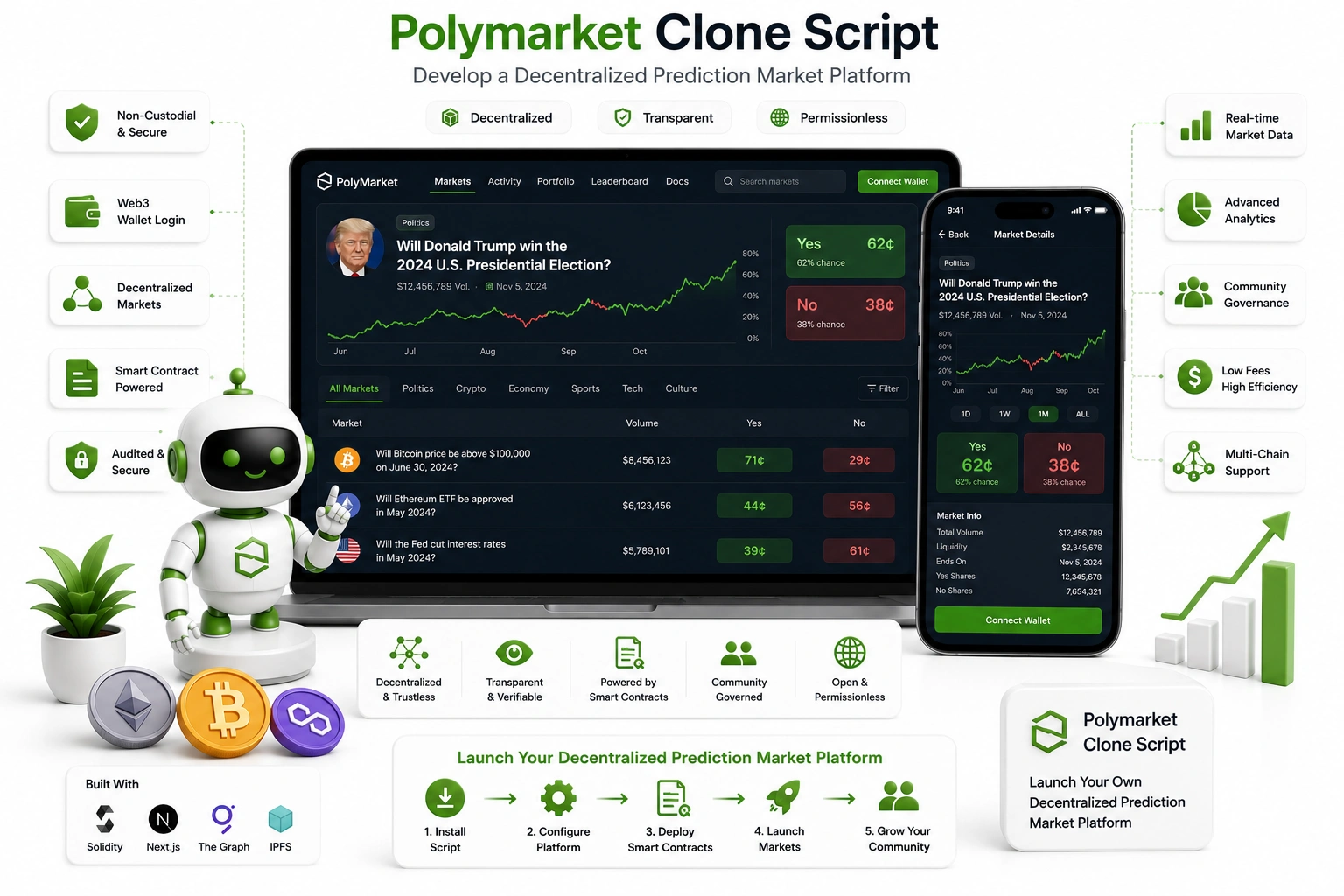
A Polymarket clone script is a complete, ready-to-deploy (or ready-to-customise) software package that replicates the core mechanics, user interface, and blockchain infrastructure of the Polymarket platform. Rather than building a prediction market from the ground up — which requires deep expertise in smart contract development, AMM design, oracle integration, and frontend development — a Polymarket clone script provides the foundational architecture that can be branded, configured, and extended for a specific use case.
What Is Included in a Polymarket Clone Script?
- Smart contracts (core logic) — the on-chain contracts that govern market creation, share trading, and outcome settlement, typically built on EVM-compatible chains (Polygon, Ethereum mainnet, Base, or Arbitrum).
- Automated Market Maker (AMM) engine — the pricing mechanism (usually a Constant Function Market Maker or LMSR variant) that determines share prices based on current liquidity and trading activity.
- Oracle integration — the connection to trusted data sources (Chainlink, UMA, or custom oracle setups) that resolve market outcomes based on real-world events.
- Frontend trading interface — the web application where users browse markets, buy and sell outcome shares, track positions, and view market statistics.
- Wallet integration — support for MetaMask, WalletConnect, and/or embedded wallet solutions (Privy, Magic.link) that allow users to connect and transact.
- Admin panel — tools for the operator to create and manage markets, configure resolution criteria, pause or close markets, and review platform activity.
- Liquidity management — initial liquidity seeding mechanisms and liquidity provider reward structures that incentivise market depth.
- Analytics dashboard — market volume, price history, trader activity, and platform-level statistics.
How Polymarket Works: The Architecture a Clone Script Must Replicate
Understanding the technical architecture of Polymarket is essential to evaluating any Polymarket clone script — because the quality of the clone depends directly on how faithfully and how elegantly it implements these underlying mechanics.
Conditional Tokens and Binary Outcome Markets
Polymarket’s core innovation is built on conditional tokens — a standard that represents positions in a market as fungible ERC-1155 tokens. For any binary prediction market (Will X happen? Yes or No), two outcome tokens are created. Trading activity determines the price of each token, which represents the implied probability of that outcome. A token priced at $0.70 implies a 70% probability of the YES outcome. At resolution, holders of the correct outcome token redeem each token for $1 USDC; holders of the incorrect token receive nothing.
The Automated Market Maker Mechanism
Polymarket uses a Constant Function Market Maker model to provide continuous liquidity. Unlike an order book model (which requires matching buyers and sellers), a CFMM allows anyone to trade against the liquidity pool at a price algorithmically determined by the current token distribution. This is what makes Polymarket accessible without requiring deep pre-existing liquidity — traders can enter and exit positions even on low-volume markets. A quality Polymarket clone script must implement this mechanism correctly, as pricing errors in the AMM create exploitable arbitrage opportunities.
Oracle Resolution
Market resolution — determining which outcome is correct after the event — is the most sensitive component of any prediction market. Polymarket uses UMA’s Optimistic Oracle, which allows anyone to propose a resolution, then enter a dispute period during which other participants can challenge the proposed outcome. In the absence of a dispute, the resolution is accepted. This decentralised dispute resolution mechanism is what prevents a single point of failure or manipulation in the settlement process. A Polymarket clone script must implement a comparable oracle or resolution mechanism to be trustworthy.
Polygon as the Settlement Layer
Polymarket operates on Polygon (now rebranding to AggLayer), an EVM-compatible Layer 2 network that provides fast, low-cost transactions. This is why trading on Polymarket carries negligible gas costs — critical for a user experience that needs to feel frictionless. A Polymarket clone script can be deployed on Polygon, Base, Arbitrum, or another EVM L2 depending on the operator’s priorities around cost, ecosystem, and liquidity access.
Key Features to Look For in a Polymarket Clone Script
Not every Polymarket clone script on the market is built to the same standard. Here’s the feature set that separates a production-ready Polymarket clone script from a demo-quality one that won’t survive real users.
| Feature | Why It Matters | Red Flag if Missing |
| Audited smart contracts | Unaudited contracts are an existential risk — a single vulnerability can drain all platform liquidity | Any script without a credible third-party audit is not production-ready |
| Correct AMM implementation | Pricing errors create arbitrage that drains liquidity and destroys market integrity | AMM logic should be verifiable on-chain; request the contract source |
| Oracle/resolution mechanism | Biased or centralised resolution destroys trust and platform reputation instantly | Centralised admin-only resolution is a critical governance weakness |
| USDC collateral | Stablecoin collateral removes price volatility from the market mechanism itself | ETH-collateralised markets create compounding risk for users |
| Wallet abstraction / onboarding | Requiring MetaMask is a friction point that eliminates non-crypto-native users | No embedded wallet support significantly limits addressable audience |
| Mobile-responsive UI | Mobile accounts for the majority of web traffic | Desktop-only UI severely limits growth |
| Gas optimised contracts | High gas costs make small-stake trading uneconomical | Unoptimised contracts on L2 still create poor UX at scale |
| Admin market creation tools | The ability to launch, manage, and resolve markets efficiently determines operational scalability | Manual smart contract calls for market creation is not scalable |
Polymarket Clone Script Use Cases: What You Can Build
The Polymarket clone script architecture is versatile enough to serve a range of distinct market categories, each with its own user base, liquidity dynamics, and regulatory profile.
Political and Election Prediction Markets
The use case that drove Polymarket’s mainstream media breakthrough. Election prediction markets aggregate public probability assessments in real time, often outperforming traditional polls in accuracy. A Polymarket clone script targeting political markets benefits from strong organic media interest around election cycles, though it also carries the most complex regulatory exposure in many jurisdictions.
Sports Prediction Markets
Sports events provide high-frequency, objectively resolvable outcomes with massive existing audience interest. A sports-focused Polymarket clone script can target match outcomes, player performance, tournament winners, and in-game events. Sports prediction markets benefit from clear existing user demand and well-established data sources for oracle resolution.
Crypto and DeFi Event Markets
Markets predicting cryptocurrency prices, protocol governance outcomes, token launch valuations, and DeFi metric milestones. This use case is highly aligned with the crypto-native user base most comfortable with on-chain trading, and benefits from rapid event cycles that keep the market active.
Science and Research Prediction Markets
A less commercially obvious but growing use case: markets on scientific replication outcomes, drug trial results, climate benchmarks, and technology milestones. These markets serve a research and forecasting function rather than a pure speculative one, appealing to institutional and academic audiences.
Corporate and Enterprise Forecasting
Private, permissioned prediction markets used internally by companies to aggregate employee knowledge about business outcomes — product launch timelines, sales targets, market share projections. A Polymarket clone script can be deployed in a private, non-public configuration for enterprise clients who want prediction market accuracy without public exposure.
Polymarket Clone Script: Build From Scratch vs Buy Pre-Built vs Hire a Development Partner
There are three realistic paths to launching a prediction market platform using Polymarket clone script architecture. Each has distinct trade-offs that depend on your technical capability, budget, speed requirements, and customisation needs.
| Approach | Cost Range | Timeline | Best For | Key Limitation |
| Pre-built Polymarket clone script (vendor) | $5,000 – $25,000 | 2–6 weeks | Fast launch, low budget, standard feature set | Limited customisation; unaudited contracts common |
| Custom development partner | $30,000 – $120,000 | 10–20 weeks | Unique features, audited contracts, serious launch | Higher upfront cost; requires careful partner selection |
| Build in-house from scratch | $150,000 – $500,000+ | 6–18 months | Full IP control, enterprise-grade requirements | Extremely high cost; deep Web3 expertise required |
Why Most Serious Founders Choose a Development Partner Over a Pre-Built Script
The cheapest Polymarket clone script products on the market are almost never production-ready. They typically lack third-party smart contract audits (a critical security gap that can result in total fund loss), use AMM implementations that haven’t been stress-tested, have no oracle integration, and provide no regulatory guidance. For a platform handling real user funds, an unaudited Polymarket clone script is a liability, not an asset. Experienced development partners provide smart contract audits, proper oracle integration, and the kind of production-grade build that survives real users and real money.
Technical Stack for a Polymarket Clone Script: What We Build At Digitechzo
Blockchain Layer
- Primary deployment: Polygon PoS or Base (Coinbase’s L2) for low gas costs and EVM compatibility.
- Smart contract language: Solidity with OpenZeppelin libraries for standards-compliant, battle-tested implementations.
- Standards: ERC-1155 conditional tokens for outcome share representation; ERC-20 USDC for collateral.
- Audit requirement: every production Polymarket clone script we build is submitted to a credible audit firm (Certik, Trail of Bits, PeckShield, or equivalent) before mainnet deployment.
AMM and Pricing Engine
- Model: Constant Product Market Maker (CPMM) or Logarithmic Market Scoring Rule (LMSR) depending on the target market depth and liquidity requirements.
- Liquidity provision: automated initial liquidity seeding by the platform operator, with optional LP incentive mechanisms for community liquidity.
Oracle and Resolution Layer
- Decentralised resolution: UMA Optimistic Oracle integration for public, dispute-capable resolution.
- Centralised resolution option: admin-controlled resolution with multi-sig governance for private or enterprise deployments where speed is prioritised over decentralisation.
- Custom oracle support: Chainlink feeds for price-based markets (crypto markets, financial instrument markets).
Frontend and User Layer
- Framework: js with TypeScript for performance and SEO-friendliness.
- Wallet integration: MetaMask, WalletConnect, Privy (embedded wallet for non-crypto-native users), and/or Magic.link.
- Data layer: The Graph Protocol for efficient on-chain data indexing and query performance.
- Design: Custom UI/UX designed around the specific target audience rather than a generic crypto-platform aesthetic.
Regulatory Considerations Every Polymarket Clone Script Buyer Must Understand
This is the section most Polymarket clone script providers either skip entirely or dismiss with a vague “consult a lawyer” footnote. Prediction markets that involve real-money stakes sit at the intersection of securities law, gambling regulation, and financial services licensing — and the regulatory landscape varies dramatically by jurisdiction.
The US Regulatory Picture
Polymarket itself is geofenced for US users following a 2022 CFTC settlement in which the company paid a $1.4 million penalty for operating an unregistered event-based binary options platform. In the US, prediction markets that involve real-money event contracts potentially fall under CFTC jurisdiction as commodity or swap contracts. CFTC-regulated prediction markets (like Kalshi, which received a legal pathway in 2023) operate under a designated contract market licence. Anyone building a Polymarket clone script targeting US users without similar regulatory clarity carries significant legal risk.
Non-US Jurisdictions With Clearer Pathways
- Gibraltar and the Isle of Man have established crypto-friendly licensing frameworks that can accommodate prediction markets.
- Malta’s Virtual Financial Assets framework has been used by platforms in adjacent categories.
- Markets operating outside financial instrument classifications — for example, enterprise private forecasting tools with no real-money stakes — carry substantially lower regulatory exposure.
The Key Legal Question to Resolve Before Launching
Before selecting a Polymarket clone script and launching a platform, obtain specific legal advice on: (1) whether the planned market types constitute gambling, securities, or commodity contracts in your target jurisdiction, (2) whether real-money stakes require a gambling, financial services, or commodity trading licence, and (3) which user geographies you can serve legally and how to implement effective geographic restrictions. This advice is not optional — it should precede, not follow, the development investment.
How to Monetise a Polymarket Clone Script Platform
A prediction market platform built on a Polymarket clone script can generate revenue through several distinct mechanisms:
- Protocol fee on trades — a percentage fee (typically 1–2%) on every trade executed through the platform, charged at the smart contract level and credited to the protocol treasury.
- Market creation fee — a fee charged to external parties who submit markets for listing (relevant if the platform allows community-submitted markets).
- Liquidity provider fee share — a portion of trading fees allocated to liquidity providers who seed new markets, creating an incentive that reduces the operator’s own liquidity burden.
- Premium data API — market probability data is commercially valuable to media, analysts, and researchers; a paid API for accessing real-time market data is a natural B2B revenue layer.
- White-label licensing — licensing the platform as a private-label prediction market to corporate clients for internal forecasting use cases.
- Governance token (if applicable) — a protocol governance token whose value reflects platform usage and growth, though token economics require careful legal review in most jurisdictions.
Common Mistakes When Building a Polymarket Clone Script
- Deploying unaudited smart contracts — the most critical and most common mistake. A single vulnerability in unaudited contracts can result in total loss of all user funds and permanent platform reputation damage.
- Using a centralised resolution mechanism — admin-only settlement with no dispute mechanism concentrates trust in a single party, which undermines the decentralisation premise and creates a single point of manipulation.
- Ignoring regulatory exposure before launch — launching a real-money prediction market platform without jurisdiction-specific legal review is not a calculated risk; it is an avoidable risk that has resulted in enforcement actions against platforms in this space.
- Neglecting the onboarding experience — requiring users to have a funded MetaMask wallet before they can interact with the platform eliminates the majority of potential users; embedded wallets and fiat-to-crypto onboarding are essential for meaningful adoption.
- Building without a liquidity strategy — a Polymarket clone script with no initial liquidity produces markets with high slippage that no trader will use; initial liquidity must be planned and funded as part of the launch.
Expert Tips for Launching a Successful Prediction Market With a Polymarket Clone Script
- Start with a single, well-defined market niche — a Polymarket clone script targeted at one specific category (crypto events, sports, elections) with deep liquidity outperforms a general-purpose platform with thin liquidity across hundreds of markets.
- Seed markets with meaningful initial liquidity — a minimum initial liquidity that keeps maximum slippage below 5% for typical trade sizes is essential for a usable early experience; set this number before launch, not after.
- Get the smart contracts audited before mainnet, not after — audit timelines are typically three to six weeks; build this into the project schedule rather than skipping it to hit a launch date.
- Use embedded wallets for non-crypto audiences — if the target audience includes people without existing crypto experience, embedded wallet providers dramatically reduce onboarding abandonment.
- Build in a market moderation process from day one — clearly define who can create markets, what resolution criteria are acceptable, and how disputes are handled before launching publicly; retroactive policy changes create community conflict.
Frequently Asked Questions
What is a Polymarket clone script?
A Polymarket clone script is a pre-built or customisable software solution that replicates the core functionality of the Polymarket prediction market platform — including smart contracts, automated market making, oracle resolution, and a trading interface — allowing entrepreneurs to launch their own decentralized prediction market without building the underlying blockchain infrastructure from scratch.
How much does a Polymarket clone script cost?
Pre-built Polymarket clone script packages from offshore vendors typically cost $5,000–25,000 but frequently lack smart contract audits and production-grade features. A custom-built Polymarket clone script from an experienced Web3 development partner typically costs $30,000–$120,000 and takes 10–20 weeks, depending on feature scope, blockchain choice, and whether a full smart contract audit is included.
Which blockchain should I use for a Polymarket clone script?
Polygon and Base are the most practical choices for a Polymarket clone script in 2026, offering EVM compatibility, low gas costs, established DeFi liquidity, and strong developer ecosystems. Arbitrum is a viable alternative for projects that prioritise the Arbitrum ecosystem. Ethereum mainnet is generally too expensive for per-trade gas costs at the volume prediction markets require.
Is a Polymarket clone script legal?
The legality of operating a prediction market platform depends heavily on jurisdiction, the type of markets offered, and whether real-money stakes are involved. Polymarket itself is geofenced for US users following a CFTC enforcement action. Anyone building a Polymarket clone script targeting real-money markets should obtain jurisdiction-specific legal advice before launch — the regulatory environment is active and enforcement is real.
How long does it take to develop a Polymarket clone script?
A pre-built Polymarket clone script can be deployed in two to six weeks with minimal customisation. A custom-built platform with audited smart contracts, oracle integration, a full trading UI, and an admin panel typically takes 10–20 weeks. Smart contract auditing alone adds three to six weeks and should be planned for from the start of the project rather than scheduled as an afterthought.
Conclusion: A Polymarket Clone Script Is the Fastest Path to a Production Prediction Market — If It’s Built Right
The prediction market category has moved from an academic curiosity to a multi-billion-dollar asset class with mainstream media attention, institutional participation, and demonstrated user demand. A Polymarket clone script gives founders a realistic entry point into that market without the multi-year, multi-million-dollar investment of building the foundational blockchain infrastructure from zero.
The caveat — and it matters — is that the quality gap between a cheap, unaudited Polymarket clone script and a production-ready, audited, legally reviewed platform is enormous. Prediction markets handle real user funds, and corners cut in smart contract security or regulatory compliance don’t stay hidden for long. The right Polymarket clone script, built by a team that understands both the technical and legal dimensions of the space, is the difference between a platform that builds genuine trust and one that makes the wrong kind of headlines.
Digitechzo builds production-grade Polymarket clone script solutions for founders who are serious about launching a prediction market platform — with audited smart contracts, proper oracle integration, and embedded wallet onboarding that makes the platform accessible to non-crypto audiences. Get in touch to discuss your prediction market concept, your target jurisdiction, and what a realistic build scope and budget looks like for your specific use case.
About The Author