
AI Automation for Small Business Australia: The Ultimate 2026 Growth Guide
Most small business owners in Australia aren’t short on hard work — they’re short on hours. Between serving customers, chasing invoices, managing staff, and trying to find time to actually grow the business, the day runs out long before the to-do list does. That’s the real reason AI automation for small business Australia has gone from a niche curiosity to a genuine survival strategy in the space of a few years: it’s the closest thing to hiring extra hands without the extra payroll.
The challenge isn’t whether AI automation works — the evidence on that is now well established. The challenge is knowing where to start, which tools actually suit a 5–50 person business rather than an enterprise budget, and how to avoid the expensive trial-and-error that puts so many owners off automation after one bad experience with the wrong tool.
At Digitechzo, we work specifically with Australian small and mid-sized businesses to map where time is actually being lost — not in theory, but in their real day-to-day operations — before recommending a single piece of software. This guide pulls that experience together into one place: what AI automation for small business actually means in 2026, what it costs, which areas deliver the fastest return, the mistakes that sink most first attempts, and a practical framework for getting started without betting the business on it.
Quick Answer
“AI automation for small business Australia covers tools and systems — chatbots, workflow automation, lead scoring, scheduling, and AI-assisted operations — that handle repetitive tasks without adding headcount. Most Australian SMEs see a measurable return within three to six months when they start with one high-volume process rather than automating everything at once, with typical entry costs ranging from a few hundred dollars a month to a low five-figure upfront investment for a custom build.”
What Does AI Automation for Small Business Actually Mean in 2026?
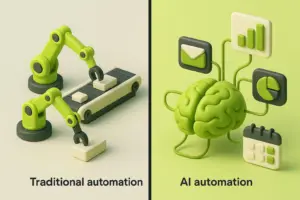
AI automation for small business is the use of artificial intelligence — not just simple rule-based scripts, but systems capable of understanding language, predicting outcomes, and making decisions within defined boundaries — to handle tasks that previously required a person’s direct attention. The distinction matters because “automation” existed long before AI did; what’s changed is that automation can now handle far more open-ended, conversational, and judgement-adjacent work than a basic if-this-then-that script ever could.
Traditional Automation vs AI Automation: What’s the Real Difference?
- Traditional automation — follows fixed rules and breaks the moment a situation falls outside what was explicitly programmed (e.g. a Zapier trigger that only fires on an exact form field match).
- AI automation — uses machine learning or large language models to interpret intent, handle variation, and improve over time as it processes more real data, such as a chatbot understanding a customer’s question however it’s phrased.
In practice, the strongest small business systems combine both: AI handles understanding and decision-making, while traditional rule-based logic provides guardrails around sensitive actions like payments or data changes.
Why 2026 Is a Turning Point for Australian Small Business Automation
Three forces are converging to make this the right time for small businesses specifically, not just large enterprises. First, the cost of AI tools has fallen sharply as competition between providers has intensified, putting capability that used to require an enterprise budget within reach of a five-person business. Second, no-code and low-code platforms mean automation no longer requires an in-house developer to set up or maintain. Third, rising operating costs — wages, commercial rent, and compliance overheads — have made the cost of manual, repetitive work harder to absorb than ever before.
The Australian Bureau of Statistics’ Business Conditions and Sentiments survey has tracked a steady rise in the proportion of small businesses reporting use of AI tools over recent survey periods, reflecting a broader shift from early experimentation toward operational adoption. Separately, global research from McKinsey on generative AI’s impact on knowledge work has consistently found that a substantial share of time spent on administrative, research, and routine communication tasks is technically automatable with current AI capability — work that makes up a disproportionate share of a small business owner’s week.
What This Means for a Typical Small Business Owner
If you’re spending evenings on invoicing, weekends catching up on customer follow-ups, and early mornings checking overnight enquiries, you’re not alone — and increasingly, that pattern isn’t necessary. The tools that handle these specific tasks are no longer experimental; they’re mature, affordable, and built for businesses exactly your size.
The Five Areas Where Small Businesses Get the Fastest Return

Not every part of a business benefits equally from automation. Based on the patterns we see across Australian SME engagements, five areas consistently deliver the fastest, most measurable return.
1. Customer Service and Support
AI chatbots and ticket routing absorb the repetitive, predictable share of customer enquiries — order status, basic troubleshooting, opening hours — freeing staff for complex or high-value conversations, often around the clock.
2. Lead Generation and Sales Follow-Up
AI-driven lead capture and scoring ensure new enquiries get a fast, prioritised response instead of sitting in an inbox until someone has time — directly affecting conversion rates, since response speed is one of the strongest predictors of whether a lead converts.
3. Appointment Scheduling and No-Show Reduction
For service-based businesses, AI scheduling tools reduce missed appointments through smarter reminder timing and automated rebooking, directly protecting revenue that would otherwise be lost to empty slots.
4. Back-Office and Workflow Automation
Invoicing, onboarding, reporting, and approval workflows are some of the most automatable tasks in any business because they follow predictable, repeatable steps — ideal first targets for businesses new to automation.
5. Marketing Content and Personalisation
AI tools now assist with drafting marketing content, personalising email sequences, and analysing campaign performance, reducing the time small marketing teams (or solo owners) spend on production work.
Comparing the Five Areas by Speed of Return
| Area | Typical Setup Time | Typical Cost Range (AUD) | Speed of ROI |
| Customer service automation | 4–8 weeks | $500 – $3,000/mo | Fast — within 1–3 months |
| Lead generation automation | 3–6 weeks | $300 – $2,000/mo | Fast — within 1–3 months |
| Appointment scheduling | 2–4 weeks | $50 – $1,000/mo | Very fast — within weeks |
| Workflow/back-office automation | 2–12 weeks | $3,000 – $40,000 upfront | Moderate — within 2–6 months |
| Marketing automation | 2–6 weeks | $200 – $1,500/mo | Moderate — within 2–4 months |
Real-World Example: A Compounding Automation Journey
A 14-person property management business in Melbourne started with a single automation: AI-driven maintenance request routing, which cut the time staff spent manually triaging incoming requests by roughly 70%. Encouraged by the early result, the business added automated lease renewal reminders three months later, then an AI chatbot for routine tenant questions six months after that.
Eighteen months in, the combined effect freed close to the equivalent of one full-time role’s worth of administrative time — redeployed into business development rather than cut, since the owner used the freed capacity to take on more managed properties without growing headcount at the same rate. The lesson reflected in this pattern matters more than the specific numbers: automation compounds when businesses start narrow, prove value, and expand deliberately, rather than attempting everything in one ambitious rollout.
DIY Tools vs Hiring an Automation Partner: Pros and Cons
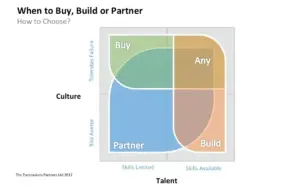
DIY No-Code Tools (Zapier, Make, HubSpot Free Tier, etc.)
- Pros: low cost to start, fast to experiment, no developer required for simple workflows
- Cons: limited to simple, single-step automations before complexity (and the risk of errors) increases sharply
In-House Build
- Pros: full control, knowledge stays internal, no ongoing consultant fees
- Cons: requires technical skills most small businesses don’t have on staff, and is slow without dedicated resourcing
Hiring an Automation Consultant or Partner
- Pros: combines strategic prioritisation (what to automate first) with technical build experience across multiple past projects and industries
- Cons: higher upfront cost than DIY tools, though typically faster to a working result and lower risk of an expensive false start
A practical middle path for many small businesses: use DIY tools for very simple, low-risk automations, and bring in a partner once a process touches customer data, payments, or multiple connected systems where mistakes get expensive.
The Digitechzo 90-Day Automation Roadmap for Small Business
- Days 1–14: Audit — track where time actually goes across the business for two weeks; most owners are surprised by what the data shows versus what they assumed.
- Days 15–21: Prioritise — score each repetitive task by time spent versus difficulty to automate, and select one high-time, low-difficulty process to start with.
- Days 22–45: Build and test — implement the first automation, test it against real scenarios (including awkward edge cases), and involve the staff who’ll actually use it.
- Days 46–60: Launch and monitor — go live, track results daily for the first two weeks, and adjust based on what’s actually happening rather than what was planned.
- Days 61–75: Measure the result — calculate actual hours or cost saved against the original baseline from the audit phase — this number justifies (or doesn’t) the next investment.
- Days 76–90: Plan the next automation — use the proven result to select the second process, building a compounding system rather than a one-off project.
Government Support and Funding for Small Business AI Adoption
Australian small businesses exploring automation shouldn’t assume the full cost has to come out of pocket. Federal and state governments have periodically run grant programs, digital adoption initiatives, and small business advisory services aimed at encouraging technology uptake, though specific programs and funding availability change regularly.
- Check business.gov.au — the federal government’s central hub for current grants, including any technology or digital adoption-specific funding open at the time you’re researching.
- State-based small business support — states including NSW, Victoria, and Queensland have run their own small business digital adoption programs and advisory services from time to time, worth checking directly with your state’s small business commissioner.
- Industry association resources — many industry bodies offer member access to discounted software or advisory support specifically aimed at digital transformation.
Because eligibility and program availability shift frequently, it’s worth checking current listings directly rather than relying on older articles — a detail many “ultimate guide” posts on this topic leave out entirely.
Industries Where Australian Small Businesses Are Automating Fastest
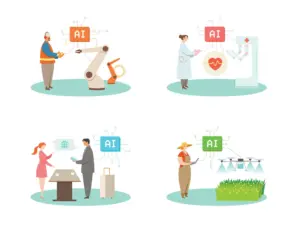
- Professional services — accounting, legal, and consulting firms automating client intake, document collection, and routine reporting.
- Retail and e-commerce — inventory syncing, order confirmations, and customer service handled without manual intervention.
- Healthcare and allied health — appointment scheduling, intake forms, and patient communication automated while clinical decisions stay firmly human.
- Trades and field services — quoting, scheduling, and invoicing triggered automatically the moment a job status changes.
- Hospitality and personal services — booking management and customer follow-up automated to handle volume without proportionally growing front-of-house staff.
Common Mistakes Small Businesses Make With AI Automation
- Automating before mapping the process — speeding up a broken workflow just produces bad outcomes faster; fix the process logic first.
- Trying to automate everything at once — ambitious, all-at-once rollouts fail more often than a series of small, proven wins.
- Choosing tools based on hype rather than fit — the most talked-about platform isn’t necessarily the right one for your specific stack and budget.
- Skipping staff buy-in — automation that the team doesn’t understand or trust gets quietly worked around within weeks.
- Never measuring the result — without a before-and-after figure, it’s impossible to know if the investment actually worked, or to justify the next one to stakeholders.
- Ignoring data privacy obligations — any automation touching customer data needs to respect the Australian Privacy Principles from day one, not as an afterthought.
Expert Tips for Getting Started With AI Automation
- Start with your most repeated task, not your biggest problem — high-frequency, low-complexity tasks build momentum and trust faster than ambitious, high-stakes projects.
- Involve the staff doing the work, not just management — the people closest to a process usually know exactly where it breaks down, and their buy-in determines whether the automation actually gets used.
- Budget for maintenance, not just the build — automations need occasional updates as your business, pricing, and processes evolve.
- Keep a human checkpoint on anything customer-facing and sensitive — full automation isn’t always the goal; removing 80–90% of manual effort while keeping a review step for exceptions is often the smarter outcome.
- Treat the first automation as a pilot, not a verdict — one underwhelming result doesn’t mean automation doesn’t work for your business; it usually means the use case or tool needs adjusting.
Frequently Asked Questions
What is AI automation for small business?
AI automation for small business refers to using artificial intelligence — chatbots, workflow tools, predictive scoring, and intelligent scheduling — to handle repetitive operational tasks without requiring additional staff, freeing existing teams to focus on work that needs human judgement.
How much does AI automation cost for a small business in Australia?
Costs vary widely by use case, ranging from under $100 a month for simple no-code automations to $40,000 or more upfront for a custom-built system spanning multiple business functions. Most Australian small businesses start with a single automation in the $300–$2,000 monthly range before expanding further.
What’s the easiest type of automation for a small business to start with?
Appointment scheduling and reminder automation, along with basic customer service chatbots, are typically the fastest and lowest-risk starting points, since they’re well-supported by mature, affordable tools and don’t require deep integration with sensitive internal systems.
Is AI automation only useful for tech-savvy businesses?
No. Most successful small business automation projects involve owners and staff with no technical background at all — the tools are designed for non-technical users, and the businesses seeing the best results are the ones that focused on clearly defining the problem, not on having in-house technical expertise.
Will automation reduce the number of staff I need?
In most small business deployments, automation redirects staff time toward higher-value work rather than reducing headcount outright. Many owners use the freed capacity to take on more clients or projects without growing the team at the same rate, rather than cutting roles.
Conclusion: The Businesses Pulling Ahead in 2026 Started Small
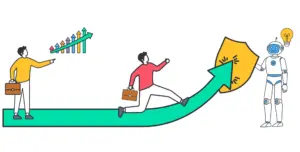
The Australian small businesses gaining the most ground in 2026 aren’t necessarily the ones with the biggest tech budgets — they’re the ones that picked one repetitive, time-consuming process, automated it properly, measured the result, and used that proof to build momentum for the next one. AI automation rewards a deliberate, staged approach far more than an ambitious all-at-once leap.
If you’re not sure where your business would get the fastest return from automation, Digitechzo runs a practical audit for Australian small businesses — mapping where your team’s time actually goes and showing you exactly which process would deliver the quickest, most measurable win before you spend a dollar on tools. Get in touch to start with a clear plan built around your business, not a generic checklist.
About The Author