
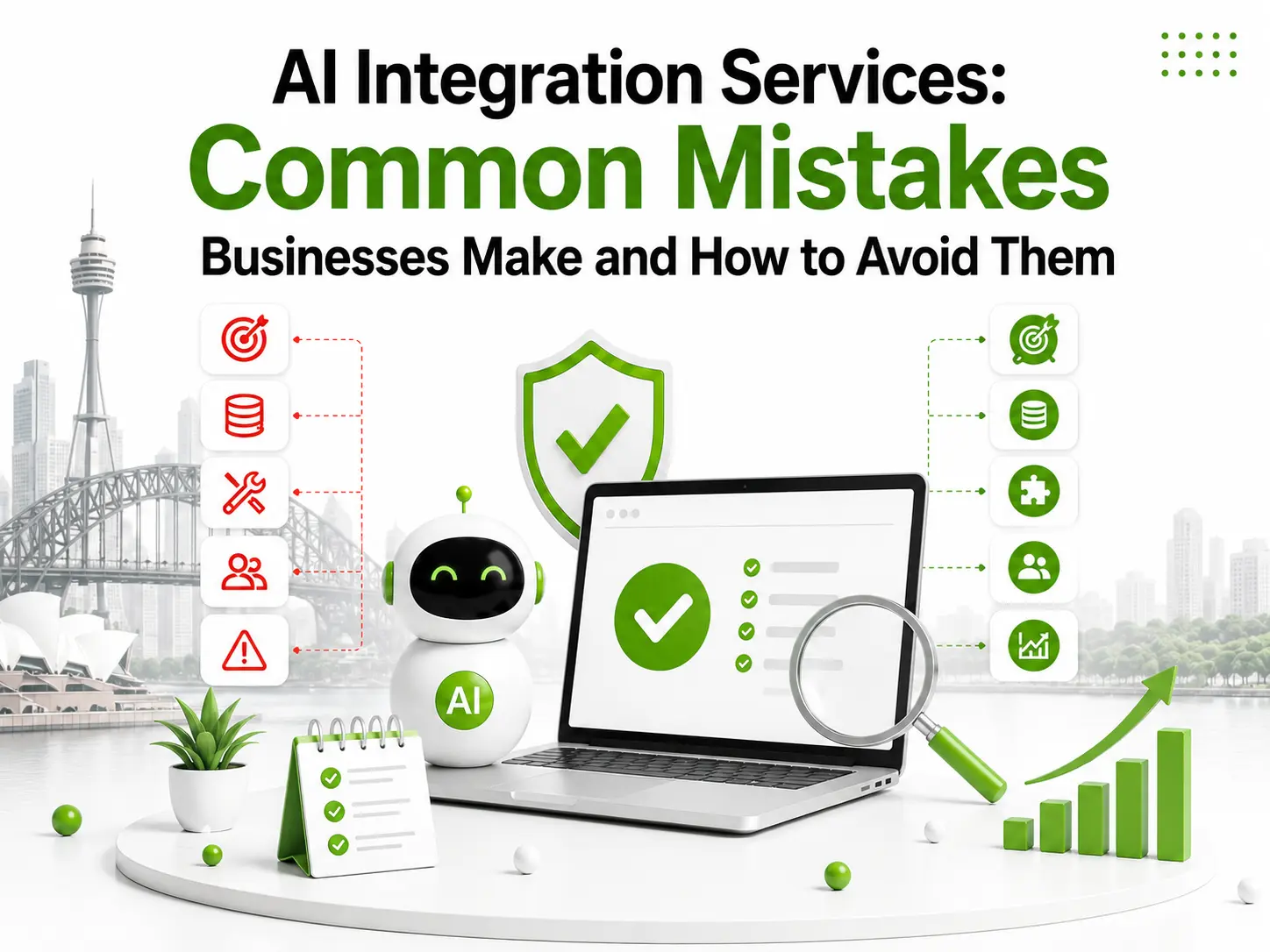
AI Integration Services: Common Mistakes Businesses Make and How to Avoid Them
|
Somewhere between the boardroom excitement and the implementation invoice, things go wrong. A company invests in AI integration services, spends months on setup, and ends up with a system that nobody uses — or worse, one that actively makes their operations messier than before.
It’s more common than most vendors will admit. Gartner has repeatedly flagged that a significant majority of AI and machine learning projects fail to move from pilot to production. And the businesses that do struggle share a remarkably consistent set of mistakes — the same errors, made in the same order, often for the same reasons.
At digiTechzo, we’ve worked alongside Australian businesses across retail, professional services, logistics, and healthcare to design and deploy AI integration strategies that actually stick. This guide draws on that experience to give you something most content in this space won’t: an honest, field-tested breakdown of where AI integration services go wrong — and exactly what you can do about it.
|
What Are AI Integration Services? (And What They’re Not)
AI integration services refer to the process of embedding artificial intelligence capabilities — such as machine learning, natural language processing, predictive analytics, or generative AI — into a business’s existing systems, workflows, and data infrastructure.
This is distinct from simply purchasing an AI tool or subscribing to a platform. Integration means the AI connects to, learns from, and improves your specific operational environment — your CRM, your inventory system, your customer service platform, your financial data.
|
AI Integration Services INCLUDE |
AI Integration Services DO NOT Include |
|
Connecting AI models to live business data |
Buying a SaaS AI tool with no customisation |
|
Custom workflow automation using AI |
Asking ChatGPT questions manually |
|
Training or fine-tuning models on your data |
Installing off-the-shelf software |
|
API connections between AI and your systems |
A one-time AI strategy consultation |
|
Ongoing monitoring, retraining, and optimisation |
A demo or proof-of-concept that never ships |
The confusion between ‘using AI tools’ and ‘having AI integration’ is itself one of the most expensive mistakes businesses make — because it creates false confidence.
Why So Many AI Integration Projects Fail
Before diving into specific mistakes, it’s worth understanding the systemic reasons AI integration services underperform:
- Misaligned expectations — Leadership expects transformation; teams expect a tool that works out of the box.
- Technology-first thinking — Selecting platforms before understanding the problem they need to solve.
- Organisational resistance — Staff who weren’t consulted and don’t trust the new system.
- Data infrastructure debt — AI can only be as good as the data it’s trained on and connected to.
- Inadequate post-launch support — Integration isn’t deployment. Most of the value (and most of the problems) emerge in the first 90 days after go-live.
|
The 9 Most Common Mistakes Businesses Make with AI Integration Services
Mistake 1: Starting with Technology, Not Business Outcomes
The single most common failure mode. A business hears about an AI tool at a conference, sees a competitor mention it on LinkedIn, or gets sold by a vendor — and jumps to implementation without asking: what specific problem are we solving, and how will we know if we’ve solved it?
Without a clear outcome definition, there’s no way to configure the AI correctly, no way to measure success, and no way to make the case for continued investment when results are ambiguous — which they will be if the goal was never defined.
|
Mistake 2: Underestimating Data Quality Requirements
AI is only as intelligent as the data it’s built on. Businesses consistently underestimate how much time and effort goes into data preparation — and overestimate how clean their existing data actually is.
Common data problems that derail AI integration services: duplicate records in the CRM, inconsistent field formatting across systems, missing historical data, siloed databases that have never been connected, and compliance-restricted data that can’t be used for training.
A realistic data readiness audit typically reveals that 40–60% of the data work happens before a single AI model is trained or integrated.
|
Mistake 3: Choosing the Wrong AI Integration Partner
The AI vendor market is crowded with providers who are excellent at demos and underprepared for delivery. Businesses often choose partners based on brand recognition, price, or a polished pitch deck — rather than evidence of relevant, comparable implementations.
Red flags to watch for when evaluating AI integration services providers:
- No case studies from your industry or business size
- Vague statements about ‘leveraging AI’ with no technical specifics
- No mention of post-integration support or monitoring
- Proposals that go from discovery to delivery in under 2 weeks
- Pricing that seems too low to include real customisation
|
Mistake 4: Ignoring Change Management
Your team doesn’t automatically trust a new AI system. And if they don’t trust it, they won’t use it — or they’ll use it inconsistently in ways that undermine its value and skew its outputs.
Change management for AI integration services is not a soft skill add-on. It is a core technical requirement. Systems that aren’t used generate no data for improvement. Systems that are used inconsistently generate misleading data.
This is especially acute in customer-facing AI deployments, where staff will often override the system ‘just this once’ until the exception becomes the rule.
|
Mistake 5: Piloting in Isolation, Then Expecting Scale
Proof of concept projects are valuable — but many businesses run a successful pilot in a controlled environment, then assume the same results will materialise at scale across a messier, more complex real-world operation.
The conditions that make a pilot succeed — clean test data, engaged users, close oversight, simplified workflows — are rarely replicated at full deployment. Organisations then get frustrated when ‘the AI that worked perfectly in the pilot’ fails in production.
|
Mistake 6: No Integration Architecture Plan
Many businesses approach AI integration as a point solution — connecting AI to one system in isolation. This works short-term but creates technical debt quickly: different AI tools with different data formats, no single source of truth, and integration layers that become fragile and expensive to maintain.
A Melbourne-based professional services firm we worked with had independently integrated three AI tools across their marketing, ops, and finance teams over 18 months. None of them talked to each other. Data had to be manually exported and imported between systems. The ‘automation’ was creating more manual work, not less.
|
Mistake 7: Skipping Security and Compliance Review
AI integration services necessarily involve connecting business data to external systems and models. In Australia, this creates clear obligations under the Privacy Act 1988, the Australian Privacy Principles, and sector-specific regulations (APRA for finance, My Health Records Act for healthcare).
The most common compliance gaps: sending personal customer data to third-party AI APIs without adequate data processing agreements, storing AI-processed data in jurisdictions that don’t meet Australian privacy standards, and failing to document AI decision-making in regulated industries.
|
Mistake 8: Treating Deployment as the Finish Line
Go-live is not the end of an AI integration project. It’s the beginning of the most important phase: the period where the system is tested against real-world conditions, where edge cases emerge, where users find friction points, and where the model needs adjustment based on actual performance data.
Businesses that treat AI integration as a project with a completion date — rather than an ongoing operational capability — consistently underperform those that build in structured post-launch review cycles.
|
Mistake 9: Measuring Vanity Metrics Instead of Business Outcomes
‘Our AI processed 10,000 customer inquiries last month’ is not a business outcome. It’s a volume metric. What matters is: did customer satisfaction improve, did resolution time decrease, did staff costs reduce, did customer lifetime value increase?
Businesses frequently track activity metrics (how much the AI is doing) rather than outcome metrics (what the business gained). This makes it impossible to justify continued investment and often masks the fact that the AI is busy but not valuable.
|
The Hidden Cost of Bad AI Integration
The direct cost of a failed AI integration — wasted software spend, lost implementation fees, abandoned tools — is painful but visible. The indirect costs are often larger and take longer to surface:
|
Hidden Cost Category |
How It Manifests |
Typical Impact |
|
Team trust erosion |
Staff lose confidence in technology initiatives; future adoption becomes harder |
High |
|
Opportunity cost |
Months spent on a failed project instead of initiatives that would have generated ROI |
High |
|
Data contamination |
Poor AI outputs ingested back into business systems corrupt source data |
Medium–High |
|
Vendor lock-in |
Proprietary integrations that are expensive to unwind when switching providers |
Medium |
|
Compliance exposure |
Undiscovered data handling violations surface during an audit or breach |
Very High |
|
Customer experience damage |
Poorly configured customer-facing AI creates friction and erodes trust |
High |
What Good AI Integration Services Actually Look Like
A well-structured AI integration engagement — whether with a partner like digitechzo or an in-house team — follows a consistent pattern that separates high-performing implementations from failed ones:
- Discovery and problem definition — Structured stakeholder interviews, process mapping, and outcome definition before any technology is discussed.
- Data readiness assessment — Audit of existing data quality, availability, and compliance status across all relevant systems.
- Architecture design — A blueprint of how AI will connect to existing infrastructure, including data flows, APIs, and security boundaries.
- Phased build and pilot — Small-scope implementation with real data and real users, with explicit go/no-go criteria before scaling.
- Change management and training — Staff communication, training sessions, and feedback loops embedded into the implementation timeline.
- Post-launch optimisation — Structured 90-day review cycle with performance monitoring, model retraining, and iterative improvement.
Comparing DIY vs. Managed AI Integration Services
|
Factor |
DIY AI Integration |
Managed AI Integration Services |
|
Initial cost |
Lower (tool subscriptions only) |
Higher (includes expertise and time) |
|
Time to value |
Longer — steep learning curve |
Faster — experienced implementation |
|
Data readiness support |
Self-managed |
Guided audit and remediation |
|
Compliance guidance |
DIY — risk of gaps |
Included in scoping |
|
Post-launch support |
Community forums, vendor docs |
Dedicated review and optimisation |
|
Failure rate |
Higher — without structured methodology |
Lower — with proven frameworks |
|
Best for |
Simple, single-tool automations |
Multi-system, data-intensive use cases |
DIY integration works well for simple, single-tool automations with clean data and a clear process. When complexity increases — multiple systems, sensitive data, customer-facing AI, or regulated industries — managed AI integration services deliver significantly better outcomes and lower total risk.
Expert Tips to Get It Right the First Time
Tip 1: Map your worst process, not your easiest one. The biggest ROI in AI integration usually comes from the most painful manual processes — not the ones that almost work already.
- Tip 2: Run a ‘data walk’ before scoping. Ask your team: where does this data come from, where does it go, and what happens when it’s wrong? This surfaces integration risks before they become project blockers.
- Tip 3: Define your ‘human in the loop’ policy before you automate. Decide in advance which decisions AI can make autonomously, which require human review, and which are never delegated to AI. Document it. Revisit it quarterly.
- Tip 4: Build a reset protocol into every AI workflow. What happens when the AI gets it wrong? Every integration needs a clear path for humans to override, correct, and report errors — without those reports getting buried.
- Tip 5: Don’t underestimate your own team’s knowledge. The people doing the work every day know the edge cases, the exceptions, and the workarounds that aren’t in any process document. Interview them deeply before designing any AI workflow.
- Tip 6: Start internal, then go external. Automate and optimise internal processes before deploying AI in any customer-facing context. Internal failures are recoverable. Customer-facing failures are reputation events.
Frequently Asked Questions (FAQs)
What are AI integration services and why do businesses need them?
AI integration services are the process of connecting artificial intelligence capabilities — such as machine learning, natural language processing, and automation — into a business’s existing systems and workflows. Businesses need them to move beyond generic AI tools and actually embed intelligent capabilities into the specific processes that drive their operations, such as customer service, inventory management, invoicing, or sales forecasting.
How long does AI integration take for a typical business?
A well-scoped, single-workflow AI integration typically takes 4–12 weeks from discovery to go-live, depending on data complexity and the number of systems involved. Multi-system integrations across an entire business function (such as marketing or operations) typically take 3–6 months. Rushed timelines under 4 weeks for anything more than simple automation are a red flag.
How much do AI integration services cost?
Costs vary significantly by scope and provider. Simple workflow automations using existing platforms (such as Zapier combined with an AI model) may cost $3,000–$15,000 for setup plus monthly platform fees. Complex, custom integrations involving multiple systems, proprietary data, and regulatory requirements typically range from $25,000–$150,000+. Always evaluate total cost of ownership — including ongoing support and optimisation — not just the implementation fee.
What questions should I ask an AI integration services provider?
Key questions include: Can you share case studies from businesses with similar data environments to ours? How do you handle data compliance for Australian businesses? What does your post-launch support model look like and for how long? How do you measure integration success and what metrics will you track? What happens if the integration underperforms against its targets?
Can AI integration services work for small businesses, or is it only for large enterprises?
AI integration is increasingly viable for small and medium businesses. Cloud-based AI tools, API-first platforms, and managed integration providers have reduced both the cost and complexity of implementation significantly. SMEs typically start with one high-impact workflow (such as customer inquiry handling or invoicing) rather than enterprise-scale transformation — and this targeted approach often delivers faster ROI than broader enterprise programmes.
Conclusion: Integration Done Right Is a Competitive Advantage
The difference between AI integration that transforms a business and AI integration that wastes money is not the technology. It’s the decisions made before, during, and after implementation.
Businesses that get AI integration right share a consistent set of behaviours: they define outcomes before selecting tools, they invest in data quality, they bring their teams along, and they treat post-launch as the beginning — not the end.
The businesses that struggle fall into the same traps: technology-first thinking, vague success criteria, ignored change management, and no plan for what happens after go-live.
AI integration services done well create compounding advantage: faster operations, better decisions, and a team that’s freed from repetitive work to focus on what actually requires human judgement. That advantage grows over time. Which is why the cost of getting it wrong — and the reward for getting it right — are both larger than most businesses initially estimate.
About The Author