
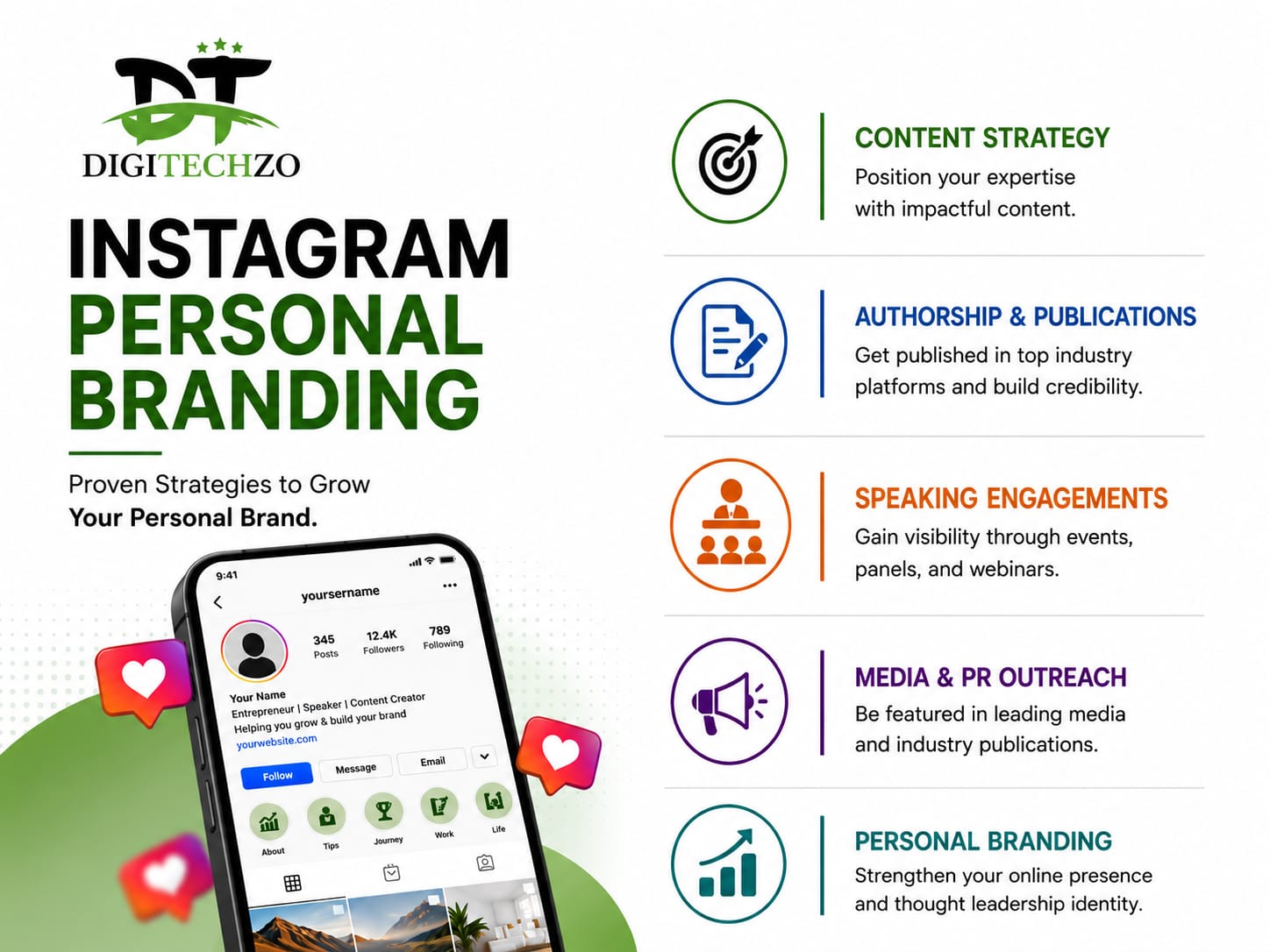
If you’ve posted consistently for months and your follower count still looks the same, you’re not alone — and it’s probably not an algorithm problem. It’s a positioning problem. Most people trying to build Instagram personal branding treat their profile like a photo diary instead of a brand asset, and that single mistake quietly kills growth before it starts.
At Digitechzo, we’ve spent years helping creators, founders, and consultants turn scattered Instagram activity into a recognizable, revenue-generating personal brand. What separates the accounts that break through from the ones that stay stuck at 2,000 followers isn’t luck or a secret hashtag list — it’s a repeatable system. This guide breaks down that exact system.
Quick Answer
Building a strong Instagram personal brand means defining a clear niche and point of view, maintaining consistent visual and messaging identity, publishing content that solves specific audience problems, and engaging authentically to build trust over time. Growth follows clarity — not the other way around.
What Instagram Personal Branding Actually Means
Instagram personal branding is the deliberate process of shaping how people perceive you on the platform — your expertise, values, personality, and the specific problem you solve for a specific audience. It’s the difference between “someone who posts on Instagram” and “the person people think of when they think of X.”
A personal brand isn’t your bio, your logo, or your color palette. Those are outputs. The brand itself is the mental shortcut people form after repeated exposure to your content. Think of any creator you follow closely — you can probably summarize what they stand for in one sentence. That’s the goal.
Personal Brand vs. Business Brand: What’s the Difference?
| Factor | Personal Brand | Business Brand |
|---|---|---|
| Face | A real, visible individual | A company, product, or logo |
| Trust driver | Relatability and consistency | Reputation and scale |
| Content style | Opinion-led, story-led | Product-led, offer-led |
| Growth speed | Often faster (human connection) | Often slower to build trust |
| Flexibility | Can pivot niches with audience intact | Harder to pivot without rebrand |
Understanding this distinction matters because many people accidentally build a business page with a personal photo — no clear point of view, just information. That’s not personal branding; it’s broadcasting.
Why Most Personal Brands Fail on Instagram
Before strategies, it’s worth understanding why the majority of attempts stall. In our work auditing creator accounts, three failure patterns show up repeatedly:
- No defined audience — trying to appeal to “everyone” dilutes messaging until it resonates with no one.
- Inconsistent identity — switching niches, tones, or aesthetics every few weeks confuses the algorithm and the audience simultaneously.
- Content without a job — posting because “you’re supposed to post” rather than because each piece of content moves a viewer one step closer to trusting you.
Instagram’s own creator resources emphasize that accounts sustaining engagement over time typically publish around a specific theme rather than general lifestyle content. Niche clarity isn’t a nice-to-have — it’s the foundation everything else sits on.
Step 1: Define Your Niche and Positioning
This is the step almost everyone skips, and it’s the single highest-leverage decision in the entire process.
The Niche + Angle Formula
A niche alone (“fitness,” “marketing,” “finance”) isn’t enough — it’s oversaturated and undifferentiated. What works is:
Niche + Unique Angle + Target Audience
For example:
- Not “fitness” — but “strength training for women over 40 returning after injury.”
- Not “marketing” — but “organic marketing frameworks for solo consultants with no ad budget.”
This formula does two things: it narrows the competition and it makes your content instantly relevant to a specific scroller, which increases save and share rates — two signals Instagram’s ranking system weighs heavily.
How to Find Your Angle
- List 3 topics you have genuine, hands-on experience in.
- List 3 audiences who actively struggle with something in those topics.
- Identify what you believe that most people in your space get wrong.
That third point — your contrarian or unique belief — is usually where the real brand angle lives.
Step 2: Build a Consistent Visual and Voice Identity
Once positioning is clear, identity is what makes you recognizable in a fast-scrolling feed.
Visual Consistency
- Pick 2-3 core colors and stick to them across grid posts, Stories highlights, and Reels covers.
- Use consistent typography for text overlays — mismatched fonts read as unprofessional.
- Keep a repeatable content structure (e.g., always opening Reels with a hook frame in the same style).
Voice Consistency
Your tone — witty, blunt, warm, analytical — should feel the same whether someone reads your caption, your Story text, or your comment replies. Inconsistent voice is one of the fastest ways to erode the “mental shortcut” trust that personal branding depends on.
Bio Optimization for Personal Branding
Your bio should answer three questions in under 150 characters:
- Who you help
- What result you deliver
- Why you’re credible to say so
Example: “Helping first-time founders build hiring systems | Ex-Head of Talent @ 2 startups | Free hiring checklist below ⬇️”
Step 3: Create a Content Framework, Not Random Posts
Random posting produces random results. A content framework produces compounding ones.
The 4-Pillar Content System
Most sustainable personal brands rotate across four content pillars:
- Educational — teach something specific and actionable.
- Authority — share results, case studies, behind-the-scenes proof of expertise.
- Relatable — struggles, opinions, personal stories that humanize you.
- Connective — direct calls for engagement, polls, questions, community-building.
A weekly rhythm might look like: 2 educational posts, 1 authority post, 2 relatable posts, 1 connective post. This mix keeps the account from feeling like a lecture or a highlight reel.
Hook Writing: The Most Underrated Skill
Instagram’s average watch time on Reels is short, so the first 1-2 seconds of video or the first line of a caption decide whether the content gets consumed. Strong hooks tend to fall into these categories:
- Contrarian: “Stop posting daily — it’s hurting your growth.”
- Curiosity gap: “The one metric nobody checks before going viral.”
- Direct value: “3 caption formulas that doubled my saves.”
Step 4: Use Instagram Features Strategically
Different formats serve different roles in the personal branding funnel.
Reels vs. Carousels vs. Stories
| Format | Best For | Typical Role in Funnel |
|---|---|---|
| Reels | Reach, discovery, new audience | Top of funnel |
| Carousels | Depth, saves, positioning as expert | Middle of funnel |
| Stories | Daily connection, polls, behind-the-scenes | Trust-building, retention |
| Live | Direct Q&A, real-time authority | Deep trust, conversion |
Pros of Reels: highest reach potential, ideal for new audience discovery. Cons of Reels: shorter attention span, less depth, higher production effort.
Pros of Carousels: higher save rates, positions you as a teacher. Cons of Carousels: slower reach growth, more design time needed.
A balanced personal brand strategy uses Reels to attract, carousels to educate, and Stories to retain — rather than relying on one format alone.
Step 5: Build Real Engagement, Not Vanity Metrics
Follower count is the least meaningful metric in personal branding. What actually predicts long-term brand strength:
- Save rate — indicates content worth returning to.
- Share rate (DMs and Stories) — indicates content worth associating your name with.
- Comment quality — thoughtful comments signal genuine investment, not just algorithmic engagement bait (“comment 🔥 if you agree”).
Practical Engagement Habits
- Reply to comments with follow-up questions, not just “thanks!”
- Spend 10-15 minutes daily engaging with accounts in your niche before and after posting.
- Use polls and question stickers to source content ideas directly from your audience — this doubles as market research.
Step 6: Turn Followers Into Trust and Trust Into Income
A personal brand that doesn’t eventually convert attention into opportunity is a hobby, not a strategy — even if monetization isn’t your primary goal.
The Trust Ladder
- Awareness — someone discovers you via Reels or Explore.
- Familiarity — they see you repeatedly and recognize your name or face.
- Trust — they engage, DM, or reference your advice.
- Conversion — they buy, hire, refer, or collaborate.
Skipping steps — asking for conversion at the awareness stage — is why many “sell in every caption” accounts stagnate. Trust has to compound before conversion becomes natural.
Common Mistakes in Instagram Personal Branding
- Chasing trends that don’t fit the niche. A trending audio with irrelevant content confuses the algorithm’s topic-matching and dilutes brand clarity.
- Inconsistent posting cadence. Sporadic bursts followed by silence make it harder for the algorithm to establish a distribution pattern for your account.
- Copying another creator’s identity. Audiences can sense inauthenticity quickly, and imitation rarely outperforms the original.
- Ignoring analytics. Not reviewing Instagram Insights means repeating content that doesn’t work simply because it “felt” like it should.
- Over-polishing everything. Personal brands that look overly corporate lose the “personal” element that makes the format effective in the first place.
Expert Tips for Faster, Sustainable Growth
- Batch content weekly, not daily — this protects consistency during busy weeks and reduces decision fatigue.
- Repurpose one core idea across three formats (Reel, carousel, Story) instead of creating three separate ideas — this reinforces the same message without extra creative load.
- Audit your last 10 posts monthly against save and share rates, not just likes, to identify what’s actually resonating.
- Build a “content bank” of audience questions from DMs and comments — it removes the guesswork of “what do I post today.”
- Give it 90 days minimum before judging a niche or strategy — most compounding effects in personal branding aren’t visible in the first few weeks.
FAQs
Q: How long does it take to build a personal brand on Instagram?
Most creators start seeing meaningful traction — recognizable engagement, DMs referencing content, inbound opportunities — between 3 to 6 months of consistent, niche-focused posting. Growth is rarely linear; it often comes in sudden jumps after a period of steady output.
Q: Do I need to show my face to build a personal brand on Instagram?
No, though it typically accelerates trust-building. Some successful personal brands use voiceover, text-based content, or hands-only demonstrations while still maintaining a consistent, recognizable style and voice.
Q: How many times a week should I post to grow my personal brand?
Consistency matters more than frequency. Three to five quality posts per week, sustained over months, generally outperform daily posting that isn’t sustainable long-term.
Q: What’s the biggest difference between a personal brand and an influencer?
An influencer’s value often comes primarily from reach and audience size. A personal brand’s value comes from a specific point of view and expertise — which can be monetized through business, consulting, or authority even at a smaller following size.
Q: Can I change my niche later without losing my audience?
Yes, if the transition is gradual and tied to your existing expertise or values. Abrupt, unrelated pivots tend to cause follower drop-off, while adjacent pivots (e.g., fitness coach moving into mindset coaching) usually retain most of the audience.
Conclusion
Instagram personal branding isn’t about posting more — it’s about positioning clearly, showing up consistently, and building trust systematically until your name becomes shorthand for a specific kind of value. The creators who break through aren’t necessarily the most talented; they’re the most consistent and the most clearly positioned.
If you’re ready to move from guessing to executing a real personal branding strategy, Digitechzo works with creators and founders to build exactly this kind of system — from positioning to content frameworks to growth execution. Start by auditing your last 10 posts against the framework above, and you’ll likely already see where the gaps are.
About The Author