
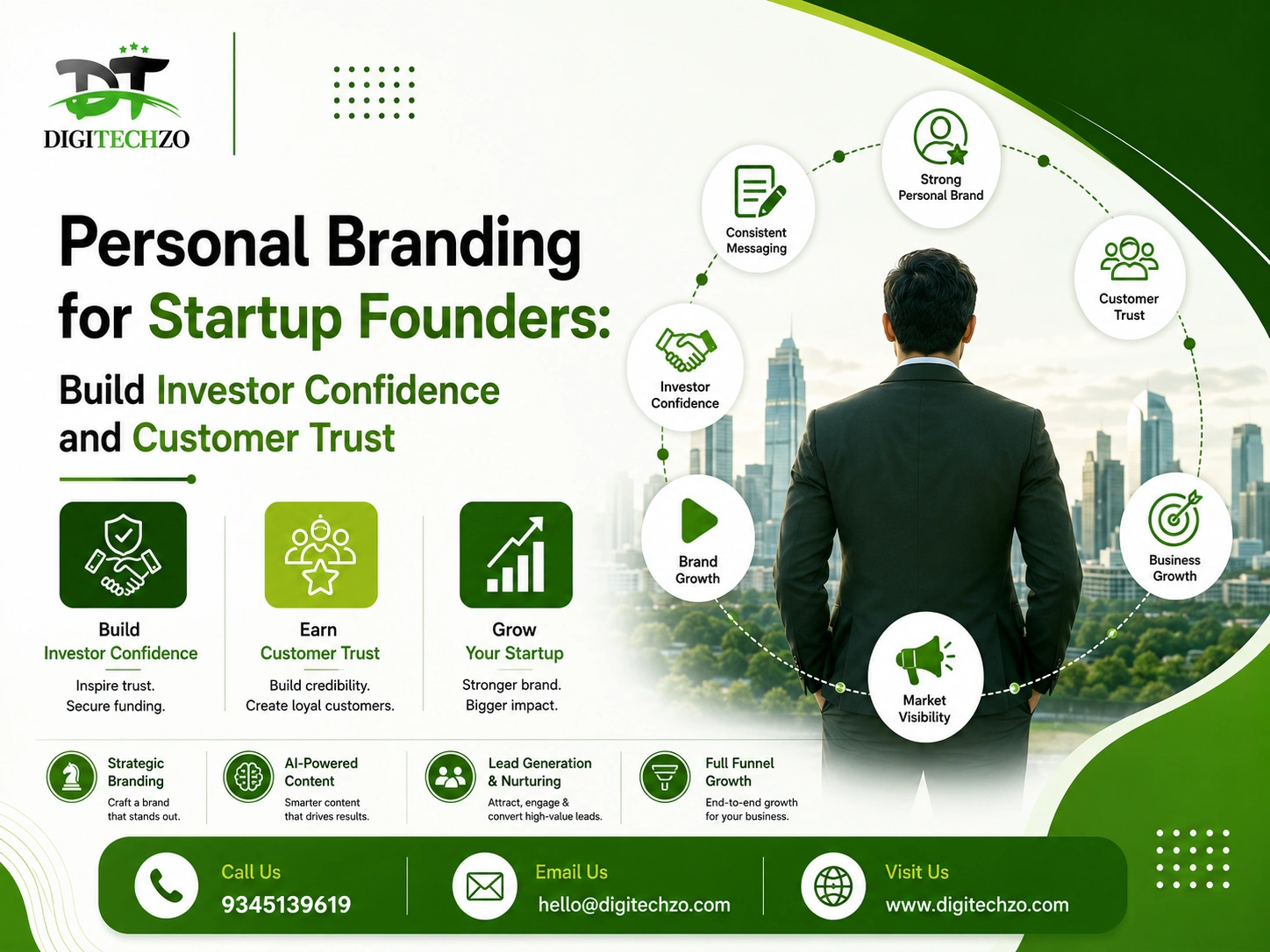
Two founders pitch the same idea, the same market size, and nearly identical decks. One gets a term sheet in three weeks. The other gets “let’s stay in touch.” The difference usually isn’t the business model — it’s that investors, customers, and future hires had already formed an opinion of the first founder before the meeting even started. That’s the compounding effect of a strong personal brand, and it’s one of the least understood levers in early-stage growth.
Personal branding for startup founders isn’t about becoming a social media personality — it’s about building visible, credible proof of judgment, execution, and vision that de-risks every decision someone makes about you: whether to invest, whether to buy, whether to join. This guide, developed with input from DigiTechzo, a growth marketing partner that works with founders and early-stage startups on brand and go-to-market visibility, breaks down exactly how founder branding drives fundraising, customer acquisition, and hiring — often more efficiently than the company brand alone.
Quick Answer
Personal branding for startup founders is the deliberate process of building a credible, visible reputation — through content, public track record, and thought leadership — that reduces perceived risk for investors, customers, and potential hires before they ever interact with the company directly. Unlike company branding, founder branding is portable: it follows the founder across ventures and compounds over an entire career, not just a single product’s lifecycle.
Why Founder Branding Often Outperforms Company Branding Early On
In the earliest stages of a startup, the company itself has almost no track record — no years of customer reviews, no established market position, no institutional trust. The founder is often the only credible signal available.
This is why:
- Investors fund people before they fund products at the earliest stages. Pattern recognition, judgment, and communication clarity are being evaluated as much as the pitch deck itself.
- Early customers take a leap of faith on unproven products, and a visible, credible founder reduces that perceived risk significantly compared to an anonymous company page.
- Talent joins founders, not just job descriptions. Especially pre-Series A, strong candidates are often betting on the founder’s vision and execution ability more than the current product.
Founders who build visibility and credibility independent of the company’s own marketing create a trust shortcut that compounds across fundraising rounds, product launches, and even future ventures.
The Three Audiences a Founder Brand Must Serve
Most founder branding advice focuses only on one audience — usually investors or Twitter/LinkedIn followers — and misses that a founder brand actually needs to satisfy three distinct groups simultaneously, each evaluating different signals.
Investors
Looking for: judgment under uncertainty, coherent narrative about the market, evidence of execution velocity, and coachability.
Customers
Looking for: credibility that the product will actually work, transparency about the company’s stage and limitations, and a human they can trust behind the brand.
Talent and Future Hires
Looking for: clarity of vision, evidence the founder can lead through ambiguity, and public signals of company momentum and culture.
A founder brand built exclusively to impress investors (heavy fundraising jargon, VC-insider language) often reads as inaccessible to customers. A brand built purely for customer charm can look unserious to institutional investors. The strongest founder brands find language that works across all three audiences simultaneously — usually by focusing on specific, concrete stories rather than audience-specific jargon.
Building Investor Confidence Through Personal Branding
What Investors Are Actually Evaluating
Beyond the pitch deck, most experienced investors are informally assessing a founder’s public track record before a first meeting — looking at how the founder communicates, whether their public claims match reality over time, and whether they demonstrate consistent execution.
Practical Ways to Build This Signal
- Publish specific, dated progress updates (traction, milestones, lessons from setbacks) rather than only celebratory announcements — consistency and honesty about setbacks often build more investor trust than a highlight reel.
- Write about your specific market thesis, not generic startup advice — this demonstrates the depth of thinking investors are trying to assess.
- Be visible before you’re fundraising. Founders who build a public track record months or years before an active raise often find due diligence conversations shorter, because much of the “who is this person” research is already answered publicly.
Example scenario: A B2B SaaS founder began publishing monthly, numbers-included progress updates well before actively fundraising — including a few updates describing missed targets and the specific adjustments made afterward. By the time of an active raise, several investors referenced having already followed the company’s trajectory, which shortened early conversations significantly, since the track record and founder judgment were already visible rather than needing to be established from scratch in the pitch meeting.
Building Customer Trust Through Founder Visibility
Why Anonymous Startups Convert Slower
Early-stage products often lack the third-party validation (reviews, case studies, brand recognition) that reduces purchase risk for customers. A visible, credible founder can partially substitute for that missing social proof.
Practical Trust-Building Actions
- Show your face and your reasoning, not just your product’s features. Explaining why a decision was made builds more trust than simply announcing what was built.
- Respond publicly to customer feedback, including criticism — visible responsiveness signals a founder who’s actually paying attention.
- Share the “why now” story specifically, not a generic origin story — customers trust founders who clearly understand the exact problem they’re solving.
Content Strategy for Founders Who Don’t Have Time to “Be a Creator”
Founders often avoid personal branding because they assume it requires becoming a full-time content creator. In reality, founder branding is far more efficient than typical influencer content, because the source material — actual company building — already exists.
High-Leverage, Low-Time Content Formats
| Content Type | Time Investment | Audience Impact |
|---|---|---|
| Monthly progress/metrics updates | Low | High (investors + team) |
| “What I learned this week” specific lessons | Low | Medium-high (all audiences) |
| Customer story breakdowns | Medium | High (customers + investors) |
| Long-form thesis/market posts | Medium-high | High (investors + talent) |
| Reactive commentary on industry news | Low | Medium (visibility/reach) |
Pros and Cons of Common Founder Channels
LinkedIn/X (Twitter)
- Pros: Directly reaches investors, operators, and talent; fast feedback loop
- Cons: Requires consistency to build algorithmic reach
Long-form blog/newsletter
- Pros: Owned audience, strong for detailed thesis-sharing, compounding SEO value
- Cons: Slower initial audience growth than social platforms
Podcast guest appearances
- Pros: Borrowed audience and credibility, lower production effort than hosting your own
- Cons: Less control over framing and less frequent cadence
Founder Brand vs. Company Brand: Managing the Overlap
A common tension: how much of the spotlight should the founder take versus the company itself?
The most effective balance:
- Use the founder’s voice for vision, thesis, and narrative — the “why” behind the company
- Use the company’s official channels for product updates, customer support, and operational announcements
- Keep the founder’s personal brand active independent of the company account, since it remains valuable even through pivots, rebrands, or future ventures
Founders who build recognition entirely through the company account often lose that audience and credibility if the company shuts down, pivots dramatically, or is acquired. A founder’s independent brand is a durable career asset regardless of any single company’s outcome.
Common Mistakes Founders Make With Personal Branding
- Only posting during fundraising. This reads as opportunistic rather than authentic, and investors notice the pattern.
- Copying “founder influencer” tropes (generic hustle content, recycled startup aphorisms) instead of sharing specific, real insight from their own building process.
- Hiding setbacks entirely. A brand that only shows wins reads as less credible than one that shows judgment through both successes and recoveries.
- Treating the personal brand as marketing fluff rather than a legitimate part of fundraising and customer acquisition strategy.
- Inconsistent visibility. Sporadic bursts of activity around major announcements, followed by silence, fail to build the compounding trust consistent presence creates.
- No clear point of view. Founders who only comment neutrally on industry news, without a distinct thesis, rarely stand out from the broader noise.
Expert Tips to Build Founder Authority Efficiently
- Repurpose internal updates you’re already writing. Board updates, investor emails, and internal all-hands notes often contain the exact raw material for high-value public content, lightly adapted.
- Publish specific numbers where possible. Concrete metrics (“grew from 40 to 310 paying customers in five months”) build more credibility than vague growth claims.
- Build the habit before you need it. Founders who wait until an active fundraise to start building visibility lose the compounding advantage of a pre-established track record.
- Engage genuinely with your specific industry community, not just broadcast — thoughtful replies and engagement often build relationships faster than original posts alone.
- Track which content actually leads to investor or customer conversations, and double down on that specific format rather than spreading effort evenly across every possible channel.
FAQs
What is personal branding for startup founders?
It’s the process of building a visible, credible reputation — through content, track record, and thought leadership — that reduces perceived risk for investors, customers, and potential hires, independent of the company’s own marketing.
Does personal branding actually help with fundraising?
Yes — investors often informally research a founder’s public track record before meetings, and a consistent, credible presence can shorten due diligence conversations by answering “who is this founder” questions before they’re formally asked.
Should founders build their personal brand before or during fundraising?
Before, whenever possible. Founders who build visibility ahead of an active raise benefit from a pre-established track record, rather than trying to build credibility and raise capital simultaneously.
How much time does founder personal branding actually require?
Efficient founder branding often repurposes content already being created for internal updates, customer communication, or investor relations, requiring far less additional time than typical influencer-style content creation.
What’s the biggest difference between founder branding and company branding?
Founder branding is portable and follows the individual across ventures and career stages, while company branding is tied to a single product or business and doesn’t transfer if the company pivots, shuts down, or is acquired.
Final Thoughts
In early-stage company building, trust is the scarcest resource — and personal branding is how founders manufacture it before the company has years of track record to rely on. Founders who build visible, consistent, and honest public presence create a compounding advantage across fundraising, customer acquisition, and hiring that a polished company website alone can never replicate.
If you’re ready to turn your founder story and progress into a system that actually builds investor and customer trust, DigiTechzo works with startup founders to build exactly this kind of visibility strategy — from positioning and content systems to the go-to-market support that turns attention into pipeline. Reach out to start mapping your founder brand strategy today.
About The Author