
Scroll through Instagram or YouTube for sixty seconds and you’ll see it: brands that used to post static images are now leading with fast-cut, high-energy Reels. If your feed still looks like 2021, you’re not just behind on trends — you’re losing reach, engagement, and ultimately, customers.
At Digitechzo, we’ve worked with brands stuck in this exact spot: decent products, a real audience, but content that simply doesn’t move. What usually fixes it isn’t a bigger budget — it’s a dedicated Reels creation service that understands hooks, pacing, and platform algorithms well enough to turn fifteen seconds of video into a steady pipeline of leads.
This guide breaks down what Reels creation services actually involve, why they outperform traditional content formats, what a good process looks like, the mistakes that quietly kill performance, and how to choose a partner who can deliver results instead of just “content.”
Quick Answer
Reels creation services combine scripting, filming, editing, and platform-specific optimization to produce short-form videos designed to maximize reach and conversions. Businesses that invest in professionally made Reels typically see higher engagement, longer watch time, and more inbound leads than those relying on static posts or generic in-house clips — because Reels are built for how platform algorithms actually distribute content today.
What are reels creation service?
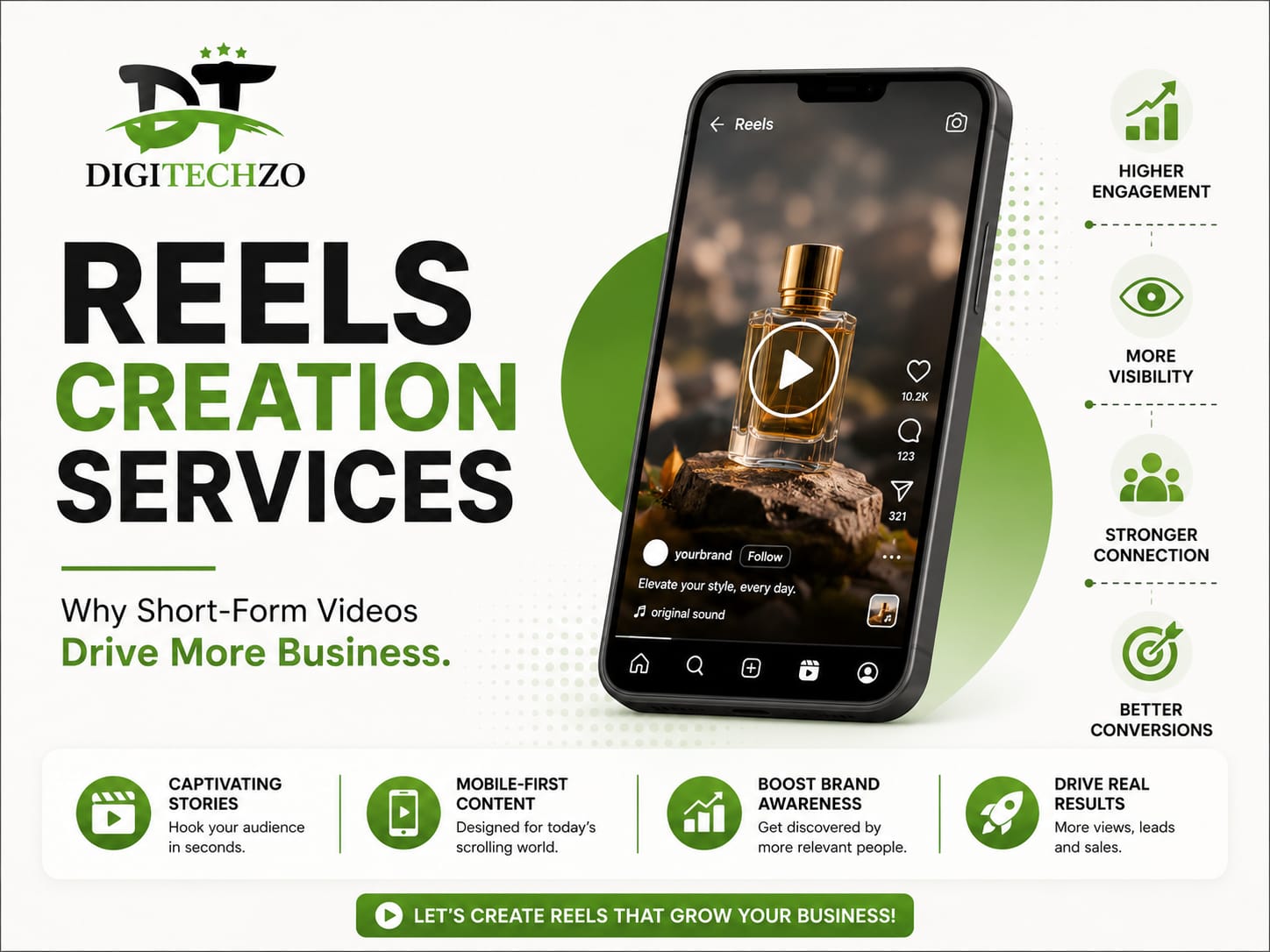
Reels creation services are end-to-end production support for short-form vertical video — typically 15 to 90 seconds — built specifically for platforms like Instagram, YouTube Shorts, and Facebook Reels. Unlike generic video editing, this work is tied directly to distribution mechanics: how each platform’s algorithm scores watch time, replays, shares, and saves.
A proper service usually covers:
- Strategy and scripting — identifying hooks that stop the scroll in the first 2 seconds
- Filming or sourcing footage — either shot fresh or repurposed from existing assets
- Editing and pacing — cuts, captions, transitions, sound syncing
- Platform optimization — aspect ratio, trending audio, caption placement, hashtag strategy
- Performance tracking — watch-through rate, shares, saves, and conversion tracking
This is different from simply “making a video.” It’s engineering a piece of content around what a specific algorithm is designed to reward.
Why Short-Form Video Outperforms Other Content
The Attention Economy Has Changed
Average attention span on social feeds has dropped sharply over the past few years, and platforms have adapted by prioritizing formats that deliver value fast. A well-made Reel front-loads its payoff in the first few seconds — something a long-form video or static caption simply can’t replicate.
Algorithms Are Built to Favor Reels
Instagram, YouTube, and Facebook have all confirmed publicly that short-form video gets disproportionate organic reach compared to other formats, because it keeps users inside the app longer. A brand posting Reels consistently is essentially getting free distribution that a static post won’t receive.
Reels Build Trust Faster Than Text or Images
Video lets a prospect hear your tone, see your product in motion, and judge credibility in seconds. For service-based businesses especially, a founder or team member speaking on camera does more to build trust than five paragraphs of website copy.
Real-World Example
A mid-sized skincare brand we worked with had strong product photography but flat engagement. After shifting 70% of their content budget into Reels — before/after transformations, ingredient breakdowns, and quick tutorials — their profile visits and DMs asking “where to buy” increased noticeably within the first month. The product didn’t change. The format did.
What a Professional Reels Workflow Actually Looks Like
Pre-Production
- Audience and competitor research
- Hook-first scripting (the first 1-2 seconds decide 80% of performance)
- Trend and audio scouting relevant to the niche
Production
- Vertical (9:16) filming setup
- Lighting and audio quality — often more important than camera resolution
- Multiple takes for natural, non-scripted delivery
Post-Production
- Fast-paced editing matched to trending cut styles
- Captions burned in (most viewers watch with sound off)
- Strategic use of text overlays for key selling points
Distribution & Optimization
- Posting time aligned with audience activity
- A/B testing hooks and thumbnails
- Iterating based on retention graphs, not just likes
In-House vs. Agency Reels: A Practical Comparison
| Factor | In-House Team | Reels Creation Service |
|---|---|---|
| Speed | Often slower, competing priorities | Dedicated production timelines |
| Trend awareness | Inconsistent | Actively tracked daily |
| Editing quality | Varies by skill level | Professional, platform-tuned |
| Strategy | Content-first | Conversion and algorithm-first |
| Cost | Salary + software + time | Scalable, project or retainer-based |
Pros of outsourcing Reels creation:
- Faster turnaround with consistent quality
- Access to specialists (scripting, editing, strategy) instead of one generalist
- Data-backed iteration instead of guesswork
Cons to weigh:
- Less immediate control over day-to-day changes
- Requires clear brand guidelines upfront to maintain voice
- Ongoing collaboration needed for authenticity
Common Mistakes Brands Make With Reels
- Treating Reels like ads. Overly polished, sales-heavy Reels get skipped. The best-performing ones feel native to the platform.
- Ignoring the first 2 seconds. If the hook doesn’t create curiosity or tension immediately, the algorithm stops showing it to new viewers.
- Posting inconsistently. Sporadic posting resets momentum; algorithms reward consistency over one-off virality.
- No clear CTA. A Reel that entertains but doesn’t direct viewers anywhere wastes the attention it earned.
- Ignoring analytics. Likes are vanity metrics — watch-through rate and shares are what actually indicate algorithmic favor.
Expert Tips for Higher-Converting Reels
- Hook with a problem, not a product. “Still doing X the hard way?” outperforms “Check out our new product.”
- Keep captions punchy. Short, readable text overlays retain viewers who watch muted.
- Repurpose long-form content. A single podcast or webinar can yield 10+ Reels with the right editing approach.
- Use pattern interrupts. A sudden zoom, cut, or sound change mid-video re-engages viewers who are about to scroll away.
- Always end with a next step. Whether it’s “link in bio” or a direct question in the caption, give viewers somewhere to go.
How to Choose a Reels Creation Service
Look for a partner that can show you:
- A portfolio of Reels with actual performance data, not just polished output
- A process that includes strategy and scripting, not just editing
- Familiarity with your specific platform’s current algorithm behavior
- Willingness to iterate based on retention and conversion data, not just aesthetics
This is exactly the gap Digitechzo was built to close — pairing creative execution with a strategy layer most editing-only freelancers don’t offer, so Reels are built to convert, not just look good.
FAQs
Q:What makes a Reel go viral?
No single factor guarantees virality, but Reels that combine a strong first-2-second hook, high replay value, and native platform pacing consistently get more algorithmic distribution than polished, ad-like content.
Q:How many Reels should a business post per week?
Most brands see meaningful traction posting 3–5 times per week. Consistency matters more than volume — a steady cadence signals reliability to the algorithm.
Q:Do Reels work for B2B businesses, not just B2C?
Yes. B2B brands use Reels for behind-the-scenes content, quick tips, client testimonials, and founder-led thought leadership, often achieving higher engagement than text-based LinkedIn posts.
Q:How long should a Reel be?
Shorter Reels (15–30 seconds) typically get higher completion rates, which the algorithm rewards. Longer Reels (60–90 seconds) work well for tutorials or storytelling if pacing stays tight.
Q:Can old content be turned into Reels?
Absolutely. Webinars, testimonials, blog posts, and even customer support FAQs can be re-cut into multiple Reels, extending the value of content you’ve already created.
Final Thoughts
Short-form video isn’t a passing trend — it’s how platforms are structured to distribute content today. Brands that treat Reels as an afterthought will keep losing reach to competitors who treat it as a core channel.
If your current content isn’t converting the way it should, the fix usually isn’t more content — it’s better-engineered content. That’s where a dedicated Reels creation service, like the one we run at Digitechzo makes the difference between videos that get views and videos that get leads.
Ready to turn your short-form content into a real lead channel? Reach out to Digitechzo for a free content audit and see exactly where your Reels strategy is leaving business on the table.
About The Author