

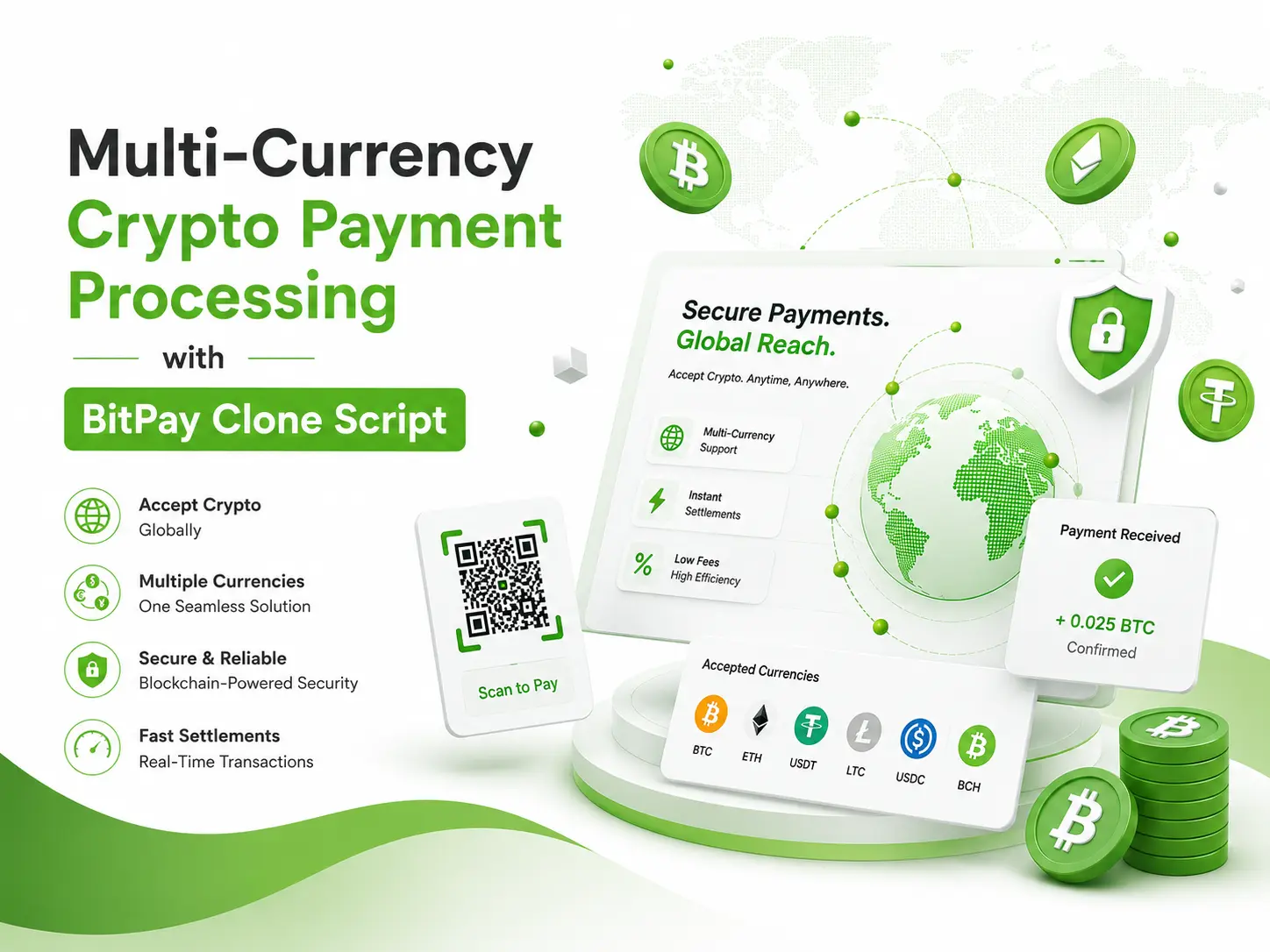
Why Business Get Crypto Payments Wrong?
Picture this: a customer in Germany wants to pay you in Bitcoin, another in Singapore wants to use USDT, and a third in Brazil only holds Litecoin. Your checkout page supports exactly one coin. Two of those three sales just walked away.
This is the silent revenue leak most merchants never notice. They assume “accepting crypto” means bolting on a single Bitcoin address and calling it done. Meanwhile, global crypto ownership crossed 560 million users in 2024 according to Crypto.com’s industry research, and that user base is spread across hundreds of coins and stablecoins — not one.
A multi-currency crypto payment gateway solves this by letting a single checkout accept dozens of cryptocurrencies, auto-convert them, and settle in the currency you actually want (fiat or stablecoin). The fastest, most cost-effective way to build one isn’t from scratch — it’s by deploying a BitPay clone script, a ready-made, customizable payment processing platform modeled on proven industry architecture.
At DigiTechzo, we’ve spent years building white-label crypto infrastructure for exchanges, wallets, and payment processors, which is what pushed us to write the guide we wish existed when we first evaluated clone scripts for a client’s payment stack. This article breaks down exactly what a multi-currency BitPay clone script is, how it technically works, what separates a good one from a liability, and how to launch one without the six-month build cycle.
Quick Answer
A multi-currency crypto payment gateway built on a BitPay clone script lets merchants accept 50+ cryptocurrencies through one integration, with automatic conversion, real-time settlement, and enterprise-grade security. Instead of building from zero (6–12 months, $150K+), a white-label clone script gets you live in 2–6 weeks at a fraction of the cost, while giving you full source-code ownership and customization control.
What Is a Multi-Currency Crypto Payment Gateway?
A multi-currency crypto payment gateway is software infrastructure that lets a business accept payments in multiple cryptocurrencies through a single integration point — typically an API, plugin, or hosted checkout page — while giving the merchant a unified dashboard to track, convert, and settle funds.
Unlike a single-coin wallet address (the “old” way businesses started accepting Bitcoin around 2013–2015), a proper gateway handles:
- Coin detection and conversion — customer pays in any supported coin, merchant receives their preferred settlement currency
- Real-time exchange rate locking — protects both parties from volatility during the payment window
- Multi-chain support — Bitcoin, Ethereum, and other blockchains have different transaction speeds and fee structures, and the gateway abstracts that complexity away
- Compliance and reporting — transaction logs formatted for accounting and tax purposes
In short: it’s the crypto equivalent of a Stripe or PayPal checkout, except it speaks 40–100 currencies instead of one.
What Is a BitPay Clone Script?
BitPay pioneered much of the modern crypto payment processing model — invoice-based checkout, merchant dashboards, automatic fiat settlement, and developer APIs. A BitPay clone script replicates this proven architecture as a deployable, white-label software package that any business or entrepreneur can license, customize, and launch under their own brand.
Think of it the way “Airbnb clone scripts” or “Uber clone scripts” work in other industries — the core logic and workflow are already engineered and battle-tested; what you’re buying is the accelerated path to market, not a copy of BitPay’s actual codebase or trademarks.
A quality clone script typically includes:
- Source code ownership (not a rented SaaS license)
- Admin panel for merchant and transaction management
- Plugin support for platforms like WooCommerce, Shopify, and Magento
- REST APIs for custom integrations
- White-label branding so the platform looks entirely like your own product
Why “Clone Script” Doesn’t Mean Low Quality
There’s a common misconception that clone scripts are cut-corner, copy-paste products. In reality, the best ones — including what we architect at Digitechzo — are built fresh on modern, audited codebases that follow the proven workflow of successful platforms while adding improvements: better security layers, additional coin support, and modular customization the original platforms don’t offer to third parties.
How Multi-Currency Payment Processing Actually Works
Understanding the technical flow helps you evaluate any script you’re considering. Here’s what happens in the ~2–10 minutes between a customer clicking “Pay with Crypto” and funds landing in your account:
Step 1: Invoice Generation
The gateway generates a unique invoice with a fixed fiat value (e.g., $250) and displays real-time crypto equivalents across supported currencies.
Step 2: Rate Locking
Because crypto prices can swing 2–5% in minutes, the system locks an exchange rate for a short window (typically 10–15 minutes) so neither merchant nor customer is exposed to volatility mid-transaction.
Step 3: Blockchain Confirmation
The customer sends payment from their wallet. The gateway monitors the relevant blockchain (Bitcoin, Ethereum, or others) for the required number of confirmations — usually 1–6 depending on the coin and risk tolerance configured by the merchant.
Step 4: Auto-Conversion (Optional)
If the merchant has opted for fiat or stablecoin settlement, the gateway executes conversion through integrated liquidity providers or exchanges, shielding the business from holding volatile assets.
Step 5: Settlement
Funds are deposited — either to a crypto wallet, a linked bank account, or a stablecoin balance — and the transaction is logged in the merchant dashboard for reconciliation.
This entire pipeline needs to be fast, secure, and resilient to network congestion — which is exactly where the quality of the underlying clone script matters most.
Core Features to Look For
Not every “multi-currency gateway” delivers on its promise. Here’s the feature checklist we recommend when evaluating any script:
| Feature | Why It Matters |
|---|---|
| 50+ coin support | Wider market reach, fewer abandoned checkouts |
| Non-custodial wallet option | Merchant controls private keys — reduces third-party risk |
| Multi-chain compatibility (BTC, ETH, BSC, Polygon, etc.) | Lower gas fees, faster confirmations for customers |
| Auto-conversion to fiat/stablecoin | Removes volatility exposure for merchants |
| White-label branding | Builds trust and brand consistency |
| Two-factor authentication & cold storage integration | Security against hacks — critical given $2.2B+ was lost to crypto hacks in 2024 per Chainalysis data |
| Plugin/API ecosystem | Faster integration with existing e-commerce stacks |
| Real-time analytics dashboard | Business intelligence for reconciliation and reporting |
Pros and Cons of a BitPay Clone Script Approach
Pros:
- Launch in weeks, not months
- Full source-code ownership (no recurring platform lock-in with some vendors)
- Customizable to your exact currency and branding needs
- Lower upfront cost than ground-up development
Cons:
- Quality varies enormously between vendors — due diligence is essential
- Some cheap scripts skimp on security audits (a critical red flag)
- You still need ongoing technical maintenance post-launch
Build vs. Buy vs. Clone: A Real Comparison
| Approach | Time to Launch | Typical Cost | Customization | Risk Level |
|---|---|---|---|---|
| Build from scratch | 6–12 months | $150,000–$400,000+ | Full | High (dev/security risk) |
| SaaS gateway (rent access) | 1–2 weeks | Ongoing % fees, no ownership | Limited | Low, but vendor-dependent |
| BitPay clone script | 2–6 weeks | $5,000–$40,000 (one-time, varies by scope) | High | Medium (vendor quality-dependent) |
For most businesses — especially exchanges, e-commerce platforms, remittance startups, and fintechs — the clone script sits in the sweet spot: enterprise-grade functionality without enterprise-grade timelines or budgets.
Use Cases: Who Actually Needs This
- E-commerce platforms expanding into crypto-native customer segments without losing conversion rate to unsupported coins
- Crypto exchanges wanting to offer merchant payment processing as a value-added revenue stream
- Remittance and cross-border payment startups avoiding traditional SWIFT delays and fees
- SaaS companies billing international clients who prefer stablecoin payments over currency-conversion-heavy card processing
- Entrepreneurs launching a payment processor brand who want to compete with established players without BitPay’s or Coinbase Commerce’s fee structures
Real scenario: A mid-sized online electronics retailer we advised was losing an estimated 8–12% of international checkout attempts because their single-coin BTC wallet didn’t match customer wallet holdings. After deploying a multi-currency gateway, checkout abandonment on the crypto payment option dropped noticeably within the first billing cycle — because customers could finally pay in the coin they already held, without needing to buy or swap currencies mid-purchase.
Common Mistakes Businesses Make
- Choosing the cheapest script without a security audit. Payment infrastructure is not where you cut corners — an unaudited script is a future breach waiting to happen.
- Ignoring multi-chain gas fee differences. A gateway that only routes through Ethereum mainnet without Layer-2 or alt-chain support will frustrate customers with high fees.
- Skipping compliance planning. Depending on your jurisdiction, crypto payment processing may trigger KYC/AML obligations — plan for this before launch, not after a regulator inquiry.
- Underestimating settlement volatility risk. Merchants who hold crypto without auto-conversion can see real revenue swings of 5–15% in a single day.
- Treating it as “set and forget.” Blockchain networks evolve — new coins, updated protocols, fee structures. A gateway needs maintenance, not just a launch.
- No fallback for failed/delayed transactions. Network congestion happens; a good system needs clear timeout and refund logic, not silent failures.
Expert Tips for Choosing a Clone Script Vendor
- Ask for a live demo on testnet, not just screenshots. If a vendor hesitates, that’s a signal.
- Request the security audit report. Reputable vendors have had smart contracts and wallet modules independently reviewed.
- Check for non-custodial architecture options. You want control over funds, not dependency on a third party’s solvency.
- Verify multi-chain roadmap, not just current support. New chains and tokens emerge constantly; ask how updates are handled.
- Clarify licensing terms clearly. Confirm whether you get full source code, white-label rights, and unrestricted resale/customization — some vendors quietly restrict this.
- Start with a pilot on one product line or region before a full rollout, so you can stress-test settlement and support workflows with real (but limited) transaction volume.
This is the same evaluation framework our team at Digitechzo walks clients through before any deployment — it filters out roughly half of vendors in the market within the first two questions.
FAQs
1. What is a multi-currency crypto payment gateway?
It’s a payment processing system that allows a business to accept multiple cryptocurrencies through a single checkout, with automatic conversion and settlement into a preferred currency, similar to how a card processor handles multiple card networks through one integration.
2. Is a BitPay clone script legal?
Yes. A clone script replicates a proven software workflow and architecture, not proprietary code or trademarks. It’s comparable to how many e-commerce platforms share similar checkout flows. Businesses should still ensure their vendor delivers original, independently built code.
3. How much does a multi-currency crypto payment gateway cost to launch?
Costs typically range from $5,000–$40,000 for a white-label clone script depending on features, source code ownership, and customization scope — significantly less than the $150,000+ typically required to build comparable infrastructure from scratch.
4. How many cryptocurrencies can a BitPay clone script support?
Most quality clone scripts support 50–100+ cryptocurrencies and major stablecoins, with multi-chain compatibility across networks like Bitcoin, Ethereum, BNB Chain, and Polygon.
5. Do I need a crypto license to run a payment gateway?
Requirements vary by country and depend on whether you custody customer funds. Non-custodial models typically face lighter regulatory requirements than custodial ones, but you should always consult a legal professional familiar with your jurisdiction before launch.
Conclusion
A multi-currency crypto payment gateway isn’t a nice-to-have anymore — it’s table stakes for any business that wants to capture the growing share of customers who transact in crypto. Building one from scratch is slow and expensive; renting SaaS access limits your control and long-term margins. A well-built BitPay clone script gives you the fastest path to a secure, scalable, fully-owned payment platform — without reinventing engineering that’s already been proven at scale.
If you’re evaluating vendors, don’t just compare price — compare security posture, source code ownership, multi-chain roadmap, and post-launch support. That’s the difference between a payment gateway that grows with your business and one that becomes a liability.
About The Author