

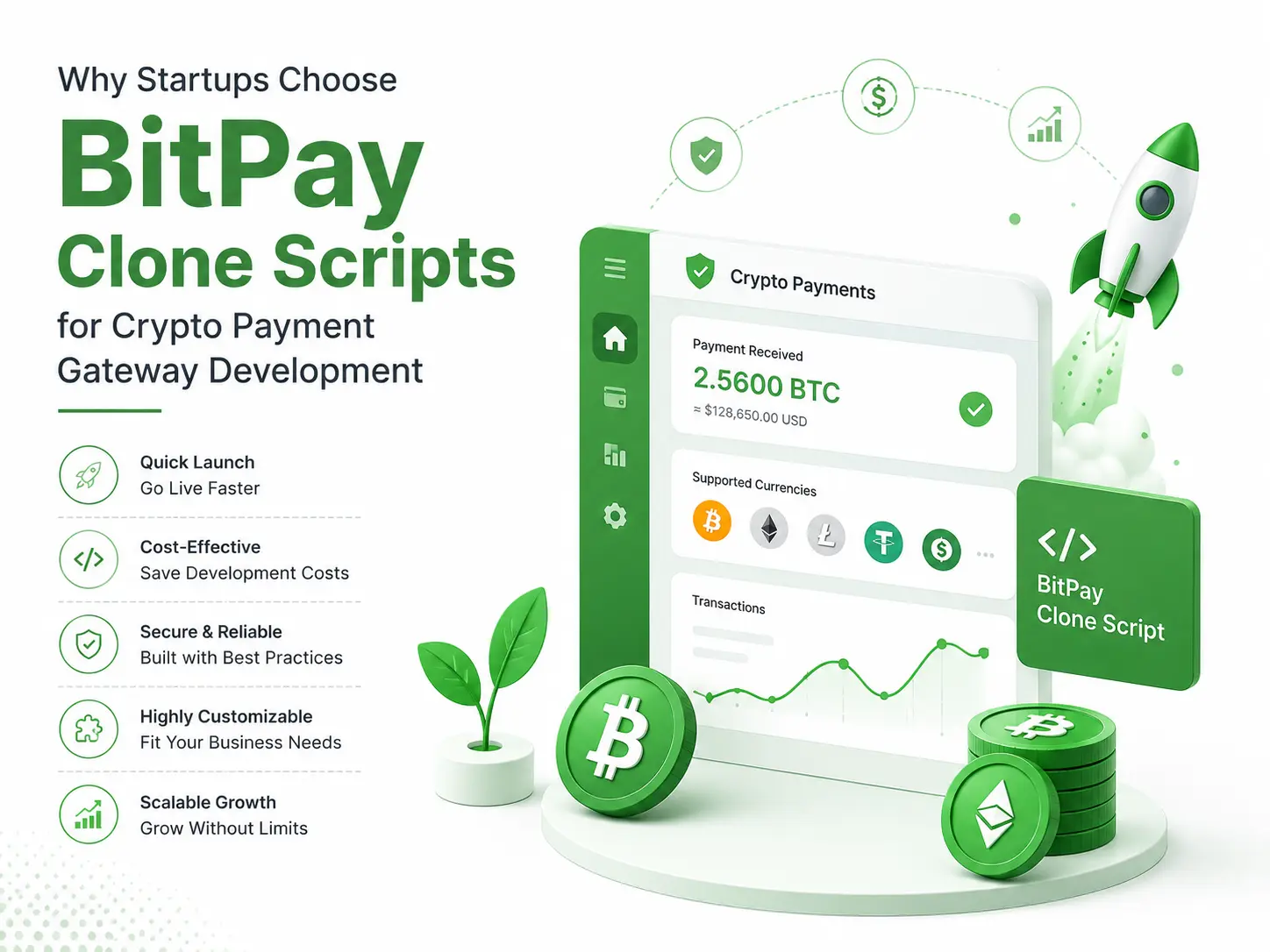
A founder we spoke with last quarter had a working product, a small user base, and one blocker standing between him and revenue: he couldn’t accept crypto payments without either paying a payment processor 3-4% per transaction or spending eight months building infrastructure from scratch. He’s not alone. This is the exact wall hundreds of Web3 startups hit every year, and it’s the reason why crypto payment gateway development through pre-built clone scripts has become the default path for lean teams that need to launch fast without burning their runway on infrastructure.
At DigiTechzo, we’ve worked with founders in exactly this position — teams that needed a production-ready crypto payment gateway in weeks, not quarters. This guide breaks down why BitPay clone scripts specifically have become the go-to solution, what’s actually inside one, where the trade-offs lie, and how to evaluate whether this route fits your business.
Quick Answer
BitPay clone scripts give startups a pre-built, customizable crypto payment gateway framework that replicates BitPay’s core architecture — multi-currency wallet support, invoice generation, merchant dashboards, and settlement logic — without the 6-12 month build cycle of custom development. They cost a fraction of ground-up development, launch in 2-6 weeks, and are best suited to startups that need speed and cost efficiency over full architectural ownership.
What Is a BitPay Clone Script?
A BitPay clone script is a pre-developed software framework that replicates the core functionality of BitPay — one of the earliest and most established crypto payment processors — including invoice creation, wallet integration, multi-chain support, merchant onboarding, and transaction settlement.
Unlike a copy-paste template, a well-built clone script is a modular foundation. Development teams take this base architecture and customize the branding, supported coins, fee structure, compliance layer, and UI to match a specific business model — whether that’s an exchange, an e-commerce checkout plugin, or a B2B invoicing tool.
Think of it the way you’d think of a WordPress theme for e-commerce: the checkout logic, cart, and payment flow already work. You’re not reinventing payment processing — you’re adapting a proven system to your brand and your users.
Why Crypto Payment Gateway Development Is Hard to Build From Scratch
Before understanding why clone scripts win, it helps to understand what founders are actually up against with ground-up crypto payment gateway development:
- Multi-chain complexity — Supporting Bitcoin, Ethereum, and stablecoins like USDT/USDC each requires separate node integration, wallet logic, and gas fee handling.
- Security architecture — Cold/hot wallet separation, multi-signature approval, and key management aren’t optional; a single vulnerability can mean total fund loss.
- Regulatory layers — KYC/AML integration varies by jurisdiction and changes frequently.
- Real-time exchange rate handling — Crypto volatility means your gateway needs live price feeds and conversion logic to avoid merchant losses.
- Settlement and payout systems — Merchants need reliable fiat or stablecoin payout options, which requires banking or liquidity partnerships.
Industry estimates for custom-built crypto payment gateways with this level of functionality typically range from $40,000-$150,000+ in development costs and 6-12 months in timeline, depending on chain support and compliance scope. For a startup validating a market, that’s often more capital and time than the runway allows.
Why Startups Specifically Choose Clone Scripts
1. Speed to Market
A BitPay clone script can go from acquisition to live deployment in 2-6 weeks versus 6-12 months for custom builds. For startups racing to capture early market share, this compressed timeline is often the single deciding factor.
2. Lower Upfront Capital Risk
Instead of front-loading six figures into infrastructure before validating demand, founders spend a fraction of that on a proven framework and preserve capital for marketing, liquidity, and compliance.
3. Battle-Tested Architecture
BitPay has processed crypto transactions at scale since 2011. A clone script inherits architectural patterns — invoice expiration handling, double-spend protection, webhook-based confirmations — that have already been stress-tested in production, rather than patterns a new dev team has to discover through trial and error.
4. Easier Compliance Retrofitting
Most clone scripts come with a KYC/AML module already scaffolded, which is significantly easier to configure to a specific jurisdiction than building identity verification logic from zero.
5. Focus Shifts to Differentiation, Not Plumbing
When the payment infrastructure is already solid, the founding team can spend its engineering hours on what actually differentiates the product — user experience, merchant tools, loyalty features — instead of re-solving problems that are already solved industry-wide.
Example scenario: A Southeast Asian e-commerce startup wanted to let merchants accept USDT and Bitcoin at checkout. Building custom infrastructure was quoted at 8 months. Using a customized BitPay clone script with a payment plugin layer, they launched merchant-side crypto checkout in 5 weeks and onboarded their first 40 merchants within the following quarter.
What’s Actually Inside a BitPay Clone Script
A genuinely usable clone script — not just a UI skin — includes:
- Multi-currency wallet engine (BTC, ETH, major stablecoins, and often Layer 2 tokens)
- Invoice generation system with expiration timers and QR code checkout
- Merchant dashboard for tracking transactions, payouts, and analytics
- Admin panel for managing fee structures, supported coins, and user permissions
- Webhook and API layer for e-commerce plugin integrations (Shopify, WooCommerce, Magento)
- Settlement module for converting crypto to fiat or stablecoin payouts
- Security layer: multi-sig wallets, 2FA, encrypted key storage
- KYC/AML scaffolding for compliance customization
If a vendor’s “clone script” is missing the settlement module or security layer, it’s a front-end demo, not a deployable gateway — a distinction worth confirming before you buy.
Clone Script vs Custom Development vs Third-Party API
| Factor | BitPay Clone Script | Custom Build | Third-Party API (e.g., Coinbase Commerce) |
|---|---|---|---|
| Time to launch | 2-6 weeks | 6-12 months | 1-2 weeks |
| Upfront cost | Low-Moderate | High | Low (but ongoing fees) |
| Code ownership | Full ownership after purchase | Full ownership | None — you’re renting access |
| Customization depth | High | Highest | Limited to API’s allowed parameters |
| Long-term transaction fees | None (self-hosted) | None (self-hosted) | Typically 1%+ per transaction |
| Compliance control | Configurable | Fully custom | Locked to provider’s policy |
| Best for | Startups needing speed + ownership | Enterprises with unique architecture needs | MVPs testing demand with minimal investment |
Featured snippet answer: The main difference between a BitPay clone script and a third-party crypto payment API is ownership. A clone script gives you a self-hosted, fully owned gateway with no recurring transaction fees, while a third-party API is a rented service that charges per-transaction and limits customization.
Pros and Cons of BitPay Clone Scripts
Pros
- Significantly faster deployment than custom builds
- Full source code ownership (with reputable vendors)
- No recurring per-transaction platform fees
- Proven architecture reduces security and stability risk
- Customizable branding, fee logic, and supported assets
Cons
- Quality varies heavily by vendor — poorly built scripts carry real security risk
- Still requires internal or outsourced dev resources for customization and maintenance
- Compliance modules need jurisdiction-specific configuration, not plug-and-play
- Less architectural flexibility than a fully custom system if your use case is highly unconventional
Common Mistakes Startups Make
- Choosing the cheapest vendor without a security audit. A clone script handling real crypto transactions without third-party penetration testing is a liability, not a shortcut.
- Assuming “clone” means “copy-paste ready.” Every serious deployment needs configuration for supported coins, fee logic, and regional compliance — skipping this step leads to broken user experiences at launch.
- Ignoring liquidity and payout infrastructure. A gateway that accepts crypto but has no reliable fiat/stablecoin settlement path leaves merchants stuck holding volatile assets.
- Underestimating ongoing maintenance. Blockchain networks update, node software needs patching, and new stablecoins emerge — a clone script isn’t “set and forget.”
- Skipping legal review of KYC/AML setup. Regulatory requirements differ by country; a US-focused compliance template won’t automatically satisfy EU or APAC requirements.
Expert Tips Before You Buy or Build
- Ask for the source code, not just a demo. Reputable vendors hand over full, well-documented source code — not obfuscated builds you can’t audit or extend.
- Request a security audit report or commission an independent one before going live with real funds.
- Start with fewer supported coins. Launching with BTC, ETH, and one or two major stablecoins is easier to secure and maintain than supporting a dozen chains from day one.
- Budget for post-launch development, not just the initial purchase — plan for at least 15-20% of the initial build cost annually for maintenance and upgrades.
- Validate the settlement partner before committing — ask how fiat payouts are processed and what the actual settlement time is, not just the marketed one.
FAQs
Q1: Is a BitPay clone script legal to use?
Yes. A clone script refers to replicating BitPay’s functionality and architecture pattern, not copying proprietary code or trademarks. Reputable development vendors build original codebases inspired by BitPay’s feature set, which is standard practice in fintech and SaaS development.
Q2: How much does a BitPay clone script cost?
Costs vary by vendor, feature depth, and customization level, generally landing well below the cost of fully custom crypto gateway development. Get itemized quotes covering source code, customization, and post-launch support separately.
Q3: Can a BitPay clone script handle high transaction volume?
Yes, if built on scalable architecture with proper database indexing, load balancing, and node infrastructure. Volume capacity depends on the underlying build quality, not the “clone script” label itself — this is why vendor due diligence matters.
Q4: Do I need a crypto license to launch a payment gateway?
In most jurisdictions, yes — operating a money services business or payment processor typically requires registration or licensing. This varies significantly by country, so legal consultation before launch is essential regardless of which development path you choose.
Q5: What’s the difference between a BitPay clone and a white-label crypto payment solution?
A clone script typically gives you owned source code to modify freely, while white-label solutions are often licensed software you rent with restrictions on modification. Clone scripts generally offer more long-term flexibility; white-label options can be faster to deploy but come with vendor lock-in.
Conclusion
Crypto payment gateway development doesn’t have to mean a year-long engineering sprint before you see your first transaction. For startups that need to move fast, protect runway, and still own their infrastructure long-term, BitPay clone scripts offer a genuinely practical middle ground between expensive custom builds and restrictive third-party APIs — provided you choose a vendor who delivers real, audited, production-grade code rather than a superficial demo.
If you’re evaluating whether a clone script fits your roadmap, it’s worth getting a technical assessment before committing capital. Digitechzo works with startups on exactly this kind of crypto payment infrastructure decision — from architecture review to full deployment — and can walk you through what a realistic build would look like for your specific use case.
About The Author