
The $80 Billion Opportunity You Could Be Missing
Imagine launching your own NFT marketplace — without writing a single line of code from scratch, without burning through months of development time, and without spending $200,000+ on a custom build. That is exactly what an NFT marketplace script makes possible.
The NFT market, despite its well-publicized cycles, remains a fundamentally transformative space. Trading volume across major platforms crossed $80 billion in peak periods, and the infrastructure demand — white-label platforms, niche marketplaces, creator-focused ecosystems — is still wide open. The question is not whether NFT marketplaces will remain relevant. It is who will build the next generation of them.
At DigiTechzo, we have worked with entrepreneurs, gaming studios, music labels, and real estate companies to deploy NFT trading platforms rapidly using ready-made marketplace scripts. What we consistently see is that businesses that move fast with proven technology win market share. Those that wait for a perfect custom build often miss the window entirely.
This guide gives you the full picture: what an NFT marketplace script actually contains, how to evaluate your options, what it costs, and how to launch a platform that can compete in real markets — not just in a sandbox.
|
What Is an NFT Marketplace Script?
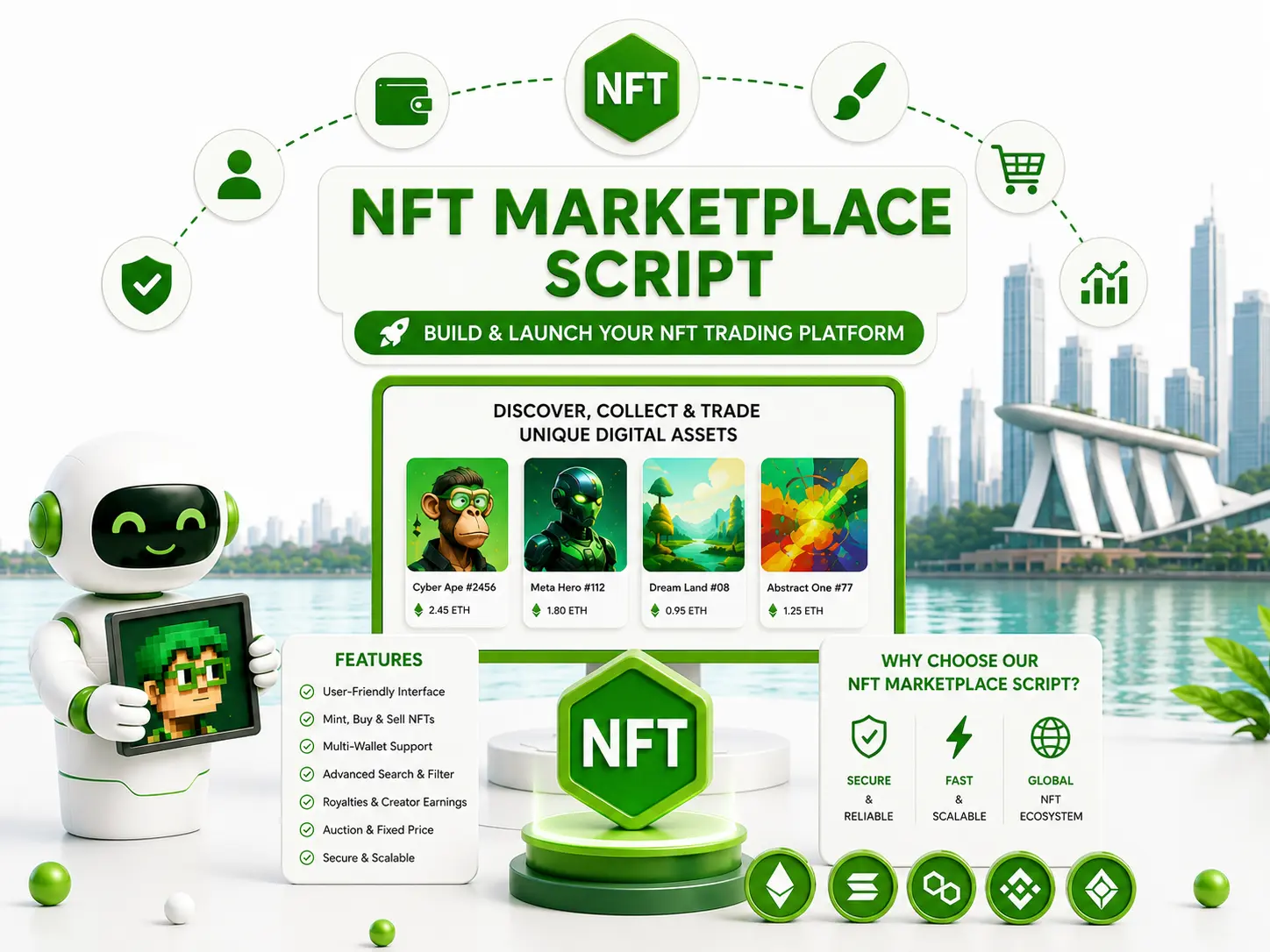
An NFT marketplace script is a pre-developed, fully functional codebase that replicates the core functionality of platforms like OpenSea, Rarible, or LooksRare — customized and rebranded for your specific use case.
Think of it as a turnkey framework. The heavy technical lifting — smart contract architecture, wallet integration, blockchain API connections, auction logic, and metadata handling — is already done. You inherit a battle-tested foundation and layer your brand, niche, and features on top.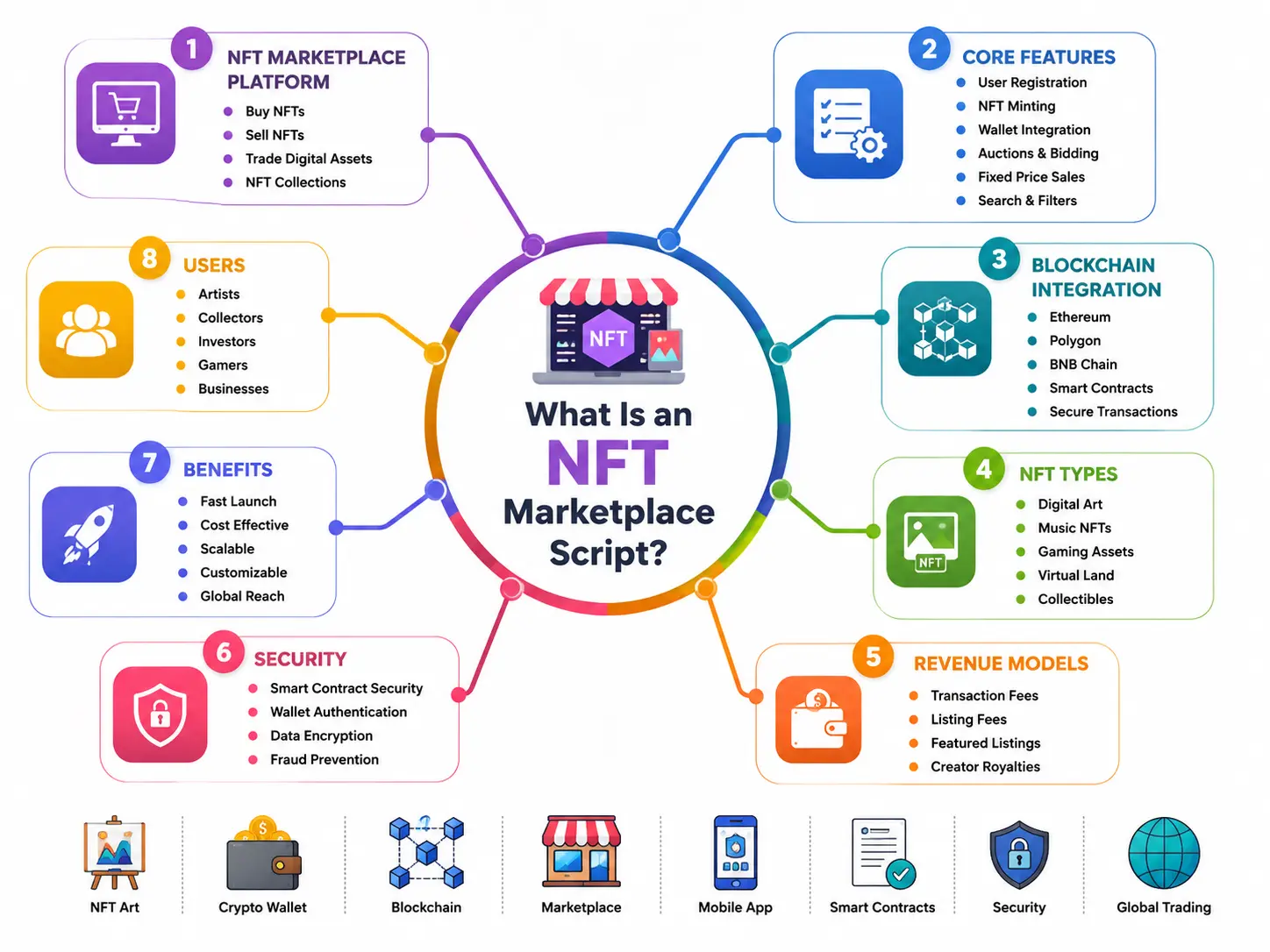
What a Typical NFT Marketplace Script Includes
- Smart contracts for minting, buying, selling, and transferring NFTs
- User authentication and wallet connection (MetaMask, WalletConnect, Coinbase Wallet)
- NFT minting interface for creators
- Auction and fixed-price listing mechanisms
- Royalty distribution logic (typically ERC-2981 standard)
- Admin dashboard for platform management
- Search, filter, and collection browsing
- Activity feeds and transaction history
- Multi-blockchain support (Ethereum, Polygon, BNB Chain, Solana)
Unlike a SaaS marketplace builder, a script gives you full ownership of the source code. You are not renting access — you own the platform.
Why Use an NFT Marketplace Script Instead of Building from Scratch?
This is one of the most important strategic decisions an NFT entrepreneur will make. Here is a direct comparison:
|
Factor |
Custom Build vs. Script |
|
Development Time |
Custom: 6-18 months | Script: 2-8 weeks |
|
Cost |
Custom: $150,000-$500,000+ | Script: $5,000-$50,000 |
|
Smart Contract Audits |
Custom: Required separately | Script: Often pre-audited |
|
Code Ownership |
Custom: Full | Script: Full (white-label) |
|
Time to Market |
Custom: Slow | Script: Fast |
|
Customization Depth |
Custom: Unlimited | Script: High (with modifications) |
|
Ongoing Maintenance |
Custom: Your team | Script: Vendor support available |
The math is simple: a script compresses your time to market by 80-90% while maintaining nearly all the flexibility of a custom build — especially when you choose a script with clean, well-documented code.
The Hidden Cost of Building from Scratch
Most entrepreneurs underestimate what a custom NFT marketplace actually requires: Solidity developers for smart contracts, backend engineers for indexing and APIs, frontend developers for the UI, security auditors for smart contract review, and a DevOps team for blockchain node infrastructure. A script eliminates or dramatically reduces all of these.
Core Features Every NFT Marketplace Script Must Have
Not all scripts are created equal. Before evaluating any NFT marketplace script, use this checklist of non-negotiable features:
Essential Smart Contract Features
- ERC-721 and ERC-1155 token standard support
- Lazy minting (gas-free minting until first sale)
- On-chain royalty enforcement (ERC-2981)
- Bulk minting capability
- Escrow logic for auction settlements
Platform & UX Features
- Storefront creator pages with customizable branding
- Collection creation and management
- Advanced search with trait/attribute filtering
- Mobile-responsive design
- Real-time notifications for bids and sales
Business & Monetization Features
- Configurable platform fee (typically 1-5% per transaction)
- Featured collection and banner placement (for paid promotion)
- Admin whitelist and content moderation tools
- Analytics dashboard for volume, users, and revenue
- Multi-currency support (ETH, MATIC, USDC, etc.)
Security Requirements
- Verified smart contract audits from reputable firms (Certik, Hacken, etc.)
- Rate limiting and bot protection
- IPFS or Arweave decentralized storage integration
- Two-factor authentication for admin accounts
Types of NFT Marketplace Scripts
The NFT marketplace script market has segmented meaningfully. Understanding the categories helps you choose the right foundation for your platform.
General-Purpose Marketplace Scripts
These replicate the OpenSea model — broad asset support, multiple categories, public access. Best for entrepreneurs who want to capture a wide creator audience or build a regional marketplace alternative.
Niche-Vertical Scripts
Vertical scripts are pre-configured for specific asset classes. Examples include gaming asset marketplaces (with in-game item metadata schemas), music NFT platforms (with streaming preview support), sports collectibles platforms, and real estate tokenization marketplaces. These provide a competitive edge by including domain-specific features out of the box.
White-Label Enterprise Scripts
Designed for businesses, agencies, and brands that want to deploy branded NFT experiences. These typically include more robust admin controls, multi-tenant architecture, and enterprise support SLAs.
Multichain Marketplace Scripts
As the NFT ecosystem has fragmented across Ethereum, Polygon, Solana, BNB Chain, Avalanche, and Layer 2 networks like Arbitrum and Optimism, multi-chain support has become a key differentiator. The best scripts today support cross-chain asset display and at minimum two EVM-compatible chains.
Top NFT Marketplace Script Platforms — Compared
Based on technical evaluation, community feedback, and feature depth, here are the leading NFT marketplace script solutions in the market:
|
Platform / Script |
Best For |
Key Strengths |
|
Rarible Protocol (open source) |
Developers |
Multichain, open standard, royalty support |
|
NFT-Marketplace (GitHub OSS) |
Startups |
EVM compatible, low cost, fast deploy |
|
Appy Pie NFT Builder |
No-code users |
Drag-and-drop, quick setup |
|
Digitechzo White-Label Script |
Entrepreneurs & Enterprises |
Full source code, audit-ready, multichain |
|
OpenSea SDK |
Aggregator builders |
Deep liquidity integration, API-first |
|
Mintable Clone Script |
Creator platforms |
Lazy minting focus, strong creator UX |
Selecting the right script depends on your niche, technical team capacity, budget, and go-to-market speed requirements. For most commercial deployments, a white-label NFT marketplace script with source code ownership is the most strategically sound choice.
How to Choose the Right NFT Marketplace Script
With dozens of options available, use this evaluation framework before making a purchase decision:
Step 1 — Define Your Niche and Target User
The biggest mistake is starting with technology before strategy. Who are your creators? What kind of NFTs will your platform feature — art, gaming items, music, real estate tokens, event tickets? Your niche determines which script type fits.
Step 2 — Evaluate Blockchain Compatibility
If you are targeting Ethereum-native collectors, ensure Ethereum mainnet support. If you want low gas fees for mass-market creators, Polygon or BNB Chain support is essential. If you are eyeing Solana’s gaming-heavy user base, you need a Solana-compatible codebase or a multichain architecture.
Step 3 — Assess Code Quality and Documentation
Request access to a demo, review the code repository structure, and evaluate the documentation quality. Poor documentation is a red flag — it means customization will be expensive and slow. Clean modular code with clear separation of concerns is what you want.
Step 4 — Verify Smart Contract Audit Status
Smart contract vulnerabilities have cost NFT platforms millions. Confirm whether the script’s contracts have been audited, by whom, and when. A reputable script vendor will provide the audit report on request.
Step 5 — Confirm Licensing and Resale Terms
Some scripts have restrictive licenses that prevent white-labeling or resale. Ensure the license explicitly grants you the right to brand, modify, and commercialize the platform without royalty obligations to the script provider.
Step 6 — Evaluate Support and Update Commitments
Blockchain protocols evolve rapidly. ERC standards, gas optimization techniques, and wallet APIs change frequently. A script vendor that commits to periodic updates is an asset; one that sells and disappears is a liability.
Step-by-Step: How to Launch Using an NFT Marketplace Script
Here is a realistic launch roadmap for a production-grade NFT marketplace using a white-label script:
Phase 1: Preparation (Week 1)
- Define your platform niche, target blockchain(s), and primary asset categories
- Acquire the NFT marketplace script with full source code license
- Set up development environment: Node.js, Hardhat/Truffle, IPFS node or Pinata account
- Register your domain and cloud hosting (AWS, GCP, or Vercel for frontend)
Phase 2: Configuration and Customization (Weeks 2-3)
- Deploy smart contracts to testnet; run initial functional tests
- Configure platform fee percentage, supported tokens, and chain RPC endpoints
- Apply branding: logo, color scheme, typography, homepage layout
- Set up IPFS/Arweave storage for NFT metadata and media
- Integrate wallet providers: MetaMask, WalletConnect at minimum
Phase 3: Testing (Week 4)
- Conduct end-to-end QA: minting, listing, buying, auction bid/settle flows
- Run a security review on smart contract interactions
- Test on mobile devices; validate responsive layout
- Load test the backend for concurrent user scenarios
Phase 4: Launch (Week 5-6)
- Deploy smart contracts to mainnet
- Configure your domain, SSL, and CDN
- Onboard initial creator partners for launch collections
- Announce platform via social media, Discord, and Web3 communities
- Monitor platform health, gas estimations, and transaction indexing
NFT Marketplace Script Pricing: What to Expect
Pricing for NFT marketplace scripts varies significantly based on feature depth, blockchain support, source code access, and support terms:
|
Tier |
What You Get |
|
Open Source (Free) |
Base functionality, limited support, requires significant dev work |
|
Entry-Level ($2,000-$8,000) |
Single chain, basic features, limited customization |
|
Mid-Range ($8,000-$25,000) |
Multi-chain, full source code, 3-6 months support |
|
Enterprise ($25,000-$80,000+) |
Custom features, dedicated support, audit assistance, SLA |
For most serious commercial deployments, the $8,000-$25,000 range represents the best value — you get full source code ownership, multichain support, and enough vendor support to navigate the initial deployment complexity.
Compare that to the cost of a single senior Solidity developer ($150-$250/hour) — a custom build starts looking extremely expensive very quickly.
Common Mistakes When Launching an NFT Marketplace
After working with dozens of NFT platform launches, these are the mistakes that consistently derail projects:
Mistake 1: Skipping Smart Contract Audits
Even if the script vendor claims the contracts are pre-audited, any customization you make to the smart contracts requires a fresh review. Unaudited contract changes have resulted in catastrophic exploits across multiple platforms.
Mistake 2: Choosing the Wrong Blockchain for Your Audience
Launching an art marketplace on BNB Chain when your target collectors primarily use Ethereum is a mismatch that will hurt creator and buyer adoption. Research where your target audience already lives on-chain.
Mistake 3: Underinvesting in Liquidity and Creator Onboarding
A marketplace with no listings is a ghost town. Successful launches always have curated initial collections ready to go live on day one. Creator partnerships before launch — not after — are what drive early traction.
Mistake 4: Ignoring IPFS/Decentralized Storage
Storing NFT metadata on centralized servers defeats a core value proposition of NFTs. If your server goes down, the NFTs effectively break. Always use IPFS or Arweave for metadata and media storage.
Mistake 5: Underestimating Gas Optimization
High gas fees drive users away. If you are deploying on Ethereum mainnet, ensure your smart contracts are gas-optimized. Lazy minting, where gas is paid only on first sale, is the modern standard and should be non-negotiable.
Mistake 6: Buying a Script Without Reviewing the Code
Some vendors sell screenshots and demos but deliver spaghetti code that is impossible to customize. Always request a code preview or GitHub access to the repository before purchasing.
Expert Tips for a Successful NFT Platform Launch
Tip 1: Niche Down to Stand Out
The market does not need another general-purpose marketplace competing with OpenSea. The biggest opportunities in 2025-2026 are vertical platforms: gaming assets, tokenized real-world assets (RWAs), music rights, fashion NFTs, and creator membership passes. A focused niche lets you build a community, not just a platform.
Tip 2: Build the Community Before the Platform
The most successful NFT marketplaces we have seen launch with an engaged Discord or Telegram community already primed. Start community building 60-90 days before your go-live date. Your first 500 community members are more valuable than any feature.
Tip 3: Implement a Creator Verification System
Copy fraud — someone uploading another creator’s work — is rampant on open marketplaces. Implement a lightweight creator verification process (even just social media profile linking) before listing. This protects your brand and creator relationships.
Tip 4: Design for Mobile from Day One
Over 60% of NFT browsing happens on mobile, even if purchases tend to happen on desktop. A mobile-optimized UI is not optional. Ensure your script renders correctly on iOS and Android before launch.
Tip 5: Plan Your Revenue Model Beyond Transaction Fees
Platform fees (1-2.5%) are the obvious revenue stream. But the most resilient marketplace businesses layer in: featured listing fees, launchpad services for new collections, creator verification badges, and branded white-label deployments for enterprise clients. Think about this at the architecture stage so you can enable these features without rebuilding.
Tip 6: Use Testnet for Soft Launches
Before mainnet deployment, run a 2-4 week public testnet phase with real users. This surfaces UX issues, smart contract edge cases, and gas estimation errors in a zero-risk environment. Many high-profile launch failures could have been avoided with proper testnet testing.
Frequently Asked Questions (FAQs)
What is an NFT marketplace script?
An NFT marketplace script is a pre-built software package containing all the code needed to run a functioning NFT trading platform. It includes smart contracts, a frontend interface, backend APIs, and admin tools — enabling entrepreneurs to launch their own marketplace without building from scratch.
How long does it take to launch an NFT marketplace using a script?
With a properly documented, high-quality NFT marketplace script, most platforms can be configured, customized, and launched to mainnet within 4-8 weeks. Complex customizations or novel blockchain integrations may extend the timeline to 10-12 weeks.
Do I need to know how to code to use an NFT marketplace script?
Basic configuration (branding, fee settings, supported chains) can often be done without deep coding knowledge. However, meaningful customization of smart contracts and backend logic requires Solidity experience and Node.js/React skills. Most serious commercial deployments involve at least a small technical team.
Is it legal to use a white-label NFT marketplace script?
Yes, provided you purchase a script with a commercial license that explicitly permits white-labeling and resale. Always review the license agreement before purchasing. You are responsible for compliance with local securities laws regarding tokenized assets on your platform.
How much does it cost to build an NFT marketplace from an NFT marketplace script?
The script itself typically costs between $5,000 and $50,000 depending on the feature tier. Add to that server infrastructure costs ($200-$1,000/month), blockchain deployment costs (gas fees for smart contract deployment, which range from $100 to $2,000+ depending on the chain and network conditions), and optional customization development work.
Conclusion: The Fastest Path to Your Own NFT Marketplace
The NFT marketplace space is not slowing down — it is maturing. That means the window for launching a differentiated, niche-focused platform with loyal creators and engaged collectors is very much open. The platforms that win in this next phase will not be the ones that spent 18 months building from scratch. They will be the ones that used an NFT marketplace script to move fast, validate their concept, and iterate based on real user feedback.
An NFT marketplace script gives you everything you need: the smart contract architecture, the trading mechanics, the creator tools, and the admin infrastructure. What you bring is the vision, the niche, and the community.
At DigiTechzo, we specialize in white-label NFT marketplace scripts that are production-ready, multichain, and fully customizable — with smart contracts that can be reviewed and audited independently. Whether you are an entrepreneur entering the Web3 space, a business tokenizing real-world assets, or a gaming studio building an in-game economy, we can help you launch faster and smarter.
About The Author