
The decentralized finance (DeFi) revolution is no longer a trend — it’s a multi-trillion-dollar infrastructure shift. If you’re a startup, entrepreneur, or enterprise looking to launch your own decentralized trading platform, a DeFi Exchange Script is the fastest, most cost-efficient path forward. But not all scripts are created equal, and choosing the wrong foundation can cost you months of development time and hundreds of thousands of dollars.
At DigiTechzo, we’ve helped dozens of businesses launch fully functional, scalable decentralized exchanges using white label DeFi scripts — and in this guide, we’ll share everything we’ve learned so you don’t have to figure it out the hard way.
Quick Answer
A DeFi Exchange Script is a pre-built, customizable codebase that lets you launch a decentralized exchange (DEX) without building from scratch. White label versions give you full branding control, faster time-to-market (2-6 weeks vs. 6-12 months), and significantly lower development costs. The best scripts include smart contract integration, liquidity pool management, and multi-chain support.
What Is a DeFi Exchange Script?
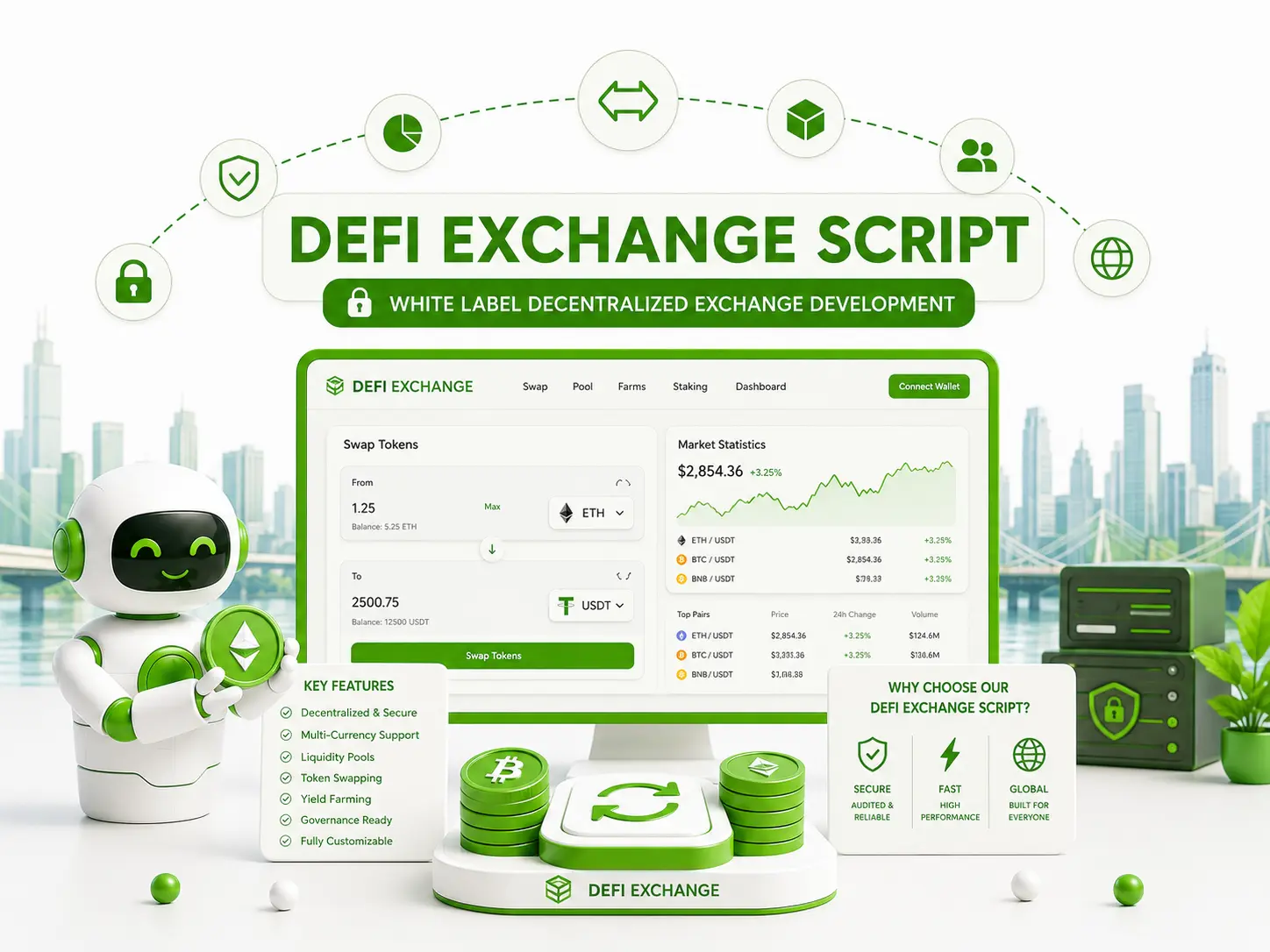
A DeFi Exchange Script is a ready-made software solution that replicates the core functionality of a decentralized exchange. Think of it as a turnkey DEX platform — one that handles everything from token swaps and liquidity pools to smart contract execution and wallet connectivity — without requiring you to build each component from zero.
These scripts are designed to replicate or improve on proven DEX platforms like Uniswap, PancakeSwap, or SushiSwap, giving you a technically solid, audited foundation to build your own brand on top of.
What a DeFi Exchange Script Typically Includes:
- Automated Market Maker (AMM) engine or order book logic
- Smart contracts for token swaps and liquidity provision
- Admin dashboard for fee configuration and token listing
- Web3 wallet integration (MetaMask, WalletConnect, Trust Wallet)
- Multi-chain support (Ethereum, BSC, Polygon, Solana, etc.)
- Frontend user interface (fully brandable)
- Yield farming and staking modules (in premium versions)
The ‘white label’ aspect means the entire frontend, branding, and user experience is yours — your logo, your colors, your domain, your name.
How Does a White Label DEX Script Work?
Understanding the technical architecture helps you evaluate vendors and make smarter decisions. Here’s a simplified breakdown of how a white label DeFi exchange script operates:
Layer 1: Smart Contracts (On-Chain Logic)
The backbone of any DEX is its smart contracts. These self-executing programs live on the blockchain and handle all trade logic — including swaps, fees, liquidity pool ratios, and slippage protection. A quality DeFi exchange script comes with pre-audited smart contracts that you can deploy to your target chain.
Layer 2: Backend / Middleware
This includes the indexing engine, subgraph APIs, price oracles (like Chainlink), and the transaction routing logic. Some scripts abstract this entirely; others give you full control.
Layer 3: Frontend Interface
The user-facing application — where traders connect wallets, select token pairs, and execute swaps. This is the layer you’ll customize most heavily for branding.
Real-world scenario: A fintech startup in Southeast Asia used a white label DeFi exchange script to launch a DEX targeting local token projects. Within 5 weeks of purchase, they went live on BNB Chain with custom branding, a referral system, and native token integration — something that would have taken 8+ months to build from scratch.
Key Features to Look for in a DeFi Exchange Script
Not all scripts deliver equal value. Here’s what separates a production-ready DeFi exchange script from a poorly engineered shortcut:
Non-Negotiable Core Features
- Audited Smart Contracts — insist on a third-party audit report (CertiK, Hacken, etc.)
- AMM or Hybrid Order Book — determine which trading model fits your target users
- Multi-chain or Cross-chain Support — single-chain DEXes limit growth potential
- Liquidity Pool Management — LP token minting, fee distribution, impermanent loss display
- Slippage Tolerance Controls — essential for user trust on volatile pairs
- Token Listing Interface — admin-controlled or permissionless listing options
- Gas Optimization — particularly critical on Ethereum-compatible chains
Value-Adding Features (Competitive Differentiators)
- Yield Farming / Staking Modules — increases platform stickiness
- Analytics Dashboard — TVL, volume, pool performance metrics
- Referral / Affiliate System — critical for organic growth
- Mobile-Responsive UI — over 60% of DeFi users access via mobile
- Dark mode and UI theming — increasingly expected by crypto-native users
- Governance Module — for platforms planning a DAO structure
Security Essentials
- Reentrancy attack protection
- Flash loan exploit mitigations
- Front-running protection (commit-reveal or MEV resistance)
- Emergency pause functionality for smart contracts
DeFi Exchange Script vs. Building from Scratch: A Real Comparison
This is the decision most founders wrestle with. Here’s an honest, data-informed comparison:
|
Factor |
White Label DEX Script |
Build from Scratch |
|
Time to Launch |
2 – 6 weeks |
6 – 18 months |
|
Cost Estimate |
$5,000 – $30,000 |
$150,000 – $500,000+ |
|
Technical Risk |
Low (pre-audited contracts) |
High (unproven codebase) |
|
Customization |
High (UI + feature modules) |
Unlimited (but expensive) |
|
Maintenance |
Vendor-supported updates |
Your team responsible |
Verdict: For 90% of startups and businesses, a white label DeFi exchange script delivers far better ROI. Building from scratch only makes sense when you need a fundamentally novel mechanism that no existing script provides.
Top Use Cases for DeFi Exchange Scripts
1. Launching a Niche DEX for a Specific Token Ecosystem
Projects building their own token economy — gaming tokens, NFT utility tokens, or RWA tokens — often want their own DEX rather than relying on Uniswap’s generic interface. A custom-branded DeFi exchange script lets them control liquidity, fees, and UX.
2. Crypto Exchange Businesses Expanding into DeFi
Centralized exchanges (CEXes) facing regulatory pressure are using DeFi exchange scripts to add a non-custodial trading layer, giving users self-custody options without rebuilding their entire platform.
3. Regional DeFi Platforms
Markets in Southeast Asia, Africa, and Latin America are seeing strong grassroots DeFi adoption. Local entrepreneurs are launching region-specific DEXes with localized languages, preferred chains, and community token support.
4. DeFi-as-a-Service (DaaS) Providers
Some companies buy a white label DEX script and then white-label it further to other clients, building a SaaS business on top. This B2B2C model is particularly effective in emerging markets.
5. Protocol-Owned Liquidity Platforms
DAOs and DeFi protocols that want to own their trading infrastructure — rather than bootstrapping liquidity on third-party DEXes — use DEX scripts to build protocol-native exchanges with treasury-controlled liquidity pools.
How to Choose the Right White Label DEX Development Partner
Your script vendor is as important as the script itself. Here’s a framework for evaluating development partners:
Technical Due Diligence Checklist
- Can they show you a live demo of the DEX script in action?
- Do they provide the full source code (not just a hosted solution)?
- Is there a third-party smart contract audit report available?
- Which blockchains are natively supported? (EVM-compatible only? Or multi-chain?)
- What’s the deployment process — do they handle it, or do you?
- Is the codebase documented? What tech stack is used?
Business & Support Considerations
- What post-launch support is included?
- Do they offer ongoing development for feature additions?
- What’s their policy on code ownership and licensing?
- Do they have references or case studies from prior clients?
A rule of thumb from our experience at Digitechzo: if a vendor can’t show you a live, working demo within 24 hours of inquiry — move on. Legitimate DEX script providers have production-ready demos running at all times.
Common Mistakes Businesses Make When Buying a DEX Script
After helping clients launch DEX platforms across multiple chains, we’ve seen the same critical errors repeated. Here’s what to avoid:
Mistake #1: Prioritizing Price Over Audit Quality
A $2,000 DEX script with no audit is a liability. DeFi hacks are a billion-dollar annual problem — and unaudited smart contracts are the most common vector. Skimping on security to save $5,000 at launch can cost you everything post-exploit.
Mistake #2: Ignoring Liquidity Strategy
A DEX without liquidity is a ghost town. Many founders focus entirely on the tech and launch with zero liquidity plan. You need to plan for initial LP incentives, partnerships, or a liquidity mining program before you go live.
Mistake #3: Choosing a Single-Chain Script Without Growth Plan
If your script only runs on one chain and that chain falls out of favor (or becomes congested), you’re stuck. Always plan for multi-chain expansion from day one.
Mistake #4: Launching Without Legal/Compliance Review
DeFi is increasingly under regulatory scrutiny — especially in the US, EU, and UK. Not every DEX is legally identical, and some features (like fiat on-ramp or KYC-required token listings) trigger different compliance requirements. Get a legal review before launch.
Mistake #5: Underestimating UI/UX Polish Requirements
DeFi users are spoiled by Uniswap’s clean UX. A confusing interface with unclear error messages or slow transaction feedback will kill retention. Budget adequately for frontend polish — it’s what users actually touch.
Expert Tips for Launching a Successful Decentralized Exchange
Tip 1: Start with One Chain, Architect for Multi-Chain
Launch on BNB Chain or Polygon for lower gas fees and faster traction, but ensure your smart contract architecture is chain-agnostic so you can bridge to Ethereum, Solana, or others later without rebuilding.
Tip 2: Build Your Liquidity Before You Go Live
Pre-seed at least 2–3 core trading pairs with meaningful liquidity before announcing launch. Even $50,000–$100,000 in seed liquidity creates a dramatically better first-impression experience than launching with empty pools.
Tip 3: Integrate Price Oracles on Day One
Don’t rely on spot prices alone. Integrate Chainlink or Pyth Network oracles for accurate, manipulation-resistant price feeds — especially important if you plan to offer leveraged products or lending alongside your DEX.
Tip 4: Launch a Referral Program Simultaneously
Organic growth in DeFi is driven by community. A well-structured referral program (5–10% fee share for referrers) can 3–5x your early user acquisition without ad spend. Build this into your script from day one rather than bolting it on later.
Tip 5: Plan Your Token Listing Policy Early
Decide upfront whether your DEX is permissionless (anyone can list any token) or curated (you approve token listings). Each model has different UX, legal, and reputational implications. Most successful early-stage DEXes start curated and go permissionless after establishing trust.
FAQs About DeFi Exchange Scripts
Q1: What exactly is a DeFi Exchange Script and how does it work?
A DeFi Exchange Script is a pre-built, customizable software package that powers a decentralized exchange. It includes smart contracts (which handle all trades on-chain), a frontend interface (which users interact with), and backend infrastructure (APIs, indexers, price feeds). You deploy the smart contracts to a blockchain, customize the UI with your brand, and launch — without writing core DEX logic from scratch.
Q2: How much does a white label DeFi exchange script cost?
Costs vary significantly based on features and vendor. Basic scripts with AMM functionality on a single chain typically range from $5,000 to $15,000. Full-featured scripts with multi-chain support, yield farming, staking, and governance modules typically run $20,000 to $50,000. Factor in ongoing development, security audits, and infrastructure costs on top of the base script price.
Q3: How long does it take to launch a DEX using a white label script?
With a quality DeFi exchange script and an experienced development partner, most clients go from purchase to live deployment in 2 to 6 weeks. This includes smart contract deployment, UI customization, testing, and auditing. Building from scratch typically takes 6 to 18 months for the same outcome.
Q4: Is a DeFi Exchange Script secure?
Security depends entirely on the quality of the script and your deployment process. Look for scripts with verified third-party smart contract audits from firms like CertiK, Hacken, or Peckshield. Additionally, run your own penetration testing on the frontend. Never launch with unaudited contracts regardless of what a vendor claims.
Q5: Can I add custom features to a white label DEX script?
Yes — that’s the entire value proposition of white label solutions. Most professional DeFi exchange scripts are modular, meaning you can add or remove features: custom fee structures, new trading pairs, staking modules, NFT integration, cross-chain bridges, and more. At Digitechzo, we build all our DEX scripts with a modular architecture specifically to support this kind of iterative expansion.
Conclusion: Your DeFi Exchange Is Closer Than You Think
The window to enter the decentralized exchange market is still open — but it’s competitive. The difference between platforms that win market share and those that fade into obscurity comes down to execution speed, user experience, and technical reliability.
A well-chosen DeFi Exchange Script eliminates the biggest barrier — time — and lets you focus your energy on what actually drives growth: community, liquidity strategy, token partnerships, and product-market fit.
Whether you’re launching a niche DEX for a specific token ecosystem, expanding a centralized exchange into DeFi, or building a protocol-native trading platform for your DAO, the right white label solution gives you a production-grade foundation without the 12-month build cycle.
About The Author