
Most teams building a prediction market platform make the same expensive mistake: they design the trading UI first and the settlement logic last. Then, three months in, they discover their order matching engine can’t handle binary outcome markets at scale, their oracle integration is a single point of failure, and their liquidity model bleeds money on every low-volume market. By the time they realize it, they’ve burned six figures and a launch window.
If you’re evaluating prediction market platform architecture — whether you’re a founder, a CTO, or a product lead scoping a build — this guide breaks down exactly how these systems are engineered, where they fail, and what a production-grade stack actually looks like. This isn’t a theoretical overview. It’s a technical breakdown based on how real prediction market and forecasting platforms are architected in practice.
At Digitechzo, we’ve worked with fintech and Web3 teams designing trading infrastructure, including prediction market and forecasting engines, and this guide reflects the architectural patterns, trade-offs, and failure points we’ve seen repeatedly across those builds.
Quick Answer
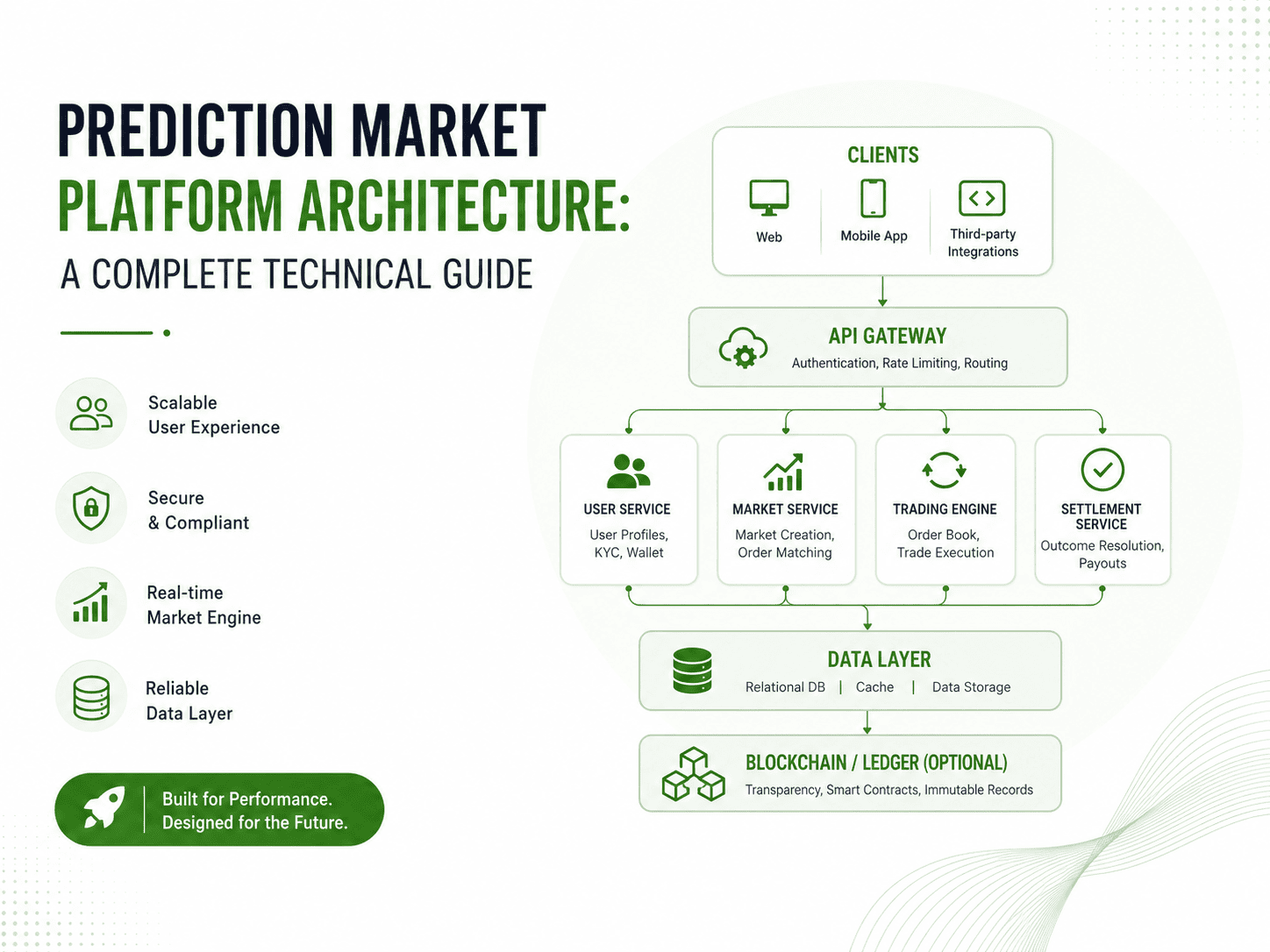
A prediction market platform architecture consists of five core layers: a market creation engine, an order matching/AMM layer, an oracle and resolution system, a settlement and payout engine, and a liquidity and risk management layer, all sitting on top of a ledger (traditional database, blockchain, or hybrid). The hardest engineering problems aren’t the UI — they’re oracle trust, liquidity bootstrapping, and settlement finality.
What Is a Prediction Market Platform, Technically?
A prediction market platform is a trading system where the tradable asset is a claim on a future event outcome rather than a company share or commodity. Technically, this means every architectural decision downstream — pricing, matching, settlement — has to account for one thing traditional exchanges don’t: the outcome is unknown until an external event resolves it, and someone (or something) has to be trusted to report that outcome accurately.
This single constraint is what separates prediction market architecture from a standard trading platform. You’re not just building an exchange. You’re building an exchange bolted to a truth verification system.
Platforms like Polymarket, Kalshi, Manifold, and Metaculus each solve this differently — some on-chain with decentralized oracles, some off-chain with regulated data feeds — but the core architectural layers are consistent across all of them.
Core Architecture Layers
Every functioning prediction market platform, regardless of tech stack, is built on five layers:
| Layer | Function | Failure Impact if Poorly Built |
|---|---|---|
| Market Creation Engine | Defines questions, outcomes, resolution criteria | Ambiguous markets, disputes |
| Trading Engine (Order Book/AMM) | Matches buyers and sellers, sets prices | Poor liquidity, price manipulation |
| Oracle & Resolution Layer | Determines the real-world outcome | Wrong settlements, fraud, lawsuits |
| Settlement & Payout Engine | Distributes funds based on outcome | Payment delays, insolvency risk |
| Liquidity & Risk Management | Ensures markets remain tradable | Wide spreads, capital inefficiency |
Let’s go through each in depth, because this is where most technical guides stay shallow — and where most platforms actually fail.
Market Creation & Question Engine
This is the layer competitors almost never cover in depth, yet it’s where most real-world disputes originate.
A market creation engine needs to enforce structural rules before a question ever goes live:
- Binary vs categorical vs scalar markets — Will X happen (Yes/No), which of N outcomes will occur, or where will a value land on a range (e.g., “What will the Fed funds rate be?”).
- Resolution source binding — Every market must be programmatically tied to a specific, verifiable data source at creation time, not decided after the fact.
- Ambiguity filtering — Automated or human review to reject vague questions (“Will the economy improve?”) that can’t be objectively resolved.
- Deadline and resolution window logic — Separating the “event deadline” from the “resolution confirmation window” (usually 24–72 hours) to allow dispute time.
Real-world example: Polymarket’s 2020 US election markets faced resolution disputes not because the trading engine failed, but because resolution criteria weren’t airtight enough for edge cases (contested results, recounts). The fix wasn’t a trading engine patch — it was a rewrite of the resolution criteria schema at market creation.
Expert insight: Build your question schema with a mandatory resolution_source, resolution_criteria_text, and dispute_window_hours field enforced at the database level, not just the UI. Teams that leave this optional at the API layer inevitably ship ambiguous markets.
Trading Engine: Order Book vs AMM
This is the layer most technical guides focus on exclusively — but it’s only one-fifth of the real system.
Order Book Model
A central limit order book (CLOB) matches buy and sell orders directly, similar to a stock exchange.
Pros:
- Transparent, familiar pricing mechanism
- Efficient at high volume
- Tight spreads when liquidity is deep
Cons:
- Needs active market makers to avoid wide spreads
- Cold-start problem: new/niche markets have no liquidity
- Requires a matching engine capable of sub-second performance
Automated Market Maker (AMM) Model
An AMM (commonly using LMSR — Logarithmic Market Scoring Rule — or constant-product formulas) sets prices algorithmically based on a liquidity pool rather than matching individual orders.
Pros:
- Always tradable, even with zero counterparties
- Ideal for long-tail, low-volume markets
- Lower infrastructure complexity than a full matching engine
Cons:
- Capital inefficiency (liquidity providers bear more risk)
- Price slippage on large trades
- LMSR requires careful subsidy/loss-bound tuning to avoid platform insolvency
Which One Should You Build?
| Use Case | Recommended Model |
|---|---|
| High-volume markets (politics, sports, macro events) | Order book |
| Long-tail/niche markets (thousands of low-volume questions) | AMM (LMSR) |
| Platforms needing both | Hybrid — AMM for bootstrapping, order book once liquidity matures |
Manifold Markets and Polymarket both evolved this way — starting AMM-first for cold-start liquidity, then layering in order-book mechanics as volume grew. This hybrid pattern is now the de facto standard for new platforms, and it’s rarely discussed in competitor content that treats AMM vs order book as an either/or decision.
Oracle & Resolution Systems
This is the single highest-risk component in the entire architecture, and it deserves more engineering attention than the trading engine itself.
An oracle system answers one question: who — or what — decides the real-world outcome, and how do you prevent that decision from being wrong or manipulated?
Oracle Architecture Options
- Centralized oracle (single trusted source) — Platform admin or a licensed data provider resolves markets manually. Fast, simple, but a single point of trust and failure. This is how Kalshi (a CFTC-regulated exchange) operates — resolution tied to specific regulated data feeds with compliance oversight.
- Decentralized oracle (UMA, Chainlink-style) — A network of validators/reporters stakes collateral and votes on outcomes; disputes trigger arbitration. Used by Polymarket via UMA’s Optimistic Oracle.
- Community/consensus resolution — Users or a reputation-weighted panel resolve markets, common on platforms like Manifold for informal/social markets.
Technical Requirements for a Reliable Oracle Layer
- Dispute window with economic bonding — Anyone disputing a resolution should stake collateral, discouraging frivolous disputes while allowing legitimate corrections.
- Multi-source verification — Never resolve high-value markets off a single API or data feed; cross-reference at least two independent sources programmatically.
- Immutable audit trail — Every resolution decision, timestamp, and data source snapshot should be logged and retrievable, both for compliance and dispute resolution.
- Escalation path — A defined process (human review board, arbitration DAO, or regulatory escalation) for edge cases the automated system can’t resolve.
Practical scenario: Imagine a market: “Will Company X’s Q3 revenue exceed $500M?” If your oracle only pulls from one press release feed and that feed has a typo or delay, your entire settlement layer inherits that error — and now you’re refunding or re-settling thousands of trades. This is why oracle architecture, not trading engine speed, is usually the actual bottleneck in production prediction markets.
Settlement & Payout Architecture
Once resolution is confirmed, the settlement engine has to:
- Lock the market (halt new trades)
- Calculate payouts per position (straightforward for binary markets, more complex for scalar/categorical)
- Execute transfers — on-chain via smart contract, or off-chain via ledger updates and a payment processor
- Handle partial settlements for disputed or partially-resolved markets
Key architectural decision: synchronous vs asynchronous settlement.
- Synchronous (common in traditional finance-style platforms): payouts execute immediately upon resolution confirmation. Simpler, but requires the platform to hold sufficient reserve capital at all times.
- Asynchronous (common in blockchain-based platforms): users manually claim payouts via smart contract calls after resolution. Reduces platform gas/processing costs but adds friction and requires clear user communication.
Regulated platforms like Kalshi settle through connections to traditional banking rails with compliance checks at the payout stage (AML screening, reporting thresholds). Crypto-native platforms settle via smart contract, where the payout logic is deterministic and auditable on-chain but irreversible if the resolution was wrong — which is exactly why the dispute window in the oracle layer has to happen before settlement, never after.
Liquidity & Risk Management
This layer is almost entirely ignored in competing guides, yet it determines whether your platform is financially sustainable.
- Liquidity subsidy budgeting — If you’re running an AMM (especially LMSR), you must cap your maximum subsidy loss per market mathematically before launch, or a single high-volume, high-volatility market can drain your treasury.
- Market maker incentive programs — Rebates, fee-sharing, or token incentives to attract professional liquidity providers to order-book markets.
- Position limits and circuit breakers — Caps on maximum exposure per user per market to prevent whales from moving prices artificially, plus automatic trading halts on abnormal volume spikes.
- Fee architecture — Trading fees, resolution fees, and withdrawal fees need to be modeled against your liquidity incentive costs, or your unit economics won’t work at scale.
On-Chain vs Off-Chain vs Hybrid Architecture
| Factor | On-Chain (Smart Contract) | Off-Chain (Traditional DB) | Hybrid |
|---|---|---|---|
| Transparency | Full public auditability | Requires trust in operator | Partial |
| Speed | Slower (block confirmation times) | Fast | Mixed |
| Regulatory fit | Harder in regulated markets (e.g., US) | Easier to obtain licensing (like Kalshi’s CFTC approval) | Depends on jurisdiction |
| Cost | Gas fees per trade/settlement | Server costs only | Mixed |
| Best for | Global, permissionless platforms | Regulated, compliance-first platforms | Platforms scaling from crypto-native to regulated |
Most serious new builds in 2025–2026 are trending hybrid: off-chain matching engines for speed, with on-chain settlement and resolution for auditability — giving you the trust benefits of blockchain without the latency cost on every single order.
Security & Compliance Architecture
Security in prediction markets goes beyond standard web app hardening because you’re handling real financial exposure tied to information that can be front-run.
- Insider information controls — Employees or oracle operators with early knowledge of an outcome must be architecturally restricted from trading (segregated permissions, trading halts pre-resolution).
- Smart contract audits — Non-negotiable for on-chain settlement layers; a single reentrancy bug can drain an entire settlement pool.
- KYC/AML integration — Required for regulated jurisdictions; architecturally, this means your onboarding flow needs a pluggable identity verification layer, not a hardcoded one, since requirements vary by region.
- Regulatory classification — In the US, prediction markets tied to events can be classified as event contracts under CFTC jurisdiction; architecture should support jurisdiction-based feature flags (some markets available in some regions only) from day one, not retrofitted later.
Common Mistakes
- Treating the trading engine as the hardest problem. It’s usually the oracle and liquidity layers that break first in production.
- Skipping a dispute window to speed up settlement — this is how platforms end up refunding entire markets after a bad resolution.
- Using a single data source for high-value market resolution.
- No position limits, allowing a single large trader to manipulate thin markets.
- Hardcoding resolution logic per market instead of building a reusable resolution schema — this doesn’t scale past a few dozen markets.
- Ignoring capital reserve requirements for synchronous settlement, leading to payout delays that destroy user trust.
- Building on-chain-only from day one in a jurisdiction where regulatory approval requires off-chain compliance rails.
Expert Tips
- Start with an AMM (LMSR) for market bootstrapping, and layer in order-book matching only once you have consistent volume — don’t build both from day one.
- Bake your resolution schema (source, criteria, dispute window) into the database layer as required fields, not optional UI inputs.
- Model your maximum LMSR subsidy loss per market before launch — this single calculation prevents the most common early-stage insolvency issue in AMM-based platforms.
- Build your oracle layer to support multi-source cross-verification even if you launch with a single source — retrofitting this later is significantly harder than designing for it upfront.
- Treat compliance as an architectural layer (feature flags, jurisdiction routing, pluggable KYC), not a legal afterthought bolted onto the frontend.
FAQs
What is the core difference between a prediction market and a betting platform, architecturally?
A prediction market’s price reflects the market’s aggregated probability estimate of an outcome and shifts continuously through trading, while a betting platform sets fixed odds determined by the operator. Architecturally, this means prediction markets need a continuous pricing engine (order book or AMM), whereas betting platforms need an odds-setting and liability management engine.
Should I use blockchain for my prediction market platform?
Use blockchain if transparency and permissionless global access are core to your value proposition, since it makes resolution and settlement publicly auditable. Use an off-chain traditional database if speed, regulatory approval, and low transaction costs matter more, since it’s easier to integrate with compliance and banking rails.
How do prediction markets resolve disputes over outcomes?
Most reliable platforms use a bonded dispute window after initial resolution, where anyone can challenge the outcome by staking collateral, triggering either automated re-verification against multiple data sources or human/DAO arbitration before final settlement.
What causes most prediction market platforms to fail technically?
The two most common technical failure points are oracle unreliability (wrong or manipulated resolutions) and liquidity mismanagement (AMM subsidy losses or order books too thin to trade), not the trading engine itself.
Is an order book or AMM better for a new prediction market platform?
An AMM, typically LMSR-based, is better for a new platform because it guarantees tradability even with zero counterparties, solving the cold-start liquidity problem; order books become more efficient once consistent trading volume develops.
Conclusion
Building a prediction market platform isn’t really a trading-engine problem — it’s a systems problem spanning question design, oracle trust, settlement finality, and liquidity economics, all of which have to work together or the platform breaks at the seams. The teams that get this right treat resolution logic and liquidity modeling with the same engineering rigor as the matching engine, not as afterthoughts.
If you’re scoping a build and want a second set of eyes on your architecture before you commit engineering hours, Digitechzo works with founders and product teams on exactly this kind of trading and forecasting infrastructure. Reach out for a technical architecture review before you write your first line of code — it’s a lot cheaper to fix on paper than in production.
About The Author