
A prospective tenant fills out an inquiry form on your listing at 9 PM on a Sunday. By the time someone from your team responds Monday afternoon, that lead has already toured two other properties and signed a lease elsewhere. Multiply that scenario across dozens of listings a month, and you start to see why so many property businesses lose good tenants not because of pricing or location — but because of response speed.
This is the exact problem a property management CRM with AI is built to solve. Unlike a generic CRM adapted for real estate, or a property management tool with basic contact lists bolted on, a purpose-built property management CRM with AI treats lead response, tenant lifecycle, and renewal management as one continuous, intelligently automated pipeline — not three disconnected spreadsheets.
At Digitechzo, we’ve worked with property businesses struggling with exactly this disconnect — strong marketing generating leads that then die in an inbox because there’s no system actively managing the follow-up. This guide breaks down what a real property management CRM with AI actually does, how it differs from both generic CRMs and standard property management software, and how to evaluate one properly before buying.
Quick Answer
A property management CRM with AI combines lead capture, automated follow-up, tenant lifecycle tracking, and renewal management into one system, using AI to prioritize hot leads, personalize outreach timing, and predict which tenants are likely to renew or churn. It’s built specifically for the property rental funnel — not adapted from generic sales CRM software.
What Is a Property Management CRM with AI?
A property management CRM with AI is a specialized customer relationship management system built specifically for the rental property lifecycle — from the first inquiry on a listing through lease signing, tenancy, renewal, and eventual move-out — with AI layered in to prioritize, automate, and predict outcomes at each stage.
The distinction that matters here is specialization. A generic CRM tracks contacts and deals; a property management CRM with AI understands rental-specific concepts natively — unit availability, lease terms, renewal windows, and maintenance history — and connects lead behavior to actual property data automatically.
Why “With AI” Isn’t Just a Marketing Add-On
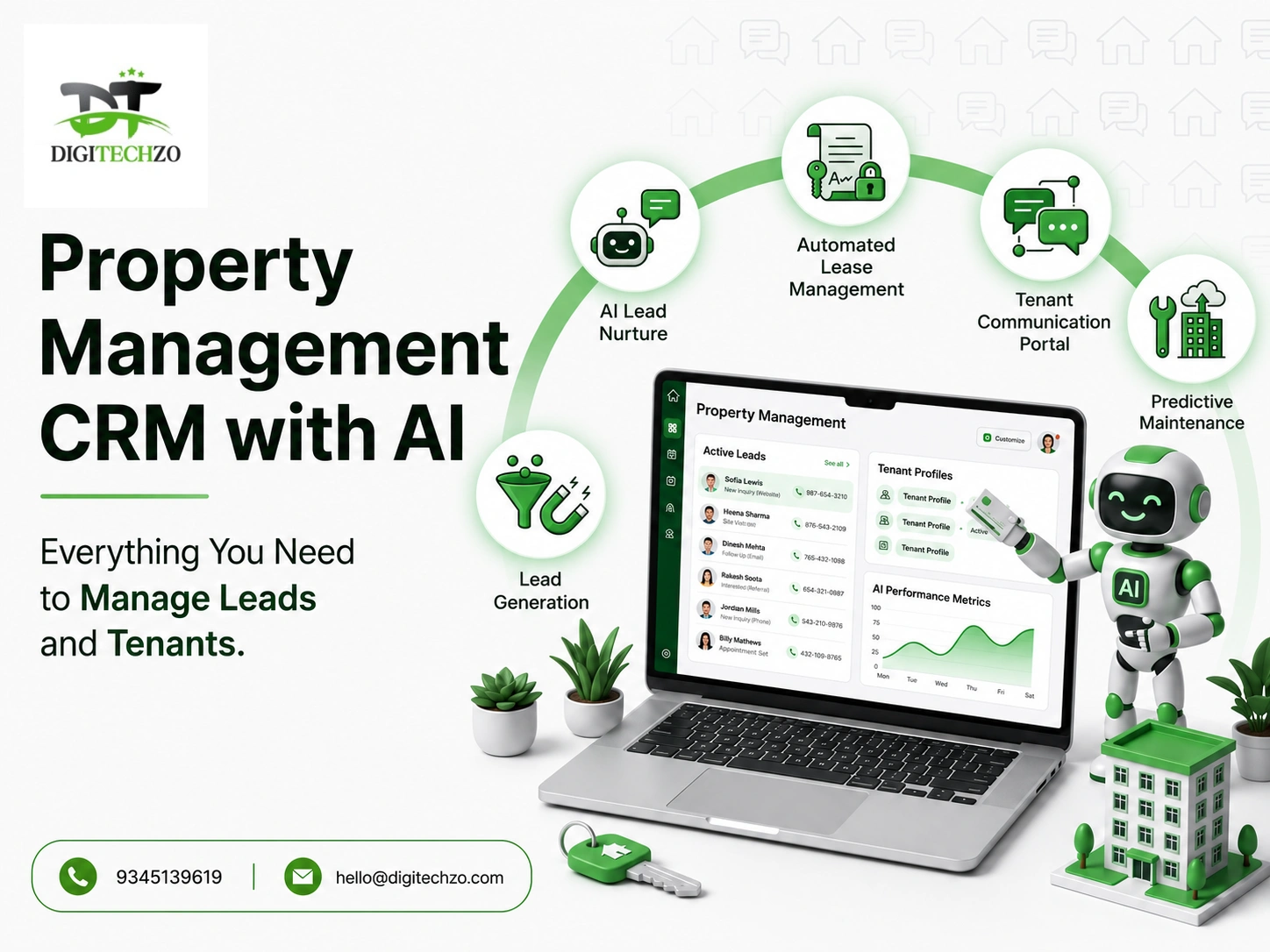
The AI layer in a genuine property management CRM with AI does three things a rule-based CRM cannot:
- Scores leads by likelihood to convert, based on behavior patterns like response speed, questions asked, and browsing history — not just a static “hot/warm/cold” tag a human assigns manually.
- Predicts renewal likelihood for existing tenants using payment history, maintenance request patterns, and communication tone, flagging at-risk tenants months before a lease expires.
- Automates follow-up timing intelligently, sending the next touchpoint when a lead is statistically most likely to respond, rather than on a fixed generic schedule.
Why Generic CRMs Fail Property Businesses
Sales-focused CRMs like general-purpose pipeline tools were built for B2B sales cycles — a single deal closing once, with a defined sales process. Rental leasing doesn’t work that way, and forcing a generic CRM into property management usually creates friction rather than efficiency:
- No native concept of unit availability, so leads keep getting shown units that are already leased.
- No connection between lead data and tenant data once a lease is signed, meaning the CRM’s usefulness effectively ends at the point it should be most valuable — during the tenancy and renewal period.
- Manual tagging replaces genuine prediction, since generic CRMs don’t understand rental-specific signals like maintenance frequency or payment consistency.
A property management CRM with AI fixes this by treating the lead-to-tenant-to-renewal journey as one connected pipeline instead of a series of disconnected tools bolted together after the fact.
Core Features of a Property Management CRM with AI
1. AI Lead Scoring and Prioritization
Every inbound inquiry gets scored based on real signals — response speed to your team’s messages, specific questions asked, and browsing behavior on your listings — so your team knows exactly which leads to call first instead of working through inquiries in the order they arrived.
2. Automated, Personalized Follow-Up Sequences
Rather than a single generic follow-up email, the system sends contextual messages based on what the lead has actually asked about — pet policy questions trigger different follow-up content than parking availability questions, for instance.
3. Unified Lead-to-Tenant Data Pipeline
Once a lead signs a lease, their entire inquiry and communication history carries forward into their tenant profile, giving your team full context instead of starting from zero the moment they become a tenant.
4. Renewal Prediction and Retention Workflows
The AI layer analyzes payment consistency, maintenance request sentiment, and communication patterns to flag which tenants are unlikely to renew, triggering proactive retention outreach months before the lease expires.
5. Conversational AI for Instant Response
A chatbot layer can answer common prospect questions instantly at any hour, capturing and qualifying leads even when your team isn’t actively monitoring inquiries — directly addressing the response-speed problem that costs so many property businesses good leads.
6. Multi-Channel Communication Tracking
Every interaction — email, SMS, portal message, or call log — lives in one timeline per contact, so nothing gets lost across different communication channels your team happens to be using.
Lead Management vs. Tenant Management (Why Both Matter)
Many property management tools handle one side of this well and the other poorly. A genuine property management CRM with AI needs to excel at both, because they’re fundamentally connected:
Lead management focuses on:
- Speed of first response
- Qualification accuracy (budget, move-in timeline, unit fit)
- Conversion from inquiry to signed lease
Tenant management focuses on:
- Ongoing communication and satisfaction tracking
- Renewal prediction and retention
- Maintenance-related sentiment that often predicts churn before a tenant explicitly says they’re leaving
The connection matters because a tenant’s original lead behavior — how many questions they asked, how much they negotiated — often correlates with how they’ll behave during tenancy. A property management CRM with AI that treats these as one continuous dataset builds genuinely more accurate predictions than tools that separate lead data from tenant data entirely.
Comparison: Property Management CRM with AI vs. Alternatives
| Factor | Generic Sales CRM | Basic PM Software Contact List | Property Management CRM with AI |
|---|---|---|---|
| Rental-specific data model | No | Partial | Yes |
| Lead scoring | Generic, manual tags | None | AI-based, behavior-driven |
| Renewal prediction | No | No | Yes |
| Lead-to-tenant continuity | No | No | Yes |
| 24/7 automated response | Rare | Rare | Standard |
Pros and Cons
Pros:
- Captures and responds to leads faster, directly improving conversion rates
- Connects the full tenant journey from first inquiry through renewal
- Surfaces retention risk early enough to act on it
- Reduces manual follow-up work significantly for leasing teams
Cons:
- Requires clean data migration if switching from a generic CRM or spreadsheet system
- AI scoring accuracy improves over time — early predictions are less reliable without sufficient historical data
- Can feel like overkill for very small portfolios with low lead volume
- Team adoption requires genuine process change, not just new software
How to Evaluate One Before Buying
- Ask for a live lead-scoring demo using realistic data — not a generic sales pitch — to see how the AI actually ranks leads.
- Confirm the lead-to-tenant data handoff works seamlessly; ask specifically what happens to a lead’s history once they sign a lease.
- Check renewal prediction transparency. Ask what specific signals the model uses, since a vague answer usually means shallow implementation.
- Test the conversational AI yourself as a prospective tenant would, checking response quality and escalation handling.
- Verify integration with your existing listing syndication and property management software, since a CRM operating in isolation from your listings loses much of its value.
Real-World Scenarios
Scenario 1 — Multi-property leasing team: A leasing team managing inquiries across 15 properties implemented AI lead scoring and found their team was previously spending equal time on low-intent browsers and serious prospects; after implementation, average response time to high-intent leads dropped significantly since the system surfaced them first.
Scenario 2 — Renewal-focused property manager: A property manager overseeing 200 units used renewal prediction to identify a cluster of tenants showing declining satisfaction signals (slower payment timing, increased maintenance complaints) three months before lease expiration, allowing proactive retention conversations instead of last-minute scrambling to fill vacancies.
Scenario 3 — After-hours lead capture: A small property business relying on manual weekend responses implemented a conversational AI layer specifically to capture and qualify after-hours inquiries, converting leads that previously went cold before Monday morning follow-up.
Common Mistakes
- Migrating from a generic CRM without cleaning historical data first, causing the AI model to learn from inconsistent or duplicate records.
- Treating lead scoring as fully automatic without occasionally auditing it against actual conversion outcomes to catch drift.
- Ignoring the tenant side of the CRM and only using it for lead capture, missing the renewal prediction value entirely.
- Not training the leasing team on how scoring works, leading to skepticism and manual overrides that undermine the system’s usefulness.
- Choosing a platform based on “AI” branding alone without verifying it actually connects lead and tenant data in one pipeline.
Expert Tips
- Feed the system your full historical lead data during onboarding, even if messy — more historical signal improves scoring accuracy faster than starting from zero.
- Set a monthly review of lead scoring accuracy against actual lease signings to catch calibration issues early.
- Use renewal prediction alerts as a trigger for a specific retention workflow, not just a passive dashboard flag someone might forget to check.
- Keep your leasing team’s manual judgment in the loop for edge cases — AI scoring should inform prioritization, not fully replace human read on a prospect.
- Audit chatbot conversation logs monthly to catch recurring questions worth addressing directly on your listing pages, reducing repetitive inquiries altogether.
Frequently Asked Questions
What is a property management CRM with AI?
A property management CRM with AI is a specialized system that manages the full rental lifecycle — from lead inquiry through tenancy and renewal — using AI to score leads, automate follow-up, and predict tenant renewal likelihood, unlike generic CRMs built for standard sales pipelines.
How is a property management CRM with AI different from regular property management software
Property management software typically focuses on operations like rent collection and maintenance, while a property management CRM with AI focuses specifically on the lead-to-tenant relationship pipeline, including marketing response, lead scoring, and renewal prediction.
Can a property management CRM with AI reduce tenant turnover?
Yes, by identifying early signals of declining tenant satisfaction — like slower payments or increased maintenance complaints — months before a lease expires, giving property managers time to intervene with retention outreach.
Do small property businesses need a property management CRM with AI?
Businesses with low lead volume or very small portfolios may not need the full system yet, but even small operations benefit significantly from 24/7 automated lead response, since slow follow-up is one of the most common reasons good leads are lost regardless of portfolio size.
How accurate is AI lead scoring in property management CRMs?
Accuracy improves substantially with historical data volume; systems typically become meaningfully more reliable after several months of real lead and conversion data, so early scoring should be treated as directional rather than definitive.
Final Thoughts
The property businesses converting the most leads into signed leases aren’t necessarily generating more inquiries than their competitors — they’re responding faster and following up smarter, which is exactly what a genuine property management CRM with AI is built to do. It closes the gap between marketing spend and actual leases signed, while also protecting the renewals that keep your portfolio stable long after the lead has become a tenant.
If you’re evaluating whether your property business needs a dedicated property management CRM with AI — or comparing specific platforms against your lead volume and portfolio size — Digitechzo’s advisory team can walk through your current lead-to-lease process and point you toward the right fit. Reach out for a free consultation.
About The Author