
Every founder who wants to launch a crypto exchange eventually hits the same wall: build fast and cheap with a Binance clone script, or invest more time and money into custom exchange development? Pick wrong, and you either burn your runway on a rigid product that can’t scale, or you blow your launch window building something users don’t need yet.
We’ve sat across the table with founders on both sides of this decision — some who shipped in 30 days with a white-label script and captured a market before competitors even had a whitepaper, and others who spent eight months building custom architecture that later became their biggest competitive moat. Neither path is universally “better.” The right answer depends on your budget, timeline, regulatory environment, and long-term product vision.
This guide breaks down the real trade-offs — cost, security, scalability, compliance, ownership — so you can make a decision based on your business reality, not marketing hype from vendors trying to sell you one option.
This article is brought to you by the exchange development team at Digitechzo, where we’ve architected and deployed both clone-based and fully custom trading platforms for clients across the US, UAE, and Southeast Asia.
Quick Answer
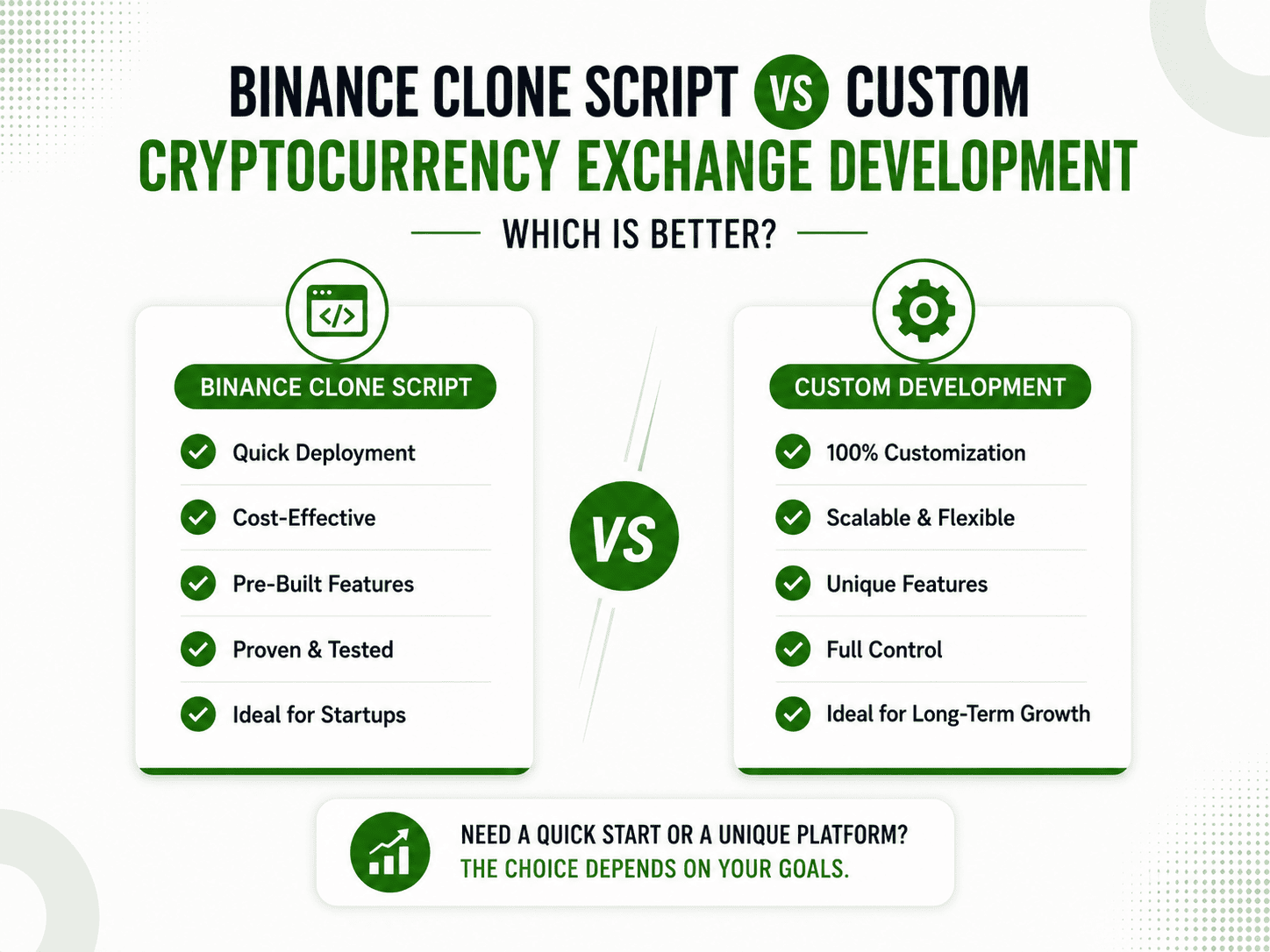
A Binance clone script is a pre-built, white-label exchange framework you customize and launch in 2–4 weeks — ideal for startups validating demand with limited budget. Custom exchange development is built from the ground up over 4–9 months, giving you full code ownership, unique architecture, and long-term scalability — ideal for funded businesses planning to operate at institutional scale. If you need speed and lower risk, choose a clone script. If you need full control, regulatory flexibility, and a defensible tech moat, choose custom development.
What Is a Binance Clone Script?
A Binance clone script is pre-developed exchange software that replicates the core features of Binance — spot trading, wallet integration, order matching, admin dashboard, and KYC modules — packaged as a ready-to-deploy product. Vendors customize the branding, add or remove features, and deploy it on your infrastructure.
Think of it less as a “copy” and more as a framework. The underlying matching engine, liquidity architecture, and security layers are pre-built; what you’re buying is speed to market, not a literal duplicate of Binance’s proprietary code (which is neither available nor legal to replicate).
Typical clone script features include:
- Spot and futures trading modules
- Multi-currency wallet (hot/cold)
- Admin panel with user, trade, and fee management
- KYC/AML integration
- Liquidity API connections
- Mobile app (iOS/Android) templates
- P2P trading module (optional)
Real-world scenario: A regional fintech startup in the UAE wanted to launch a crypto exchange targeting retail traders before a competitor entered the market. They had 6 weeks and a limited seed budget. A customized clone script let them go live in 5 weeks with core trading, KYC, and a branded mobile app — capturing early market share while their competitor was still in development.
What Is Custom Exchange Development?
Custom cryptocurrency exchange development means building the entire platform from scratch — architecture, matching engine, order book logic, wallet infrastructure, security protocols, and UI/UX — tailored specifically to your business model.
This approach gives you:
- A proprietary matching engine tuned to your trading volume and asset mix
- Custom liquidity aggregation logic (not tied to a vendor’s pre-set integrations)
- Full control over the tech stack (language, database, cloud architecture)
- The ability to build unique features competitors can’t easily replicate (algorithmic trading tools, custom fee models, institutional APIs)
Real-world scenario: A Series A-funded exchange targeting institutional traders needed sub-millisecond order execution and custom risk-management logic that no off-the-shelf script supported. They invested 7 months in custom development. The result: an execution engine fast enough to attract market-maker partnerships that a templated solution simply couldn’t have supported.
Binance Clone Script vs Custom Exchange Development: Head-to-Head Comparison
| Factor | Binance Clone Script | Custom Exchange Development |
|---|---|---|
| Time to launch | 2–4 weeks | 4–9 months |
| Initial cost | $8,000 – $25,000 | $50,000 – $250,000+ |
| Code ownership | Shared/licensed (varies by vendor) | 100% yours |
| Customization depth | Moderate (UI, features, branding) | Unlimited |
| Scalability | Good for early-to-mid stage volume | Built for high-frequency, institutional scale |
| Security architecture | Pre-audited, vendor-dependent | Custom-audited, fully controllable |
| Regulatory flexibility | Limited to vendor’s compliance modules | Fully adaptable to any jurisdiction |
| Best for | Startups, MVPs, regional launches | Funded companies, institutional platforms |
| Ongoing maintenance | Vendor-dependent updates | In-house or dedicated dev team |
Pros & Cons: Binance Clone Script
Pros:
- Fast go-to-market (critical in a fast-moving crypto market)
- Lower upfront capital requirement
- Pre-tested core modules reduce launch-day bugs
- Easier for non-technical founders to manage
Cons:
- Limited differentiation from competitors using similar scripts
- Dependent on vendor for updates and bug fixes
- May carry technical debt if the codebase isn’t well-documented
- Harder to scale beyond a certain trading volume without re-architecture
Pros & Cons: Custom Exchange Development
Pros:
- Full ownership and control of source code
- Built to your exact compliance and business logic
- Scales natively with your growth (no re-platforming later)
- Stronger competitive moat — harder for others to replicate
Cons:
- Higher upfront cost and longer development timeline
- Requires an experienced, dedicated development team
- More testing and security auditing cycles before launch
- Higher risk if requirements aren’t clearly scoped early
Cost Breakdown: Clone Script vs Custom Build
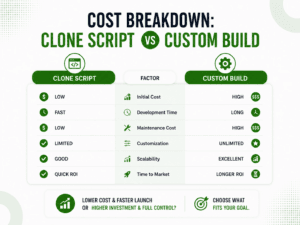
Cost is rarely just the sticker price. Here’s what actually factors in:
Clone Script Total Cost of Ownership:
- Base script license: $8,000–$25,000
- Customization (branding, feature tweaks): $2,000–$10,000
- Server/infrastructure setup: $500–$2,000/month
- Ongoing vendor support/license renewal: often 15–20% annually
Custom Development Total Cost of Ownership:
- Discovery and architecture design: $5,000–$15,000
- Core development (matching engine, wallets, admin): $40,000–$180,000
- Security audits (essential, not optional): $10,000–$30,000
- QA, compliance integration, deployment: $10,000–$25,000
A pattern we see consistently: founders underestimate that a clone script’s lower entry cost often comes with a higher long-term cost if the platform later needs re-architecture to scale. Conversely, custom builds have a higher entry cost but a lower total cost per user at scale, since there’s no vendor licensing tax.
Security Considerations
Security is where the two approaches diverge most sharply — and where the stakes are highest. Exchange hacks remain one of the industry’s biggest risks; billions of dollars in crypto assets have been lost to exchange breaches over the years, according to blockchain security firms that track on-chain exploits.
With a clone script:
- Security is only as strong as the vendor’s original codebase
- You inherit any undisclosed vulnerabilities in the shared framework
- Reputable vendors provide penetration-tested code — but always request the audit report before buying
- Multiple exchanges running the same script share the same attack surface, making them a more attractive target for coordinated exploits
With custom development:
- You control the entire security architecture — cold wallet policy, multi-sig implementation, withdrawal throttling, DDoS protection
- You commission independent third-party audits tailored to your exact code
- Higher initial security investment, but no shared-vulnerability risk with other exchanges
Expert insight: Regardless of which path you choose, never skip a third-party smart contract and infrastructure audit before going live with real funds. This is non-negotiable — it’s the single most common point of failure we see in exchange launches.
Scalability and Long-Term Growth
A clone script can comfortably handle tens of thousands of daily active users and moderate trade volume. Problems emerge when:
- Trade volume spikes beyond what the matching engine architecture supports
- You need to add asset classes (derivatives, margin, staking) the script wasn’t designed for
- You require custom API rate limits for institutional clients
Custom-built exchanges are architected with headroom from day one — horizontally scalable matching engines, microservices architecture, and database sharding strategies designed for growth, not retrofitted after the fact.
Practical guidance: If you’re projecting under 50,000 monthly active traders in your first 18 months, a well-built clone script will likely serve you fine. Beyond that — or if you’re targeting institutional/market-maker volume — plan for custom architecture from the start.
Regulatory and Compliance Factors
Compliance requirements differ wildly by jurisdiction — and this is where generic clone scripts can become a liability.
- KYC/AML depth: Some jurisdictions require tiered KYC with enhanced due diligence for high-value accounts. Not all clone scripts support this out of the box.
- Reporting requirements: Custom builds let you integrate directly with local regulatory reporting APIs; clone scripts may require costly vendor customization.
- Licensing: Whichever route you take, the software is only one piece — you’ll still need proper money transmitter or VASP licensing in your target markets. No script or custom build substitutes for legal compliance work.
Which One Should You Choose? A Decision Framework
Ask yourself these four questions:
- What’s your runway? Under $50K and need to launch fast → clone script.
- What’s your target scale? Regional/retail focus → clone script. Institutional/high-frequency → custom.
- How unique is your business model? Standard spot trading → clone script. Novel features (algo trading, unique fee models, DeFi integration) → custom.
- What’s your compliance complexity? Single jurisdiction, standard KYC → clone script. Multi-jurisdiction or complex reporting → custom.
A hybrid path also works well for many founders: launch with a customized clone script to validate the market, then migrate to a custom-built platform once you hit scale. This is the approach we most often recommend at Digitechzo, since it balances speed-to-market with long-term flexibility.
Common Mistakes to Avoid
- Choosing a vendor based on price alone. The cheapest clone script often has the weakest security posture and worst documentation.
- Skipping the security audit to save time or money before launch — the most expensive mistake in this industry.
- Underestimating liquidity setup. Both approaches need real liquidity partnerships; a great platform with no order book depth will fail regardless of the tech.
- Not planning for compliance early. Retrofitting KYC/AML into a live exchange is far harder than building it in from day one.
- Assuming custom = automatically better. Over-engineering a custom platform before validating market demand wastes capital that could’ve funded marketing and liquidity instead.
- Ignoring source code ownership terms. Some clone script vendors retain rights to the codebase — read the licensing agreement carefully before signing.
Expert Tips
- Request a live demo, not just a sales deck. Test the admin panel and trading interface yourself before committing to any vendor.
- Ask for the audit report, not just an audit “claim.” A credible vendor will share the actual penetration test results.
- Negotiate source code escrow with clone script vendors, so you’re not locked in if they go out of business.
- Start liquidity conversations early — whether clone or custom, your exchange is only as good as its order book depth.
- Build compliance into your MVP scope, not as an afterthought — regulators are paying closer attention to exchanges in 2026 than ever before.
- Budget 15–20% extra for post-launch iteration regardless of which path you choose — no first version ships perfect.
Frequently Asked Questions
Is a Binance clone script legal? Yes, as long as it’s an original codebase inspired by Binance’s feature set and not a literal copy of Binance’s proprietary code or trademarks. Reputable vendors build original software; you’re licensing a framework, not stolen IP.
How much does it cost to build a crypto exchange like Binance? A customized clone script typically costs $8,000–$25,000, while a fully custom-built exchange ranges from $50,000 to $250,000+, depending on features, security audits, and scale requirements.
Can I switch from a clone script to a custom platform later? Yes. Many exchanges start with a clone script to validate demand and later migrate to custom architecture once trading volume and revenue justify the investment.
Which is more secure: a clone script or custom development? Custom development offers stronger security control since the architecture is unique to you, but a well-audited clone script from a reputable vendor can be equally secure for early-stage volume. The audit quality matters more than the build method.
How long does it take to launch a crypto exchange? A customized clone script can launch in 2–4 weeks. A custom-built exchange typically takes 4–9 months, depending on feature complexity and compliance requirements.
Final Verdict
There’s no universal winner between a Binance clone script and custom cryptocurrency exchange development — only the right fit for your stage, budget, and growth ambitions. If speed and capital efficiency matter most right now, a clone script gets you into the market fast. If you’re building for scale, institutional clients, or a defensible long-term product, custom development is worth the investment.
The founders who get this decision right are the ones who map their choice to a clear 12–18 month roadmap, not just launch-day requirements.
If you’re weighing this decision for your own exchange project, our team at Digitechzo has built both clone-based and fully custom trading platforms for clients across multiple markets. We’re happy to review your requirements and give you an honest recommendation — including telling you if a clone script is genuinely the smarter move for your situation, even if that means a smaller project for us.
Ready to move forward? Talk to our exchange development team for a free architecture consultation and cost estimate tailored to your business.
About The Author