
Prediction markets aren’t a side trend anymore. They’re becoming a real category, and 2026 is shaping up to be the year founders stop asking “should we build one?” and start asking “what should ours actually include?” That second question is harder than it looks, because not every Kalshi Clone Script on the market is built the same way.
Some vendors sell a stripped-down betting interface with a new logo slapped on top. Others deliver a genuinely trade-ready Prediction Market Platform with real order matching, compliance tooling, and analytics baked in. The gap between the two is where most buyers get burned.
This guide breaks down the exact Kalshi Clone Script Features you should demand before signing with any development partner. It’s written from a builder’s perspective, not a sales page — the kind of detail teams like DigiTechzo, an AI and FinTech Software Development company with hands-on experience building event trading and clone script platforms, walk clients through during technical discovery calls.
Quick Answer
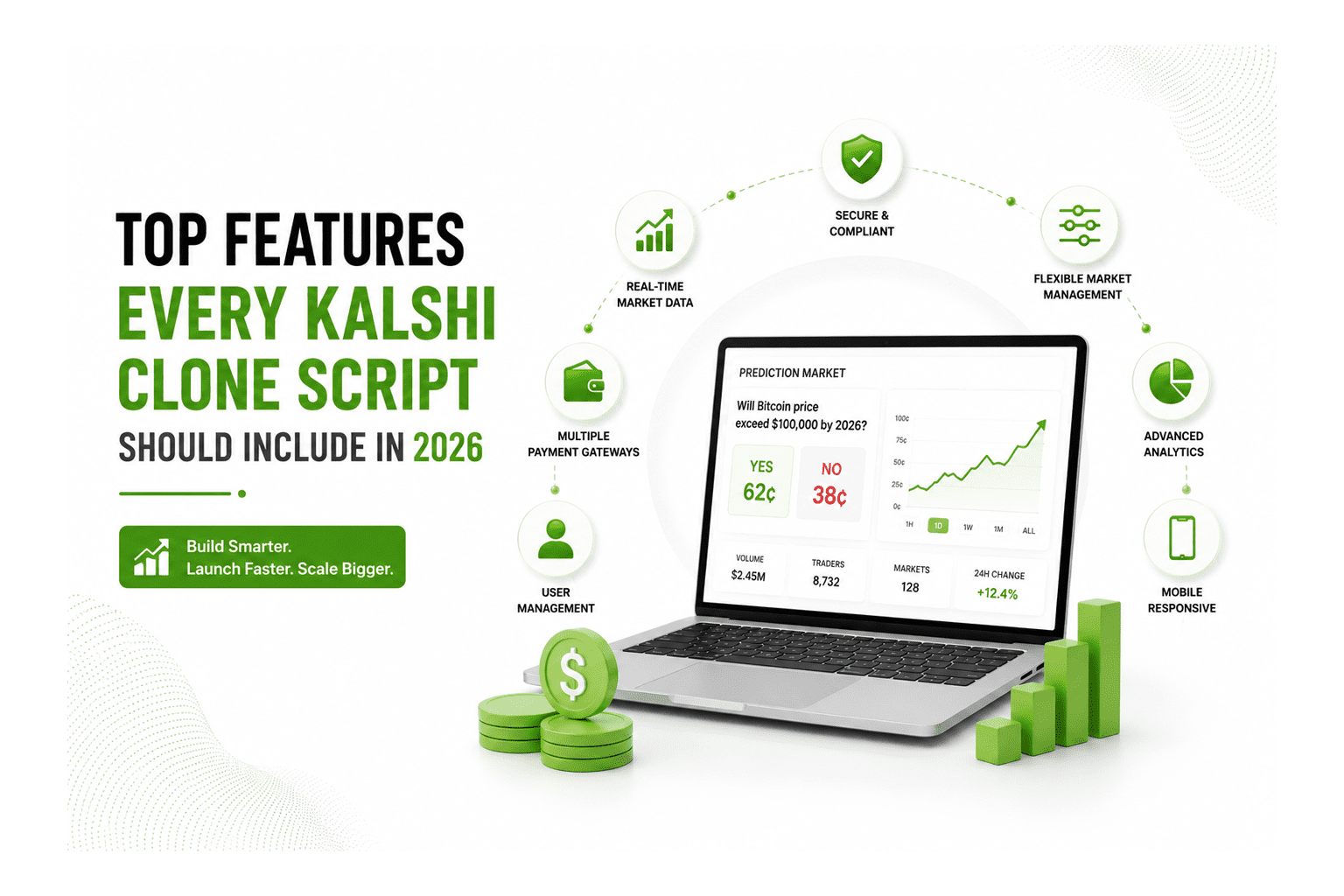
A production-ready Kalshi Clone Script in 2026 needs 15 core capabilities: secure authentication, flexible event creation, organized market categories, real-time odds pricing, AI-driven analytics, a multi-currency wallet, KYC/AML compliance, integrated payment gateways, a powerful admin dashboard, a liquidity engine, a low-latency trading engine, mobile responsiveness, bank-grade security, multi-language support, and open API integration. Skipping any one of these creates real business risk — from compliance failures to poor liquidity to user churn. The best platforms combine these into a modular, white-label-ready Event Trading Platform that can scale across markets and jurisdictions.
What is a Kalshi Clone Script?
A Kalshi Clone Script is a pre-built, customizable software foundation that replicates the core mechanics of a regulated event-contract exchange like Kalshi — market creation, real-time price discovery, order matching, and settlement — without forcing you to build everything from scratch.
Think of it as a launchpad, not a finished product. A well-engineered clone script gives you the trading engine, wallet infrastructure, and admin tools as modular components. Your development partner then customizes branding, market categories, compliance rules, and integrations around your specific business model.
This is different from a generic Binary Options Platform template. Binary options software is typically simpler — fixed payout, fixed expiry, minimal market depth. A true prediction market clone needs dynamic pricing, live order books, and probability-based contract values that shift with real trading activity.
Why Businesses Are Investing in Prediction Markets in 2026
Interest in this space isn’t hype-driven anymore — it’s backed by real usage patterns and real revenue models.
Key drivers behind the 2026 surge:
- Mainstream awareness – Kalshi and Polymarket brought prediction markets into everyday conversation, especially around elections and economic events.
- High engagement economics – Event trading sees strong repeat usage, particularly around recurring events like earnings calls, weather cycles, and sports seasons.
- AI-enhanced trading experiences – Platforms embedding an AI Prediction Platform layer for smarter market curation and pricing insights are outperforming static competitors.
- White-label demand – Media companies, fintech startups, and niche communities want a White Label Prediction Market they can brand and launch quickly instead of building from zero.
- Diversified monetization – Trading fees, data licensing, and premium features create multiple revenue streams from a single platform.
Real-world example: Polymarket scaled globally on a decentralized, crypto-native model, while Kalshi took the regulated U.S. exchange route. Both prove that a Real Money Trading Platform built around event outcomes can succeed under very different structures — which is exactly why the underlying clone script needs to be flexible, not rigid.
Top Features Every Kalshi Clone Script features Should Include
This is the core of the guide. Each feature below directly impacts trading experience, compliance posture, or platform revenue — skip one, and you’ll feel it post-launch.
1. User Authentication
Secure, frictionless login is the first trust signal your platform sends. Look for:
- Multi-factor authentication (MFA)
- Social and email login options
- Biometric login for mobile apps
- Session management with automatic timeout on suspicious activity
Featured snippet answer: User authentication in a Kalshi Clone Script should combine multi-factor authentication, biometric login, and secure session management to protect real-money accounts from unauthorized access.
2. Event Creation
Your admin team needs the ability to launch new markets fast, without engineering support for every new event.
- Template-based event creation for recurring categories (weather, earnings, sports)
- Custom event builder for one-off or trending topics
- Automated resolution source linking (APIs, verified data feeds)
- Approval workflows to prevent low-quality or ambiguous markets going live
3. Market Categories
Organized categorization keeps a Prediction Market Platform usable as it scales past a handful of markets.
- Politics, economics, sports, crypto, entertainment, and weather as baseline categories
- Trending and “closing soon” filters
- Search and tag-based discovery
- Category-level liquidity dashboards for admins
4. Real-Time Odds
Pricing has to update instantly as trades happen, or users lose trust fast.
- Live order book depth visualization
- WebSocket-based price streaming
- Historical price charting per contract
- Probability-to-price conversion displayed clearly for new traders
5. AI Analytics
This is where a standard clone script becomes a genuine AI Prediction Platform.
- AI-driven market trend detection
- Predictive liquidity forecasting per event
- Anomaly detection for suspicious trading patterns
- Personalized market recommendations based on user trading history
6. Wallet
A secure, flexible wallet system underpins every transaction on the platform.
- Multi-currency support (fiat and crypto)
- Instant deposit and withdrawal processing
- Transaction history with exportable statements
- Segregated user funds from operational funds
7. KYC & AML
Non-negotiable for any Real Money Trading Platform handling regulated markets.
- Automated identity verification (document + biometric matching)
- Tiered verification levels based on transaction volume
- Real-time AML transaction monitoring
- Geofencing to restrict access by jurisdiction
8. Payment Gateway
Seamless payments reduce drop-off at the exact moment users are ready to fund an account.
- Multiple payment gateway integrations (cards, bank transfer, crypto)
- Fast settlement times
- Transparent fee display before confirmation
- Fraud detection layered into the payment flow
9. Admin Dashboard
Operators need full visibility without digging through raw data.
- Real-time platform-wide exposure and liquidity monitoring
- User management and KYC approval queues
- Revenue and fee configuration controls
- Market performance analytics
10. Liquidity Engine
Thin liquidity kills prediction markets faster than almost anything else.
- Built-in market-maker tools to seed early liquidity
- Dynamic spread adjustment based on volume
- Liquidity incentive programs for active traders
- Cross-market liquidity balancing tools
11. Trading Engine
The trading engine is the technical heart of the platform — and the hardest part to get right.
- Low-latency order matching (sub-second execution)
- Support for market and limit orders
- Scalable architecture to handle volume spikes during major events
- Fail-safe mechanisms to prevent mismatched trades during outages
12. Mobile Responsive
Most trading activity now happens on mobile, especially during live events.
- Fully responsive web trading interface
- Native iOS and Android app options
- Push notifications for price alerts and market resolution
- Simplified mobile order placement flow
13. Security
Security has to be architectural, not an add-on.
- End-to-end encryption for data in transit and at rest
- Cold storage for the majority of crypto holdings
- Regular third-party penetration testing
- Immutable audit logs for every trade and settlement event
14. Multi-language
Global reach requires more than translated buttons.
- Full UI localization, not just text translation
- Multi-currency display alongside language settings
- Region-specific compliance messaging
- Localized customer support workflows
15. API Integration
Open APIs turn a closed platform into an extensible ecosystem.
- Public API for algorithmic traders and data partners
- Webhook support for real-time event notifications
- Third-party data feed integrations for market resolution
- Developer documentation and sandbox environment
Feature Comparison: Basic Clone Script vs. Enterprise-Grade Clone Script
| Feature | Basic Clone Script | Enterprise-Grade Kalshi Clone Script |
|---|---|---|
| Order Matching | Simple fixed-odds logic | Real-time dynamic matching engine |
| AI Analytics | None or minimal | Full AI-driven trend and fraud detection |
| KYC/AML | Basic identity check | Tiered verification + real-time AML monitoring |
| Liquidity Tools | Manual only | Built-in liquidity engine with incentives |
| API Access | Limited or none | Full public API with developer docs |
| Mobile Support | Responsive web only | Native apps + responsive web |
| Customization | Minimal | Fully modular, white-label ready |
Pros and Cons of Feature-Rich Clone Scripts
| Pros | Cons |
|---|---|
| Faster time-to-market than full custom build | Higher upfront cost than a barebones script |
| Proven trading mechanics reduce technical risk | Requires careful vetting of the development partner |
| Easier to scale post-launch with modular architecture | Some vendors overstate “AI” or “customization” capabilities |
| Better investor and regulator confidence | Ongoing maintenance still required for compliance updates |
Essential Tech Stack
The technology behind a Custom Kalshi Clone determines whether it can actually handle real trading volume.
- Frontend: React.js or Next.js for web, React Native or Flutter for mobile
- Backend: Node.js or Go microservices for high-throughput API handling
- Trading Engine: Rust, Go, or C++ for low-latency order matching
- Database: PostgreSQL for transactional data, TimescaleDB for time-series market data
- Real-Time Layer: WebSockets for live price streaming
- Blockchain (optional): Ethereum, Polygon, or Solana for transparent on-chain settlement
- Infrastructure: AWS or GCP with Kubernetes for auto-scaling during high-traffic events
Compliance & Security
Compliance isn’t a feature you bolt on later — it shapes the entire architecture of your Fintech Software Development project.
Best practices:
- Classify your platform correctly under relevant financial regulations before development begins
- Build geofencing and jurisdiction-based restrictions into the core system, not as a patch
- Automate KYC/AML workflows rather than relying on manual review at scale
- Maintain immutable, auditable transaction logs for regulator and investor confidence
- Partner with licensed or compliant infrastructure providers for payment processing
Expert insight: The platforms that survive regulatory scrutiny are the ones that treated compliance as a design requirement from day one — not the ones that tried to retrofit it after their first compliance audit flagged a gap.
Monetization Models
A well-built Kalshi Clone Script features should support multiple revenue streams, not just one fee type.
| Revenue Stream | How It Works |
|---|---|
| Trading fees | Small percentage charged per contract trade |
| Withdrawal fees | Flat or percentage-based fee on cash-outs |
| Market maker spreads | Revenue from platform-provided liquidity |
| Premium subscriptions | Advanced analytics, early market access, ad-free experience |
| Data licensing | Selling aggregated market sentiment data to third parties |
| White-label licensing | Licensing the platform to other operators under their brand |
Common Mistakes
- Choosing a vendor based on price alone – The cheapest clone script often lacks a real matching engine or proper compliance tooling.
- Underestimating liquidity needs at launch – Too few active markets or traders leads to wide spreads and poor user experience.
- Treating KYC/AML as optional at MVP stage – Retrofitting compliance later is more expensive and riskier than building it in from the start.
- Ignoring mobile-first design – Most trading activity happens on mobile during live events; a desktop-only experience loses users.
- Skipping load testing before major events – Traffic spikes during high-interest events can crash under-tested trading engines.
Expert Tips
- Ask vendors to demo the matching engine under simulated load, not just the UI. This is where most weak clone scripts fall apart.
- Prioritize 2–3 event categories at launch rather than spreading liquidity thin across too many markets.
- Request a compliance architecture walkthrough before signing — not just a feature list.
- Choose a modular platform so you can swap payment providers or add new market categories without a full rebuild.
- Validate AI claims directly. Ask exactly what the “AI analytics” module does — trend detection, fraud detection, and pricing recommendations are very different capabilities.
Buyer Checklist Before Choosing a Kalshi Clone Script Vendor
- [ ] Does the trading engine support real-time, low-latency order matching?
- [ ] Is KYC/AML built-in and automated, not manual?
- [ ] Does the platform include a liquidity engine or market-maker tools?
- [ ] Is the architecture modular and white-label ready?
- [ ] Does the vendor provide a public API and developer documentation?
- [ ] Has the platform undergone third-party security testing?
- [ ] Can the vendor show real client case studies or working demos?
Why Choose DigiTechzo
DigiTechzo builds prediction market platforms as a Fintech Software Development engineering problem first — compliance, security, and trading performance are architected in from day one, not patched on after launch.
What that looks like in practice:
- Modular Kalshi Clone Script architecture that supports both fast MVP launches and long-term custom scaling
- AI-enhanced analytics built directly into the trading and admin experience
- Regulatory-first discovery process to map compliance requirements before development begins
- Full white-label flexibility for brands, media companies, and fintech startups entering the event trading space
- Post-launch scaling support, including liquidity tooling and infrastructure monitoring as trading volume grows
Teams evaluating a Custom Kalshi Clone consistently run into the same tradeoff: speed versus long-term flexibility. DigiTechzo’s approach is built to give clients both — a fast path to launch, without sacrificing the architecture needed to scale later.
FAQs
1. What features should a Kalshi Clone Script include in 2026?
A strong Kalshi Clone Script should include real-time order matching, AI-driven analytics, KYC/AML compliance, a secure multi-currency wallet, a liquidity engine, mobile responsiveness, and open API access — all built on a modular, white-label-ready architecture.
2. How is a Kalshi Clone Script different from a Binary Options Platform?
A Kalshi Clone Script uses dynamic, probability-based pricing driven by live order matching, while a Binary Options Platform typically uses fixed payout structures with less market depth and simpler trading mechanics.
3. Can a Kalshi Clone Script be white-labeled?
Yes. A well-architected clone script is designed to be white-labeled, allowing businesses to launch a fully branded prediction market platform without building the underlying trading infrastructure from scratch.
4. Does a Kalshi Clone Script need AI features?
AI features aren’t strictly required, but they significantly improve platform performance through smarter market curation, fraud detection, and personalized trading recommendations — turning a standard clone into a genuine AI Prediction Platform.
5. How long does it take to launch a Kalshi Clone Script platform?
Depending on customization scope, a Kalshi Clone Script-based MVP can typically launch in 8 to 12 weeks, while a more customized, compliance-heavy deployment may take 4 to 6 months.
Conclusion
The difference between a prediction market platform that scales and one that stalls almost always comes down to features you can’t see on the surface — the matching engine’s real-time performance, the depth of the compliance layer, and how well the liquidity tools actually work under load.
Before choosing a Kalshi Clone Script vendor, use the feature checklist and comparison points in this guide to ask sharper questions and avoid the common mistakes that sink launches. A genuinely enterprise-grade platform isn’t just a rebranded template — it’s a modular, compliant, AI-enhanced Event Trading Platform built to grow with your business.
If you’re ready to move from research to a real technical roadmap, DigiTechzo’s team can walk you through a scalable, secure, and fully customizable Kalshi Clone Script built around your specific market and compliance needs — reach out to start the conversation.
About The Author