You’ve decided to build a prediction market platform. Now comes the harder decision: Kalshi Clone Script vs Custom Development — and it’s not a question you can afford to get wrong.
Choose the wrong path, and you’ll either burn six figures on infrastructure you didn’t need, or you’ll launch on a rigid clone script that collapses the moment you try to scale into a new market category. Both outcomes kill momentum, and momentum is everything in a category as fast-moving as event trading.
This guide breaks down exactly how a Kalshi clone compares to a fully custom prediction market platform — cost, timeline, scalability, compliance, and long-term ownership — so you can make the call with real data, not guesswork. Teams like DigiTechzo, who build fintech and blockchain platforms for a living, see founders face this exact fork in the road constantly, and the right answer almost always depends on where your business actually is today, not where you hope to be in three years.
Let’s get into it.
Quick Answer
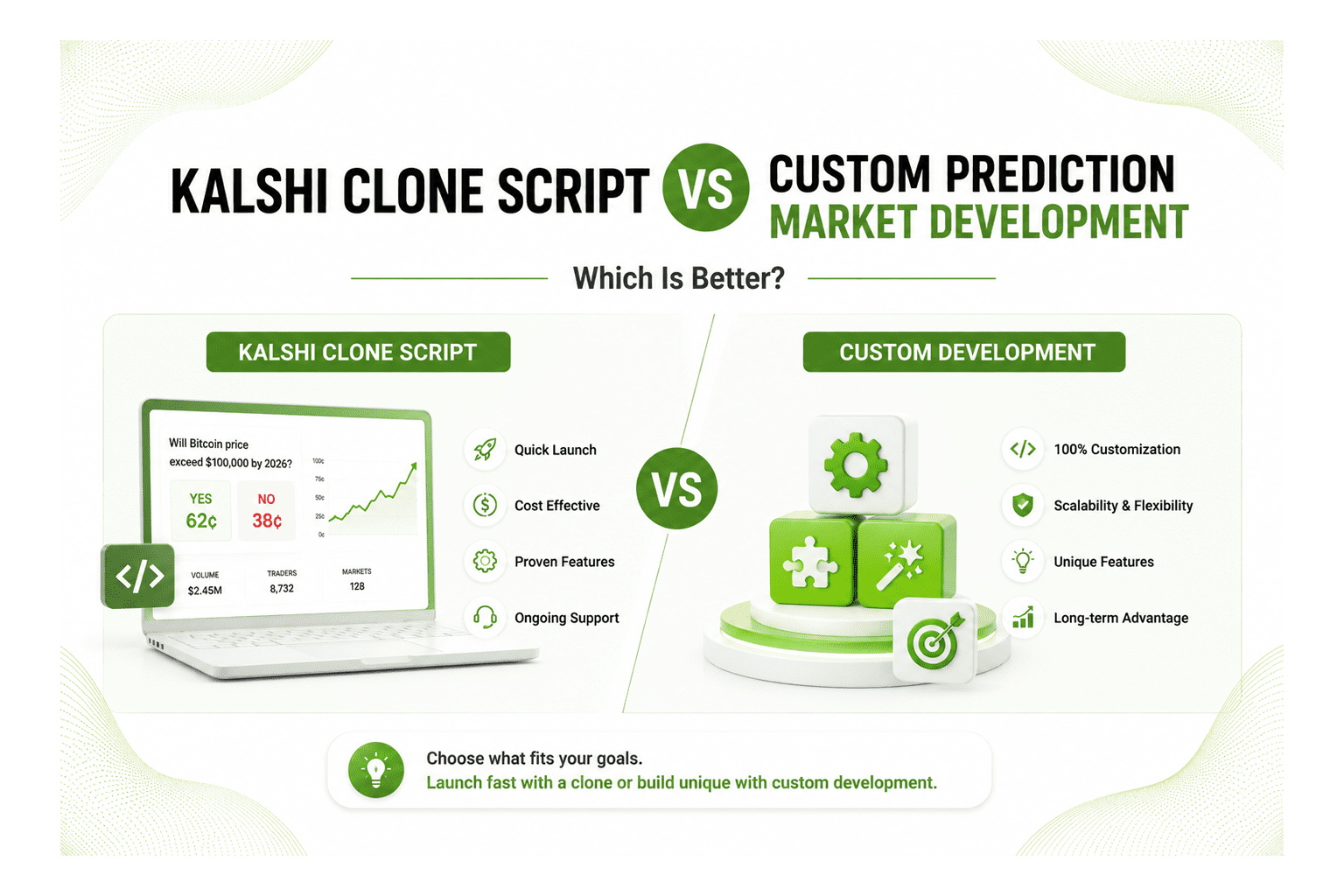
If you need to validate market demand fast and control costs, a Kalshi Clone Script gets you live in 6–10 weeks for a fraction of the price. If you need deep customization, multi-jurisdiction compliance, proprietary matching logic, or long-term scalability, Custom Prediction Market Development is the better investment — even though it costs more and takes longer upfront. Most serious operators start lean with a clone script framework and migrate to custom infrastructure once they’ve proven demand and need to scale.
What is a Kalshi Clone Script?
A Kalshi clone script is a pre-built software framework that replicates the core mechanics of an event trading platform — Yes/No contract trading, order matching, wallet management, and basic KYC — packaged so a development team can customize and deploy it quickly.
Think of it as a foundation, not a finished house. A good clone script gives you:
- A working order matching engine (usually simplified compared to Kalshi’s own infrastructure)
- Wallet and payment module scaffolding
- Basic admin tools for market creation and settlement
- A trading UI you can rebrand and adjust
What it doesn’t give you is deep customization. Most clone scripts are built around one core architecture, and pushing them beyond their intended use case — new market categories, custom pricing logic, multi-region compliance — gets expensive fast, sometimes more expensive than starting custom would have been.
This is where prediction market software vendors differ wildly in quality. Some hand over rigid, closed-source packages. Others — DigiTechzo included — build modular clone frameworks specifically so components can be swapped or upgraded later without a full rebuild.
What is Custom Prediction Market Development?
Custom prediction market development means building your platform’s architecture, trading engine, compliance layer, and UI from scratch, engineered around your specific business model and target market.
This approach gives you full ownership over:
- Matching engine logic — how orders are priced, matched, and settled
- Compliance architecture — built for your specific target jurisdictions from day one
- Data infrastructure — how market data, user behavior, and settlement history are stored and analyzed
- Scalability design — how the system handles 500 users versus 500,000
A custom prediction market platform takes longer to build and costs more upfront, but it’s the only path that gives you full intellectual property ownership and unrestricted room to grow. If your long-term plan includes white-labeling your platform, expanding into new regulatory regions, or building proprietary AI-driven pricing models, custom development isn’t optional — it’s the only structurally sound option.
Kalshi Clone Script vs Custom Development (Detailed Comparison)
Here’s the side-by-side breakdown most vendors won’t give you straight.
| Factor | Kalshi Clone Script | Custom Development |
|---|---|---|
| Development Time | 6–10 weeks | 4–8 months |
| Cost | $25,000 – $60,000 | $80,000 – $250,000+ |
| Customization | Limited to framework’s architecture | Fully tailored to business logic |
| Scalability | Moderate; often needs re-architecture at scale | Built for scale from the ground up |
| Security | Depends on vendor’s existing framework quality | Custom-hardened for your specific risk profile |
| Compliance Readiness | Basic, often single-jurisdiction | Multi-jurisdiction, built-in from day one |
| UI/UX | Template-based, limited flexibility | Fully custom, brand-specific |
| Performance | Adequate for moderate trading volume | Optimized for high-frequency, high-volume trading |
| Ownership | Often licensed, not fully owned | 100% IP ownership |
| Maintenance | Dependent on vendor’s update cycle | Full control over updates and patches |
| Revenue Potential | Capped by platform limitations | Unlimited — supports new revenue streams as you grow |
| Time to Market | Fast | Slower, but more sustainable long-term |
Featured snippet answer: A Kalshi clone script is faster and cheaper to launch but limited in customization and scalability, while custom prediction market development costs more and takes longer but delivers full ownership, compliance flexibility, and long-term scalability.
When Should You Choose a Kalshi Clone Script?
A clone script is the right call when:
- You’re validating demand. You don’t yet know if your niche (regional sports, crypto price events, local politics) has enough trader interest to justify heavy investment.
- Budget is the primary constraint. You need to launch under $60,000 and can’t stretch further right now.
- Your compliance scope is narrow. You’re targeting one jurisdiction with straightforward regulatory requirements.
- Speed to market matters more than differentiation. You need to be live before a competitor claims the niche.
- You’re testing a specific event category, not building a broad, multi-vertical exchange.
Example: A startup wanting to test a niche event trading platform focused purely on regional sports outcomes doesn’t need enterprise-grade infrastructure on day one. A clone script lets them validate the concept, gather real trading data, and decide whether to scale before committing serious capital.
When Should You Build a Custom Prediction Market?
Custom development makes sense when:
- You’re targeting multiple jurisdictions with different compliance requirements (US, EU, offshore).
- You need proprietary trading logic — dynamic pricing models, AI-driven market curation, or unique settlement mechanisms.
- White-label licensing is part of your roadmap. You plan to eventually license your platform to other operators.
- You expect high trading volume. A clone script’s matching engine likely wasn’t built for high-frequency order flow.
- Investors expect defensible IP. “We licensed a clone script” is a very different pitch than “we built proprietary trading infrastructure.”
Example: A fintech company planning to launch a prediction exchange across three regulatory regions, with plans to eventually offer B2B white-label access to media partners, cannot realistically retrofit that complexity onto a rigid clone framework. Custom architecture is the only viable path.
Real-World Business Scenarios
Scenario 1: The Niche Validator A two-person founding team wants to test a prediction market app development idea around crypto price movements. They have $40,000 and six months of runway. A clone script gets them live in 8 weeks, and they use real trading data to raise a seed round before committing to a custom rebuild.
Scenario 2: The Regulated Fintech A funded startup with a CFTC compliance strategy already mapped out needs a platform built for scale from day one, with audit-ready logging and multi-region KYC. They skip the clone script entirely and go straight to custom development, because retrofitting compliance later would be more expensive than building it right the first time.
Scenario 3: The Pivoting Operator A team launches on a clone script, hits liquidity and performance limits at 15,000 active users, and migrates their matching engine and compliance layer to custom infrastructure — while keeping their existing user base and brand intact. This hybrid path is increasingly common among teams that started lean and scaled smart.
Cost Breakdown
| Component | Clone Script | Custom Development |
|---|---|---|
| Core platform build | $15,000 – $35,000 | $50,000 – $150,000 |
| KYC/AML integration | $3,000 – $8,000 | $8,000 – $20,000 |
| Payment gateway setup | $2,000 – $6,000 | $6,000 – $15,000 |
| Mobile app development | $5,000 – $15,000 | $20,000 – $50,000 |
| Compliance/legal consulting | Often excluded | $10,000 – $30,000+ |
| Total estimated range | $25,000 – $60,000 | $80,000 – $250,000+ |
Hidden Costs Most Businesses Ignore
These are the line items that blindside founders after launch:
- Licensing renewal fees on clone scripts — many vendors charge ongoing licensing costs that add up over 2–3 years.
- Re-architecture costs when a clone script hits scalability limits and needs partial custom rebuilding.
- Payment processor onboarding delays — betting-adjacent businesses often face extended underwriting timelines, which cost time even if not direct cash.
- Compliance consulting — many clone script vendors don’t include legal/regulatory guidance, leaving founders to source this separately.
- Data infrastructure costs — storing and querying time-series market data at scale gets expensive if not architected efficiently from the start.
- Third-party API dependency costs — KYC providers, data feed providers, and cloud infrastructure all scale in cost with user volume.
Security & Compliance Considerations
Security can’t be an afterthought in fintech software development, and prediction markets carry the same risk profile as any exchange handling real money.
Non-negotiables regardless of which path you choose:
- End-to-end encryption for all financial data
- Multi-factor authentication on all user accounts
- Regular third-party penetration testing
- Immutable audit logs for every trade and settlement event
- KYC/AML verification aligned to your target jurisdiction’s requirements
Where the paths diverge: Clone scripts inherit whatever security posture the vendor originally built — you’re trusting their architecture decisions. Custom development lets you design security controls around your specific risk profile, which matters enormously if you’re handling higher trading volumes or operating in stricter regulatory environments.
Scalability Challenges
Scalability isn’t just about handling more users — it’s about handling more complexity without breaking.
Common scalability bottlenecks:
- Matching engine throughput — clone scripts often weren’t designed for high order-flow volume, causing latency under load.
- Database architecture — time-series market data grows fast; poorly indexed databases slow down price charts and order history.
- Market category expansion — adding new event types (crypto, sports, politics) sometimes requires structural changes a clone script can’t accommodate.
- Geographic expansion — scaling into new jurisdictions requires modular compliance logic, which rigid clone frameworks rarely support cleanly.
A genuinely scalable prediction market platform is built with microservices architecture from the start, allowing the trading engine, compliance layer, and payment system to scale independently as demand grows in different areas.
Revenue Models
Both approaches can support similar monetization strategies, but custom platforms typically unlock more revenue flexibility over time.
- Trading fees — a percentage per contract trade, the primary revenue driver for most platforms
- Withdrawal fees — flat or percentage-based fees on cash-outs
- Premium features — advanced analytics, early market access, API access for power users
- Data licensing — selling anonymized market sentiment data to research firms or media outlets
- White label prediction market licensing — licensing your infrastructure to other operators, a revenue stream only realistically available with custom-built, modular architecture
Common Mistakes to Avoid
- Choosing a clone script purely on price without checking whether the vendor’s architecture can scale or be modified later.
- Skipping compliance planning because “the clone script includes KYC” — basic KYC integration isn’t the same as jurisdiction-specific regulatory readiness.
- Over-building custom infrastructure before validating demand, burning capital on features nobody’s asked for yet.
- Ignoring ownership terms — some clone script vendors retain partial rights or ongoing licensing control over your platform.
- Underestimating migration costs if you plan to move from a clone script to custom infrastructure later without planning the transition upfront.
Expert Tips Before Choosing
- Ask clone script vendors directly whether the architecture is modular. If core components can’t be swapped later, you’re locking yourself into their roadmap, not yours.
- Get compliance guidance before choosing your tech path, not after — your target jurisdiction should influence your architecture decisions from day one.
- Budget for a potential migration even if you start with a clone script. Treat it as a phase one, not a permanent decision.
- Prioritize matching engine quality above UI polish. A beautiful interface on a slow trading engine will lose users faster than a plain interface with fast, reliable execution.
- Talk to a development partner who’s built both paths. Vendors who only offer clone scripts — or only offer custom builds — have an inherent bias in how they’ll advise you.
Frequently Asked Questions
1. Is a Kalshi Clone Script cheaper than custom prediction market development? Yes. A Kalshi clone script typically costs $25,000–$60,000, while custom prediction market development ranges from $80,000 to $250,000+, depending on compliance scope and feature complexity.
2. Can I upgrade from a Kalshi Clone Script to a custom platform later? Yes, this is a common path. Many operators launch on a modular clone script to validate demand, then migrate the matching engine, compliance layer, and infrastructure to custom-built systems once they’ve proven traction and need to scale.
3. Which option is better for regulatory compliance — clone script or custom development? Custom development is generally better for compliance-heavy use cases, since it allows you to build jurisdiction-specific KYC/AML workflows and geofencing from the ground up, rather than adapting a generic framework after the fact.
4. How long does it take to build a prediction market platform with a clone script vs custom development? A Kalshi clone script typically launches in 6–10 weeks. Custom prediction market development takes 4–8 months, depending on the number of supported jurisdictions and feature complexity.
5. Do I own the platform if I use a Kalshi Clone Script? It depends on the vendor’s licensing terms. Some clone scripts are licensed rather than fully owned, meaning you may face ongoing fees or usage restrictions. Custom development gives you complete IP ownership by default.
Final Verdict
There’s no universally “better” option in the Kalshi Clone Script vs Custom Development debate — there’s only what’s right for your current stage.
If you’re validating a new market category with limited capital, a clone script gets you live fast and cheap, and that speed has real strategic value. If you already know your compliance scope, expect high trading volume, or plan to build a defensible, investable business around proprietary infrastructure, custom development is worth the extra time and cost.
The smartest operators don’t treat this as a permanent choice — they treat it as a sequence. Start lean, prove demand, then invest in custom infrastructure once the data justifies it.
Conclusion
Whichever path fits your business today, the underlying goal is the same: a fast, reliable, and compliant prediction market software platform that traders trust and regulators don’t flag. Getting the architecture decision right early saves you from expensive rebuilds and compliance headaches down the road.
DigiTechzo has worked with founders on both ends of this decision — from lean clone script launches to fully custom, multi-jurisdiction prediction exchanges — and can help you map out exactly which approach fits your budget, timeline, and long-term goals.
Ready to figure out the right build strategy for your prediction market platform? Book a free consultation with DigiTechzo’s fintech development team and get a clear, honest recommendation before you spend a dollar on development.
About The Author