
Every day, businesses leave thousands of dollars on the table — not because they lack customers, but because they can’t accept cryptocurrency payments. As digital assets move mainstream, the demand for robust, scalable crypto payment gateways is accelerating faster than most businesses can keep up with.
That’s exactly where a CoinPayments Clone Script changes the game. If you want to build a full-featured, multi-currency crypto payment platform without starting from zero, this guide is built for you.
At DigiTechzo, we’ve helped startups and enterprises deploy production-ready crypto payment solutions using battle-tested clone scripts — and this guide captures everything we’ve learned. Whether you’re an entrepreneur, a fintech founder, or a developer evaluating options, you’ll walk away with a clear, actionable understanding of what a CoinPayments clone script is, what it should include, and how to launch fast without compromising quality.
|
What Is a CoinPayments Clone Script?
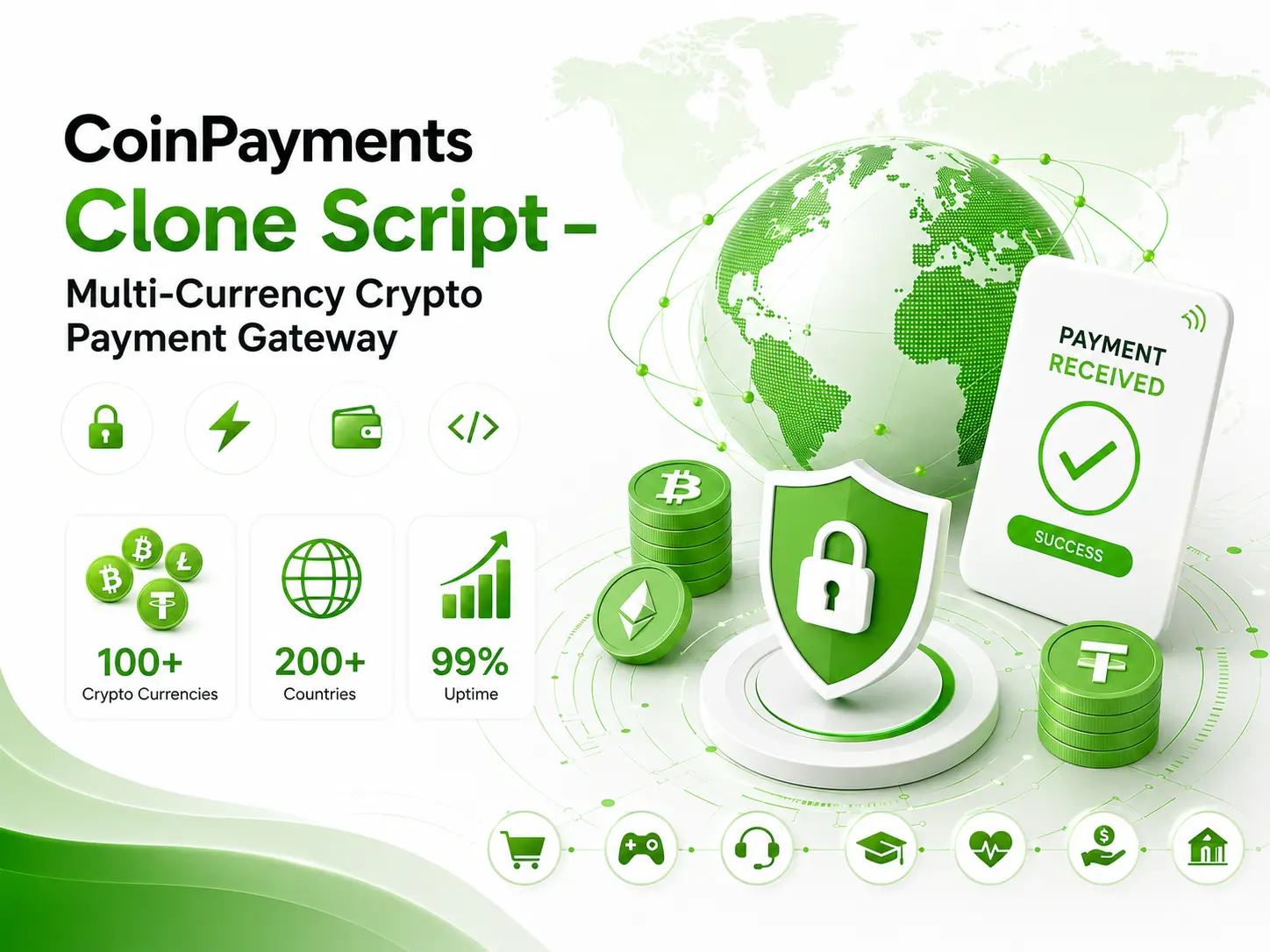
A CoinPayments Clone Script is a pre-built, white-label software package that mirrors the complete functionality of CoinPayments.net — one of the world’s largest and oldest cryptocurrency payment processors, supporting over 2,000 cryptocurrencies.
Instead of spending 12–18 months (and $150,000+) building a crypto payment gateway from scratch, a clone script gives you a fully functional, customizable codebase you can deploy, brand, and launch as your own platform — typically within 1–4 weeks.
The clone script isn’t a copy of CoinPayments’ proprietary code. It’s an independently developed solution engineered to deliver the same workflows, features, and user experience — rebuilt from the ground up.
|
How Does CoinPayments Work? (And Why Clone It?)
CoinPayments operates as a crypto payment processor that sits between merchants and their customers. Here’s the simplified flow:
- Customer selects cryptocurrency at checkout
- CoinPayments generates a unique wallet address for the transaction
- Customer sends funds to that address
- CoinPayments confirms the transaction on-chain and notifies the merchant via IPN
- Merchant receives payment in crypto or auto-converted to stablecoins/fiat
Why does this model deserve cloning? Because it solves a real, universal problem:
- Global reach: Crypto transactions bypass geographic banking restrictions.
- Lower fees: Typical crypto payment fees are 0.5–1% vs. 2–4% for credit cards.
- No chargebacks: Blockchain transactions are irreversible — merchants eliminate fraud risk.
- Speed: Settlements happen in minutes to hours vs. days for bank transfers.
The crypto payment market is projected to exceed $4.5 trillion in transaction volume by 2030 (Allied Market Research). The window to capture market share in this space is wide open — and a CoinPayments clone script is your fastest route in.
Core Features of a CoinPayments Clone Script
A production-ready CoinPayments Clone Script isn’t just about accepting Bitcoin. Here’s what separates a serious solution from a basic demo:
Merchant Dashboard
Real-time transaction monitoring and reporting
API key management for integration with e-commerce platforms
Withdrawal management and wallet balance overview
Invoice generation and payment button creation
Multi-Currency Wallet
Hot and cold wallet architecture for security
Support for Bitcoin, Ethereum, BNB, USDT, USDC, Litecoin, XRP, and 100+ others
Automatic wallet address generation per transaction
Payment Gateway APIs
RESTful API for seamless integration with any website or app
IPN (Instant Payment Notification) system for real-time webhooks
Payment buttons and hosted checkout pages
WooCommerce, Shopify, Magento, and OpenCart plugins
Coin Conversion Engine
Auto-conversion of received crypto to stablecoins (USDT, USDC) or BTC
Integration with real-time price feeds (CoinGecko, Binance, CoinMarketCap)
Configurable conversion thresholds and scheduling
Admin Panel
Full KYC/AML compliance management
User and merchant account management
Fee structure configuration per coin or merchant tier
Transaction dispute resolution tools
System health monitoring and alert management
Security Infrastructure
Two-factor authentication (2FA) for all accounts
Multi-signature wallet support
IP whitelisting and rate limiting on APIs
AES-256 encryption for sensitive data
DDOS protection and WAF integration
Multi-Currency Support: The Real Competitive Edge
The most powerful feature of any CoinPayments Clone Script is genuine multi-currency support — not just ETH and BTC. Here’s why this matters strategically:
Different user demographics prefer different coins. DeFi users may pay in USDC. Gaming communities transact in specific tokens. International remittance users prefer XRP or Stellar for speed. If your platform only supports 5–10 coins, you’re already leaving customers behind.
A well-built clone script should support:
- Layer 1 blockchains: Bitcoin, Ethereum, BNB Smart Chain, Solana, Avalanche, Tron
- Stablecoins: USDT (ERC-20, TRC-20, BEP-20), USDC, DAI, BUSD
- ERC-20/BEP-20 tokens: Any standard token can be added via admin panel
- Privacy coins: Monero (XMR), Zcash — for platforms requiring privacy options
- Layer 2 solutions: Polygon, Arbitrum, Optimism for low-fee transactions
|
Technical Architecture Overview
Understanding the technical stack helps you evaluate script quality and long-term scalability:
Recommended Technology Stack
|
Layer |
Technology Options |
Why It Matters |
|
Frontend |
React.js / Vue.js |
Fast, responsive merchant dashboards |
|
Backend |
Node.js / Laravel / Django |
High-throughput API handling |
|
Blockchain Integration |
Web3.js, Ethers.js, Bitcoin RPC |
Direct node connectivity |
|
Database |
PostgreSQL + Redis |
Relational + caching for speed |
|
Queue System |
RabbitMQ / Bull |
Async transaction processing |
|
Infrastructure |
AWS / GCP + Docker + Kubernetes |
Scalable deployment |
Blockchain Node Setup
Quality clone scripts connect directly to full nodes rather than relying entirely on third-party APIs (which can go down). Look for:
- Full node support or integration with QuickNode / Alchemy as fallback
- Webhook listener for incoming transaction monitoring
- Multi-confirmation settings per coin (configurable)
- Orphan transaction detection and handling
CoinPayments Clone Script vs. Building from Scratch
| Factor | Clone Script |
Build from Scratch |
|
Time to Launch |
2–6 weeks |
12–18+ months |
|
Development Cost |
$5,000–$30,000 |
$150,000–$500,000+ |
|
Core Features |
Pre-built & tested |
Built iteratively |
|
Customization |
White-label ready |
Unlimited (but costly) |
|
Security Audits |
Usually included |
Requires separate engagement |
|
Regulatory Compliance |
Often pre-configured |
Must build from scratch |
|
Support & Maintenance |
Provided by vendor | Entirely in-house |
The conclusion is clear: unless you have deep pockets, a large dev team, and 18 months to spare, a clone script dramatically de-risks your launch — especially in a market that’s moving this fast.
Top Use Cases & Who Should Use a CoinPayments Clone Script
Crypto Payment Startups
Entrepreneurs looking to build a standalone crypto payment gateway business — charging merchants a percentage per transaction. This is the core use case and most profitable long-term model.
E-Commerce Platforms
Online stores wanting to add crypto payment capabilities alongside traditional payment methods. The clone’s plugin/API architecture integrates with existing storefronts in hours.
Freelance & Invoice Platforms
Platforms serving global freelancers who need to receive crypto payments without geographic banking restrictions. Particularly high-value in markets where PayPal and Stripe don’t fully operate.
Gaming & NFT Marketplaces
Platforms processing micro-transactions in native game tokens or requiring NFT purchase flows. Multi-chain support and fast confirmation times are critical here.
Remittance Services
Businesses enabling international money transfers via crypto rails, converting on the receiving end. Lower fees than traditional wire transfers make this a highly competitive offering.
White-Label B2B Solutions
Tech companies licensing their crypto payment infrastructure to other businesses — building a SaaS model on top of the clone script.
How to Choose the Right CoinPayments Clone Script Provider
Not all clone scripts are created equal. Here’s the framework for evaluating providers:
- Source code ownership: Ensure you receive 100% of the source code with no licensing restrictions. Avoid SaaS-only models if you need full control.
- Coin support and extensibility: Ask how new coins are added. The answer should be ‘via admin panel’ — not ‘requires custom development.’
- Security audit history: Request penetration test reports or third-party audit results. No audit history is a red flag.
- Demo environment access: Never purchase without testing a live demo. Verify IPN delivery, wallet generation speed, and API responsiveness.
- Regulatory compliance features: KYC/AML modules, GDPR-compliant data handling, and jurisdiction-specific tax reporting are non-negotiable for serious operations.
- Post-launch support: Minimum 6–12 months of technical support. Blockchain ecosystems change fast — you need a vendor that keeps up.
- Customization scope: Verify what’s configurable (fee structures, coin listings, UI themes) vs. what requires code changes.
Common Mistakes to Avoid
- Mistake 1 – Ignoring blockchain node reliability: Many cheap scripts rely entirely on shared third-party nodes. When those go down during high traffic, your entire payment system fails. Insist on dedicated node support or fallback redundancy.
- Mistake 2 – Underestimating compliance requirements: Launching a crypto payment gateway without KYC/AML compliance can result in platform shutdowns and legal liability. Build compliance in from day one, not as an afterthought.
- Mistake 3 – Choosing lowest-cost providers: A $500 script might save money upfront but cost tens of thousands in security incidents, downtime, and rebuilds within 6 months. TCO (Total Cost of Ownership) matters more than initial price.
- Mistake 4 – Skipping IPN testing: Instant Payment Notifications are the heartbeat of your payment system. Merchants lose trust instantly if their system fails to receive payment confirmations. Test IPN under load before launch.
- Mistake 5 – No cold wallet strategy: Keeping 100% of user funds in hot wallets is a catastrophic security risk. Any serious platform should move 90–95% of holdings to cold storage automatically.
- Mistake 6 – Ignoring mobile UX: Over 60% of crypto transactions originate from mobile. A desktop-only merchant dashboard or non-responsive checkout flow is a conversion killer.
Expert Tips for Launching Successfully
- Tip 1 – Start with 10–15 high-volume coins: Don’t try to support 500 coins on day one. Focus on BTC, ETH, BNB, USDT, USDC, SOL, XRP, and a few others. Add more based on merchant demand.
- Tip 2 – Build a merchant acquisition funnel before launch: Line up 10–20 merchants who will use your platform from day one. Empty platforms struggle to attract the next wave. Early merchant volume creates social proof.
- Tip 3 – Price competitively but protect your margin: CoinPayments charges 0.5% per transaction. To compete, start at 0.3–0.4% but add a tiered volume model where high-volume merchants pay less.
- Tip 4 – Integrate with popular e-commerce platforms immediately: WooCommerce alone powers over 29% of online stores globally. A working WooCommerce plugin on launch day gives you immediate distribution.
- Tip 5 – Publish your security measures publicly: A published security page detailing your wallet architecture, encryption standards, and audit status builds immediate trust with enterprise merchants.
- Tip 6 – Set up monitoring before going live: Use tools like Grafana + Prometheus or Datadog to monitor transaction throughput, failed payments, and node connectivity in real time. You want to detect failures before merchants do.
Frequently Asked Questions (FAQs)
Q1: How long does it take to deploy a CoinPayments Clone Script?
With a quality pre-built script, deployment takes 2–6 weeks including server setup, customization, integration testing, and soft launch. Full-featured go-live with compliance layers can take 6–10 weeks.
Q2: How many cryptocurrencies can a CoinPayments Clone Script support?
Most enterprise-grade clone scripts support 100–2,000+ cryptocurrencies. The number depends on blockchain node integrations and whether ERC-20/BEP-20 token addition is handled dynamically via admin panel.
Q3: Is a CoinPayments Clone Script legal to use?
Yes — a clone script is a custom-built software solution, not a copy of proprietary code. However, you must comply with financial regulations in your jurisdiction, including obtaining necessary money transmission licenses and implementing KYC/AML programs.
Q4: What is IPN and why is it critical for a crypto payment gateway?
IPN (Instant Payment Notification) is a server-to-server callback that notifies a merchant’s system when a payment is confirmed on the blockchain. Without a reliable IPN system, merchants cannot automate order fulfillment, making your platform unviable for serious e-commerce use.
Q5: How much does a CoinPayments Clone Script cost?
Pricing ranges from $5,000 for basic scripts to $25,000–$50,000 for enterprise-grade solutions with full source code, security audits, compliance modules, and dedicated support. Custom development on top of a base script adds cost depending on scope.
Conclusion – Your Fastest Path to a Multi-Currency Crypto Payment Gateway
The cryptocurrency payment industry is not a future trend — it’s an accelerating present reality. Businesses that build robust crypto payment infrastructure today will hold lasting competitive advantages over those that wait.
A CoinPayments Clone Script dramatically compresses the time, cost, and complexity of entering this market. When chosen carefully and deployed correctly, it gives you a production-grade payment platform with multi-currency support, merchant tools, compliance infrastructure, and API capabilities — without the 18-month development timeline.
The keys to success are straightforward: choose a provider that offers full source code ownership, supports the currencies your target market uses, has a verifiable security track record, and backs the product with responsive technical support.
About The Author