
SaaS Development Cost: Everything Founders Should Know
The most common question founders ask before starting a SaaS project is also the one most agencies answer vaguely: how much will it cost? The industry has a frustrating habit of responding with ranges so wide they’re functionally useless — “anywhere from $30,000 to $500,000” tells a founder almost nothing about what their specific product, with their specific requirements, will actually need.
SaaS development cost is genuinely variable, but it’s not unpredictable. The factors that drive it are knowable in advance, and a good development partner should be able to give you a realistic, itemised estimate after a proper scoping session rather than a vague range designed to avoid commitment. The difference between a $60,000 SaaS build and a $250,000 one is almost never about the developer’s hourly rate — it’s about specific, identifiable choices made in scoping, architecture, and team structure.
At Digitechzo, we scope and build SaaS products for Australian and international founders every year. This guide walks through every cost category involved in SaaS development, the specific decisions that drive those costs up or down, what a realistic Year 1 budget looks like by product type, the hidden costs most founders discover mid-project rather than upfront, and how to evaluate whether a quote you’ve received is realistic.
Quick Answer
“SaaS development cost in Australia typically ranges from $50,000–$100,000 for a well-scoped MVP to $200,000–$500,000+ for a full-featured initial product with enterprise-grade infrastructure. The biggest cost drivers are the number and complexity of integrations, team location and seniority, infrastructure and compliance requirements, and how much of the product is custom-built versus configured from existing platforms. Ongoing infrastructure, maintenance, and support typically add $1,000–$10,000 a month on top of the build cost.”
The Full Picture: Every Cost Category in SaaS Development
SaaS development cost is made up of several distinct categories that are easy to conflate when founders think only about the build. Understanding each category is the starting point for an accurate budget.
1. Discovery and Scoping
Before a line of code is written, a properly run project includes a discovery phase where requirements are defined, architecture is planned, and a realistic scope is established. Skipping this phase doesn’t eliminate the cost — it transfers it to the build, where scope uncertainty is far more expensive to resolve.
- Typical cost: $3,000–$20,000 depending on product complexity.
- What it produces: a defined scope document, technical architecture, and a reliable estimate for the build phase.
- Why it matters: projects without a proper discovery phase almost always experience scope creep, budget overruns, and rework that could have been avoided.
2. UX/UI Design
Design is consistently underinvested in early SaaS products, and it’s consistently one of the primary drivers of early churn. A product users can’t understand or navigate quickly enough to experience its value will churn regardless of how good the underlying functionality is.
- Typical cost: $8,000–$40,000 for a full MVP design including user research, wireframes, high-fidelity screens, and component library.
- What it produces: a design system, all major user flows, and a handoff package the development team can build from without guessing at intent.
3. Frontend Development
The code that runs in the user’s browser — what they see, click, and interact with. Frontend complexity scales with the number of distinct user-facing screens, the sophistication of interactivity, and whether the product needs to perform well on mobile as well as desktop.
- Typical cost: $20,000–$80,000+ for MVP-stage frontend, depending on screen count and interaction complexity.
- Key driver: number of unique screens; a product with 8 screens costs far less than one with 30.
4. Backend Development and APIs
The server-side code that handles data processing, business logic, authentication, billing, and integrations. Backend complexity scales with the number of integrations, the complexity of the data model, and whether the product needs to handle high-volume processing.
- Typical cost: $25,000–$100,000+ for MVP-stage backend.
- Key driver: integration count and complexity; each external system added is a meaningful additional scope item.
5. Third-Party Integrations
Connecting the SaaS product to external platforms — payment processors, CRMs, email tools, accounting software, data providers — is one of the most significant and most underestimated sources of SaaS development cost. Each integration involves authentication, data mapping, error handling, and ongoing maintenance as third-party APIs evolve.
- Typical cost per integration: $2,000–$15,000 depending on API quality and data complexity.
- Common mistake: treating integrations as trivial line items rather than meaningful scope items with their own testing requirements.
6. Infrastructure and Cloud Costs
SaaS products run on cloud infrastructure — AWS, GCP, or Azure — and carry ongoing usage-based costs that scale with the product’s activity. Unlike the one-time build cost, infrastructure costs compound as the product grows.
- Typical MVP-stage cost: $200–$1,500 per month for a product with modest early traffic.
- Typical growth-stage cost: $1,500–$10,000+ per month as user count, data volume, and compute requirements scale.
- Key items: compute (servers), database, storage, CDN, email delivery, monitoring, and CI/CD pipeline.
7. Quality Assurance and Testing
Thorough QA is one of the most commonly cut items in SaaS development cost discussions, and one of the most expensive omissions. Bugs reaching early customers destroy trust at the exact moment the product most needs to build it.
- Typical cost: 15–20% of total development cost for a properly tested product.
- What it covers: manual testing, automated regression tests, edge case coverage, and performance testing under realistic load.
8. Security and Compliance
Security architecture, data encryption, penetration testing, and compliance requirements (SOC 2, ISO 27001, healthcare data standards, financial services regulations) all add to SaaS development cost — and are almost always required for B2B products selling to enterprise or regulated-industry customers.
- Typical additional cost: $10,000–$50,000+ depending on the compliance framework required.
- When it matters most: products handling health information, financial data, or personal data at scale face the highest compliance burden.
9. Post-Launch Maintenance and Support
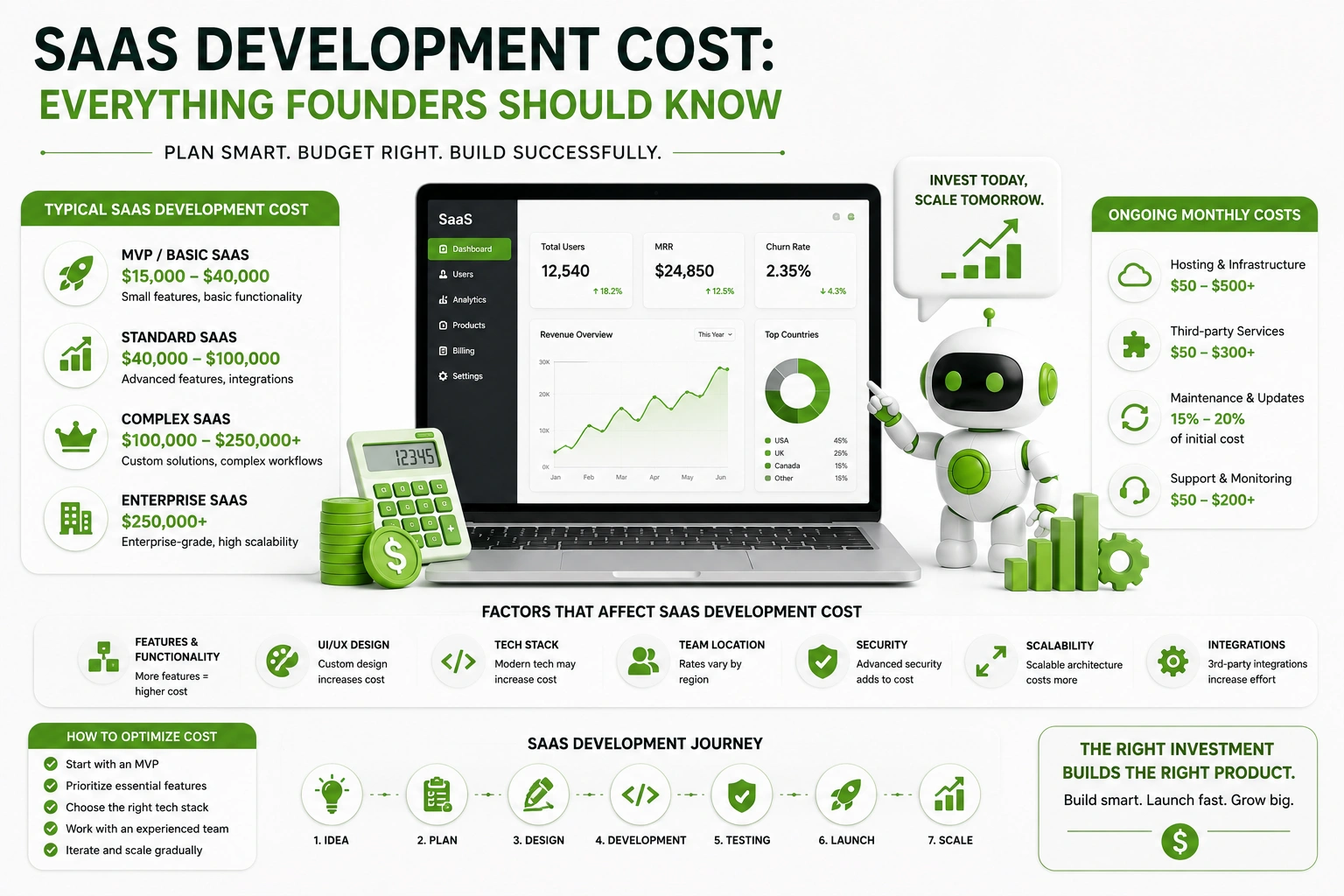
A SaaS product in production requires ongoing bug fixes, security patches, dependency updates, and performance monitoring. Industry estimates typically place ongoing maintenance cost at 15–25% of the initial build cost annually, plus the cost of continued feature development.
- Typical cost: $2,000–$15,000 per month for an active SaaS product in growth stage, covering maintenance, support, and incremental development.
SaaS Development Cost by Product Type: Realistic Ranges
Rather than one vague range, here’s what SaaS development actually costs broken down by the type of product being built, using typical Australian market pricing for 2026.
| Product Type | MVP Build Cost (AUD) | Full V1 Cost (AUD) | Typical Timeline |
| Simple B2B workflow tool (1 core workflow, Stripe billing) | $50,000 – $90,000 | $100,000 – $180,000 | 12–18 weeks |
| Multi-feature B2B SaaS (3–5 modules, 3–5 integrations) | $90,000 – $160,000 | $180,000 – $350,000 | 18–28 weeks |
| Marketplace or two-sided platform | $80,000 – $150,000 | $200,000 – $400,000 | 20–32 weeks |
| AI-powered SaaS (LLM features, data pipeline) | $80,000 – $160,000 | $180,000 – $400,000 | 18–30 weeks |
| Enterprise SaaS (SSO, audit logs, custom roles, compliance) | $150,000 – $300,000 | $350,000 – $600,000+ | 28–44 weeks |
| No-code MVP (Bubble, Webflow + Zapier) | $8,000 – $25,000 | Not applicable | 3–6 weeks |
Note: MVP costs reflect the minimum scope needed to validate the core hypothesis with paying users. Full V1 costs reflect a more complete product with multiple user roles, richer functionality, and additional integrations. Both exclude ongoing infrastructure, support, and post-launch development costs.
The Five Decisions That Move SaaS Development Cost the Most
Two SaaS products that sound similar on paper can differ in build cost by a factor of three or four, because of specific decisions made before the first line of code. Understanding these drivers lets founders make informed trade-offs rather than discovering them mid-build.
Decision 1: Team Location and Engagement Model
| Team Model | Typical Blended Day Rate (AUD) | Best For | Key Trade-off |
| Australian agency (senior team) | $1,500 – $3,000/day | Founders needing close collaboration and fast iteration | Highest cost; highest communication quality |
| Blended (AU lead + offshore build) | $900 – $1,600/day | Balance of quality, communication, and cost | Requires strong AU-side project management |
| Offshore agency (managed) | $400 – $900/day | Budget-constrained founders with a technical PM | Communication overhead; quality variance |
| In-house team (2–3 engineers) | Salary-based ($180k–$400k/yr total) | Founders with technical co-founder, long-term vision | Highest fixed cost; full control |
Decision 2: Build vs. Configure vs. Buy
Every feature in a SaaS product can be built from scratch, configured from an existing service, or bought as a third-party integration. Building gives maximum flexibility and uniqueness; configuring or buying is faster and cheaper but creates ongoing dependency.
- Authentication — build from scratch (expensive, risky) vs. Auth0/Clerk/Supabase Auth (3–5 days vs. 6–8 weeks — almost always use a service).
- Billing and subscriptions — build a billing system (months) vs. Stripe Billing (days) — always use Stripe at MVP stage.
- Email delivery — build SMTP infrastructure vs. Postmark/SendGrid (hours vs. weeks) — always use a service.
- AI features — train a model from scratch (extremely expensive) vs. use OpenAI/Anthropic API (days) — almost always use an API.
Each decision to configure or buy rather than build reduces SaaS development cost and timeline; each decision to build custom creates a maintenance obligation that compounds over time.
Decision 3: Number of User Roles and Permission Levels
Every distinct user role — admin, team member, client, viewer, super admin — multiplies the number of screens that need to be designed and built, the complexity of the data model, and the testing surface. A product with two user roles is not twice the complexity of a product with one; it’s often three to four times the complexity once all the permission logic, role-switching, and view customisation are included.
Decision 4: Multi-Tenancy Architecture
How the product isolates different customers’ data determines both the initial architecture cost and the compliance ceiling the product can reach. Shared schema (all customers in one database) is fastest and cheapest to build; separate databases per customer is most expensive but required for enterprise deals in regulated industries. Most MVP-stage products start with shared schema and migrate later — but that migration has a cost that should be factored into the overall SaaS development cost projection.
Decision 5: Integration Depth
A product that reads data from Salesforce and writes a summary costs far less than one that runs two-way sync, handles conflict resolution, and maps custom fields. Integration depth — not just integration count — is what actually drives cost. When evaluating a quote, ask for the integration specification, not just a list of systems named.
Hidden SaaS Development Costs Most Founders Discover Too Late
The biggest budget surprises in SaaS projects are almost always predictable, but they require the right questions at scoping to surface. Here are the most common costs that don’t appear in initial quotes.
- Data migration — if your early customers are moving from an existing tool, importing their historical data is a meaningful development project in its own right, often $5,000–$20,000+ per customer segment.
- Onboarding flow development — most founders underestimate how much engineering work it takes to build a great first-run experience; the difference between 30% and 70% activation rates is mostly onboarding, and good onboarding takes real build time.
- Email transactional system — every product event (sign up, password reset, invoice sent, usage alert) that triggers an email requires design, copywriting, and template development that isn’t always included in a basic backend quote.
- Admin and internal tooling — customer support and internal operations need a view into the product’s data; building even a basic admin panel is typically $8,000–$20,000 and is almost always underestimated.
- Analytics instrumentation — tracking what users do in the product requires deliberate engineering work to fire the right events; a product without this is flying blind through the most important learning period.
- Third-party API rate limits and reliability handling — building graceful degradation for when external APIs go down or hit rate limits is often excluded from basic integration scope estimates.
- Performance optimisation under load — a product that works for 10 users often breaks at 500; load testing and the fixes it reveals are costs that appear after launch if not planned for before it.
What a Realistic Year 1 SaaS Budget Actually Looks Like
Rather than looking at build cost in isolation, founders should model the full Year 1 budget: build, launch, infrastructure, post-launch development, and the cost of continuing to iterate based on early user feedback.
| Budget Category | Conservative (AUD) | Mid-Range (AUD) | Well-Funded (AUD) |
| Discovery and scoping | $5,000 | $12,000 | $20,000 |
| UX/UI design | $10,000 | $25,000 | $45,000 |
| MVP development (build) | $55,000 | $100,000 | $180,000 |
| QA and testing | $8,000 | $18,000 | $35,000 |
| Infrastructure (12 months) | $4,800 | $12,000 | $30,000 |
| Post-launch dev and maintenance | $12,000 | $30,000 | $60,000 |
| Marketing website + branding | $8,000 | $18,000 | $35,000 |
| Total Year 1 budget | $102,800 | $215,000 | $405,000 |
Conservative budget assumes a blended or offshore team, no-code tools where possible, and a narrow MVP scope. Mid-range assumes an Australian boutique agency with a well-scoped MVP. Well-funded assumes an experienced Australian team, comprehensive design, and a more complete initial product.
How to Calculate Whether the SaaS Development Cost Is Justified
Cost without a revenue model is just spending. Before committing to a SaaS development budget, run this calculation to confirm the economics work at your target price and conversion rate.
- Define your target MRR at break-even — the monthly revenue needed to cover ongoing infrastructure, maintenance, and support (typically $3,000–$15,000 per month for a standard SaaS).
- Calculate customers needed at break-even — target MRR divided by your planned monthly price per customer.
- Estimate time to break-even — if you can realistically acquire 10 paying customers in the first three months and grow from there, does the math reach break-even before the runway runs out?
- Model the payback period on the build cost — total build cost divided by monthly net profit at a realistic scale gives the payback period in months; if it’s beyond 36 months, the unit economics need reconsidering.
As a concrete example: a $100,000 MVP build, priced at $299/month per customer, with a realistic 20 paying customers in the first six months generates $5,980 MRR. That doesn’t cover a $15,000 monthly cost base on its own, which means either the price, the conversion assumption, or the cost base needs adjusting before the first dollar of development is committed.
Common Mistakes Founders Make When Budgeting SaaS Development Cost
- Treating the MVP cost as the full budget — the MVP build is typically 40–60% of the first year’s actual cost when infrastructure, post-launch development, and marketing are included.
- Getting quotes without a defined scope — asking for a SaaS development quote without a specification produces a range, not an estimate; the difference between three quotes is almost always the assumptions each agency made to fill the undefined gaps.
- Underestimating integration costs — each integration is a meaningful development and testing item; a product with five integrations does not cost the same as one with zero, regardless of how the initial quote is framed.
- Ignoring ongoing infrastructure and maintenance in the budget — founders consistently plan for the build but not for the $5,000–$15,000 a month that keeps the product running and improving after launch.
- Choosing a partner based on price without checking process — the cheapest SaaS development quote is almost always missing phases (discovery, QA, post-launch support) that become expensive surprises mid-project.
Expert Tips for Managing SaaS Development Cost
- Run a paid discovery phase before committing to a full build — a $5,000–$15,000 discovery engagement produces a reliable scope and estimate; it’s the cheapest insurance against a $50,000 mid-build surprise.
- Lock the MVP scope in writing before development starts — a signed scope document with explicit post-MVP deferrals prevents the “just one more feature” conversations that compound into weeks of additional cost.
- Use managed cloud services rather than custom infrastructure at MVP stage — Vercel, Railway, Supabase, and similar managed platforms cost more per unit at scale but save significant engineering time and maintenance overhead at early stage.
- Negotiate a change-control process before signing a development contract — scope changes during a build should have a defined process (written brief, estimate, approval) rather than being added informally and billed at the end.
- Budget 20% of the build cost as a contingency, not an afterthought — well-run SaaS projects still encounter unforeseen complexity; treating contingency as part of the plan rather than a crisis fund makes it significantly less stressful.
Frequently Asked Questions
How much does SaaS development cost in Australia?
SaaS development cost in Australia ranges from $8,000–25,000 for a no-code MVP to $50,000–$160,000 for a custom-coded MVP and $200,000–$500,000+ for a full-featured initial product. Most B2B SaaS products built with an Australian or blended development team land in the $60,000–$160,000 range for a properly scoped MVP, plus $3,000–10,000 a month in ongoing costs.
What is the biggest factor in SaaS development cost?
The single biggest driver of SaaS development cost is integration complexity — the number and technical depth of connections to external systems like CRMs, payment platforms, accounting software, and data providers. A product with five deep integrations can cost two to three times as much as a functionally similar product with one simple integration.
Is it cheaper to hire a development agency or build an in-house team?
For the MVP stage, a development agency is almost always cheaper on a total-cost basis because there are no recruitment costs, no long-term employment commitments, and no time cost of building a team. In-house teams become more cost-effective beyond the MVP stage when the product has validated its direction and requires ongoing, full-time engineering capacity.
How much does it cost to maintain a SaaS product after launch?
Ongoing SaaS maintenance costs typically run $2,000–15,000 per month, covering infrastructure, bug fixes, security patches, dependency updates, and incremental feature development. Infrastructure alone is $200–1,500 a month at MVP scale and grows with user volume and data storage requirements.
Can I reduce SaaS development cost by using no-code tools?
Yes, significantly at the MVP stage. No-code platforms like Bubble can reduce initial build cost to $8,000–25,000 and cut timelines to three to six weeks. The trade-off is a ceiling on customisation, performance, and integration depth that typically requires a full rebuild once the product grows beyond early-stage simplicity, so the total cost of a no-code-then-rebuild path is often higher than starting with a properly scoped custom build.
Conclusion: SaaS Development Cost Is Predictable When You Know What to Ask
SaaS development cost isn’t a mystery — it’s the sum of knowable decisions made before the build starts. The scope, the team model, the integration depth, the infrastructure choices, and the maintenance plan all contribute to a number that a good development partner should be able to estimate reliably after a proper scoping session. What makes budgets fail isn’t unknown unknowns; it’s known decisions that weren’t made explicitly before the clock started.
If you’re preparing to build a SaaS product and want an honest, itemised cost estimate for your specific idea rather than a vague range, Digitechzo runs a paid discovery and scoping engagement that produces a documented scope, a reliable budget, and a realistic timeline before any development commitment is made. Get in touch to start there — the scoping cost is the most valuable line
item in the budget.
About The Author