
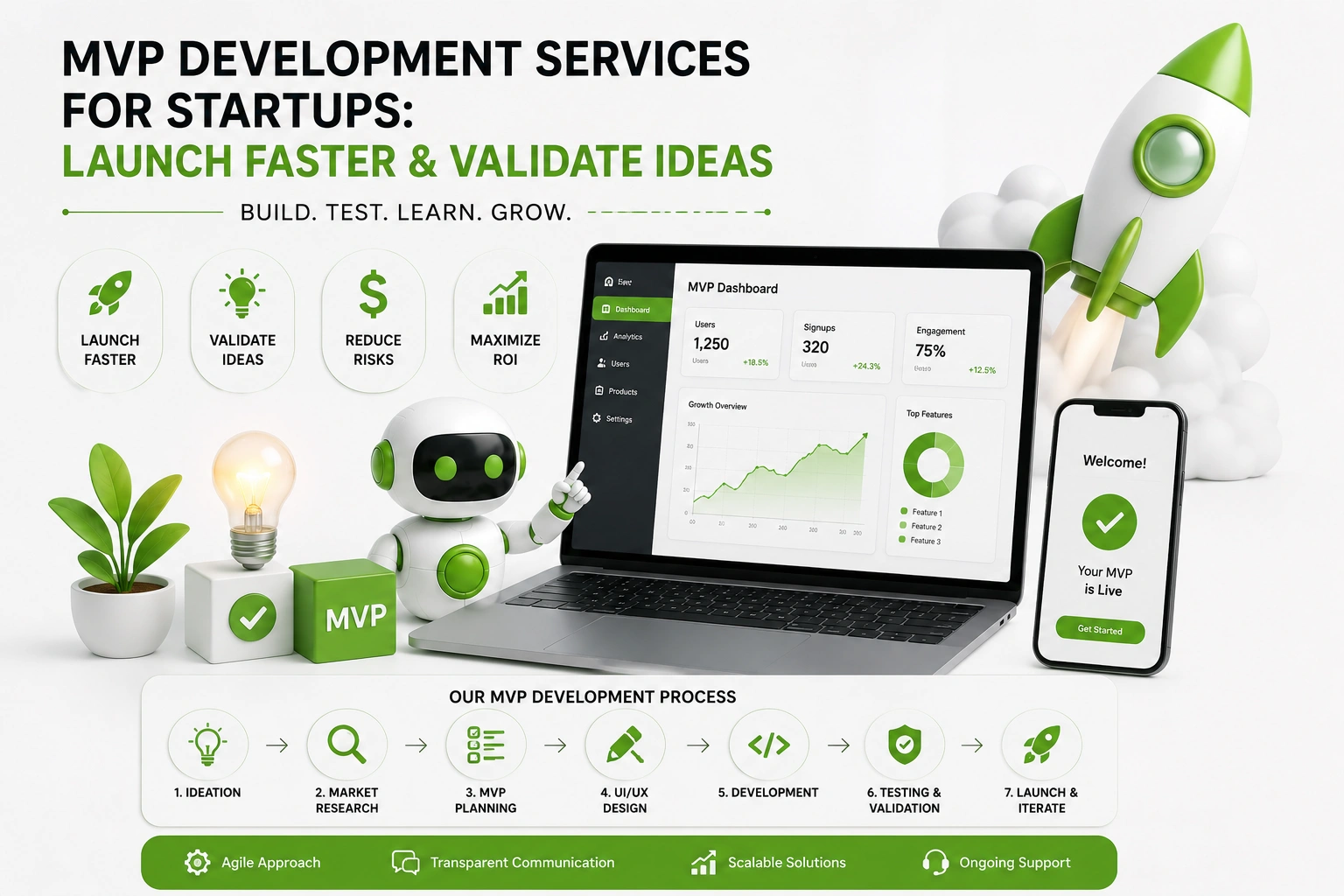
MVP Development Services for Startups: Launch Faster and Validate Ideas
Most startup ideas don’t fail because the founder lacked drive or the market didn’t exist. They fail because the team spent twelve months building the wrong version of the right idea — a fully-featured product nobody actually validated, launched too late to the wrong early customers, and burned through runway before discovering what the product should have been six months earlier. That’s not a story about bad luck; it’s a story about skipping the MVP.
MVP development services exist precisely to prevent this. A properly scoped, properly built minimum viable product lets a startup test its core hypothesis with real users in a fraction of the time and cost of a full product build — and the learning from that test changes everything: the product direction, the pricing, the customer profile, and often the problem statement itself.
At Digitechzo, we work with Australian startups and early-stage founders to scope, build, and launch MVPs that generate real signal rather than polished demos that confirm what the team already believes. This guide walks through what MVP development services actually include, how to choose the right partner, what an MVP genuinely should and shouldn’t be, the cost to expect, and the questions that separate good engagements from expensive mistakes.
Quick Answer
“MVP development services help startups scope, design, build, and launch a minimum viable product — the smallest, most functional version of a product that generates real validation signal from paying users. Most well-scoped startup MVPs take 8–16 weeks and cost $25,000–$120,000 to build with a professional development partner, with the right scope defined by what’s needed to test the core hypothesis rather than by what the full product vision contains.”
What Are MVP Development Services?
MVP development services are the end-to-end professional support for taking a startup idea from concept to a launchable, testable product — covering strategy and scoping, UX design, technical architecture, development, quality assurance, and launch. Unlike hiring a freelancer for isolated build tasks, a professional MVP development service provides a team that works through the full lifecycle with a single coherent strategy.
What’s Included in MVP Development Services
- Product strategy and discovery — clarifying the core hypothesis the MVP is designed to test, defining the target user, and mapping the single workflow the product must nail.
- MVP scoping and feature prioritisation — ruthlessly separating the features that test the hypothesis from the features that are simply on the roadmap but not needed yet.
- UX/UI design — wireframes, user flows, and UI design that make the core workflow fast to understand and easy to act on, even in an early product.
- Technical architecture — selecting the right stack, infrastructure, and data model for the product’s requirements and future scale path.
- Development and build — engineering the application, integrations, authentication, and billing in a way that’s stable enough for real users and extensible enough for the next phase.
- QA and testing — validating that the product works correctly before it reaches early users, including edge cases and failure states.
- Launch support — deploying to production, setting up monitoring and error alerting, and preparing for the operational realities of the first users.
What an MVP Is — and What It Is Not
The term minimum viable product is one of the most widely misunderstood concepts in the startup world. Clarifying what it actually means changes how MVP development services should be scoped and evaluated.
The MVP Misconceptions That Waste the Most Money
| Misconception | Reality |
| An MVP is a rough, buggy version of the full product | An MVP is a fully functional product with a narrow scope — it does one thing properly, not everything poorly |
| An MVP should include all the ‘core’ features | An MVP includes only the features necessary to test the primary hypothesis with paying users |
| An MVP is a prototype or mockup | A prototype is for internal feedback; an MVP is for real users who ideally pay for access |
| The MVP phase ends at launch | Launch is the beginning of the MVP phase, not the end — the signal you collect post-launch defines what comes next |
| An MVP needs to be technically impressive | An MVP needs to be reliable enough to generate clean signal; technical sophistication comes later |
The One Question That Defines Every MVP Scope
| What is the smallest, most focused version of this product that would cause your first ten target customers to pay for it? Everything in the MVP must survive this question. Everything that doesn’t is post-MVP scope. |
Types of MVP Development Services and When to Use Each
Not all MVPs are built the same way, and the right approach depends on the stage of validation, the budget available, and how technical the core product actually needs to be. A good MVP development services partner will recommend the right type before proposing a build — not default to a full custom build regardless of context.
1. No-Code / Low-Code MVPs
Built using platforms like Bubble, Webflow, or Glide, these MVPs test product concepts without custom code. They’re fastest and cheapest, but they hit real limits in complexity, performance, and customisation.
- Best for: ideas where the interface and workflow are the innovation, not the underlying technology.
- Cost range: $5,000–$25,000 | Timeline: 3–6 weeks.
- Limitation: architectural debt accumulates quickly; migrating away from no-code platforms as the product scales is often painful and expensive.
2. Concierge / Wizard of Oz MVPs
Rather than automating the core workflow, a person manually completes the service behind the scenes while the user interface creates the impression of a working product. Airbnb famously validated its early concept by manually photographing and listing properties before automating any of the process.
- Best for: testing whether users will pay for an outcome before investing in automating the process that delivers it.
- Cost range: $2,000–$10,000 (mostly design and landing page) | Timeline: 2–4 weeks.
- Limitation: doesn’t test scalability or the automated product experience; best as a pre-build validation step rather than a long-term approach.
3. Prototype-Led MVPs (Coded Foundation)
A real, custom-coded product built to a defined, narrow scope — the approach most professional MVP development services deliver. The product is stable enough for real users, built on architecture that can grow, and focused exclusively on the core value hypothesis.
- Best for: ideas where the technology itself is the differentiator, or where the workflow is too complex for no-code platforms.
- Cost range: $25,000–$120,000 | Timeline: 8–18 weeks.
- Limitation: higher upfront cost; requires more precise scoping to avoid building too much before validating demand.
4. API-First MVPs
Where the product’s value is delivered through integrations or APIs rather than a standalone UI. Common in developer tools, B2B data products, and infrastructure plays.
- Best for: products where the core customer is a developer or where the product sits inside another platform’s ecosystem.
- Cost range: $20,000–$80,000 | Timeline: 8–14 weeks.
How to Choose MVP Development Services: The Right Partner vs the Wrong One
The partner you choose for your MVP shapes not just the product that gets built, but the process through which you discover whether your hypothesis was right. The wrong partner builds exactly what you specified and calls it done. The right one pushes back on scope, asks uncomfortable questions about validation, and builds something that generates real signal.
Green Flags: Signs of a Strong MVP Development Partner
- They ask what hypothesis the MVP is testing before asking for a feature list
- They have genuine opinions about scope and push back on features they believe don’t serve the MVP goal
- They can show you MVPs they’ve built for past clients with real post-launch outcomes, not just screenshots
- Their proposal itemises discovery, design, build, QA, and launch as separate phases with distinct deliverables
- They proactively raise the question of what happens after the MVP — what success looks like and what the next phase would involve
Red Flags: Warning Signs to Take Seriously
- They quote a fixed price without a discovery phase to understand the actual requirements
- They agree to everything in the feature list without questioning what’s necessary for the MVP versus what’s a nice-to-have
- Their portfolio shows polished products but no insight into what the products validated or how the businesses are performing
- They have no process for handling scope changes mid-build, suggesting changes will be billed without a clear change-control framework
- They communicate infrequently, hand over code at the end of a long period without interim milestones, or can’t clearly explain their development methodology
MVP Development Services Cost: What to Expect in Australia
Cost is the question most founders lead with and most agencies are evasive about. Here’s what MVP development services actually cost in Australia in 2026, broken down honestly.
| MVP Type | Typical Cost (AUD) | Timeline | What Drives the Cost |
| No-code MVP (Bubble, Webflow) | $5,000 – $25,000 | 3–6 weeks | Complexity of workflow, number of integrations |
| Simple coded MVP (1 core workflow) | $25,000 – $55,000 | 8–12 weeks | Auth, billing, core feature, one integration |
| Standard B2B SaaS MVP | $55,000 – $100,000 | 10–16 weeks | Multiple integrations, admin layer, onboarding flow |
| Complex or AI-powered MVP | $80,000 – $150,000+ | 14–22 weeks | LLM integration, data pipeline, compliance layer |
| Marketplace or multi-sided MVP | $70,000 – $130,000 | 14–20 weeks | Two user types, payment escrow, matching logic |
What’s Usually Not Included in the Quoted Price
- Branding and visual identity — logo, colour system, and brand guidelines are typically separate from the product build cost.
- Marketing website — the product’s public-facing landing page or marketing site is usually a separate scope item.
- Ongoing hosting and infrastructure costs — cloud infrastructure costs are typically $50–$500 a month for an MVP-stage product but are billed separately to the build fee.
- Third-party software licences — tools like Stripe, Intercom, or analytics platforms carry their own subscription costs.
- Post-launch support retainer — bug fixes, minor enhancements, and monitoring after launch are typically quoted separately.
The Digitechzo MVP Development Services Framework
Every MVP we build follows the same sequence of gates. Each gate must be passed before the next phase begins, because skipping a gate doesn’t save time — it multiplies rework at the most expensive possible stage.
- Hypothesis definition — document the single riskiest assumption the MVP is designed to test. If there isn’t one clear hypothesis, there isn’t a clear MVP.
- User and problem validation check — confirm that the founding team has spoken to at least 15–20 target users about the problem before MVP development begins. If not, run validation first.
- Core workflow mapping — diagram the single most important thing the user does in the product, from entry to value moment. This is the build priority.
- Feature triage — every proposed feature is categorised as Must Have (tests the hypothesis), Should Have (useful but not essential for validation), or Post-MVP. Only Must Haves are built in the MVP.
- Technical architecture decision — select the stack and infrastructure based on what’s right for the product, not the team’s personal preference or the most fashionable technology.
- Staged build with fortnightly demos — build in two-week sprints with working, testable software demonstrated at the end of each sprint, not a big reveal at the end of the project.
- Launch and instrumentation — deploy to production with analytics and error monitoring live from day one, so the learning from the first users is captured from the first interaction.
Who Uses MVP Development Services Most Effectively?
- B2B SaaS startups — testing workflow automation or software tools for a specific industry vertical before raising a seed round.
- Marketplace founders — validating whether both sides of a two-sided market will engage before investing in the matching algorithm and trust infrastructure.
- Operators turning internal tools into products — businesses that built a proprietary process internally and want to productise it for the broader market.
- Corporate innovation teams — large businesses testing a product hypothesis outside their core codebase before committing internal engineering resources.
- Non-technical founders — people with genuine domain expertise and market insight but without the technical skills to build independently.
Case Scenario: From Concept to Paying Customers in 11 Weeks
A Melbourne-based HR professional identified a recurring problem in her industry: mid-sized businesses were spending 8–12 hours per hire on manual reference check coordination — emailing referees, chasing responses, collating feedback, and formatting reports. She’d seen the problem firsthand in dozens of organisations and had strong domain knowledge, but no technical background.
Through MVP development services, the hypothesis was defined precisely: HR managers at businesses with 50–500 employees will pay for a tool that automates reference check collection and generates a formatted report automatically. The MVP scope was locked to the core workflow — send reference request, collect responses via a structured form, generate a PDF report — with everything else (CRM integration, multi-user accounts, branded reports) explicitly deferred to post-MVP.
Eleven weeks and $52,000 later, the product launched to a waitlist of 40 HR professionals she’d built during the development phase. Within the first three weeks, 12 paid subscriptions converted. The signal was unambiguous, the unit economics held, and the next six months of development were funded by the evidence rather than guesswork.
Common Mistakes When Using MVP Development Services
- Confusing MVP with prototype — a prototype tests a concept internally; an MVP tests it in the market with real users. Treating an MVP like a prototype means never getting real validation signal.
- Expanding scope mid-build — every feature added after scoping is locked extends timeline, inflates cost, and delays the learning the MVP was built to generate.
- Not building a waitlist before the product launches — a launch to zero audience generates no signal; the marketing groundwork should run parallel to the build, not after it.
- Choosing a partner based on price alone — the cheapest MVP development services quote usually signals missing phases — typically discovery, QA, or post-launch support — that become expensive problems later.
- Not defining what success looks like before launch — without a pre-agreed definition of “the MVP worked,” teams can spend months reinterpreting ambiguous signal rather than making a clear go/no-go decision.
Expert Tips for Getting the Most From MVP Development Services
- Write a one-page hypothesis doc before the first agency meeting — state the problem, the target user, the proposed solution, and the specific signal that would confirm or deny the hypothesis. This document drives better conversations than a feature list.
- Build the waitlist during the build, not after — use the development period to run content, outreach, or community activity that builds an audience to launch to; an engaged waitlist of 50 people generates dramatically more useful signal than a cold launch.
- Get the pricing decision made before launch, not after — pricing uncertainty is one of the most common reasons MVPs generate ambiguous signal; pick a price, commit to it for the validation period, and treat pushback as data.
- Do not add features between launch and the first cohort’s feedback — the instinct to keep building while early users explore the product obscures what the product needs versus what the team imagined it needed.
- Define the post-MVP decision point in the contract — agree with your development partner in advance on what happens if the MVP validates (next phase scope and cost), and what happens if it doesn’t (what a pivot engagement looks like).
Frequently Asked Questions
What do MVP development services include?
MVP development services typically cover product strategy and hypothesis definition, MVP scoping and feature triage, UX/UI design, technical architecture, application development, quality assurance, and launch support. The scope varies between providers, so it’s important to confirm what each phase includes before signing a contract.
How much do MVP development services cost in Australia?
MVP development services in Australia typically cost between $25,000 and $120,000 for a custom-coded product, depending on complexity and the number of integrations. No-code MVPs can be built for $5,000–$25,000. Most quotes should include separate line items for discovery, design, development, QA, and launch to ensure nothing is missing from the scope.
How long does it take to build an MVP?
A well-scoped simple MVP typically takes 8–12 weeks. Standard B2B SaaS MVPs with authentication, billing, and a core workflow take 10–16 weeks. More complex products involving AI, multi-sided marketplaces, or compliance requirements commonly take 16–22 weeks. Discovery and scoping should happen before the clock starts on the build timeline.
What is the difference between MVP development services and product development?
MVP development services are focused on the earliest, most constrained phase of a product — building enough to validate a hypothesis with real users. Product development is the ongoing, iterative process that follows successful validation. A good MVP development services provider should be transparent about when the MVP engagement ends and what a product development engagement beyond that looks like.
Can I use MVP development services if I’m a non-technical founder?
Yes. MVP development services are designed precisely for founders with strong domain expertise and market insight but without technical skills. The development partner provides technical leadership, architecture decisions, and build execution. What the founder provides is deep knowledge of the problem, the user, and the market — which is at least as valuable.
Conclusion: The Right MVP Partner Shortens the Distance Between Idea and Evidence
The purpose of MVP development services is not to build a product — it’s to generate the fastest, cheapest path to evidence that the product idea is worth building further. The right partner helps you define exactly what that evidence looks like, builds only what’s needed to get it, and leaves you with something extensible rather than something that has to be thrown away once validation succeeds.
If you’re at the stage where your concept is clear but you’re not sure what to build first, or how to scope an MVP that generates real signal without burning your runway, Digitechzo provides a dedicated MVP scoping session as the starting point — no commitment to a full build, just clarity on what the right first version looks like and what it would cost to build it. Get in touch to start there.
About The Author