
How to Build a SaaS Product from Scratch in 2026
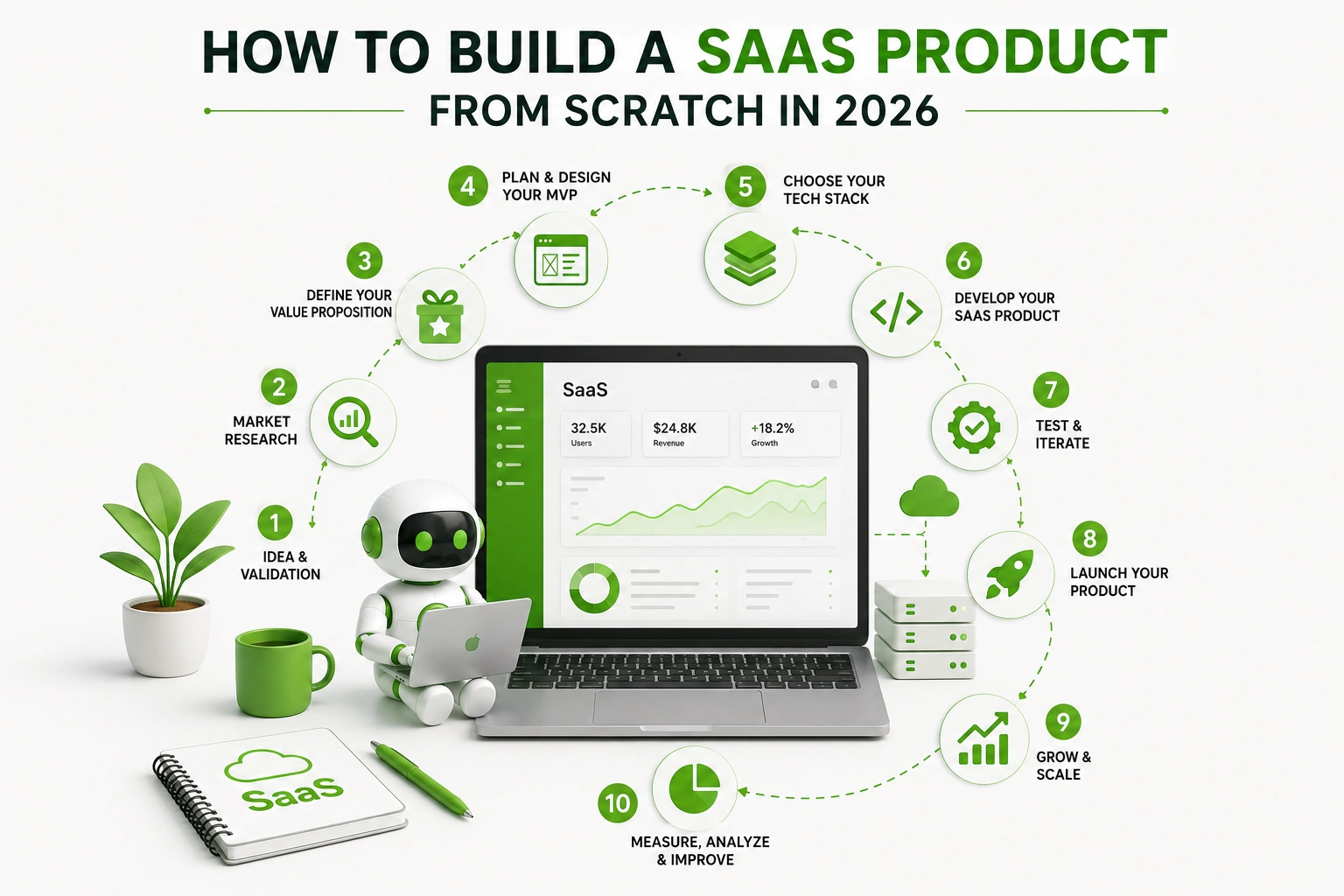
Most SaaS products fail before they ever reach a paying customer. Not because the idea was wrong, or the market was too small, but because the team skipped validation and went straight to building — burning six months of budget on features that turned out to be solving a problem nobody was urgent enough about to pay for. It’s the most predictable failure mode in SaaS product development, and it happens constantly.
If you’re planning to build a SaaS product in 2026, the technical landscape has never been more enabling. AI-assisted development, modern cloud infrastructure, and mature no-code prototyping tools mean a skilled team can ship an MVP faster and cheaper than at any point in the industry’s history. But speed of execution without a validated foundation is how you build the wrong thing very efficiently.
At Digitechzo, we’ve partnered with founders and product teams through the full SaaS product development lifecycle — from napkin-sketch validation to production-scale engineering — and the patterns that separate products that find product-market fit from those that stall are clear and consistent. This guide lays out the complete SaaS product development roadmap for 2026: what to do in what order, what it costs, the technology decisions that matter, and the mistakes that silently kill products before they find their first hundred customers.
Quick Answer
“Building a SaaS product from scratch in 2026 follows six phases: problem validation, MVP scoping, technical architecture, MVP build, go-to-market launch, and iteration toward product-market fit. Most B2B SaaS MVPs take 12–20 weeks and $40,000–$150,000 to build properly, depending on complexity. The single biggest predictor of success isn’t the technology stack — it’s whether the problem was validated with paying-intent signal before a line of code was written.”
What Is SaaS Product Development?
SaaS product development is the end-to-end process of designing, building, launching, and iterating on a software product delivered via subscription over the internet, rather than sold as a one-time licence or installed locally. It’s distinct from general software development in one critical way: the product is never finished. SaaS products exist in continuous development cycles — monthly releases, ongoing customer feedback loops, and constant iteration based on usage data.
This continuous delivery model changes how you architect the codebase, how you structure the team, how you think about pricing, and how you prioritise the backlog. Understanding this from the outset shapes better decisions at every stage that follows.
SaaS vs Traditional Software Development: Key Differences
| Factor | Traditional Software | SaaS Product Development |
| Delivery model | One-time licence, installed locally | Subscription, delivered via browser/API |
| Revenue model | Upfront licence fee | Recurring MRR/ARR |
| Update cycle | Major versions, infrequent | Continuous deployment, weekly or faster |
| Infrastructure | Customer-managed on-premise | Vendor-managed cloud infrastructure |
| Data ownership | Customer holds all data locally | Multi-tenant cloud database (with compliance implications) |
| Customer success | Post-sale support only | Ongoing onboarding, retention, expansion |
| Development culture | Project-based, end date defined | Product-based, continuous iteration |
Phase 1: Problem Validation Before SaaS Product Development Begins
The most expensive mistake in SaaS product development is starting development without evidence that the problem is urgent, frequent, and worth paying to solve. This isn’t a philosophical point — it’s a financial one. Six months of development at $20,000 a month builds the wrong product if the assumptions going into it were never tested.
What Real Validation Looks Like
Validation isn’t asking people if they like your idea. People are polite; they’ll say yes to almost anything that doesn’t cost them anything. Validation means finding signal that the problem is real and the willingness to pay is genuine:
- Problem interviews — speak with 20–30 people in your target segment about their current workflow, not about your solution. Listen for pain described spontaneously, money currently being spent on workarounds, and frequency of the problem.
- Paid intent signal — offer a waitlist with a deposit, a pre-sale of early access, or a consulting engagement that solves the same problem manually. Someone putting money down before the product exists is the strongest validation signal available.
- Competitor and substitute analysis — if nobody is currently paying anything — directly or indirectly — to solve this problem, that’s either a greenfield opportunity or evidence the problem isn’t actually painful enough.
- Willingness-to-pay range — ask directly: “if this existed and solved exactly what you described, what would you expect to pay monthly?” The range of answers tells you more about the market than a year of desk research.
Phase 2: Scoping the MVP — What to Build and What to Cut
Once validation confirms the problem is real and the willingness to pay is genuine, SaaS product development begins with the most important constraint decision you’ll make: what is the smallest, most functional version of this product that would cause your first ten customers to pay for it?
An MVP is not a prototype, a demo, or a rough version of the full product. It’s the smallest possible set of functionality that delivers the core value proposition — nothing more, nothing less. Every feature that doesn’t directly serve the core value proposition is scope creep that delays launch, inflates cost, and dilutes focus.
The Honest MVP Scoping Exercise
- List every feature you’re imagining — write down everything, without filtering.
- For each feature, ask: could a customer pay without it? — if the honest answer is yes, cut it from the MVP.
- Identify the one core workflow — what is the single thing the product must do for a user to experience the core value? Build that, deeply, before anything else.
- Define the definition of done for the MVP — what does it mean for the MVP to be complete? Write it down. This becomes the scope document that prevents feature creep mid-build.
What a B2B SaaS MVP Typically Includes
- Authentication and user management (sign up, log in, password reset)
- The core value workflow — the one thing the product does that customers pay for
- Basic admin and settings (team invite, account settings)
- Billing and subscription management (Stripe integration)
- Basic usage analytics so you can see what users actually do
- Error logging and monitoring so failures don’t go unnoticed
What a B2B SaaS MVP Typically Does Not Include
- Advanced reporting and dashboards
- Mobile apps (unless mobility is the core value proposition)
- Extensive integrations beyond one or two critical ones
- Granular permissions and enterprise SSO
- White-labelling or multi-brand support
- Public-facing API or developer tooling
Phase 3: Choosing the Right Technical Architecture for SaaS Product Development
The technology decisions made at the architecture phase persist far longer than most founders expect. Choosing a stack for speed of MVP delivery is sensible; choosing a stack the team will be locked into for three years without thinking through the implications is a common, expensive mistake.
The Stack Decision Framework for 2026
- Frontend — React and Next.js remain dominant for B2B SaaS in 2026, with the combination offering fast rendering, strong component ecosystems, and a large hiring pool. Vue and SvelteKit are credible alternatives for smaller teams.
- Backend — js (TypeScript), Python (FastAPI or Django), and Ruby on Rails all remain proven SaaS backends. The right choice depends on team expertise more than any objective technical superiority.
- Database — PostgreSQL via a managed service (Supabase, Neon, or AWS RDS) covers most SaaS use cases. Avoid premature database exoticism; the query model and reliability matter more than the brand.
- Infrastructure — AWS, GCP, and Azure all provide production-grade SaaS infrastructure. Vercel and Railway work well for frontend and small backend deployments respectively. Choose based on team familiarity and compliance requirements.
- Authentication — Auth0, Clerk, or Supabase Auth eliminates building authentication from scratch; SSO and MFA requirements should be confirmed before choosing.
- Billing — Stripe is the default in 2026; Paddle suits businesses selling internationally where VAT complexity is a concern.
- AI layer (if applicable) — OpenAI API, Anthropic API, or Mistral for LLM features; Langchain or LlamaIndex for RAG-based knowledge retrieval.
Multi-Tenancy Architecture: The Decision That Matters Most
Multi-tenancy — how the platform isolates different customers’ data within the same infrastructure — is the most consequential architectural decision in SaaS product development and the one least likely to appear in generic build guides. The three common patterns each have clear trade-offs:
| Pattern | Description | Best For | Key Trade-off |
| Shared database, shared schema | All tenants in one database, separated by tenant_id column | Early-stage, fast MVP, low security requirements | Lowest isolation; one bad query affects all tenants |
| Shared database, separate schema | One database, separate schema per tenant | Mid-market SaaS balancing cost and isolation | Schema migrations across hundreds of schemas get complex |
| Database per tenant | Separate database instance per customer | Enterprise, high compliance, sensitive data | Higher infrastructure cost, complex provisioning |
Most SaaS MVPs start with shared database, shared schema for speed and cost, with a clear plan to migrate toward higher isolation as enterprise customers and their compliance requirements arrive.
Phase 4: Building the MVP — Timelines, Costs, and Team Structures
SaaS product development is fundamentally a resource allocation problem. The three levers — time, cost, and scope — trade off against each other, and understanding realistic ranges prevents the budget surprises that kill early-stage products mid-build.
Realistic MVP Cost Ranges for 2026
| Build Approach | Typical Timeline | Typical Cost (AUD) | Best For |
| Offshore team (managed) | 16–28 weeks | $40,000 – $100,000 | Budget-constrained founders with a PM to manage quality |
| Australian boutique agency | 12–20 weeks | $80,000 – $200,000 | Founders who need close collaboration and fast iteration |
| Blended (AU lead + offshore build) | 14–22 weeks | $60,000 – $150,000 | Best balance of quality, communication, and cost |
| In-house team (2–3 engineers) | 16–26 weeks | $120,000 – $250,000 | Founders with technical co-founder, long-term vision |
| No-code/low-code (Bubble, Webflow) | 4–8 weeks | $8,000 – $30,000 | Simple workflows, non-technical founders, pure validation |
Team Composition for a Typical SaaS MVP Build
- Product manager or technical founder — owns the product vision, manages the backlog, liaises between stakeholders and engineering.
- Full-stack or backend engineer (1–2) — builds and maintains the application layer, integrations, and data model.
- Frontend engineer — builds the UI; may be combined with backend in a full-stack role for smaller MVPs.
- UX/UI designer — critical for B2B SaaS where onboarding friction is a primary churn driver; often underinvested in.
- DevOps or infrastructure (part-time or contracted) — sets up CI/CD pipeline, monitoring, and deployment infrastructure.
Phase 5: Launching and Acquiring Your First Customers
A launched SaaS product with no go-to-market strategy is a tree falling in an empty forest. Most SaaS product development guides stop at the build; the go-to-market is where most products actually succeed or fail.
The Right Launch Sequence for B2B SaaS
- Founder-led sales first — the founder should close the first ten to twenty customers personally, not because it scales but because the conversations reveal exactly what messaging works, what objections arise, and what the product still needs.
- Instrument before you scale — set up product analytics (Mixpanel, PostHog, or Amplitude) before driving traffic, so you understand what users actually do rather than guessing.
- Pick one acquisition channel, go deep — resist the temptation to be everywhere; find the single channel where your target customers already gather (LinkedIn, niche communities, direct outbound, a specific conference) and dominate it before diversifying.
- Nail onboarding before marketing spend — spending on customer acquisition before onboarding converts properly is pouring water into a leaking bucket; activation rate should be above 60–70% before paid acquisition starts.
- Measure the metrics that actually matter — MRR, churn rate, activation rate, and time-to-value are the early indicators; vanity metrics like sign-up count hide churn problems until they’re severe.
SaaS Pricing Strategy: Getting This Right from Day One
Pricing is both the most important and most postponed decision in SaaS product development. Most founders underprice significantly in the early stage out of fear, then discover late that their pricing model makes the economics of growth unworkable.
- Value-based pricing beats cost-plus always — price based on the value the product delivers to customers, not the cost of building it. A $20,000 annual saving to a customer makes a $200/month price look cheap.
- Charge from day one — free users give feedback but not signal; paying customers tell you what’s actually worth money. A 14-day free trial is fine; a permanently free tier delays finding out whether people actually value the product.
- Three tiers is the standard for B2B SaaS — Starter, Professional, Enterprise — with the middle tier doing most of the revenue work and the enterprise tier signalling the product’s ceiling for buyers doing competitive research.
- Annual plans protect cash flow — offer a 15–20% discount for annual upfront payment; this reduces churn risk and provides capital for development without external funding.
Phase 6: Iterating Toward Product-Market Fit
Product-market fit is the point at which a meaningful cohort of customers would be genuinely disappointed if the product disappeared — and their usage and retention data shows it. It’s not a feeling or a milestone you declare; it’s a pattern you observe in your churn rate, referral behaviour, and the qualitative feedback from your most engaged customers.
The iteration toward product-market fit in SaaS product development follows a consistent pattern: talk to churned customers to understand why they left, talk to your most engaged customers to understand what’s working, and use the gap between those two groups to set the next development cycle’s priorities.
Signals That Product-Market Fit Is Approaching
- Monthly churn rate dropping below 2–3% for B2B SaaS (from higher early levels)
- More than 30–40% of customers saying they would be “very disappointed” if the product no longer existed (Sean Ellis benchmark)
- Referral and word-of-mouth as a meaningful source of new customers, without you asking for it
- Revenue expanding within the existing customer base (net revenue retention above 100%)
- Customers using the product in ways you didn’t specifically design for — a sign the core value is robust enough to generalise
Common Mistakes in SaaS Product Development
- Building before validating — the most expensive mistake in SaaS; six months of development on an unvalidated assumption destroys more SaaS companies than bad code ever does.
- Scope creep during the MVP build — every feature added to the MVP extends timeline, increases cost, and delays the moment you discover what customers actually value.
- Under-investing in onboarding — a product that customers can’t quickly understand and activate will churn regardless of how good the core functionality is.
- Choosing a tech stack for trendiness rather than team expertise — the fastest build is almost always the one using the technology the team already knows deeply.
- Not instrumenting the product before launching — flying blind without analytics in the first months makes it impossible to distinguish a usage problem from a messaging problem from a pricing problem.
- Confusing activity with traction — sign-ups, website traffic, and social engagement are not revenue; only paying customers who stay paying are traction.
Expert Tips for Successful SaaS Product Development
- Get a paying commitment before building — even a small deposit or a signed letter of intent from a future customer is stronger validation than any amount of positive feedback.
- Ship weekly, not monthly — the faster the build-measure-learn cycle, the faster the product finds its fit; weekly releases create the feedback loops that monthly releases delay.
- Talk to five customers a week during early development — structured customer conversations during the build prevent building the wrong thing for months before discovering the mistake.
- Solve the retention problem before the acquisition problem — if customers are leaving faster than they’re arriving, spending on acquisition accelerates losses; fix churn first.
- Price higher than you’re comfortable with, then test down — it’s far easier to offer a discount than to raise prices after customers have anchored to a low number; start high.
Frequently Asked Questions
How long does SaaS product development take?
A properly scoped B2B SaaS MVP typically takes 12–20 weeks to build, depending on complexity, team size, and whether the core workflow requires significant third-party integrations. More complex products with enterprise-grade security or AI features can take 24–40 weeks.
How much does it cost to build a SaaS product in Australia?
Most B2B SaaS MVPs built with an Australian-based or blended development team cost between $60,000 and $200,000 to build to a launchable state. Simpler products built on no-code platforms can get to market for $10,000–30,000, while enterprise-grade SaaS products with complex integrations and compliance requirements can exceed $500,000.
What is the most important phase of SaaS product development?
Validation — before a single line of code is written. The majority of SaaS products that fail do so because they built something that wasn’t urgent or valuable enough for customers to pay for and stick with. Six weeks of deep problem validation is more valuable than six months of building on an unvalidated assumption.
Do I need a technical co-founder to build a SaaS product?
No, but you need technical leadership of some kind. Non-technical founders can successfully build SaaS products by partnering with a trusted development agency or a fractional CTO who owns the architecture and engineering quality decisions. What doesn’t work is outsourcing the technical direction entirely without any technical oversight.
What’s the difference between an MVP and a prototype?
A prototype demonstrates a concept for feedback — it doesn’t need to be built on production infrastructure or handle real user data reliably. An MVP is a real product that real customers pay for and use, built on infrastructure that can scale and maintained like a production system. The MVP is the beginning of the product; a prototype is a learning tool.
Conclusion: SaaS Product Development Rewards Discipline Over Speed
The SaaS products that find product-market fit in 2026 won’t necessarily be the fastest to build or the most technically impressive. They’ll be the ones that validated the problem before investing in the solution, scoped the MVP to its minimum viable form, shipped quickly, and iterated based on what paying customers actually did rather than what they said they wanted. SaaS product development is a discipline of sequential bets, each one informed by the last.
If you’re building a SaaS product and want a development partner who starts with validation and architecture before writing a line of code, Digitechzo works with Australian founders and product teams through the full development lifecycle — from problem framing and MVP scoping through to production build and go-to-market strategy. Get in touch to start with a product scoping session, not a sales pitch.
About The Author