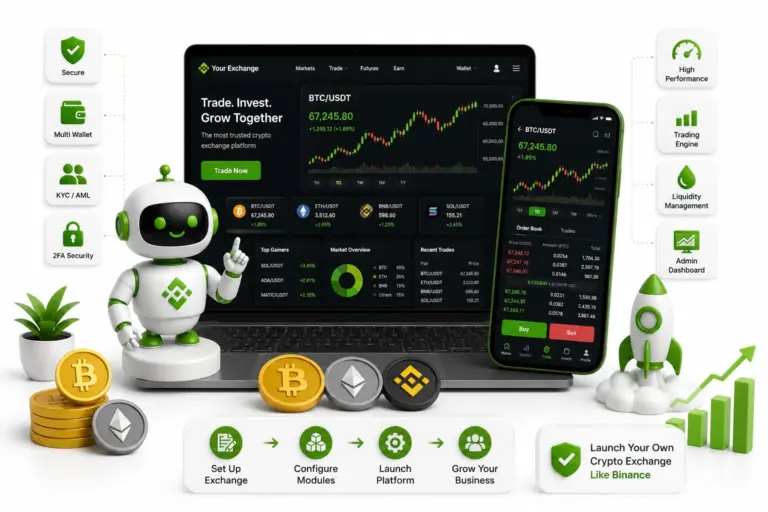

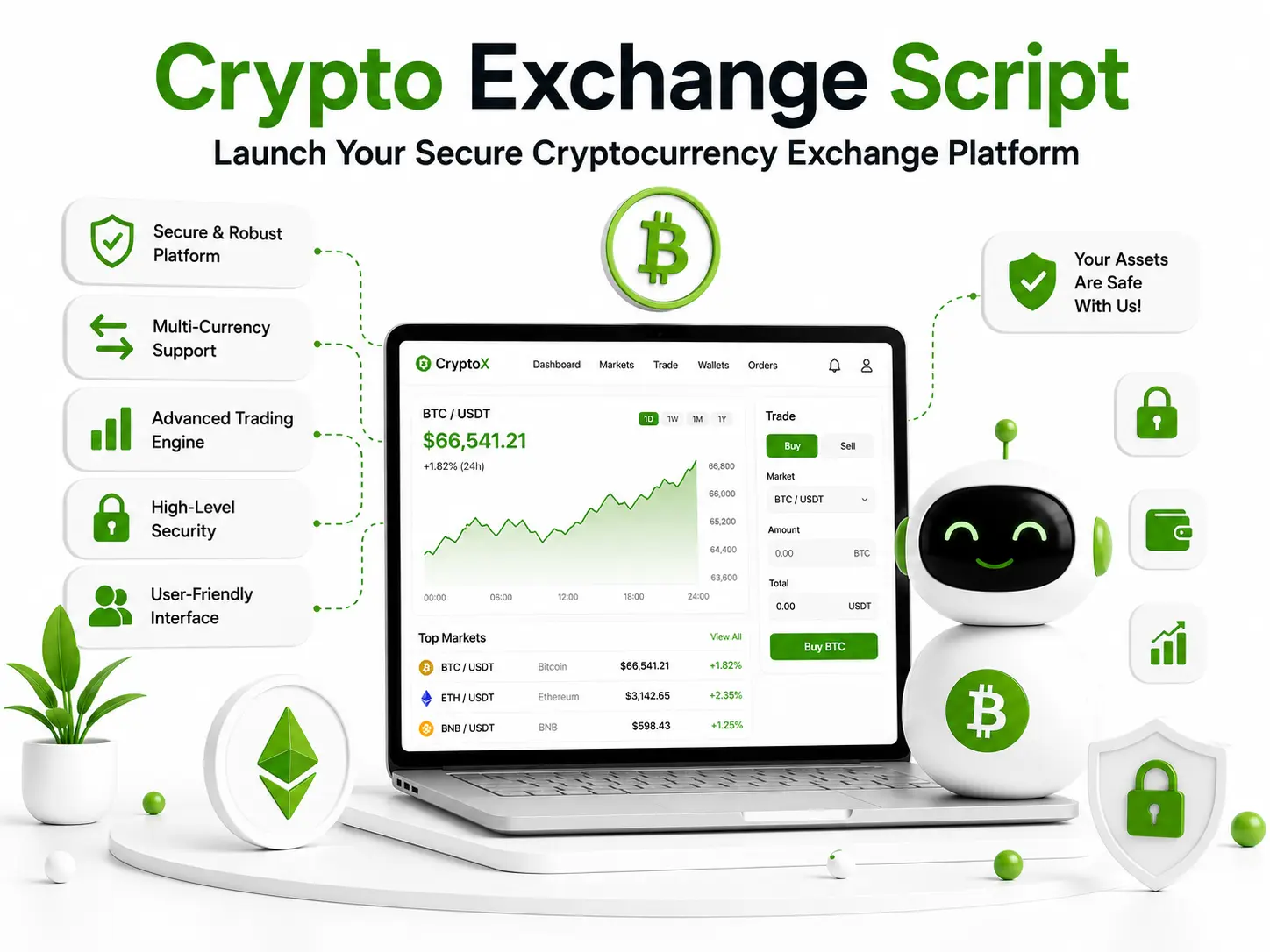
Crypto Exchange Script
Building a crypto exchange from scratch takes 12 to 18 months and costs upward of $500,000. Yet dozens of profitable cryptocurrency exchanges launch every month — in a fraction of the time and at a fraction of the cost. The difference? A crypto exchange script.
If you’re researching how to launch your own cryptocurrency trading platform, you’ve likely encountered dozens of vendors making identical promises about ‘robust’, ‘scalable’, and ‘secure’ solutions. This guide cuts through the noise. We examine what a crypto exchange script actually includes, what separates a production-ready solution from a liability, and how to evaluate vendors before you commit a single dollar.
At DigiTechzo, we’ve built, audited, and deployed blockchain fintech platforms — and we’ve seen firsthand what separates exchanges that scale from those that collapse under their first traffic spike. This guide reflects that experience.
|
What Is a Crypto Exchange Script?
A crypto exchange script is a ready-made software framework — encompassing both frontend and backend — that powers a cryptocurrency trading platform. Rather than engineering a matching engine, wallet system, liquidity module, and trading UI from zero, you license (or purchase outright) a pre-built codebase and customise it for your brand, jurisdiction, and target market.
Think of it like a white-label SaaS product, but with access to the underlying code. You get the architectural foundation; you supply the branding, the liquidity, the compliance, and the business strategy.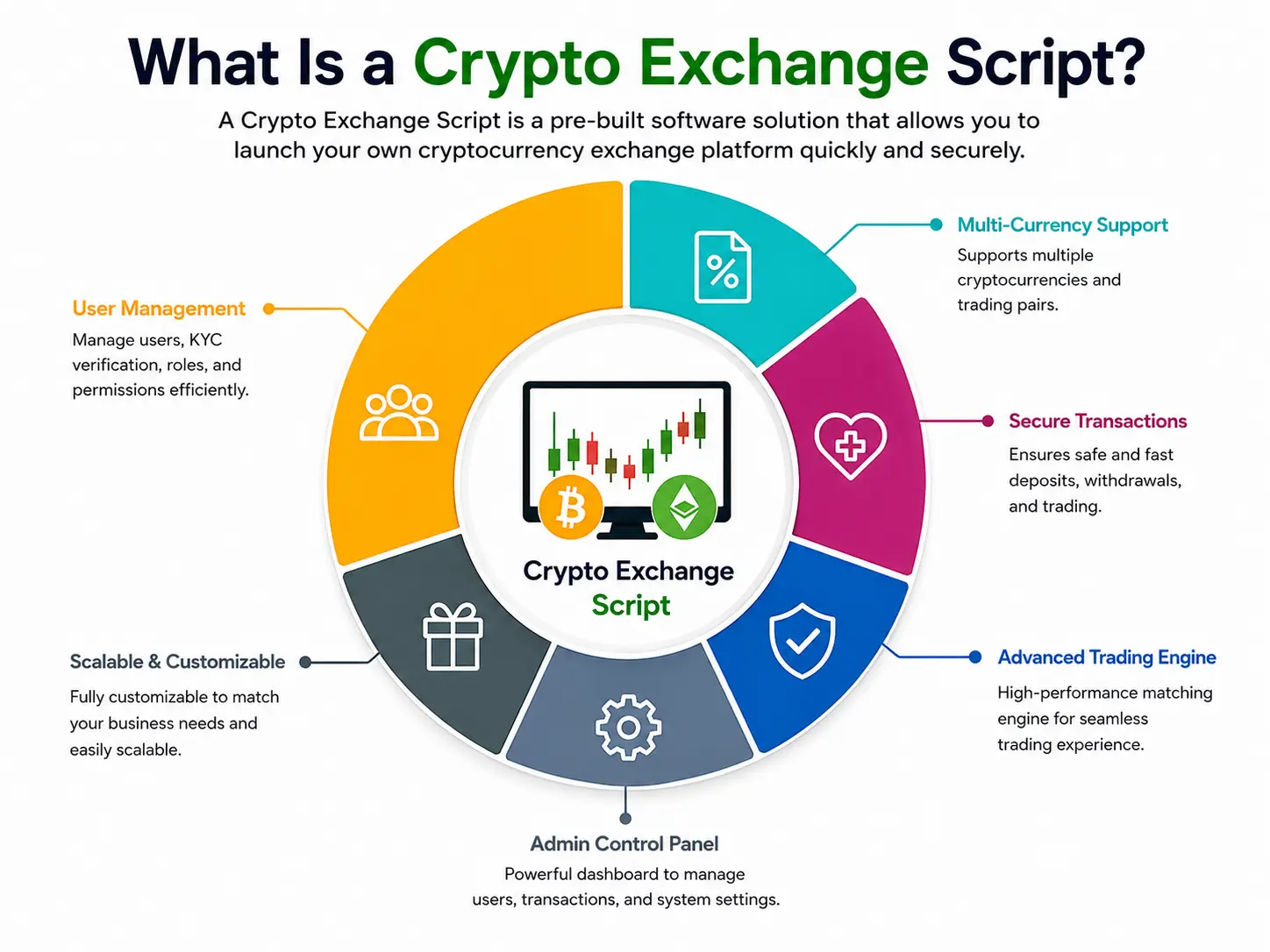
|
Crypto exchange scripts exist for several exchange types:
- Centralised Exchange (CEX) scripts — order book trading, KYC, fiat on-ramps
- Decentralised Exchange (DEX) scripts — smart contract-based, AMM or order book
- P2P Exchange scripts — escrow-based peer-to-peer trading
- Hybrid Exchange scripts — combining CEX matching speed with DEX custody
- Derivatives Exchange scripts — futures, perpetuals, options trading
How a Crypto Exchange Script Works — Under the Hood
Understanding the technical architecture of a crypto exchange script is essential for evaluating vendors honestly. A production-grade script is not a single codebase — it’s an ecosystem of interconnected services.
The Matching Engine
The heart of any centralised exchange. The matching engine processes buy and sell orders in real time, pairs compatible orders, and executes trades. High-performance matching engines handle 100,000+ transactions per second (TPS). Scripts using databases for order matching — rather than in-memory processing — will bottleneck under load. Always ask vendors: what is your matching engine’s TPS under sustained load?
Wallet Management System
Exchanges manage both hot wallets (online, for immediate liquidity) and cold wallets (offline, for majority of user funds). A robust wallet system includes multi-signature authorisation, automated sweeping of deposits to cold storage, and real-time balance reconciliation. The 2022 FTX collapse demonstrated what happens when wallet management lacks proper controls — regardless of how polished the frontend looks.
Liquidity Management
Liquidity is an exchange’s lifeblood. New exchanges face a classic cold-start problem: no traders because no liquidity; no liquidity because no traders. Modern crypto exchange scripts solve this through:
- API integration with external liquidity providers (B2C2, Cumberland, Galaxy Digital)
- Market maker bot integration for automated order placement
- Liquidity aggregation from multiple DEX and CEX sources
KYC/AML Module
Regulatory compliance begins with identity verification. A production-ready crypto exchange script integrates directly with third-party KYC providers (Sumsub, Jumio, Onfido) for automated document verification, liveness checks, and sanctions screening. Exchanges without automated KYC face manual processing bottlenecks and regulatory exposure.
Trading Engine APIs
Professional traders and market makers interact with exchanges via API — not the web interface. A crypto exchange script must provide REST and WebSocket APIs with rate limiting, API key management, and comprehensive documentation. Exchanges without robust APIs lose institutional and algorithmic traders.
Key Features to Demand in Any Crypto Exchange Script
Not all crypto exchange scripts are equal. Here’s the definitive feature checklist — segmented by priority:
Mission-Critical (Non-Negotiable)
- High-performance order matching engine (in-memory processing, not DB-based)
- Multi-signature cold wallet architecture with HSM support
- Two-factor authentication (2FA) for all user accounts
- Anti-phishing measures and session management
- Real-time trade execution with WebSocket price feeds
- KYC/AML integration with tier-based verification
- Admin dashboard with risk management controls
- Audit logs for all system and user actions
High Priority
- Fiat gateway integration (bank transfer, credit card, PayID, SEPA, SWIFT)
- Liquidity provider API integration
- Mobile apps (iOS and Android) or responsive PWA
- Multi-currency and multi-language support
- Trading fee management system (maker/taker, tiered)
- Referral and affiliate management module
Competitive Differentiators
- Advanced charting (TradingView integration)
- Copy trading and social trading features
- Derivatives and margin trading modules
- OTC (over-the-counter) desk functionality
- Crypto debit card integration
- Staking and yield product modules
Types of Crypto Exchange Scripts Compared
|
Type |
Custody |
Speed |
Compliance Req. |
Best For |
Cost Range |
|
CEX Script |
Exchange holds funds |
Very Fast |
High (KYC/AML) |
Volume-focused exchanges |
$15K–$80K+ |
|
DEX Script |
User self-custody |
Chain-dependent |
Varies by jurisdiction |
DeFi-native platforms |
$10K–$60K+ |
|
P2P Script |
Escrow-based |
Slower |
Moderate |
Emerging markets |
$5K–$30K |
|
Hybrid Script |
Flexible |
Fast |
High |
Privacy + performance |
$20K–$100K+ |
|
Derivatives Script |
Exchange holds margin |
Very Fast |
Very High |
Pro trader platforms |
$30K–$150K+ |
Crypto Exchange Script: Pros and Cons
|
✅ Pros |
❌ Cons |
|
• Launch in weeks vs. 12–18 months for custom build |
• Source code quality varies enormously between vendors |
|
• Significantly lower upfront cost |
• Vendor lock-in risk if code isn’t fully delivered |
|
• Core architecture tested across deployments |
• Shared codebase means shared vulnerability patterns |
|
• Faster iteration on branding and UX |
• May include features you don’t need (bloat) |
|
• Active vendor support and updates |
• Compliance setup still requires legal expertise |
|
• Customisable for your specific market |
• Scaling beyond vendor’s tested limits requires custom work |
Top Crypto Exchange Script Solutions — Honest Comparison
We’ve evaluated the leading vendors based on technical depth, security posture, support quality, and real-world deployment track records. Note: pricing varies based on feature scope — treat ranges as directional, not fixed.
|
Vendor / Solution |
Exchange Type |
Standout Feature |
Price Range |
Support |
Verdict |
|
AlphaPoint |
CEX / Derivatives |
Institutional-grade matching engine |
$50K–$200K+ |
24/7 Enterprise |
Best for institutional |
|
Openware (RubyDEX) |
CEX + Crypto |
Open-source base, active community |
$10K–$40K |
Community + Paid |
Best open-source |
|
Bitex Script |
CEX |
Fast deployment, fiat ready |
$8K–$25K |
Business hours |
Quick launch SME |
|
Coinsclone |
CEX / P2P / DEX |
White-label breadth |
$5K–$35K |
Business hours |
Feature variety |
|
Custom Build (Digitechzo) |
Any type |
Full compliance control, bespoke |
Project-based |
Dedicated team |
Regulated markets |
|
Uniswap V3 Fork (DEX) |
DEX / AMM |
Proven AMM architecture |
$10K–$30K |
Dev community |
DeFi launches |
|
Security: The Non-Negotiable Foundation of Your Crypto Exchange Script
Crypto exchanges are among the highest-value targets in cybersecurity. In 2023 alone, over $1.7 billion was stolen from crypto platforms through exchange hacks, smart contract exploits, and insider threats. Your crypto exchange script’s security architecture is not a feature — it’s the foundation that determines whether you survive.
Wallet Security Architecture
- 95%+ of user funds must be in cold storage at all times
- Hot wallet limits enforced with automated sweep policies
- Multi-signature (multisig) requirements for all large withdrawals
- Hardware Security Modules (HSMs) for key management in enterprise deployments
- Withdrawal whitelisting and time-lock delays for large transfers
Application Security
- OWASP Top 10 vulnerability mitigation baked into development
- DDoS protection via Cloudflare or AWS Shield
- Rate limiting on all API endpoints
- SQL injection and XSS prevention at framework level
- Regular penetration testing (minimum semi-annual for live exchanges)
Operational Security
- IP whitelisting for admin panel access
- Mandatory 2FA for all staff and admin accounts
- Full audit trail for every privileged action
- Incident response plan with defined roles and communication protocols
|
Regulatory Compliance & Licensing Considerations
Regulatory failure is the most common reason new crypto exchanges shut down. A technically excellent crypto exchange script is worthless if your operation is non-compliant. Licensing requirements vary significantly by jurisdiction:
|
Jurisdiction |
Regulatory Body |
Key Licence |
Timeline |
Complexity |
|
Australia |
AUSTRAC |
DCE Registration |
4–8 weeks |
Moderate |
|
European Union |
Local NCAs (BaFin, FCA) |
MiCA Licence (2024+) |
6–18 months |
High |
|
UAE (DIFC/ADGM) |
DFSA / FSRA |
Virtual Asset Licence |
3–6 months |
Moderate-High |
|
Seychelles |
FSA |
SD Licence |
2–4 months |
Low-Moderate |
|
El Salvador |
BCR |
Bitcoin Service Provider |
1–3 months |
Low |
|
Singapore |
MAS |
DPT Service Licence |
12–24 months |
Very High |
Your crypto exchange script must support the compliance architecture your chosen jurisdiction demands. This means configurable KYC tiers, transaction monitoring, suspicious activity reporting (SAR) capabilities, and data retention policies aligned to local law. If your vendor can’t demonstrate these, do not proceed.
Common Mistakes When Buying a Crypto Exchange Script
Mistake 1: Choosing based on price alone.
The cheapest crypto exchange script almost always costs the most in the long run. Poorly architected code means rebuilding core components under production load — at a time when downtime costs real money and reputation.
Mistake 2: Skipping the technical audit.
Most exchange operators are business people, not engineers. Hiring an independent developer for a two-day code review before purchasing can surface critical architectural flaws — including hardcoded credentials, insecure private key storage, or the use of deprecated cryptographic libraries.
Mistake 3: Assuming the script handles compliance.
A crypto exchange script gives you the technical tools for compliance — KYC integration, transaction monitoring, audit logs. It does not give you a legal licence, a compliance programme, or regulatory approval. These require separate legal counsel and, in many jurisdictions, a substantial compliance team.
Mistake 4: Ignoring liquidity from day one.
Exchanges with no liquidity plan die quickly. An empty order book drives away traders permanently. Liquidity strategy — whether through market makers, LP agreements, or liquidity provider API integration — must be determined before launch, not after.
Mistake 5: Underestimating ongoing costs.
The script purchase price is 20–30% of total first-year costs. Factor in: hosting infrastructure (AWS/GCP for high availability), KYC API fees (charged per verification), customer support staffing, security monitoring, regulatory compliance, and marketing. Exchanges that run out of operating capital before reaching critical user mass fail regardless of their script quality.
Mistake 6: Neglecting mobile experience.
Global crypto trading is majority mobile. An exchange with a poor mobile experience — slow load times, clunky trading UI, no price alerts — loses users to competitors. Evaluate the mobile apps as rigorously as the desktop platform.
Expert Tips for a Successful Crypto Exchange Launch
| 💡 Tip 1: Launch with a Niche, Then Expand |
| Don’t try to compete with Binance on day one. Pick a specific niche: a geography (Australia, Southeast Asia), an asset class (DeFi tokens, RWA assets), or a user type (pro traders, institutional). Nail that niche before expanding. Focused exchanges build loyal communities; generalist exchanges fight on price and marketing spend. |
| 💡 Tip 2: Architect for 10x Before You Need It
Your trading engine and database architecture should be designed for 10x your projected peak load from day one. The most painful (and expensive) technical work in exchange operations is scaling a database that wasn’t designed for high-frequency trading volumes. Ask your vendor how they’ve handled this in existing deployments. |
| 💡 Tip 3: Liquidity Partnership Before Launch
Approach liquidity providers and market makers 60–90 days before your planned launch. Many institutional market makers require KYB (Know Your Business) verification, API integration testing, and contractual minimums that take weeks to negotiate. Waiting until after launch means launching to an empty order book. |
| 💡 Tip 4: Build Your Bug Bounty Programme
The global security research community will probe your exchange whether you invite them to or not. A structured bug bounty programme (HackerOne, Immunefi) channelises that energy productively — paying researchers to find vulnerabilities before attackers do. Budget $10,000–$50,000 for bug bounty rewards in your first year. |
| 💡 Tip 5: Revenue Diversification from Month One |
| Trading fees alone are insufficient — especially in bear markets when volume collapses. From day one, architect revenue diversification: listing fees, staking products, OTC services, API access fees, and white-label services for other platforms. Exchanges that survive bear markets have multiple revenue streams. |
Frequently Asked Questions
Q: What is a crypto exchange script and how does it work?
A crypto exchange script is a pre-built software package — including frontend trading interfaces, backend matching engine, wallet management, and admin systems — that enables you to launch a cryptocurrency trading platform without building from scratch. You purchase or license the codebase, customise it for your brand and jurisdiction, deploy it on your own infrastructure, and launch with your own user base. The script handles the technical complexity; you handle the business, compliance, and marketing.
Q: How much does a crypto exchange script cost?
Crypto exchange script costs range from $5,000 for basic P2P scripts to $200,000+ for institutional-grade CEX solutions. A credible production-ready script for a standard centralised exchange typically falls between $15,000 and $60,000. However, the script purchase is only 20–30% of total first-year costs — add hosting, KYC API fees, legal/compliance, security audits, and marketing to get your true capital requirement.
Q: Is a crypto exchange script legal to use?
The script itself is legal software. However, operating a cryptocurrency exchange using the script requires regulatory licensing in virtually every major jurisdiction. Requirements vary significantly: Australia requires AUSTRAC DCE registration, the EU requires MiCA compliance, and the US requires money transmitter licences in each state. Launching without appropriate licences exposes operators to criminal prosecution and asset seizure. Always engage a crypto-specialised legal firm before launch.
Q: How long does it take to launch an exchange with a crypto exchange script?
With a quality script and experienced development team, a basic exchange can be technically live in 4–8 weeks. A production-ready deployment — including customisation, security hardening, compliance integration, testing, and soft launch — realistically takes 3–6 months. Regulatory licensing adds 2–18 months depending on jurisdiction. Planning for a 6-month minimum timeline from script purchase to full commercial launch is prudent.
Q: What security features should a crypto exchange script include?
At minimum: multi-signature cold wallet architecture, two-factor authentication for all accounts, DDoS protection, encrypted data at rest and in transit, rate limiting on all APIs, IP whitelisting for admin access, full audit logs, and automated withdrawal limits with manual review triggers for large transfers. Before going live, commission an independent penetration test and, for DEX components, a smart contract audit.
Conclusion: Your Crypto Exchange Script Is the Foundation — Not the Business
A crypto exchange script dramatically compresses the time and capital required to enter the cryptocurrency exchange market. What once required 18 months and a $500K+ engineering team can now be achieved in months with a fraction of that investment.
But the script is not the exchange — it’s the infrastructure. Successful exchanges are built on liquidity strategy, regulatory compliance, security discipline, and relentless focus on user experience. Operators who treat the script as a business shortcut rather than a technical foundation are the ones who fail.
Evaluate vendors rigorously. Demand security audit reports. Engage legal counsel early. Plan for liquidity before launch. And budget honestly for the full operational picture — not just the script purchase price.
About The Author