
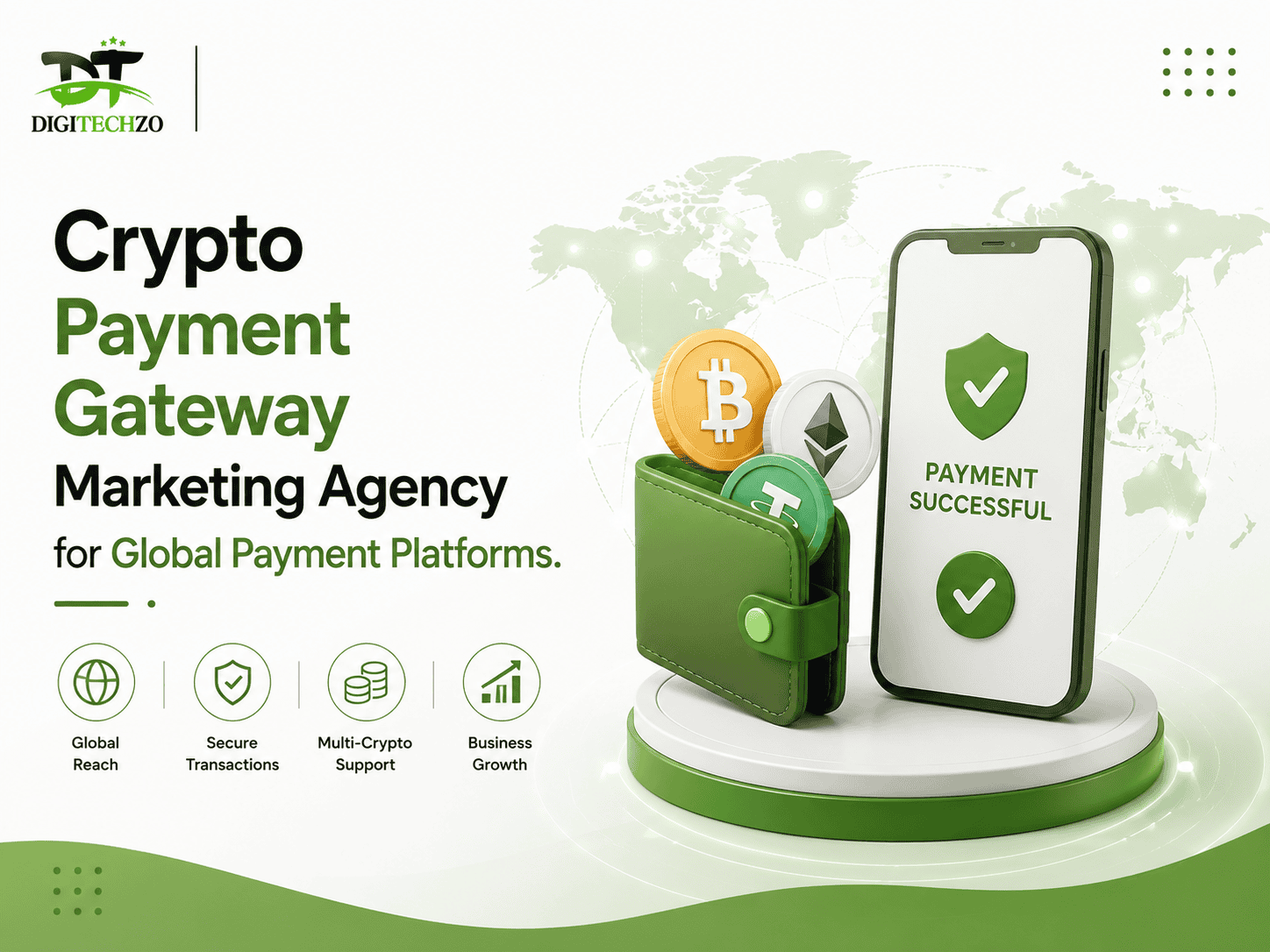
Most global payment platforms don’t fail because their crypto rails are weak. They fail because they hire a general digital marketing agency, watch every crypto keyword campaign get rejected by Google or Meta, and end up with a marketing budget spent on trial and error instead of pipeline. If you’re building or scaling a crypto payment gateway across multiple markets, you already know that standard fintech marketing playbooks break the moment “crypto” enters the picture.
That’s exactly the problem a specialized Crypto Payment Gateway Marketing Agency solves — one that understands cross-border compliance messaging, region-specific ad restrictions, and the technical due diligence enterprise buyers demand before they’ll route a single transaction through your rails.
At Digitechzo, we’ve supported crypto and blockchain payment platforms trying to acquire merchants, PSPs, and enterprise partners across multiple jurisdictions simultaneously — where a single generic landing page or ad account can get an entire campaign shut down. This guide breaks down what a specialized agency actually does differently, and how to evaluate one before you sign a contract.
Quick Answer
A crypto payment gateway marketing agency combines compliance-aware SEO, region-specific paid media, technical content, and partnership growth to help global payment platforms acquire merchants and enterprise clients across multiple jurisdictions. Unlike general marketing agencies, they understand crypto ad restrictions, cross-border regulatory nuance, and how to build trust with skeptical B2B buyers.
Why Global Payment Platforms Need a Specialized Agency
A domestic payment gateway markets to one regulatory environment, one language, and one set of buyer expectations. A global crypto payment gateway is marketing simultaneously across dozens of jurisdictions, each with different:
- Advertising restrictions on crypto-related keywords
- Licensing and disclosure requirements
- Local competitor landscapes and payment preferences
- Cultural trust signals (what reassures a buyer in Singapore differs from what reassures one in Germany)
A generic agency applying one messaging framework across all markets will produce campaigns that either get rejected, misrepresent compliance status, or simply don’t resonate. A specialized crypto payment gateway marketing agency builds region-aware campaigns from the ground up, rather than translating one template into five languages.
What a Crypto Payment Gateway Marketing Agency Actually Does
1. Compliance-First Messaging Architecture
Before writing a single headline, a specialized agency maps what can legally be claimed in each target region — licensing status, custody model, insurance coverage — and builds messaging frameworks that stay accurate everywhere the platform operates.
2. SEO for Multi-Market Commercial Intent
This goes beyond translating keywords. “Crypto payment gateway” search intent in the U.S. skews toward enterprise integration; in Southeast Asia, it often skews toward remittance and merchant adoption. Ranking well requires separate content strategies per region, not one page with hreflang tags slapped on.
3. Compliant Paid Media Across Ad-Restricted Platforms
Because Google Ads, Meta, and TikTok apply crypto-specific restrictions that vary by country, agencies with category experience maintain relationships with approved networks and build campaigns using pre-cleared messaging templates — avoiding the account suspensions that plague first-time crypto advertisers.
4. Enterprise Sales Enablement Content
Whitepapers, security audit summaries, and integration case studies that sales teams can hand directly to PSPs and exchanges during technical evaluation — content most generalist agencies don’t know how to produce credibly.
5. Partnership and Ecosystem Visibility
Placement within wallet directories, exchange integration marketplaces, and developer communities (GitHub, Web3 forums) — channels that rarely appear in a standard marketing plan but consistently produce warm, high-intent B2B leads.
6. Reputation and Trust Management
Actively monitoring and responding to review platforms, crypto news coverage, and community sentiment, since a single unresolved complaint thread can quietly kill enterprise deals in this trust-sensitive category.
The Cross-Border Marketing Challenge
Here’s a scenario every global crypto payment platform eventually runs into: a campaign that performs well in the UK gets flagged for non-compliant claims in Canada, while the exact same messaging is considered too vague to convert in the UAE, where buyers expect explicit regulatory detail upfront.
This isn’t a paid media problem — it’s a market intelligence problem. Agencies without direct crypto payments experience typically discover these gaps only after a campaign fails. Specialized agencies build region-specific compliance checklists into the campaign planning phase, not the post-mortem.
A useful framework we apply: score every target market on three axes before building campaigns —
- Regulatory clarity (how well-defined is crypto payment regulation there)
- Ad platform restrictiveness (how hard is it to run compliant paid campaigns)
- Buyer sophistication (do buyers need heavy education or are they already crypto-native)
Markets scoring low on regulatory clarity get organic-first strategies with heavy compliance documentation. Markets with high buyer sophistication and looser ad restrictions get more aggressive paid acquisition.
How to Evaluate a Crypto Payment Gateway Marketing Agency
Ask these questions before signing:
- Can you show campaigns that stayed live on restricted ad platforms? If an agency can’t demonstrate compliant crypto campaigns that didn’t get suspended, that’s a red flag.
- Do you have a process for multi-jurisdiction compliance review? Vague answers here mean you’ll be doing legal review yourself later.
- What’s your experience with B2B fintech sales cycles? Crypto payment gateway deals often take 3-9 months to close — an agency used to short e-commerce funnels will misallocate budget.
- Can you produce technical content, or only marketing copy? Enterprise buyers need integration guides and security documentation, not just blog posts.
- How do you measure success beyond form fills? Look for agencies tracking documentation engagement, sandbox sign-ups, and partner referral leads.
Channel Strategy for Global Reach
| Channel | Effectiveness for Global Crypto Platforms | Key Consideration |
|---|---|---|
| Regional SEO content | High, compounding | Requires separate strategy per market, not translation |
| LinkedIn ABM | High for enterprise | Segment by region and buyer title |
| Compliant native/programmatic ads | Medium-High | Pre-cleared creative avoids suspension delays |
| Wallet/exchange partnerships | Very High intent | Often overlooked, high conversion |
| PR in regional fintech press | Medium-High | Builds local credibility and backlinks |
| Developer community presence | High for technical buyers | Essential for API-first platforms |
Case Scenario: Scaling Across Three Markets
Consider a mid-sized crypto payment gateway expanding from a single home market into the EU, UAE, and Southeast Asia simultaneously. A generalist approach would launch one global campaign with a translated landing page for each region.
A specialized approach instead builds:
- EU: Compliance-heavy landing pages emphasizing MICA-aligned messaging and data protection, distributed through LinkedIn ABM targeting payment ops leads.
- UAE: Content emphasizing licensing detail and institutional partnerships, since buyers there expect explicit regulatory transparency before engaging.
- Southeast Asia: Merchant-focused content around remittance cost savings and mobile-first onboarding, distributed via regional fintech publications and local partnership channels.
Same product, three fundamentally different marketing motions — because the buyers, regulations, and trust signals differ in each region. This is the core value a specialized agency provides that a generalist simply can’t replicate without significant trial and error at your expense.
Generalist Agency vs. Specialized Crypto Agency
Generalist Digital Marketing Agency
Pros:
- Often lower cost
- Broad experience across industries
- Easier to find
Cons:
- Limited understanding of crypto ad restrictions — expect rejected campaigns
- No pre-built compliance messaging frameworks
- Weak credibility with technical/enterprise buyers
- Learning curve costs you time and budget
Specialized Crypto Payment Gateway Marketing Agency
Pros:
- Existing relationships with compliant ad networks
- Cross-market pattern recognition from working across the category
- Faster campaign approval and fewer suspensions
- Sales enablement content that actually holds up under technical scrutiny
Cons:
- Typically higher cost than a generalist
- Fewer agencies to choose from, so vetting matters more
Common Mistakes Global Platforms Make
- Running one global campaign with translated copy. Regulatory and cultural context get lost, and compliance risk increases.
- Choosing an agency based on portfolio breadth instead of category depth. A great e-commerce portfolio doesn’t predict crypto payments expertise.
- Underestimating ad platform restrictions until campaigns get suspended mid-launch. This wastes both budget and momentum.
- Ignoring partnership channels in favor of paid media alone. Wallet and exchange integrations often convert better than any ad campaign.
- No region-specific compliance review before launch. What’s compliant messaging in one country can be a legal liability in another.
- Measuring success only by traffic, not qualified pipeline. High traffic with low technical-buyer engagement is a vanity metric in this category.
Expert Tips for Choosing the Right Partner
- Ask for evidence of live, non-suspended crypto ad campaigns — not just case studies with vague metrics.
- Prioritize agencies that can produce technical content, since enterprise buyers evaluate documentation as closely as marketing copy.
- Insist on a market-by-market compliance review process before any campaign goes live in a new jurisdiction.
- Look for partnership and ecosystem experience, not just paid media and SEO — this channel is consistently underrated and underused.
- Set pipeline-based KPIs from day one, not just impressions or click-through rate, since B2B crypto payment sales cycles are long and traffic alone won’t show ROI.
FAQs
What does a crypto payment gateway marketing agency do differently from a regular agency?
A specialized agency builds compliance-aware messaging, navigates crypto-specific ad platform restrictions, produces technical sales enablement content, and understands the long B2B sales cycles typical of enterprise payment deals — areas where generalist agencies typically lack direct experience.
Why do crypto payment gateway ads get rejected on Google or Meta?
Google, Meta, and other major platforms apply heightened scrutiny to crypto and blockchain-related advertising, with restrictions that vary by country and change frequently. Agencies with category experience use pre-cleared messaging and approved ad networks to avoid these rejections.
How do global payment platforms market across multiple countries with different regulations?
Effective strategies build separate, region-specific campaigns rather than translating one global campaign, aligning messaging with each market’s regulatory clarity, ad platform restrictions, and buyer sophistication level.
How long does it take to see ROI from crypto payment gateway marketing?
Given B2B fintech sales cycles of 3-9 months, initial SEO and content traction typically appears within 3-4 months, while measurable pipeline and closed deals usually build over 6-12 months.
Is it worth paying more for a specialized crypto marketing agency?
For most global payment platforms, yes — the cost difference is typically offset by avoiding suspended ad accounts, wasted campaign spend on non-compliant messaging, and the longer ramp-up time a generalist agency needs to understand the category.
Conclusion
Marketing a crypto payment gateway across global markets isn’t just a bigger version of domestic fintech marketing — it’s a fundamentally different discipline that requires compliance fluency, ad platform navigation, and region-specific trust-building working together. Platforms that treat every market the same end up with rejected campaigns, wasted budget, and stalled enterprise deals.
If you’re scaling a crypto payment gateway across borders and need a marketing partner who understands the compliance, technical, and cultural nuances of each market you’re entering, that’s exactly the kind of work Digitechzo specializes in.
Ready to build a marketing strategy that actually works across your target markets? Talk to Digitechzo about your crypto payment gateway growth plan.
About The Author