
If you’ve built a tokenization platform — whether it’s for real estate, private equity, commodities, or carbon credits — you already know the hardest part isn’t the technology. It’s getting issuers and investors to trust you enough to click “connect wallet” or “start KYC.”
Most digital marketing agencies don’t understand the regulatory tightrope, dual-audience funnel, and trust deficit that come with selling a tokenization product. That gap is exactly why tokenization platform marketing services have become a distinct discipline rather than a subset of generic fintech marketing. At Digitechzo, we work specifically with RWA (real-world asset) and blockchain infrastructure platforms, so this guide isn’t theory — it’s the same framework we use with clients navigating compliance-heavy, high-stakes launches.
This article breaks down what tokenization marketing actually involves, what separates a specialized agency from a generic one, the mistakes that quietly kill CAC, and a practical framework you can apply starting today.
Quick Answer
Tokenization platform marketing services combine SEO, compliant paid acquisition, investor-grade content, and trust-building PR to solve a dual-sided problem: attracting issuers who need capital and investors who need confidence. Success depends on compliance-first messaging, long-cycle nurture funnels, and credibility signals — not generic crypto marketing tactics.
What Are Tokenization Platform Marketing Services?
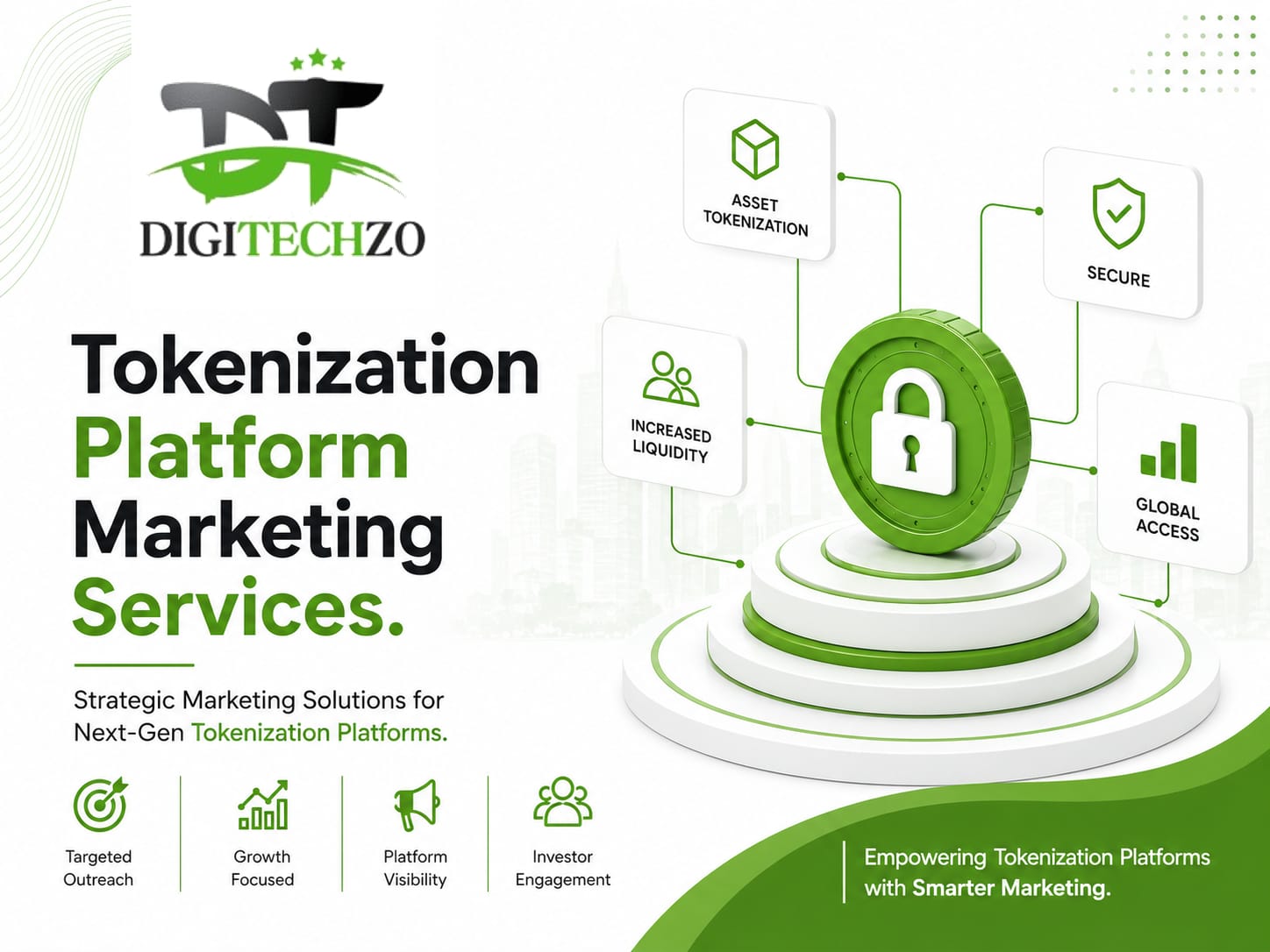
Tokenization platform marketing services are a specialized set of growth strategies — SEO, paid media, content, PR, and conversion optimization — built specifically for platforms that digitize ownership of real-world or financial assets on blockchain rails.
Unlike standard SaaS or crypto marketing, these services have to solve for three things simultaneously:
- Two distinct buyer personas (asset issuers and investors) with completely different motivations
- Jurisdiction-specific compliance constraints on how the offering can legally be advertised
- Low existing trust in tokenized assets among mainstream institutional and retail audiences
A generic performance marketing agency can run ads. A tokenization- focused agency knows which ads won’t get your account suspended, which claims trigger securities-law red flags, and how to build the credibility layer that gets a hesitant investor to actually fund a wallet.
Why Tokenization Platforms Need Specialized Marketing
1. Regulatory Complexity Shapes Every Message
Depending on the asset class, your platform may fall under securities regulations (SEC in the US, MiCA in the EU, or similar frameworks elsewhere). That means words like “guaranteed returns,” “yield,” or even certain uses of “investment opportunity” can create legal exposure if used carelessly in ad copy or landing pages. Marketing for tokenization isn’t just creative — it’s a legal-and-creative collaboration.
2. You’re Marketing to Two Audiences at Once
- Issuers want liquidity, faster capital raises, and lower fees than traditional routes.
- Investors want fractional access, transparency, and exit liquidity.
A single landing page rarely serves both well. Specialized marketing separates these funnels with distinct messaging, proof points, and CTAs — something generic agencies frequently miss, leading to diluted conversion rates on both sides.
3. Trust Is the Actual Product
Tokenized asset markets have been shadowed by crypto volatility and past scandals. Widely cited industry projections (including estimates from major consulting firms) put the tokenized asset market in the trillions of dollars by the early 2030s — but that growth only materializes if platforms can earn trust faster than skepticism grows. Marketing here is less about hype and more about proof: audits, custodianship details, regulatory registrations, and transparent tokenomics.
4. Sales Cycles Are Long and High-Value
Whether it’s an issuer raising $5M or an accredited investor allocating $50K, decisions take weeks, not minutes. That means your marketing has to support multi-touch nurture — email sequences, webinars, downloadable compliance docs — not just a single ad click.
Core Components of a Tokenization Marketing Strategy
1.SEO & Content Marketing for Tokenization Platforms
Search is often the highest-intent, lowest-CAC channel for this niche because buyers actively research before committing capital. A strong SEO strategy includes:
- Educational content around “how tokenization works” for top-of-funnel investor education
- Comparison content (“tokenized real estate vs. REITs”) that captures commercial-intent searchers
- Issuer-focused content (“how to tokenize a $10M property portfolio”) that targets B2B decision-makers
- Structured data and FAQ schema to win featured snippets on regulatory and how-it-works queries
2.Paid Acquisition (With Compliance Guardrails)
Google, Meta, and LinkedIn all have restrictive policies around crypto and securities-adjacent advertising. Effective paid campaigns for tokenization platforms typically rely on:
- Pre-approved crypto advertiser certifications (where applicable, e.g., Google’s crypto ad policy)
- LinkedIn ABM campaigns targeting issuer personas (CFOs, fund managers, real estate sponsors)
- Programmatic and native placements on finance/crypto publications
- Retargeting sequences that move users from education to KYC start, not straight to “buy”
3.Investor-Grade Content & Documentation
Investors expect the same rigor they’d get from a traditional prospectus. This includes:
- Whitepapers with clear tokenomics and legal structure explanations
- Audit and smart contract security reports made publicly accessible
- Video walkthroughs of the platform and custody model
4.Compliance-First Messaging Workflows
Every piece of consumer-facing copy should pass through a review layer that checks for securities-law triggers, misleading return claims, and jurisdiction-specific restrictions before it ever goes live.
5.Community & Trust Building
Telegram and Discord remain relevant for retail-facing platforms, but for institutional tokenization plays, LinkedIn thought leadership from founders and compliance officers does more to build credibility than any giveaway campaign ever could.
6.PR & Analyst Relations
Coverage in fintech and blockchain trade press (and mentions by industry analysts) acts as a third-party trust signal that no amount of paid media can replicate. This is often the highest-leverage, most under-invested channel for tokenization platforms.
7.Conversion Rate Optimization on the KYC/Onboarding Funnel
This is the step most agencies ignore entirely. If your KYC drop-off rate is 60%+ (common in this space), your top-of-funnel marketing spend is being wasted downstream. CRO here means:
- Reducing form friction without compromising compliance requirements
- Adding progress indicators and reassurance copy at document-upload steps
- A/B testing verification vendor flows for completion rate
Generic Agency vs. Specialized Tokenization Marketing Agency
| Factor | Generic Digital Agency | Specialized Tokenization Agency |
|---|---|---|
| Compliance awareness | Limited or none | Built into every campaign and asset |
| Ad platform policy knowledge | General knowledge only | Deep familiarity with crypto/finance ad restrictions |
| Dual-funnel strategy (issuer + investor) | Rarely separated | Built as two distinct journeys |
| KYC/onboarding CRO | Usually out of scope | Core deliverable |
| Trust-building content (audits, custody, tokenomics) | Not typically produced | Standard part of the content stack |
| Reporting metrics | Clicks, impressions, generic leads | Funded wallets, completed KYC, issuer pipeline value |
Pros of a specialized agency: faster time-to-trust, compliant creative from day one, funnel built for two audiences, better downstream conversion.
Cons: typically higher retainer cost, smaller pool of qualified agencies, longer onboarding to understand your specific asset class.
Real-World Scenario: Launching a Real Estate Tokenization Platform
Consider a platform tokenizing fractional ownership in commercial real estate. A generic approach might run broad “invest in real estate” ads driving to a single signup page. Conversion is typically weak because visitors don’t understand the legal structure, custody model, or exit liquidity — the exact objections that stall investment decisions.
A specialized approach instead separates the journey: educational SEO content explains fractional ownership mechanics and links to a dedicated investor funnel with audit reports and a clear liquidity explanation; a parallel issuer-focused funnel targets property sponsors with case studies on raise speed and fee comparisons versus traditional syndication. Retargeting nurtures each segment separately based on where they dropped off in KYC or the deal room. This kind of segmented, trust-first funnel consistently outperforms single-path campaigns in this space because it matches content to the actual objection each audience has.
Common Mistakes Tokenization Platforms Make
- Treating investors and issuers as one audience. Mixing messaging dilutes both funnels.
- Leading with hype instead of proof. Claims about returns without audits or legal grounding erode trust instantly.
- Ignoring KYC drop-off as a marketing problem. Traffic is wasted if 6 in 10 users abandon verification.
- Running ads without compliance review. This risks account bans and, worse, regulatory scrutiny.
- Underinvesting in PR and analyst relations. Paid ads can’t manufacture third-party credibility.
- No content for the “why tokenization at all” stage. Many prospects still need basic education before they’ll evaluate your platform specifically.
- Ignoring SEO because “crypto SEO doesn’t work.” It works exceptionally well for informational and comparison queries — competitors ignoring this leave high-intent traffic on the table.
Expert Tips for Scaling Tokenization Platform Growth
- Build two landing page systems, not one. Separate issuer and investor journeys from URL structure to CTA.
- Publish your compliance posture proactively. A dedicated “Trust & Compliance” page reduces sales-call objections before they happen.
- Use case studies over testimonials. Specific numbers (raise size, time-to-close, investor count) carry more weight than generic quotes.
- Treat KYC completion rate as a core marketing KPI, not just a product metric — it’s where your CAC actually gets realized or wasted.
- Invest early in trade-press relationships. Fintech and blockchain journalists move faster on stories with data-backed platforms that already have proof points ready.
- Localize compliance messaging by region if you’re marketing across multiple jurisdictions — a one-size message often under-serves every market.
FAQs
Q:What makes tokenization platform marketing different from crypto marketing?
Crypto marketing usually targets a single retail audience around token speculation. Tokenization platform marketing serves two distinct audiences — asset issuers and investors — and must operate within securities and financial promotion regulations, not just general advertising policy.
Q:How long does it take to see results from tokenization SEO?
Most platforms see meaningful organic traffic growth within 4–6 months, with qualified lead flow typically improving further as topical authority builds around 8–12 months, since informational and comparison queries in this space have moderate competition but require genuine depth to rank.
Q:Can you run paid ads for a tokenization platform on Google and Meta?
Yes, but only after meeting platform-specific certification requirements for crypto and financial products, and only with compliance-reviewed creative. Uncertified or non-compliant accounts risk suspension.
Q:What KPIs matter most for tokenization platform marketing?
Beyond traffic and leads, the metrics that matter are KYC completion rate, funded wallet conversion, cost per funded investor, and issuer pipeline value — not just impressions or clicks.
Q:Do we need separate marketing strategies for different asset classes (real estate vs. private equity vs. commodities)?
Generally yes. Each asset class has different investor expectations, regulatory nuances, and objection patterns, so messaging and proof points should be tailored rather than reused across asset types.
Final thought
Tokenization platforms don’t fail at marketing because of bad creative — they fail because generic strategies don’t account for compliance constraints, dual-sided funnels, and the trust deficit unique to this space. The platforms winning right now are the ones treating marketing as a credibility system, not just a lead-gen engine.
If you’re building or scaling a tokenization platform and want a team that already understands this playbook, Digitechzo works specifically with RWA and blockchain infrastructure platforms on exactly this kind of growth strategy. Reach out for a strategy audit of your current issuer and investor funnels — it’s usually the fastest way to spot where CAC is quietly leaking.
About The Author