
Most real-world asset (RWA) platforms don’t fail because the tokenization tech is broken. They fail because nobody outside their Telegram group knows the platform exists — and the few investors who do find it don’t trust it enough to connect a wallet.
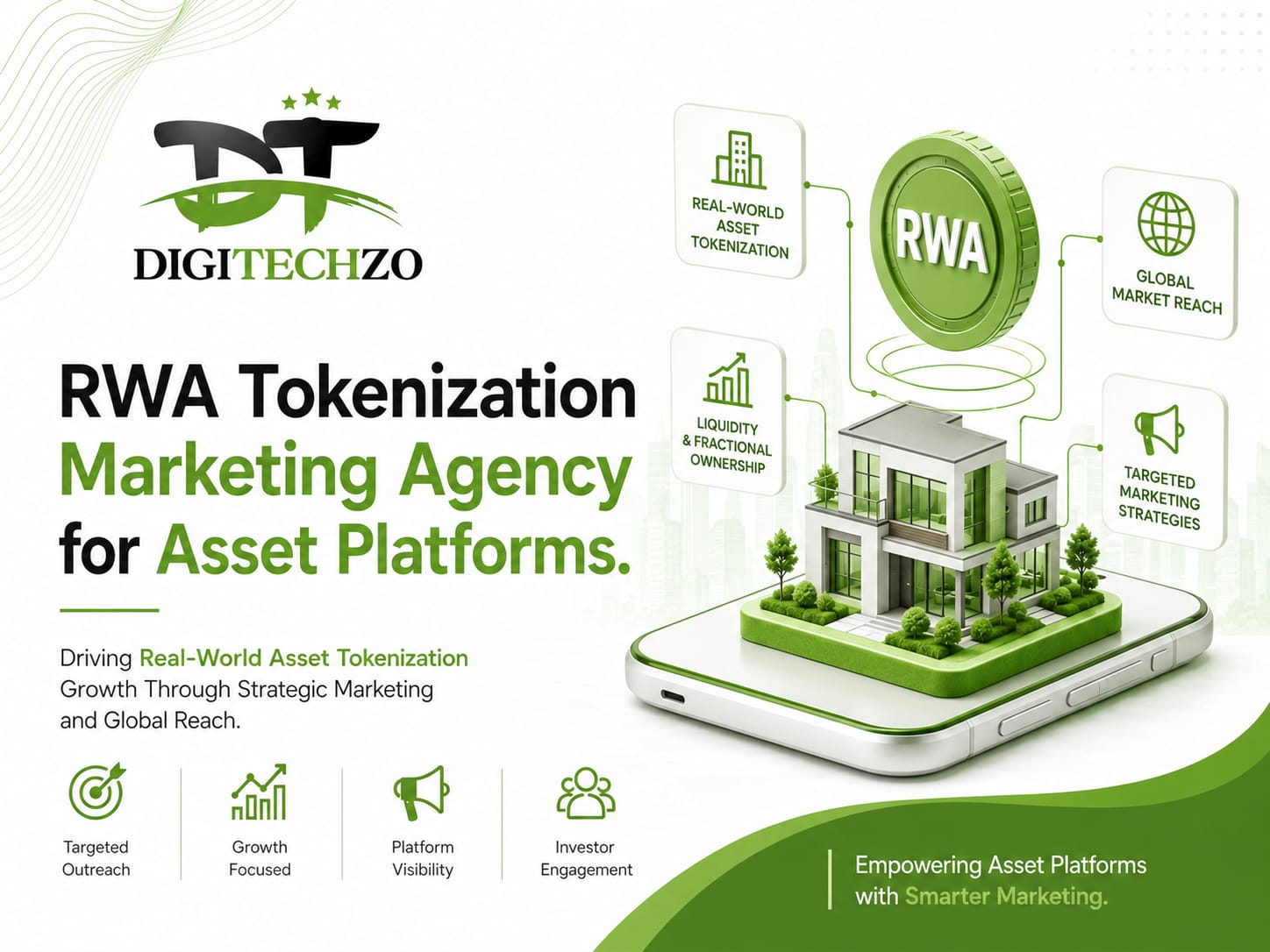
That’s the real problem a RWA tokenization marketing agency is built to solve. Tokenizing real estate, private credit, commodities, or invoices is a regulatory and technical challenge. Getting accredited investors, family offices, and crypto-native capital to actually fund those tokenized assets is a completely different discipline — one that generic Web3 marketing shops and generic real estate marketers both consistently get wrong.
This guide breaks down exactly what specialized RWA marketing looks like, why standard crypto marketing playbooks fail on RWA platforms, and how to evaluate an agency before you sign a retainer.
This guide is put together by the team at Digitechzo, a growth marketing partner working with tokenization platforms, asset originators, and Web3 fintech products on investor acquisition, compliance-aware content, and conversion infrastructure. Everything below reflects patterns we’ve seen work — and fail — across live RWA campaigns, not theory.
Quick Answer
A RWA tokenization marketing agency helps asset platforms attract qualified investors — not just wallet addresses — through compliance-aware content, targeted investor acquisition, exchange/listing PR, and conversion-optimized funnels built for KYC’d, high-intent users. Unlike general crypto marketing agencies, it understands securities-adjacent messaging, accreditation gating, and the dual audience (TradFi + Web3) that RWA platforms must speak to simultaneously.
What Is RWA Tokenization Marketing, Exactly
RWA tokenization marketing is the practice of acquiring, educating, and converting investors for platforms that turn physical or financial assets — real estate, treasury bills, private credit, commodities, art, invoices — into on-chain tokens.
It sits at the intersection of three disciplines that rarely live in one agency:
- Fintech/investor marketing — because you’re ultimately selling a financial product, not a meme or a game
- Web3 growth marketing — because your distribution channels, wallets, and community live in crypto-native spaces
- Compliance-aware content — because most RWA offerings are securities-adjacent and every headline, ad, and landing page carries regulatory risk
A platform tokenizing a $50M commercial real estate portfolio needs messaging that works for a family office CFO doing due diligence and a DeFi-native investor comparing yield across protocols. Most agencies can write for one of those audiences. Very few can write for both without diluting trust with either.
Featured Snippet Answer
RWA tokenization marketing is investor acquisition marketing for platforms that convert real-world assets into blockchain tokens — combining fintech- grade trust signals, Web3 distribution channels, and compliance-aware messaging to convert both institutional and crypto-native capital.
Why Generic Crypto Marketing Agencies Fail RWA Platforms
Most Web3 marketing agencies built their playbook on token launches, NFT drops, and DeFi protocols — audiences that reward hype, urgency, and speculative upside. RWA platforms punish that same playbook.
Here’s why the mismatch happens:
- Different trust threshold. A memecoin buyer risks $200 on vibes. An investor putting $25,000 into tokenized private credit needs audited financials, custodian details, and legal structure before they’ll even join a waitlist.
- Different regulatory exposure. “Guaranteed returns,” countdown-timer urgency, and influencer shilling — standard crypto marketing moves — can trigger securities law violations when applied to an RWA offering.
- Different sales cycle. Token launches convert in minutes. RWA investment decisions, especially for accredited or institutional capital, often take 2–6 weeks and involve multiple touchpoints (webinar, data room, call with the team).
- Wrong success metrics. Agencies used to chasing Discord member counts or Twitter impressions optimize for the wrong funnel stage entirely. RWA platforms need funded accounts and KYC completions, not vanity engagement.
We’ve seen platforms burn six-figure budgets on influencer campaigns that generated thousands of wallet connects and almost zero funded deposits — because the traffic was never qualified to begin with. That’s not a channel failure. It’s a strategy failure rooted in applying token-launch tactics to a fundamentally different buyer.
What a Specialized RWA Marketing Agency Actually Does
A competent RWA tokenization marketing agency operates across five core workstreams. Understanding these helps you evaluate whether an agency is genuinely specialized or just rebranding generic crypto services.
1. Compliance-Aware Messaging and Content
Every claim about yield, guarantees, or returns gets reviewed against how it could be read by a regulator, not just how it converts. This includes disclaimers baked into ad copy, careful separation of “utility” language versus “investment” language, and jurisdiction-aware landing pages.
2. Investor Segmentation and Targeting
RWA platforms typically serve two to three distinct investor tiers — retail (where permitted), accredited, and institutional. Each needs separate messaging, separate proof points, and often separate landing pages with different KYC depth.
3. Trust Infrastructure Content
This is the content layer most agencies skip: audit reports explained in plain English, custodian and legal structure breakdowns, tokenomics documentation, proof-of-reserve explainers, and founder/team credibility pages. For an asset class where investors are handing over real capital for a digital representation of a physical asset, this content isn’t optional — it’s the primary conversion lever.
4. Distribution Across Hybrid Channels
Not just crypto Twitter (X) and Discord — also LinkedIn (where family offices and RIAs actually spend time), fintech and real estate trade publications, SEO content targeting “how does tokenized real estate work” style queries, and partnerships with custodians or compliance vendors for co-marketing credibility.
5. Funnel and Conversion Optimization
Getting the KYC/KYB flow, waitlist-to-funded-account conversion, and data room access request process to actually convert — this is closer to fintech CRO work than typical crypto marketing.
The RWA Investor Funnel Framework
Here’s a simplified framework we use when mapping out an RWA platform’s funnel. Most platforms only build for the middle stage and wonder why conversion is low.
Stage 1 — Awareness (Educate, don’t pitch) Content answering “what is asset tokenization,” “is tokenized real estate legal,” “how do I evaluate a tokenization platform.” This is where SEO and thought-leadership content lives.
Stage 2 — Consideration (Prove trust) Audit reports, legal structure explainers, comparison content (“[Your Platform] vs [Competitor]”), founder AMAs, case studies of past tokenized offerings and their actual performance.
Stage 3 — Conversion (Reduce friction) Streamlined KYC/accreditation verification, clear minimum investment and fee disclosure, live chat or booked calls for larger tickets, and social proof from real (not fabricated) early investors.
Stage 4 — Retention (Compound the relationship) Secondary offering announcements, portfolio performance updates, referral programs — because the cost of re-engaging an existing verified investor is a fraction of acquiring a new one.
Most agencies market only Stage 1 and hope Stage 3 happens on its own. It doesn’t. The platforms that scale treat all four stages as one connected system.
Channels That Actually Work for RWA Platforms
| Channel | Best For | Notes |
|---|---|---|
| SEO / Content | Long-term inbound, high-intent search | Slower to build, compounds over time, lowest cost per qualified lead once ranking |
| Institutional and accredited investors | Underused by crypto-native agencies; high-trust environment | |
| X (Twitter) / Crypto Discord | Web3-native retail and DeFi capital | Fast but requires careful compliance framing |
| Email nurture | Moving leads through the 2–6 week decision cycle | Essential — most RWA leads don’t convert on first touch |
| PR / Trade press | Authority and third-party validation | Slow but compounds credibility for larger raises |
| Paid ads | Retargeting and awareness at scale | Restricted on some platforms for securities-adjacent offers; needs compliance review |
In-House vs Agency vs Hybrid: A Comparison
In-house team
- Pros: Deep product knowledge, full control, no ramp-up cost per campaign
- Cons: Hard to hire for this niche skillset, slow to build multi-channel capability, expensive to staff across content + paid + compliance
Generalist Web3 agency
- Pros: Cheaper, fast at hype-driven campaigns
- Cons: Wrong playbook for trust-driven, longer-cycle offerings; higher compliance risk
Specialized RWA marketing agency
- Pros: Understands the dual TradFi/Web3 audience, built-in compliance awareness, funnel designed for funded accounts not impressions
- Cons: Smaller pool of genuinely specialized agencies; higher retainer than generic shops
Hybrid (in-house lead + specialized agency for execution)
- Pros: Combines product-level knowledge with agency-level channel expertise and speed
- Cons: Requires clear ownership to avoid duplicated or conflicting messaging
For most platforms pre-Series B or pre-major-raise, the hybrid model delivers the best ROI — a lean internal marketing lead who owns strategy, paired with an agency partner for execution, content velocity, and channel expertise.
How to Choose the Right Agency: A Vetting Checklist
Before signing anything, ask these questions directly:
- Can they name specific compliance frameworks they’ve worked within (Reg D, Reg A+, Reg S, jurisdiction-specific rules)?
- Do they have case studies showing funded accounts or capital raised — not just impressions or follower growth?
- Do they understand the difference between marketing a utility token and marketing a security-adjacent RWA offering?
- Will they push back on claims that sound like guaranteed returns, or do they write whatever converts best short-term?
- Can they show content built for both an institutional and a retail/crypto-native audience?
- Do they have a point of view on your funnel, or do they just want to run ads?
If an agency can’t speak fluently about accreditation gating, custodial structures, or the difference between a security token and a utility token, they’re not specialized — they’re a generalist wearing an RWA label.
Common Mistakes RWA Platforms Make in Marketing
- Leading with yield numbers instead of trust infrastructure. Investors want to know the asset is real and legally sound before they care what it returns.
- Treating the whitepaper as the only content asset. Whitepapers convert almost no one. Plain-language explainers, FAQs, and comparison content do the actual conversion work.
- Running the same campaign across every investor tier. A retail-facing ad and an institutional pitch deck need entirely different proof points and tone.
- Ignoring SEO because “crypto lives on Twitter.” High-intent search queries like “tokenized real estate platforms” or “how to invest in tokenized private credit” convert far better than cold social traffic — and competitors are already ranking for them.
- Underinvesting in post-KYC nurture. Most platforms stop marketing the moment someone starts KYC, then wonder why completion rates are low. The 2–6 week decision window needs active follow-up.
- Copying DeFi marketing urgency tactics. Countdown timers and “limited slots” language that works for token launches reads as a red flag to the exact institutional investors RWA platforms need most.
Expert Tips for Scaling RWA Investor Acquisition
- Build a “trust page” before a growth campaign. One dedicated page covering legal structure, custodian, audit status, and team credentials — link it everywhere. It quietly does more conversion work than most ad campaigns.
- Segment your waitlist by investor type at signup. Even a single qualifying question (accredited / institutional / retail-eligible) lets you route people into the right nurture sequence instead of one-size-fits-all emails.
- Publish real numbers, even modest ones. A platform that shares actual funded volume, even if it’s early-stage, builds more credibility than one that only talks in projections.
- Treat SEO as compounding infrastructure, not a campaign. Content targeting “is [asset type] tokenization legal” or “[asset class] tokenization platform” style queries keeps generating qualified leads long after a paid campaign ends.
- Get in front of compliance-savvy audiences deliberately. Guest content on fintech and legal-adjacent publications does more for institutional trust than another crypto podcast appearance.
FAQs
Q:What does a RWA tokenization marketing agency actually do differently from a regular crypto marketing agency?
It builds compliance-aware messaging, segments campaigns by investor accreditation tier, and optimizes for funded accounts rather than impressions or wallet connects — addressing the longer, trust-driven decision cycle typical of RWA investing.
Q:How long does it take to see results from RWA marketing?
Paid and social channels can generate initial leads within weeks, but qualified, funded investors typically take 2–6 weeks per lead due to KYC and due diligence. SEO and trust-content typically take 3–6 months to compound but produce the most durable, lowest-cost qualified leads over time.
Q:Is RWA tokenization marketing regulated?
Marketing itself isn’t a licensed activity in most jurisdictions, but the underlying offering often is (securities-adjacent), which means marketing claims — especially around returns, guarantees, and urgency — carry direct regulatory risk. Compliance review should be part of any campaign, not an afterthought.
Q:Can a small RWA platform compete with well-funded competitors on marketing?
Yes — through SEO, trust-content, and precise investor segmentation rather than outspending on paid ads. Smaller platforms often win on authenticity and responsiveness in a space where trust, not ad spend, is the primary conversion lever.
Q:What’s the biggest ROI channel for early-stage RWA platforms?
Generally SEO combined with a strong trust page — because RWA investors actively research before committing capital, and platforms that show up with credible answers to their questions capture that intent at the lowest cost per qualified lead.
Final thought
Tokenizing an asset is the easy part compared to convincing someone to trust that token with real money. The platforms that scale aren’t the ones with the loudest Twitter presence — they’re the ones that built a marketing system around trust, segmentation, and a genuinely qualified investor funnel from day one.
If you’re building or scaling an RWA platform and want a partner who understands both sides of that equation — the Web3 distribution and the fintech-grade trust requirements — that’s exactly the kind of work Digitechzo does with tokenization and asset platforms. Worth a conversation before your next campaign, not after a budget’s already been spent chasing the wrong metrics.
About The Author