
Launching a prediction market platform is the easy part. Turning it into a business that actually generates sustainable revenue is where most operators get stuck. You can have a fast matching engine, a clean trading UI, and a solid user base — and still struggle to figure out Prediction Market Monetization in a way that doesn’t scare off traders or trigger compliance headaches.
This is the exact problem founders run into after they build or license a Kalshi clone script: the platform works, but the revenue model feels like an afterthought bolted on at the end. That’s backwards. Monetization needs to be designed into your platform architecture from day one, not patched in after launch.
This guide breaks down every realistic revenue stream available to a prediction market operator, how to price them without killing liquidity, and the mistakes that quietly cap most platforms’ earning potential. Teams like DigiTechzo, who build fintech and blockchain platforms for a living, see this pattern constantly — technically solid platforms that underperform commercially simply because monetization wasn’t treated as a core design decision.
Quick Answer
Prediction market platforms monetize primarily through trading fees on contract volume, supplemented by withdrawal fees, premium data/analytics subscriptions, market-maker spreads, and — for platforms with enough scale — data licensing and white-label offerings. The highest-earning platforms combine at least three of these streams rather than relying on trading fees alone, because fee-only models cap revenue and create pressure to raise fees in ways that push traders toward competitors.
Why Monetization Strategy Matters More Than Feature Count
Most new operators obsess over features — more market categories, better charts, faster onboarding. Those things matter, but they don’t answer the question investors and your own P&L will eventually ask: how does this platform actually make money at scale?
Here’s the uncomfortable truth about prediction market monetization: a platform with fewer features but a smarter revenue architecture will consistently out-earn a feature-rich platform with a single, poorly calibrated fee structure.
This matters because prediction markets are volume-driven businesses. Revenue scales with trading activity, not user count alone. A platform with 5,000 highly active traders can out-earn one with 50,000 passive sign-ups — which means your monetization design has to actively encourage trading behavior, not just tolerate it.
Core Revenue Streams for Prediction Market Platforms
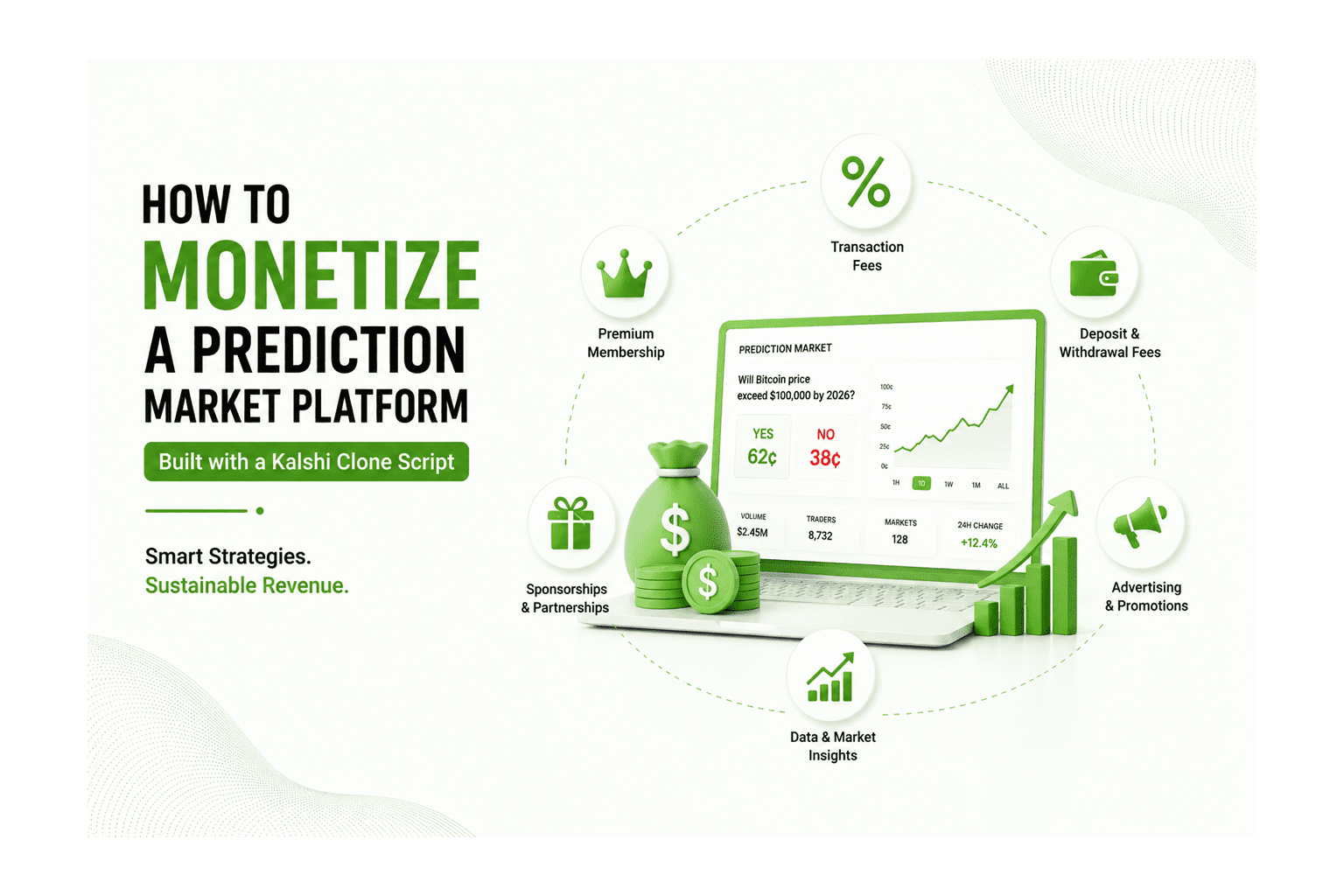
Before going deep on each one, here’s the full landscape of monetization options available to a platform built on a Kalshi clone script or custom infrastructure:
| Revenue Stream | Typical Contribution to Total Revenue | Implementation Complexity |
|---|---|---|
| Trading fees | 50–70% | Low |
| Withdrawal fees | 5–10% | Low |
| Market maker spreads | 10–20% | Medium |
| Premium/analytics subscriptions | 5–15% | Medium |
| Data licensing | 5–10% | High |
| White-label/B2B licensing | Variable, often largest single deal size | High |
Featured snippet answer: The main ways to monetize a prediction market platform are trading fees, withdrawal fees, market maker spreads, premium subscription features, data licensing, and white-label licensing to other operators.
Most platforms should treat trading fees as the revenue floor and layer additional streams on top as the user base and trading volume grow.
Trading Fees: The Foundation Layer
Trading fees are the primary and most reliable revenue source for almost every event trading platform, including Kalshi itself. The mechanic is simple: a small percentage is taken per contract trade, either on entry, exit, or both.
How to structure trading fees correctly:
- Percentage-based, not flat fees — flat fees punish small trades disproportionately and discourage frequent trading behavior.
- Tiered by volume — high-volume traders should pay lower marginal fees, which incentivizes larger positions and deeper liquidity.
- Transparent, upfront display — hidden or unclear fees are one of the fastest ways to lose trust in a real-money trading product.
Practical example: If your platform charges 2% per trade on a $10,000 daily trading volume across 500 active users, that’s a meaningfully different revenue outcome than the same fee structure applied to 500 users trading $200/month. The fee percentage matters less than the trading frequency and volume it’s applied to — which is why user engagement design directly impacts monetization, not just the fee schedule itself.
Common fee ranges observed across event trading and prediction exchange platforms:
| Fee Type | Typical Range |
|---|---|
| Per-trade fee | 1% – 5% |
| Settlement fee | 0.5% – 2% |
| Withdrawal fee | Flat fee or 1–3% |
Market Maker Spreads and Liquidity Incentives
This is a revenue lever most first-time operators overlook entirely. If your platform provides its own liquidity — acting as a market maker on thinly traded contracts — you earn the spread between buy and sell prices, in addition to standard trading fees.
Why this matters: New event categories often start with low liquidity, which means wide spreads and poor pricing for early traders. A platform that provides baseline liquidity through its own market-making function solves two problems at once — it improves the trading experience for early users, and it creates an additional revenue stream that doesn’t depend on third-party trader activity.
How this typically works in practice:
- The platform allocates a reserve of capital to seed liquidity on new or low-volume markets.
- The market-making algorithm quotes both Yes and No prices with a built-in spread.
- As external trader volume increases, the platform’s market-making exposure decreases proportionally.
This is a more advanced monetization layer, and it requires proper risk management — you’re not just collecting a fee, you’re taking on market exposure. Platforms attempting this without a properly built risk engine can end up losing money on volatile markets, so this should be introduced only after core trading and settlement infrastructure is proven stable.
Premium Features and Data Subscriptions
Not every trader wants basic access — some will pay for an edge. This is where prediction market software platforms can build recurring revenue that isn’t tied directly to trading volume, which helps smooth out revenue during low-activity periods.
Premium feature ideas that work well in this category:
- Advanced charting and order book depth data
- Early access to new market categories before general release
- API access for algorithmic traders and third-party tool builders
- Historical data exports for traders building their own models
- Ad-free or reduced-fee tiers for subscribers
Why this works: Subscription revenue is predictable and recurring, unlike trading fee revenue which fluctuates with market activity and event cycles (elections, earnings season, major sporting events). A platform that pairs volume-based trading fees with flat recurring subscription revenue is structurally more resilient than one relying on trading fees alone.
Data Licensing as a Secondary Revenue Stream
Once your platform has meaningful trading volume, the aggregated market data itself becomes valuable — independent of any single trade.
Who buys this data:
- Hedge funds and quant researchers tracking sentiment signals
- Media outlets covering political, economic, or sports forecasting
- Academic researchers studying market-based forecasting accuracy
- Other fintech platforms building complementary tools
Important consideration: Data licensing only works once you have enough volume and market diversity to produce statistically meaningful signals. A platform with thin trading activity across a handful of markets doesn’t have sellable data yet — this is a later-stage monetization layer, not a launch-day strategy.
White Label and B2B Licensing
This is the highest-ceiling revenue opportunity, but it’s also the most demanding to execute — and it’s the one competitor content on this topic almost never covers in depth.
Once your platform infrastructure is proven — stable matching engine, compliant onboarding, reliable settlement — you can license the entire platform (or specific modules) to other businesses that want to launch their own branded prediction market without building from scratch.
Who licenses white label prediction market infrastructure:
- Media companies wanting to embed prediction markets tied to live events
- Regional operators wanting to launch in a specific jurisdiction under their own brand
- Niche communities (sports, crypto, entertainment) wanting a dedicated trading experience
Why this matters for monetization strategy: A single B2B licensing deal can generate more revenue than months of consumer trading fees, because you’re monetizing your infrastructure investment multiple times over instead of just once. This is also why building on modular, well-architected infrastructure from the start — rather than a rigid, closed clone script — matters commercially, not just technically.
Pricing Strategy: How Much to Charge Without Losing Traders
Pricing is where most platforms either leave money on the table or price themselves out of relevance.
Framework for setting trading fees:
- Benchmark against comparable platforms in your specific category, not the broader fintech industry — event trading fee tolerance differs from stock trading fee tolerance.
- Test fee sensitivity in low-stakes markets first before applying pricing changes platform-wide.
- Segment by trader type — casual traders tolerate slightly higher percentage fees on small trades; active/high-volume traders expect tiered discounts.
- Watch churn signals closely after any fee change — a small fee increase that reduces trading frequency can net negative even if the per-trade margin improves.
Pros and cons of aggressive vs. conservative fee structures:
| Approach | Pros | Cons |
|---|---|---|
| Aggressive fees (higher %) | Higher revenue per trade | Risk of driving traders to competitors |
| Conservative fees (lower %) | Higher volume, better liquidity | Requires scale to generate meaningful revenue |
The right answer usually sits in the middle, adjusted based on your specific market category’s competitive landscape.
Real-World Monetization Scenarios
Scenario 1: The Volume-First Platform A platform focused on crypto price prediction markets keeps trading fees low (1%) to maximize volume and liquidity, then layers in market-maker spreads on new contracts and a premium API tier for algorithmic traders. Revenue is diversified across three streams instead of depending entirely on fee income.
Scenario 2: The Data-Driven Platform A platform built around economic and political forecasting markets reaches enough scale that its aggregated market data becomes genuinely valuable to research firms. It licenses anonymized sentiment data as a secondary revenue stream, adding recurring B2B income without increasing trading fees on retail users.
Scenario 3: The Infrastructure Licensor An operator with a stable, compliant platform pivots part of its business toward white-label licensing, offering its infrastructure to a media company that wants to launch a co-branded prediction market tied to live sports coverage. This single deal outpaces a full year of consumer trading fee revenue.
Common Mistakes in Prediction Market Monetization
- Relying on a single revenue stream. Trading-fee-only models are fragile and create pressure to raise fees in ways that damage trader trust.
- Pricing fees without testing trader sensitivity. Blanket fee increases without segmentation often reduce trading volume more than they increase revenue.
- Ignoring liquidity’s role in monetization. Thin markets with wide spreads drive traders away before any fee structure even matters.
- Launching data licensing too early. Selling data before you have meaningful volume produces low-value data that damages credibility with potential buyers.
- Treating monetization as a post-launch feature instead of a core architecture decision — this is the single biggest mistake operators make, and it’s expensive to fix retroactively.
- Underestimating B2B/white-label potential because it feels more complex than consumer monetization, even though it often has the highest revenue ceiling.
Expert Tips for Sustainable Revenue Growth
- Design your fee structure to reward trading frequency, not punish it. Tiered, volume-based discounts consistently outperform flat aggressive fees over the long term.
- Treat market-making as a liquidity investment, not just a revenue stream. Better liquidity attracts more traders, which increases total fee revenue beyond just the spread itself.
- Build your data infrastructure to support licensing from day one, even if you don’t activate that revenue stream until later — retrofitting data architecture for licensing purposes is expensive.
- Diversify revenue before you need to. Don’t wait until trading fee revenue plateaus to explore subscriptions, data licensing, or white-label opportunities.
- Monitor unit economics per market category, not just platform-wide. Some categories (major elections, high-profile sports events) will significantly outperform others in fee generation, and understanding this helps you prioritize which markets to expand.
Frequently Asked Questions
1. What is the best way to monetize a prediction market platform?
The most reliable approach combines multiple revenue streams — trading fees as the primary source, supplemented by withdrawal fees, market maker spreads, premium subscriptions, and eventually data licensing or white-label deals as the platform scales.
2. How much should a prediction market platform charge in trading fees?
Most platforms charge between 1% and 5% per trade, depending on market category and competitive positioning. Tiered fee structures that reward higher trading volume with lower marginal fees tend to perform better than flat fees across all users.
3. Can a prediction market platform make money from data alone? Yes, but only once it has meaningful trading volume and market diversity. Aggregated, anonymized market sentiment data becomes valuable to research firms, hedge funds, and media outlets, but this works as a secondary revenue stream, not a primary one for new platforms.
4. Is white-label licensing a realistic revenue stream for smaller prediction market platforms?
It becomes realistic once your platform’s core infrastructure — matching engine, compliance, and settlement — is proven stable. Smaller platforms should focus on trading fee revenue first and treat white-label licensing as a growth-stage opportunity.
5. Does prediction market monetization differ from traditional betting platform monetization?
Yes. Prediction markets built on regulated event-contract models typically monetize through trading fees and spreads similar to financial exchanges, while traditional betting platforms rely more heavily on the house edge built into odds. This distinction also affects regulatory treatment and long-term revenue predictability.
Conclusion
Prediction market monetization isn’t a single decision you make once — it’s an evolving strategy that should grow alongside your platform’s trading volume, user base, and market diversity. Trading fees will almost always be your foundation, but the platforms that build lasting, resilient revenue combine multiple streams: liquidity spreads, premium subscriptions, data licensing, and eventually B2B white-label opportunities.
Getting this right requires monetization to be treated as a core architectural decision, not a feature added after launch. DigiTechzo has worked with founders building on both Kalshi clone scripts and fully custom prediction market infrastructure, helping them design revenue architecture that scales alongside their trading volume instead of capping it.
Want a clear-eyed assessment of how to structure monetization for your prediction market platform? Book a free consultation with DigiTechzo’s fintech development team and walk away with a revenue strategy built around your specific market category and growth stage.
About The Author