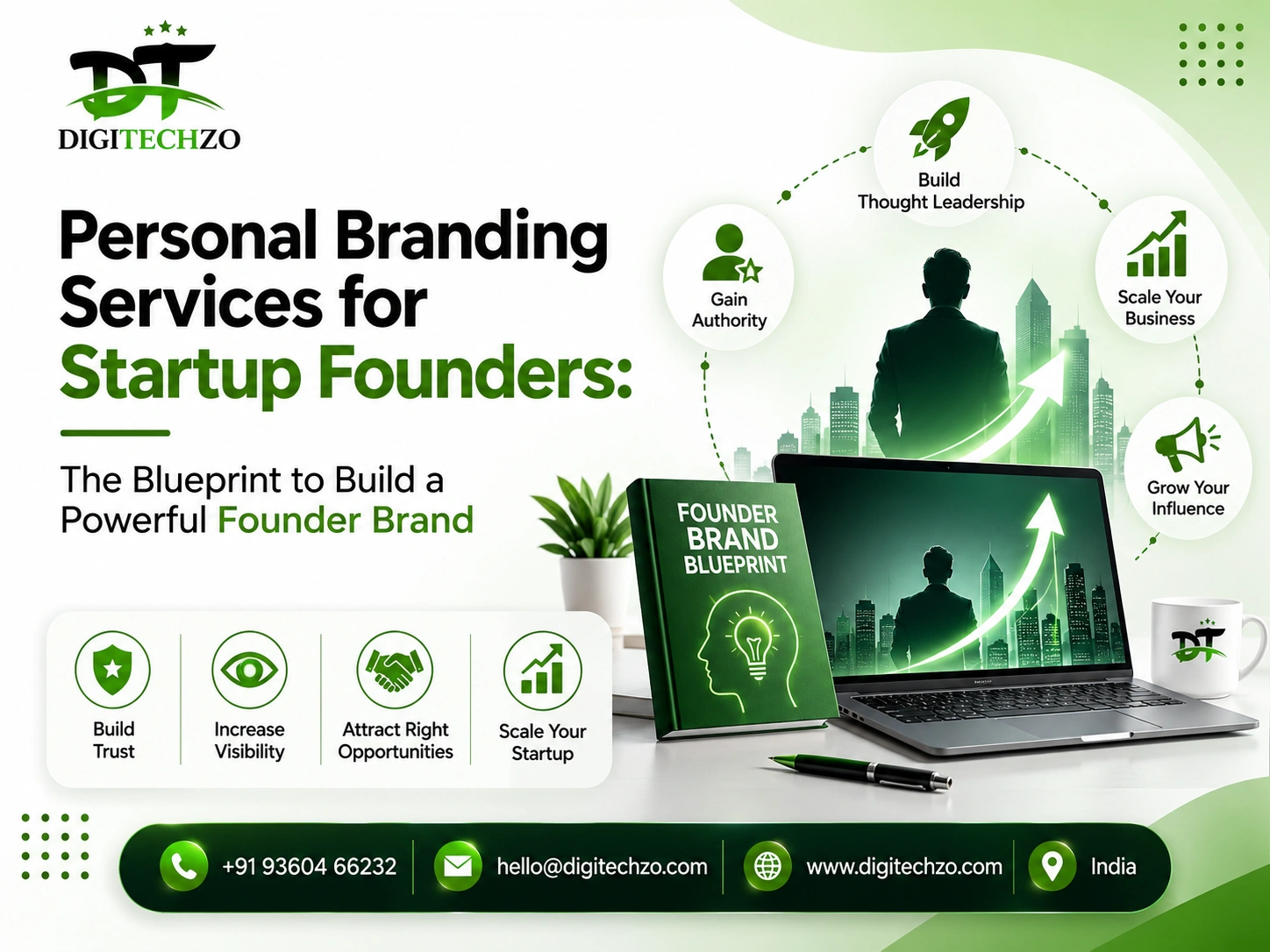
Most founders raise their seed round, ship their product, and then hit an invisible wall: nobody outside their immediate network knows they exist. Investors aren’t inbound. Journalists don’t respond. Top talent doesn’t apply. Meanwhile, a competitor with a weaker product but a founder who posts consistently on LinkedIn is closing bigger rounds and hiring faster — simply because people trust what they can see.
This is the exact problem personal branding services for startup founders are built to solve. At Digitechzo, we’ve worked closely with early-stage and growth-stage founders across SaaS, fintech, and D2C, and the pattern repeats itself constantly: the startups that scale fastest usually have a founder who has become a recognizable, credible voice in their space. This guide breaks down what founder branding actually involves, why it directly impacts fundraising and hiring, and how to choose the right partner to build it — without wasting time or budget on vanity content.
Quick Answer
Personal branding services for startup founders help you build authority and visibility as the face of your company — through strategic positioning, content, and thought leadership — so investors, customers, and top talent trust you before you even pitch them. Founders with a strong personal brand typically raise faster, attract inbound talent, and generate organic customer demand that reduces paid acquisition costs.
Why Founder Branding Is Now a Business Function, Not an Ego Project
There’s a persistent myth that founder branding is vanity — a founder chasing followers instead of building the business. The data and market behavior say otherwise.
Investors increasingly research founders on LinkedIn and Twitter/X before ever taking a call. Recruiters at competitive startups report that a founder’s public presence directly influences candidate trust during hiring, especially for senior roles where candidates are choosing between multiple offers. And in B2B sales, buyers frequently say they researched the founder’s credibility before evaluating the product itself.
In other words, founder branding isn’t separate from business growth — it’s upstream of fundraising, hiring, and sales. A founder who is a known, trusted voice removes friction at every one of these stages before a single conversation happens.
The Founder-Market Fit Signal
Beyond visibility, a strong founder brand signals something investors specifically look for: founder-market fit. When a founder consistently demonstrates deep, specific insight into their industry’s problems, it reassures investors that this isn’t a generic operator chasing a trend — it’s someone who genuinely understands the space well enough to win in it.
Why This Matters More at Early Stage
Early-stage startups often lack the traction metrics, brand recognition, or press coverage that later-stage companies rely on. In that vacuum, the founder’s personal credibility often is the company’s credibility. This is why personal branding services for startup founders tend to deliver outsized ROI specifically in the pre-seed to Series A window.
What Personal Branding Services for Startup Founders Actually Include
A quality agency doesn’t just “post content for you.” A comprehensive service typically covers five interconnected components:
Founder Narrative & Positioning
This defines the story: why you started the company, what unique insight you bring, and how you want to be known in your category (e.g., “the founder solving fintech fraud for small merchants” rather than a vague “tech entrepreneur”).
Thought Leadership Content Strategy
Long-form posts, contrarian takes, build-in-public updates, and industry commentary — engineered to demonstrate expertise, not just announce product updates.
Platform-Specific Distribution
LinkedIn and X/Twitter behave very differently from newsletters or podcasts. A strong service builds a distribution plan matched to where your specific audience (investors, customers, or talent) actually spends time.
PR & Speaking Opportunity Positioning
Pitching founders for podcasts, panels, and press features — using their content history as proof of credibility to journalists and event organizers.
Conversion Integration
Connecting the brand directly to business outcomes: optimized LinkedIn/X bios, links to demo requests, investor decks, or careers pages — so visibility converts into pipeline, not just impressions.
Founder Branding vs. Company Branding: What’s the Difference
Founders often confuse personal branding with company marketing. They serve very different psychological functions for the audience.
| Factor | Company Branding | Founder Branding |
|---|---|---|
| Trust source | Product, reviews, case studies | Founder’s personal credibility |
| Content tone | Polished, corporate | Personal, opinionated, authentic |
| Primary audience | Customers | Investors, talent, customers, press |
| Speed to build trust | Slower (needs track record) | Faster (personal story resonates immediately) |
| Best for | Established products, later-stage growth | Early-stage traction, fundraising, hiring |
Pros of Company-Only Branding
- Feels more “professional” and consistent
- Doesn’t rely on one individual’s visibility
- Easier to hand off to a marketing team
Cons of Company-Only Branding
- Slower to build trust with no track record
- Feels impersonal to investors evaluating early-stage risk
- Misses the founder-market fit signal investors look for
Pros of Founder Branding
- Builds trust faster, especially pre-traction
- Creates inbound investor and talent interest
- Differentiates in crowded categories
Cons of Founder Branding
- Requires founder’s time and authentic voice
- Can create over-reliance on one person if not systemized
- Needs consistency — sporadic posting undermines credibility
The strongest startups run both in parallel — founder brand builds trust early, company brand scales it later.
Real Scenarios: How Founder Branding Impacts Fundraising, Hiring, and Sales
Scenario 1: The Pre-Seed Founder With No Traction Metrics A first-time SaaS founder had no revenue yet but deep domain expertise in supply chain logistics. By consistently sharing specific, non-obvious insights about inefficiencies in the industry, he built enough credibility that investors began reaching out before he even opened a formal raise — because his content demonstrated founder-market fit that a pitch deck alone couldn’t.
Scenario 2: The Founder Struggling to Hire Senior Talent A Series A fintech founder found that senior engineering candidates kept choosing competitor offers. After building a consistent public presence sharing the company’s technical challenges and vision, candidates began mentioning during interviews that they “already felt aligned” with the mission — significantly shortening the hiring cycle.
Scenario 3: The Founder Whose Product Sold Itself Through Trust A B2B founder in a competitive SaaS category noticed that leads who had read his LinkedIn posts converted at a noticeably higher rate than cold outbound leads — because they arrived already trusting his expertise, effectively pre-qualifying themselves before the first sales call.
How to Choose the Right Personal Branding Partner as a Founder
Startup and Fundraising Fluency
Look for a team that understands investor psychology, fundraising timelines, and B2B sales cycles — not just general influencer marketing.
A System, Not Just Content Production
The right partner builds a repeatable system: idea sourcing, writing, editing, and distribution — not a one-off content calendar that runs out after two months.
Voice Authenticity
Since you are the brand, the agency must have a strong process for extracting your real opinions, experiences, and stories — rather than producing generic “thought leadership” that sounds like everyone else’s.
Clear Metrics Tied to Business Outcomes
Ask how success is measured — engagement is a vanity metric; inbound investor conversations, qualified leads, and candidate applications are the real indicators.
Founder Time Commitment Required
A good agency respects that founders are time-constrained and builds lightweight input systems (voice notes, quick calls) rather than demanding hours of writing each week.
Common Mistakes Founders Make With Personal Branding
- Only posting product updates — this reads as marketing, not thought leadership, and rarely builds trust with investors or talent.
- Inconsistent posting around fundraising cycles — going quiet for months, then posting heavily right before a raise, which looks opportunistic rather than authentic.
- Copying other founders’ voice and formats — audiences quickly detect generic, templated “founder content” that lacks a distinct point of view.
- Ignoring platform fit — posting investor-focused content on the wrong platform where your actual audience (VCs, senior candidates) isn’t active.
- Treating branding as a marketing task instead of a leadership responsibility — delegating it entirely without founder input results in content that lacks authentic insight.
Expert Tips to Build a Founder Brand That Actually Converts
- Share your specific, non-obvious insight — not general industry news. Investors and customers are drawn to unique perspectives, not commentary anyone could write.
- Build in public strategically. Share real metrics, challenges, and lessons — but frame them around insight, not just updates, to maximize credibility.
- Repurpose long-form thinking into short-form content. One deep essay on your industry’s biggest misconception can become a week’s worth of posts.
- Time content around milestones. Fundraising announcements, product launches, and hiring pushes all perform better when supported by consistent pre-existing content, not a sudden burst.
- Track pipeline-linked metrics. Monitor investor DMs, inbound applications, and warm leads that mention your content — not just likes and shares.
FAQs
How much do personal branding services for startup founders typically cost?
Pricing depends on scope — ranging from strategy-only engagements focused on positioning and content pillars, to full-service retainers that include writing, editing, and distribution management. Most founders should expect ongoing monthly investment rather than a one-time project, since branding compounds over time.
How soon will founder branding impact fundraising or hiring?
Early signals — increased profile views, inbound messages, and engagement from relevant investors or candidates — often appear within 60-90 days of consistent posting, while measurable pipeline impact (investor interest, candidate applications) typically builds over 3-6 months.
Should a technical or introverted founder still invest in personal branding?
Yes. Founder branding doesn’t require being an extrovert or a natural writer — many successful technical founders use structured interview-based content processes, where an agency extracts insights via short calls and converts them into polished content in the founder’s voice.
Is founder branding only useful for B2B startups?
No, though it’s especially powerful there. D2C and consumer founders also benefit significantly, since customers increasingly prefer buying from brands with a visible, trustworthy founder behind the product.
What’s the biggest difference between founder branding and company marketing?
Founder branding builds personal trust and credibility that accelerates investor, talent, and customer decisions — especially pre-traction — while company marketing focuses on promoting the product itself once trust already exists.
Conclusion
In early-stage startups, trust is the scarcest resource — and a strong founder brand is one of the fastest ways to build it before you have the traction, press, or track record to prove yourself otherwise. Founders who invest deliberately in personal branding services for startup founders consistently raise faster, attract stronger talent, and convert customers with less friction than those relying on the product to speak for itself.
At Digitechzo, we help founders turn their expertise and story into a credible, high-trust brand that directly supports fundraising, hiring, and growth — not just visibility for its own sake. If you’re ready to become the recognizable, trusted voice behind your startup, book a free founder brand strategy call with our team today and see exactly where your current presence is costing you investor interest, top talent, and warm leads.
About The Author