
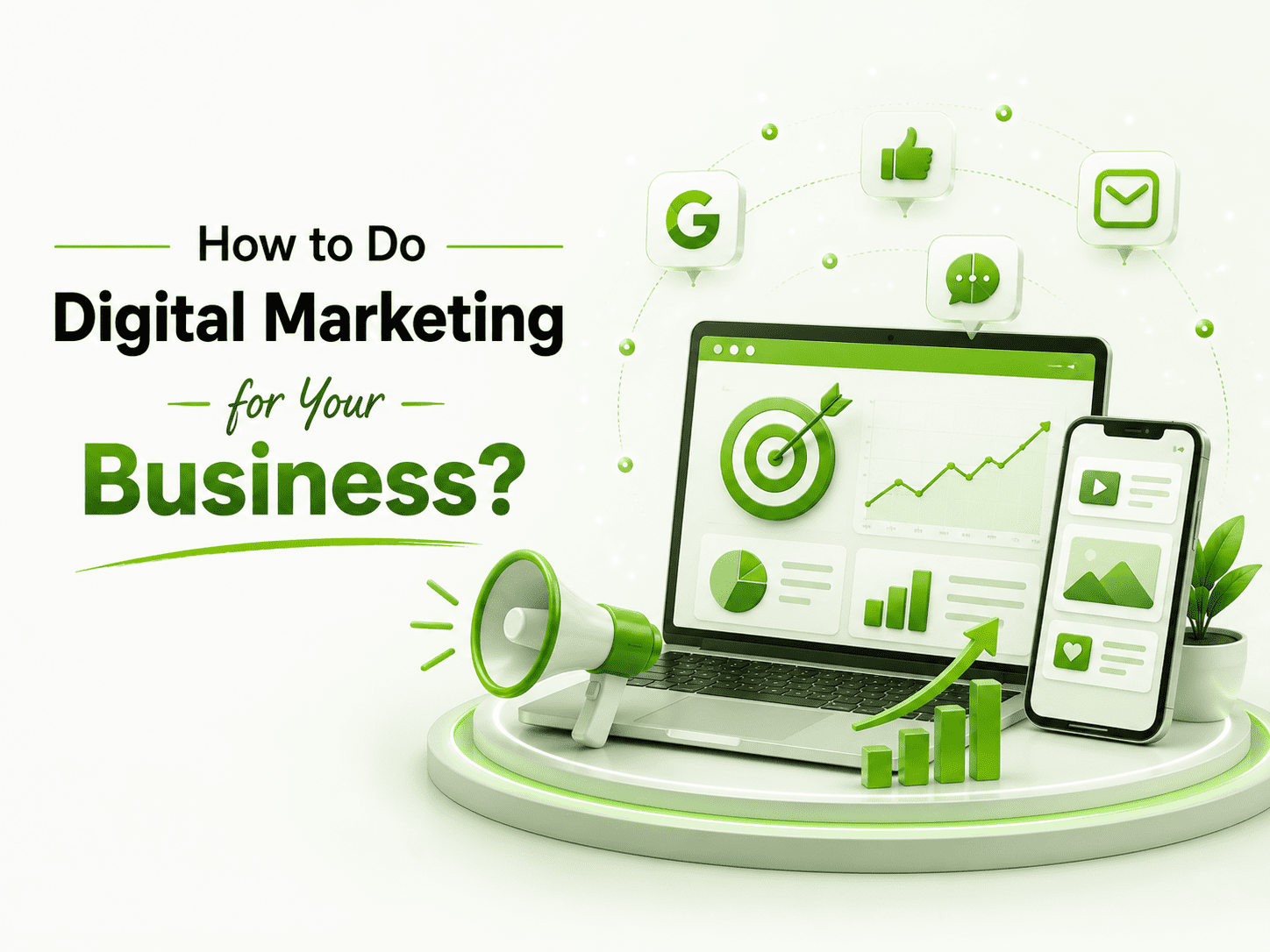
How to Do Digital Marketing for Your Business?
You posted on Instagram three times this week, boosted one of those posts for twenty dollars, and you still have no real idea whether any of it brought in a single paying customer. If that sounds familiar, you are not alone, and the issue is not that digital marketing for business does not work. The issue is that most businesses run digital marketing as a handful of disconnected tactics instead of a connected system that moves a stranger from “never heard of you” to “ready to buy.”
That gap between activity and revenue is exactly why so many founders and marketing leads feel like they are working hard and getting nowhere. Posting consistently, running ads, and sending the occasional email are not the same thing as having a strategy that compounds over time.
At Digitechzo, we have built and run digital marketing programs across industries, from local service businesses fighting for visibility on Google Maps to B2B SaaS companies competing on content and outbound. The pattern is always the same: businesses that treat digital marketing as a system outperform businesses that treat it as a list of tasks, regardless of budget size. This guide walks through exactly how to build that system, step by step, channel by channel, with the budgets and benchmarks competitors usually leave out.
Quick Answer
“Digital marketing for business means using channels like SEO, paid ads, social media, email, and content to reach customers online and track exactly what generates revenue. The businesses that win are not the ones using the most channels, but the ones that define their audience and goals first, then pick two or three channels they can execute consistently. Expect to invest roughly 5 to 12 percent of revenue in marketing, with meaningful organic results in 3 to 6 months and faster results from paid channels.”
What Is Digital Marketing for Business?
Digital marketing for business is the practice of promoting products or services through online channels, including search engines, social media, email, and paid advertising, to reach potential customers where they already spend time, track results in real time, and shift spend toward whatever is actually generating revenue instead of relying on guesswork.
Core Channels That Make Up Digital Marketing
- Search Engine Optimization (SEO): improving organic visibility in search results for terms your customers are already searching.
- Paid Search & Social Ads (PPC): buying targeted visibility on Google, Meta, LinkedIn, or other platforms, with cost and results measurable in real time.
- Content Marketing: blog posts, guides, and videos that build trust and capture search demand before a prospect is ready to buy.
- Email Marketing & Marketing Automation: nurturing leads and existing customers through targeted, triggered messaging instead of one-off blasts.
- Social Media Marketing: building audience and brand presence on the platforms where your specific customers spend time.
- Conversion Rate Optimization (CRO): improving your website and landing pages so more of the traffic you already have actually converts.
How It Differs From Traditional Marketing
- Traceability: every click, impression, and conversion can be tracked back to a specific channel and campaign, unlike a billboard or print ad.
- Targeting precision: you can reach a specific job title, location, or purchase intent rather than a broad demographic.
- Speed of iteration: a paid campaign or landing page can be tested and adjusted within days, not the weeks a print run requires.
- Lower entry cost: a business can start generating qualified traffic with a few hundred dollars, where traditional channels often demand a far larger upfront commitment.
Why Your Business Needs a Digital Marketing Strategy
Most businesses do not fail at digital marketing because they pick the wrong channel. They fail because they never define what success looks like before they start spending, so every channel ends up judged on vibes instead of numbers.
The Cost of Marketing Without a Strategy
Picture a local gym that posts daily on Instagram, runs the occasional boosted post, and sends a newsletter when someone remembers to write one. After six months, follower count is up, but membership sign-ups have not moved. The problem is not effort, it is that no single piece of that activity was built around a defined audience, a clear offer, or a way to measure which post actually drove a walk-in. Random activity creates the appearance of marketing without the mechanics of it.
What a Real Strategy Gives You
- Clarity on what works: you know which channel is actually generating revenue, so budget moves toward results instead of toward what feels productive.
- A predictable pipeline: you can forecast against real numbers instead of guessing whether this month will be busy.
- Confidence to scale: once you know the cost to acquire a customer and the value that customer brings back, scaling a working channel becomes a math problem, not a gamble.
- Protection from wasted spend: underperforming channels get cut early instead of three quarters later.
Step-by-Step Framework: How to Do Digital Marketing for Your Business
This is the exact sequence we walk clients through, in this order, because skipping a step early almost always shows up as wasted spend later.
Step 1: Define Your Target Audience & Buyer Personas
Before choosing a single channel, document who you are actually trying to reach: their role or life stage, the problem they are trying to solve, where they currently look for solutions, and what would make them trust a new brand enough to buy. A local bakery and a B2B logistics software company need entirely different channels, because their buyers behave nothing alike.
Step 2: Set Clear, Measurable Goals Tied to Revenue
Vague goals like “grow our social media” do not tell you whether the spend is working. Set goals such as generating 50 qualified leads per month at a cost under $80 each, or increasing organic traffic to product pages by 30 percent in two quarters. Tie every goal to a number you can track, ideally one that connects back to revenue, not just engagement.
Step 3: Choose the Right Channels for Your Business Type
Most businesses do not need to be on every channel. A local service business often gets the fastest return from local SEO and Google Ads, since customers are actively searching with intent to buy. A B2B SaaS company often gets more traction from content marketing, LinkedIn, and email nurture sequences, since the buying cycle is longer and more research-driven. Pick two or three channels that match how your specific customer actually searches and decides, not the channels that happen to be trending.
Step 4: Build a Content & Messaging Strategy
Your channels are the delivery mechanism; your message is what actually persuades someone to act. Build messaging around the specific problem you solve and the outcome a customer gets, not a list of features. Map content to each stage of the buyer journey: educational content for people who do not know they have a problem yet, comparison content for people evaluating options, and proof-driven content, such as case studies and reviews, for people close to deciding.
Step 5: Allocate Your Budget Across Paid, Owned & Earned Media
Paid media buys speed. Owned media, such as your website, content, and email list, builds a compounding asset that gets cheaper to leverage over time. Earned media, such as reviews, PR, and word of mouth, builds trust you cannot directly buy. Early-stage businesses often need to lean more on paid media to generate initial data and customers, then shift more budget toward owned media as content and SEO start compounding.
Step 6: Set Up Tracking & Analytics Before You Spend a Dollar
This is the step competitors skip, and it is the most expensive one to skip. Install proper conversion tracking, connect your ad accounts to analytics, and define what counts as a qualified lead before launch. Without this, you cannot tell whether $5,000 in ad spend produced ten great customers or zero, and you will end up renewing or cutting channels based on opinion instead of data.
Step 7: Launch, Measure & Optimize Continuously
Digital marketing is not a campaign you set and walk away from. Review performance weekly in the first month of any new channel, then move to a steady monthly cadence once you have a baseline. Kill what underperforms within a defined testing window, and reinvest in what is already working before testing something new.
Digital Marketing Channels Compared: Which Ones Should You Use?
Every channel has a different speed-to-result, cost structure, and ideal use case. Here is how the core channels actually compare in practice.
| Channel | Best For | Time to Results | Pros | Cons |
| SEO | Long-term organic & high-intent search traffic | 4-9 months | Compounding, low cost-per-lead over time | Slow to start, requires patience |
| Paid Search (PPC) | Capturing existing buying intent immediately | Days to weeks | Fast, highly measurable, scalable on demand | Costs stop the moment you stop paying |
| Social Media Marketing | Brand awareness for consumer brands | 2-6 months | Strong for visual/lifestyle brands | Algorithm-dependent, less direct intent |
| Email Marketing | Nurturing leads & repeat customers | Weeks | Highest ROI per dollar of any channel | Needs an existing list to be effective |
| Content Marketing | Building authority, feeding SEO & social | 3-9 months | Reusable asset, supports every channel | Resource-intensive to produce consistently |
How Much Should You Budget for Digital Marketing?
Typical Budget Benchmarks by Business Stage
There is no universal number, but commonly cited benchmarks put marketing spend at roughly 5 to 12 percent of revenue for established small and mid-sized businesses, trending toward the higher end for businesses prioritizing aggressive growth or operating in competitive categories. Early-stage businesses without existing brand recognition often need to spend proportionally more relative to current revenue just to generate enough data to optimize.
Paid vs Organic: Where to Invest First
If you need customers in the next 30 days, paid search or paid social will get you there faster, because you are buying placement rather than earning it. If you are building toward a sustainable, lower-cost-per-lead engine over the next year, organic channels like SEO and content deserve early investment, because the cost to acquire a customer through organic channels tends to fall over time, while paid costs typically hold steady or rise as competition increases. Most businesses we work with run both in parallel: paid for immediate pipeline, organic for the asset that keeps paying off after the ad budget is gone.
In-House Team vs Digital Marketing Agency vs Freelancer
Each option fits a different stage and budget. None of them is universally better; it depends on how much oversight and strategic direction you can provide internally.
| Option | Cost | Speed to Start | Strategic Depth | Best For |
| In-House Team | Highest ongoing cost | Slow to hire and ramp | High, with senior talent | Consistent budget, long-term ownership |
| Digital Marketing Agency | Mid-to-high retainer | Fast, established process | High, broad channel expertise | Multi-channel execution, no hiring |
| Freelancer(s) | Lowest cost | Fast start | Variable, often single-channel | Narrow, specific tasks only |
Common Mistakes Businesses Make With Digital Marketing
- Spreading thin across every channel: instead of mastering two or three that actually fit the business.
- Launching with no tracking in place: then judging performance from gut feeling instead of data.
- Copying a competitor’s channel mix: without checking whether their audience behaves the same way yours does.
- Treating content as a one-time project: instead of a compounding asset that needs consistency to pay off.
- Chasing vanity metrics: like followers or impressions, instead of leads, cost per acquisition, and revenue.
- Cutting a channel too early: before it has had enough time or data to prove itself, especially SEO and content.
Expert Tips for Digital Marketing Success
- Start narrow: focus on one core offer and one core audience before expanding to multiple campaigns.
- Build a simple dashboard: tracking cost per lead and cost per customer by channel, reviewed weekly.
- Repurpose before creating: push every piece of content across at least three channels before producing something new.
- Test small before scaling: validate ad creative and landing pages in small budget increments before committing larger spend.
- Build your email list early: start collecting it from day one, even before you need it, since it is the one channel you fully own.
- Set a testing window: give any new channel 60 to 90 days of defined testing before deciding to scale or cut it.
Frequently Asked Questions
What is digital marketing for business?
Digital marketing for business is the use of online channels, such as search engines, social media, email, and paid advertising, to attract, convert, and retain customers, with every action measurable so spend can be directed toward whatever is actually generating revenue.
How much should a small business spend on digital marketing?
Most small businesses budget roughly 5 to 12 percent of revenue for digital marketing, with newer businesses often spending proportionally more early on to build visibility and gather performance data before optimizing.
Which digital marketing channel works best for small businesses?
Local SEO and paid search tend to work best for small businesses with a local or service-based audience, since these channels capture people actively searching with intent to buy, while content marketing and email work well for businesses with longer consideration cycles.
How long does digital marketing take to show results?
Paid channels can generate measurable results within days to weeks, while organic channels such as SEO and content marketing typically take 4 to 9 months to build meaningful traction, since they depend on search engines building trust in a domain over time.
Should I hire an agency or do digital marketing myself?
Handling digital marketing yourself works when you have the time to learn each channel deeply and a narrow enough scope to manage it well; an agency or dedicated specialist typically makes more sense once you need multiple channels running simultaneously with consistent execution and reporting.
Conclusion: Build a System, Not a List of Tactics
Digital marketing for business is not about being everywhere at once. It is about knowing exactly who you are trying to reach, choosing the few channels that match how they actually search and decide, and tracking every dollar back to a result. Businesses that follow that sequence consistently outperform businesses that chase whatever channel is trending this quarter, regardless of budget size.
If you are ready to build a digital marketing system instead of a list of disconnected tactics, Digitechzo works with businesses at exactly this stage, from defining the right channel mix through full execution and reporting. Reach out for a strategy conversation, and you will leave with a clearer picture of where your next marketing dollar should actually go.
About The Author