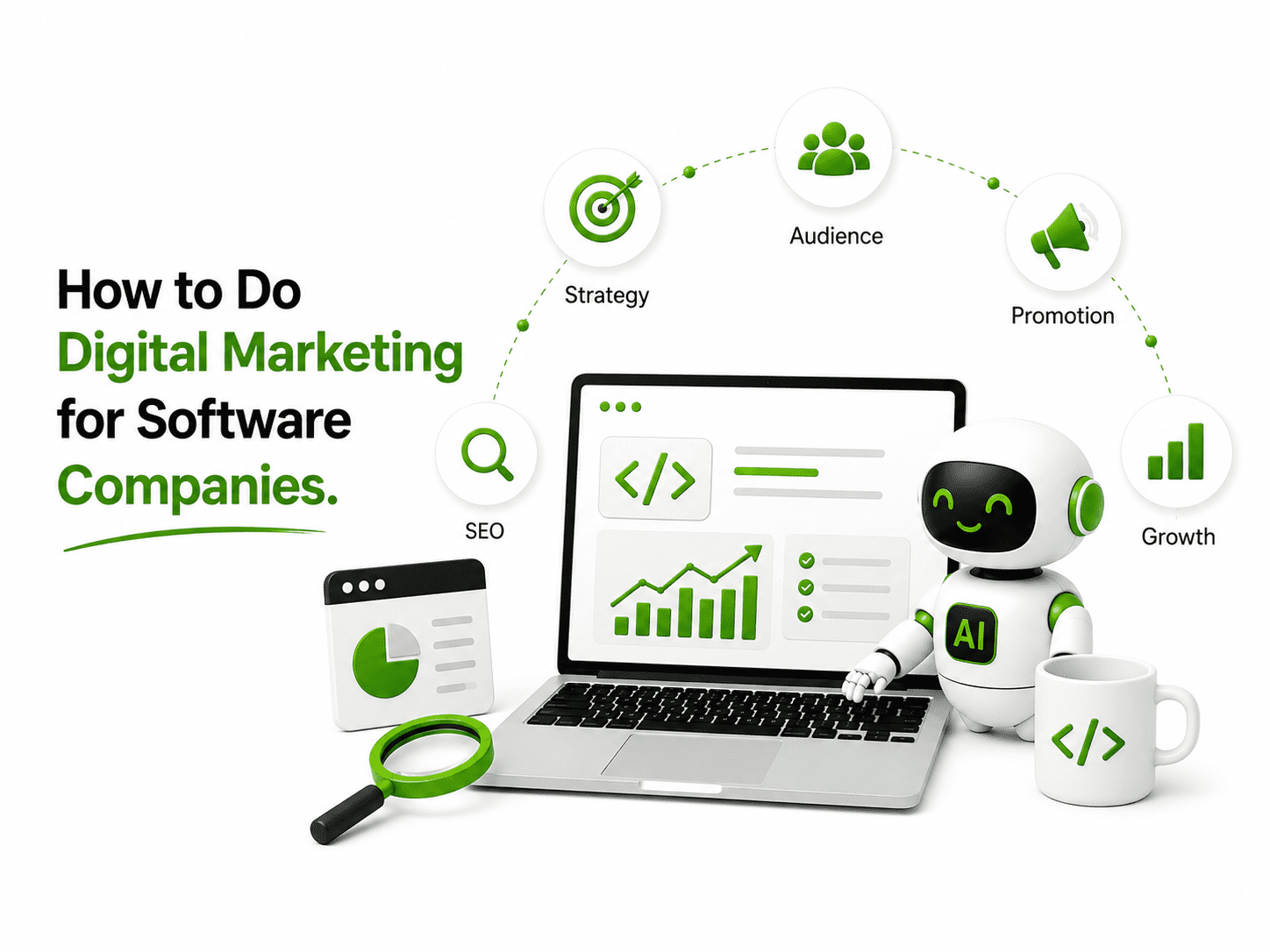
How to Do Digital Marketing for Software Companies
Software companies have a marketing problem that most general-purpose marketing guides don’t address: the buyer is not only evaluating your price and your brand, they’re evaluating whether your product is technically credible, safe to buy, and built by people who actually understand the problem. Digital marketing for software companies requires a different foundation than retail, hospitality, or professional services — and copying tactics from those industries is one of the fastest ways to build a pipeline full of people who were never going to buy.
The gap between software companies that grow steadily and those that stall after early traction is almost never the product. It’s the go-to-market engine: how they create awareness among the right buyers, how they build enough credibility to survive a competitive evaluation, and how they convert interest into revenue without a sales team doing it manually for every deal. Digital marketing for software companies, done well, is what builds that engine systematically.
At Digitechzo, we’ve worked alongside software product teams as they navigate the exact challenges this guide covers — which channels actually work for B2B SaaS versus consumer software, how to build content that earns technical trust rather than generic traffic, and how to align marketing and product so the pipeline reflects the customers who actually stay. This guide covers every layer of a high-performing digital marketing strategy for software companies, built specifically for the buying behaviour of software buyers, not generic audiences.
Quick Answer
“Digital marketing for software companies works best when it combines SEO-driven content that addresses real technical and business problems, a product-led growth motion where the product itself drives acquisition, community and partnership distribution, and targeted paid channels (LinkedIn for B2B, Google for high-intent search) — layered over a clear ICP (ideal customer profile) and a conversion infrastructure that can turn marketing-generated traffic into trial signups or sales conversations.”
Why Digital Marketing for Software Companies Requires a Different Approach
Digital marketing for software companies operates in a buying environment shaped by technical scrutiny, peer influence, and a longer evaluation cycle than most consumer purchases. Understanding these dynamics before choosing channels or creating content is what separates strategies that work from those that generate traffic but no revenue.
The Software Buyer’s Journey Is Not Linear
A typical software buyer — particularly in B2B — discovers a product through a colleague’s recommendation, evaluates it through a Google search, reads two or three competitor comparison articles, asks a community for opinions, starts a trial, abandons it, gets retargeted, starts the trial again, and then involves three other stakeholders in the final decision. Digital marketing for software companies needs to be present and credible at every stage of that non-linear journey, not just at the top.
Trust Is the Currency That Drives Software Buying Decisions
Software buyers aren’t just evaluating features and price. They’re evaluating: will this company still exist in two years? Is this product secure? Do the people who built it actually understand my problem? Will I be embarrassed recommending this internally? This is why digital marketing for software companies must be built around credibility signals — case studies, transparent documentation, technical content, and social proof — rather than pure awareness plays.
The ICP (Ideal Customer Profile) Is the Foundation
Every other decision in digital marketing for software companies — which channels, which content topics, which ad targeting, which messaging — follows from a precise answer to the question: who is the specific person this product is built for, what does their day look like when they have the problem we solve, and what are they searching for or reading when they’re actively trying to fix it? Without a crisp ICP, digital marketing for software companies produces traffic that doesn’t convert, because the people arriving don’t match the people the product was built for.
The Full Digital Marketing Channel Map for Software Companies
Digital marketing for software companies typically operates across six distinct channel categories. The right mix depends on the product’s stage, the buyer profile, and the competitive landscape.
| Channel | Best For | Typical ROI Timeline | Minimum Investment to See Signal |
| SEO and content marketing | High-intent organic discovery; long-term traffic | 6–18 months | 3–6 months of consistent publishing |
| Product-led growth (PLG) | Reducing friction to trial; viral loops; self-serve | 2–6 months | Engineering time to build PLG motion |
| LinkedIn (organic + paid) | B2B awareness; decision-maker targeting; outbound | 1–4 months | $3,000–$8,000/mo for meaningful paid results |
| Google Search Ads (PPC) | High-intent buyers actively searching for solutions | 4–8 weeks | $2,000–$10,000/mo depending on competition |
| Community and distribution | Trust-building; peer influence; word-of-mouth | 3‒9 months | Consistent participation; low cash cost |
| Email and lifecycle marketing | Lead nurturing; trial-to-paid conversion; retention | 1–3 months | Marketing automation platform ($200+/mo) |
| Review platforms and G2/Capterra | Evaluation-stage credibility; comparison traffic | 3‒6 months | Time investment to generate authentic reviews |
| Partner and integration marketing | Distribution via adjacent products’ audiences | 6–12 months | Partnership development time |
SEO and Content Marketing for Software Companies
Content marketing and SEO form the highest-leverage, most defensible channel in digital marketing for software companies over a 12–24 month horizon. Unlike paid advertising that stops the moment the budget does, well-ranked content compounds in value — ranking for high-intent keywords that reflect the actual search behaviour of your ICP at every stage of their buying journey.
The Three Content Tiers That Drive Software Company Growth
- Bottom-of-funnel (BOFU) content — targets searches by buyers who know what they want and are comparing options. Examples: ‘[Your product] vs [Competitor]’, ‘best [category] software for [industry]’, ‘[Problem] solution for [job role]’. This content should be the first priority because it targets the highest-converting traffic.
- Middle-of-funnel (MOFU) content — targets buyers who know they have a problem but haven’t committed to a solution category. Examples: ‘how to [solve problem your product addresses]’, ‘[industry] workflow automation’, ‘how to reduce [pain point] for [company size]’. This content educates and routes to the product.
- Top-of-funnel (TOFU) content — targets broader awareness and authority building. Examples: industry reports, benchmark studies, definitive guides, and trend commentary. Builds brand recognition and backlinks but takes longest to convert.
SEO Priorities Specific to Digital Marketing for Software Companies
- Target ‘best [software category]’ and ‘top [software category] tools’ keywords — these have massive buying intent and are regularly visited during evaluations
- Create comparison pages against named competitors — buyers search for these; owning your own comparison narrative is better than leaving it to review sites
- Build a technical blog that targets the specific problems your ICP searches for — not general marketing topics, but the technical and operational questions your buyers type into Google
- Create use-case pages for each industry or job role you serve — ‘[Product] for [industry]’ pages outperform generic product pages for niche buyer segments
- Earn backlinks from integration partner pages, industry publications, and tool directories — these are the highest-authority backlinks for software company SEO
The Content Types That Build Technical Trust
Digital marketing for software companies requires content formats that signal genuine expertise, not just general marketing fluency. The highest-trust content formats in the software buying journey include: detailed case studies with measurable outcomes, technical how-to guides that solve real implementation problems, comparison articles that fairly acknowledge competitor strengths, and benchmark reports with original data. These content types earn inbound links, generate word-of-mouth sharing among technical communities, and move prospects further through evaluation faster than general brand content does.
Product-Led Growth: The Channel Built Into the Product Itself
Product-led growth (PLG) is one of the most powerful and most underinvested elements of digital marketing for software companies. The basic premise is that the product itself — through a free tier, a trial, or a freemium model — is the primary acquisition mechanism, allowing users to experience value before making a buying decision and, in many cases, inviting colleagues which creates a viral loop.
PLG Mechanics That Directly Amplify Digital Marketing for Software Companies
- Free trial with activation focus — a time-limited trial converts most effectively when marketing is built around helping users reach the value moment before the trial expires, not just signing up.
- Freemium with viral exposure — Notion, Figma, and Calendly grew substantially through free-tier features that exposed the product brand to people who hadn’t paid for it (shared documents, design files, scheduling links).
- In-product referral mechanisms — software companies that systematically ask satisfied users to refer colleagues convert existing customers into a low-cost acquisition channel.
- Product-qualified leads (PQLs) — instead of relying entirely on marketing-qualified leads (MQLs), PLG surfaces users who have already experienced the product’s value as the highest-priority sales conversations.
LinkedIn Marketing for B2B Software Companies
For B2B software companies, LinkedIn is the most precise and most impactful paid channel available for digital marketing for software companies when targeting decision-makers by job title, company size, industry, and seniority. It is also one of the most expensive on a cost-per-click basis, which is why a clearly defined ICP is a prerequisite rather than a nice-to-have.
What Actually Works on LinkedIn for Software Companies
- Founder-led content — posts from the founder’s personal account consistently outperform company page posts in reach and engagement; LinkedIn’s algorithm rewards personal accounts, and buyer trust in the founder’s perspective is higher than in corporate brand content.
- Thought leadership targeting the ICP’s pain, not the product’s features — posts that describe the buyer’s problem, validate their frustration, and share a perspective on the solution outperform direct product promotion in every meaningful metric.
- LinkedIn Ads for retargeting and document downloads — LinkedIn’s most effective ad formats for digital marketing for software companies are sponsored content retargeting website visitors and document ads offering valuable content (a benchmark report, a framework, a guide) in exchange for a profile-based lead.
- Consistent employee advocacy — teams that share company content thoughtfully from personal accounts extend organic reach significantly without additional ad spend.
Google Ads for Software Companies: Targeting High-Intent Buyers
Google Search advertising is one of the fastest ways to generate pipeline for software companies when the targeting is tightly built around high-intent commercial keywords. Digital marketing for software companies through Google Ads works best for capturing buyers who are actively searching for a solution in your category — not broad awareness campaigns, which are typically less efficient than LinkedIn or content for software brands.
High-Converting Google Ads Keyword Categories for Software Companies
- Category + ‘software’ or ‘tool’ or ‘platform’: ‘[problem] software’, ‘[task] tool for [industry]’
- Alternative and migration keywords: ‘alternative to [competitor]’, ‘migrate from [competitor] to [your product]’
- Problem-solution keywords: ‘how to automate [task]’, ‘[problem] without [pain of current approach]’
- Job-role-specific queries: ‘[software] for [job title]’, ‘best [tool] for [company size]’
The Landing Page Standard for Software Company PPC
Digital marketing for software companies through paid search performs significantly better when traffic lands on a dedicated, conversion-optimised page rather than the homepage. Each ad campaign should have a corresponding landing page that matches the specific keyword intent, presents social proof relevant to the buyer profile, and has a single clear call to action — typically a free trial, a product demo booking, or a content download.
Review Platforms and Comparison Sites: The Evaluation-Stage Playbook
Buyers in the evaluation stage of the software buying journey consistently use review platforms — G2, Capterra, GetApp, Product Hunt, and industry-specific directories — to validate shortlists, check peer sentiment, and compare features. Digital marketing for software companies must include a systematic review generation and profile management strategy on these platforms, because they appear prominently in searches for the exact keywords buyers use when close to a purchase decision.
How to Build a Review Platform Presence That Drives Conversions
- Claim and fully complete your profile — a partial profile with placeholder content sends a negative trust signal at exactly the moment a buyer is comparing you against competitors who invested in theirs.
- Build a systematic review request process — ask customers for reviews at the moments when satisfaction is highest: immediately after a successful onboarding, after a positive support interaction, or after a measurable outcome.
- Respond to every review, including negative ones — how a software company responds to criticism on a public review platform tells a sophisticated buyer a great deal about what it’s like to be a customer.
- Use G2 and Capterra for retargeting audiences — visitors to your review platform profiles can be retargeted through LinkedIn and Google, keeping your brand visible through the evaluation period.
Email and Lifecycle Marketing: Converting Interest Into Revenue
Digital marketing for software companies generates pipeline; email and lifecycle marketing converts that pipeline into paying customers. The gap between a 20% trial-to-paid conversion rate and a 40% rate is almost always explained by what happens (or doesn’t happen) in the product and in the inbox between signup and the first billing date.
The Three Email Sequences Every Software Company Needs
- Activation sequence — a five to seven email series triggered on signup, designed to help the user reach the key activation milestone (the moment they’ve experienced the core value) before their trial expires. Each email should be focused on a single next action, not a tour of all the features.
- Trial expiry and conversion sequence — triggered in the final days of a trial for users who haven’t yet converted, with personalised messaging based on their usage pattern — a user who hasn’t activated needs a different email than one who’s been using the product daily and just hasn’t added a card.
- Nurture sequence for non-buyers — prospects who downloaded content or started a trial but didn’t convert should enter a lower-frequency, higher-value nurture sequence rather than being left in an abandoned list. One high-value email a month keeps the brand present without creating unsubscribe pressure.
Community and Distribution: The Underrated Channel in Digital Marketing for Software Companies
The highest-trust acquisition channel for digital marketing for software companies isn’t paid advertising or even SEO — it’s the recommendation of someone the buyer already respects. Community-based distribution builds the conditions for those recommendations to happen at scale.
Community Channels That Work for Software Companies
- Reddit and Hacker News — technical communities on both platforms are deeply skeptical of overt promotion but highly receptive to genuine contributions; showing up as a knowledgeable participant in threads relevant to your ICP’s problems builds awareness that advertising can’t replicate.
- Slack and Discord communities — most professional verticals have active Slack or Discord communities where practitioners discuss tools, problems, and recommendations; being genuinely helpful in these communities (not just promoting the product) is a high-quality acquisition channel.
- Integration partner distribution — getting listed in the app marketplace of a product your ICP already uses (HubSpot, Slack, Notion, Xero) places the product in front of a pre-qualified audience at the exact moment they’re looking for tools.
- Podcast and newsletter sponsorships — niche B2B podcasts and email newsletters targeting your specific ICP often have highly engaged, trust-primed audiences that are more receptive to software recommendations than general advertising platforms.
The Metrics That Actually Matter in Digital Marketing for Software Companies
Digital marketing for software companies generates a lot of numbers. Most of them are noise. Here are the metrics that are genuinely predictive of whether the marketing function is building a healthy business.
| Metric | What It Measures | Healthy Benchmark (B2B SaaS) |
| MQL to SQL conversion rate | Quality of marketing-generated leads | 15–35% |
| Trial activation rate | % of trials who reach the key value moment | >50%; aim for >65% |
| Trial-to-paid conversion rate | % of trials who become paying customers | 15–25% for self-serve; 20–40% for sales-assisted |
| CAC (customer acquisition cost) | Total marketing spend / new customers acquired | Should be <1/3 of LTV |
| LTV:CAC ratio | Lifetime value vs. cost to acquire | >3:1 for sustainable growth |
| Payback period | Months of revenue to recover acquisition cost | <12 months for VC-backed; <18 months for bootstrapped |
| Organic traffic growth rate | Month-over-month SEO growth | >10–15%/mo in early growth stage |
| NPS (Net Promoter Score) | Customer satisfaction and referral likelihood | >30 for SaaS; >50 for best-in-class |
Which Digital Marketing Channels to Prioritise at Each Stage
Digital marketing for software companies should look different at $0 ARR than at $1M ARR. Here’s the stage-based prioritisation framework we use with software company clients.
Stage 1: Pre-Revenue to $100k ARR — Validation and Foundation
- Founder-led LinkedIn content and direct outreach to ICP (no paid spend yet)
- Three to five core BOFU content pieces targeting the most specific, highest-intent keywords
- Presence on one or two review platforms with a minimum of 10 authentic reviews
- One community where the ICP gathers, with consistent helpful participation
- Basic email activation sequence for trial users
Stage 2: $100k–$1M ARR — Channel Development
- SEO content programme publishing consistently (2–4 pieces per month minimum)
- Google Ads on high-intent keywords; LinkedIn Ads retargeting website visitors
- Systematic review generation process built into the customer success workflow
- Email lifecycle sequences covering activation, conversion, and nurture
- First integration partner listing or marketplace presence
Stage 3: $1M+ ARR — Scale and Diversification
- Full SEO programme with topical authority content across all funnel stages
- LinkedIn Ads campaigns targeting cold audiences within ICP firmographic filters
- Podcast and newsletter sponsorships in the top two or three niche channels reaching the ICP
- A/B testing across landing pages, ad creative, and email subject lines with statistical discipline
- Partnership programme with co-marketing agreements and integration marketplace visibility
Common Mistakes in Digital Marketing for Software Companies
- Marketing to everyone instead of the ICP — generic messaging that tries to appeal to all potential buyers appeals to none of them with enough force to convert; narrow ICP targeting consistently outperforms broad reach.
- Starting paid advertising before the conversion infrastructure is ready — driving traffic to a website that can’t convert it, or to a trial that has no activation sequence, is spending money to learn nothing useful.
- Treating SEO and content as a short-term channel — software companies that expect SEO results in three months consistently abandon it at exactly the point where it would have started compounding.
- Building content around product features rather than buyer problems — content about ‘Our top 5 features’ attracts nobody; content about ‘how to solve [problem your ICP has]’ attracts exactly the right buyers.
- Ignoring the evaluation stage — digital marketing for software companies that doesn’t account for how buyers evaluate options during their decision process — comparison content, review platforms, demo quality — loses deals to competitors who do.
- Measuring vanity metrics instead of revenue metrics — traffic, social followers, and email list size matter only insofar as they predict trial signups, conversions, and revenue; reporting on them without connecting them to revenue creates false confidence.
Expert Tips for Digital Marketing for Software Companies
- Interview churned customers before building marketing messaging — the reasons customers left tell you more about what your marketing needs to address upfront than any customer survey of active users.
- Build SEO around the competitor your ICP searches for most — a ‘[Competitor] alternative’ page targeting the category leader’s brand name often generates higher-converting traffic than any generic category keyword.
- Let satisfied customers do your case studies in their own words — a customer speaking authentically about the outcome they achieved converts evaluation-stage buyers faster than the most polished marketing-written case study.
- Use product usage data to personalise marketing, not just support — users who’ve used feature X but not feature Y can be targeted with specific email or in-app content, turning the product’s data into a marketing asset.
- Publish your pricing page rather than hiding it — software buyers who can’t find pricing information increasingly move to the next option rather than filling in a contact form; transparency in pricing reduces friction for the buyers most likely to self-serve.
Frequently Asked Questions
What is digital marketing for software companies?
Digital marketing for software companies is the set of strategies and channels — SEO, content marketing, paid advertising, product-led growth, email, community, and review platforms — used to attract, convert, and retain software buyers online, tailored to the specific buying behaviour, trust requirements, and longer evaluation cycles of software purchasing decisions.
Which digital marketing channel works best for software companies?
For B2B software companies, SEO-driven content marketing and LinkedIn (organic and paid) are the highest long-term ROI channels. For short-term pipeline, Google Search Ads targeting high-intent keywords generate the fastest results. The most effective digital marketing for software companies combines organic content for long-term authority with targeted paid channels for faster pipeline, layered over a product-led growth motion that reduces friction to trial.
How much should a software company spend on digital marketing?
B2B software companies typically allocate 15–25% of revenue toward sales and marketing combined at early stage, with the marketing share growing as the product proves repeatability. Pre-revenue, a founder should expect to invest $3,000–10,000 per month to test channels and build early traction. At $500k+ ARR, allocating $15,000–40,000 per month across SEO, paid, and content production is typical for sustained growth.
How long does digital marketing take to show results for software companies?
Paid advertising (Google and LinkedIn) typically generates initial pipeline signal within four to eight weeks. SEO and content marketing take six to eighteen months to compound into meaningful organic traffic. Product-led growth changes show in trial conversion metrics within two to four months of implementation. Digital marketing for software companies rewards patience on organic channels and precision on paid ones.
What’s the difference between B2B and B2C digital marketing for software companies?
B2B digital marketing for software companies involves longer sales cycles, multiple decision-makers, a heavier reliance on content and peer trust signals, and channels like LinkedIn, G2, and direct outreach. B2C software marketing operates faster, relies more on app store optimisation, product virality, performance advertising on social platforms, and influencer distribution. The ICP, the buying trigger, and the conversion mechanism are fundamentally different, requiring distinct strategies for each.
Conclusion: Digital Marketing for Software Companies Is a System, Not a Collection of Tactics
The software companies that build consistent, compounding growth don’t win by finding one magic channel or one viral piece of content. They win by building a system where SEO earns long-term discoverability, content builds technical trust, product-led growth reduces friction to trial, paid channels capture intent at the bottom of the funnel, and lifecycle marketing converts interested users into paying customers who stay. Digital marketing for software companies, at its best, is the operating system that makes everything else grow faster.
If your software company is generating traffic but not converting it, building content but not seeing pipeline, or spending on ads without understanding which are actually closing, Digitechzo works with software companies to diagnose exactly where the marketing system is breaking and rebuild the components that aren’t performing. Get in touch to start with an honest audit of what’s working, what isn’t, and where the highest-leverage fixes are.
About The Author