
What Is an AI Property Operations Platform?

An AI property operations platform is a unified system that manages real estate operations across multiple functions — leasing, sales pipelines, tenant and client communication, maintenance coordination, and financial reporting — while using AI to prioritize tasks, predict outcomes, and automate decisions that would otherwise require manual judgment.

The defining trait of an AI property operations platform isn’t just breadth of features — it’s the intelligence layer sitting on top of those features. Instead of simply storing a maintenance request, it might flag that the request is part of a recurring pattern likely to escalate. Instead of just listing leads, it scores them by conversion likelihood.

In simple terms: an AI property operations platform is built for businesses that need one system managing multiple interconnected functions intelligently, not several disconnected tools bolted together.

What Is Traditional Property Management Software?

Traditional property management software is purpose-built around the core operational tasks of managing rental properties — rent collection, lease tracking, maintenance requests, and tenant communication — typically for a single function within the business.

It excels at digitizing and organizing property-specific workflows but generally doesn’t extend into sales pipeline management, cross-functional reporting, or predictive analytics. It answers “what’s the status of this lease?” reliably, but rarely answers “which tenants are likely to churn next quarter?”

This isn’t a weakness — for businesses focused purely on rental operations without broader sales or multi-function complexity, this focused scope is often exactly what’s needed.

The Core Difference: Scope vs Intelligence

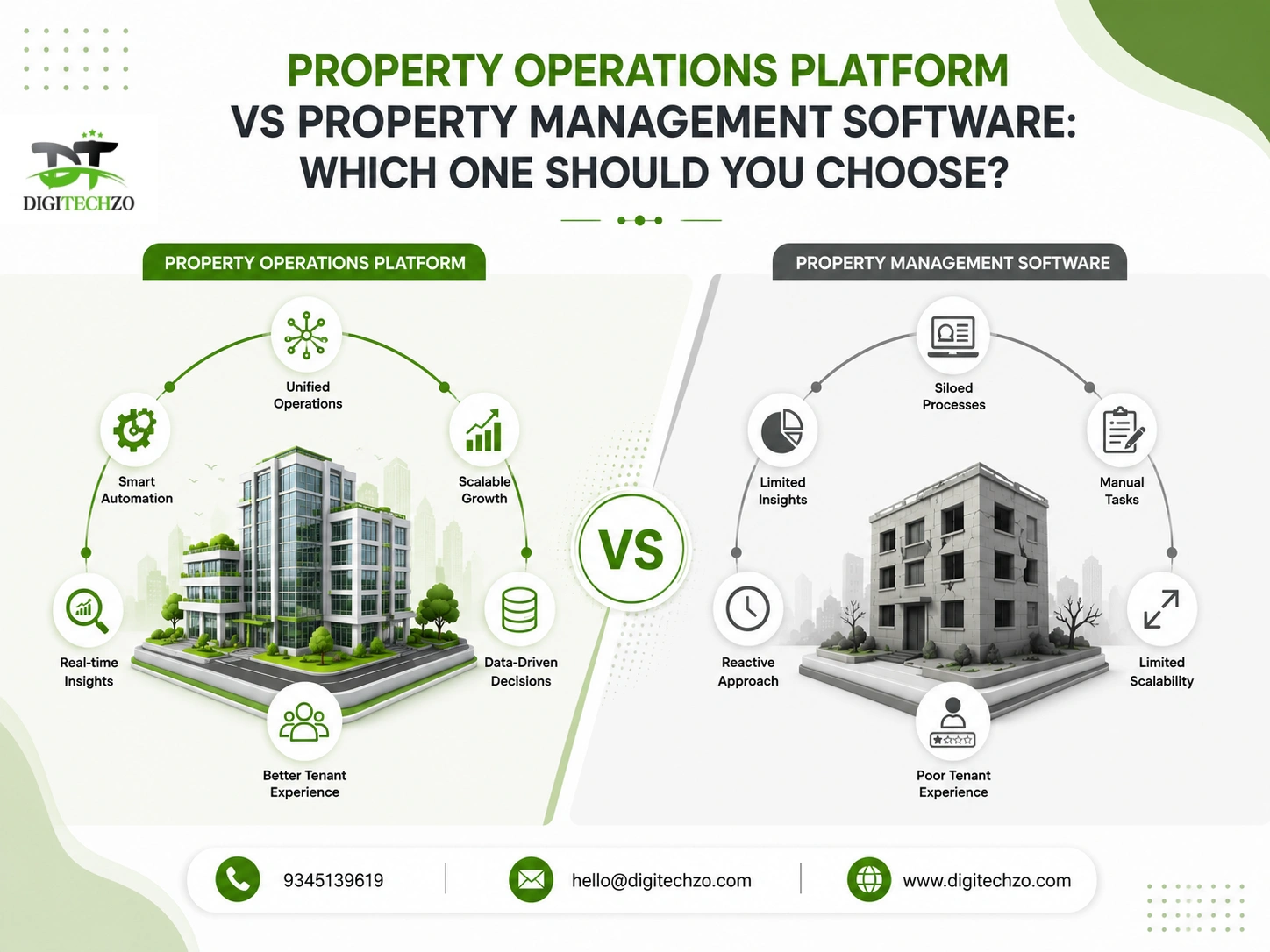
Featured Snippet Answer: The core difference between an AI property operations platform and property management software is scope and intelligence — property management software organizes single-function property tasks like leases and maintenance, while an AI property operations platform unifies multiple business functions and uses AI to predict outcomes and prioritize actions across them.

Think of it this way:

  • Property management software answers: “What needs to happen with this property?”
  • An AI property operations platform answers: “Across my entire portfolio and pipeline, what needs my attention right now, and why?”

This distinction becomes critical as businesses grow past single-function operations into managing sales, leasing, and property management simultaneously — a stage where disconnected tools start creating more friction than they solve.

Side-by-Side Comparison

Factor Property Management Software AI Property Operations Platform
Primary focus Rental property tasks Cross-functional operations (sales + leasing + management)
Intelligence layer Minimal to none Predictive analytics and AI-driven prioritization
Best for Single-function property managers Multi-function real estate businesses
Reporting Historical, task-based Predictive, business-wide
Scalability Limited beyond core property tasks Scales across departments and functions
Setup complexity Generally simpler Requires more configuration, higher long-term value

Which One Should You Choose? A Decision Framework

Rather than comparing features line by line, ask these three questions:

1. How many functions does your business actually need to manage in one system?

If you strictly manage rental properties — leases, rent, maintenance — property management software likely covers your needs. If you’re managing sales pipelines and rental operations and tenant relationships simultaneously, an AI property operations platform prevents the data fragmentation that comes from stitching together multiple disconnected tools.

2. Are your bottlenecks task-based or decision-based?

If your problem is “tasks aren’t getting tracked,” property management software solves that. If your problem is “we don’t know which leads to prioritize, which tenants are at risk, or what price to set,” that’s a decision-quality problem — exactly what an AI property operations platform is built to solve.

3. Is your business still growing in complexity, not just size?

A landlord adding more units of the same type may not need AI-driven complexity. A business adding new service lines — property management plus brokerage, plus development — is adding operational complexity, which is where an AI property operations platform earns its cost.

Pros and Cons of Each

Property Management Software

Pros:

  • Simpler to implement and learn
  • Lower cost for single-function needs
  • Well-suited for smaller, focused rental portfolios

Cons:

  • Limited visibility across business functions
  • No predictive capability — relies entirely on manual review
  • Can require multiple additional tools as the business grows

AI Property Operations Platform

Pros:

  • Unified visibility across sales, leasing, and management
  • Predictive insights reduce reliance on manual pattern-spotting
  • Scales with business complexity, not just unit count

Cons:

  • Higher upfront setup and configuration effort
  • Requires clean, sufficient data for AI predictions to be reliable
  • Can be more platform than a single-function business actually needs

Real-World Use Case Scenarios

Scenario 1: Independent Landlord With 40 Units, Single Function A landlord solely focused on rental operations — no sales pipeline, no brokerage arm — is well-served by focused property management software. The added complexity of an AI property operations platform wouldn’t yet match the business’s operational needs.

Scenario 2: Real Estate Business Running Both Brokerage and Property Management A business managing sales listings and a rental portfolio simultaneously often struggles when using separate tools for each — leads live in one system, tenants in another, with no shared visibility. An AI property operations platform unifies this, allowing leadership to see business performance across both functions in one place.

Scenario 3: Growing Portfolio Facing Rising Turnover and Pricing Guesswork A property management company outgrowing manual pricing and reactive turnover management benefits from the predictive layer an AI property operations platform provides — flagging at-risk tenants and recommending pricing before problems compound.

Signs You’ve Outgrown Property Management Software

  • You’re manually exporting data from one tool to analyze trends in another
  • Sales and property management teams operate with zero shared visibility into client or tenant history
  • Pricing and retention decisions still rely entirely on manager intuition despite having relevant data on hand
  • You’ve added multiple point solutions (a separate CRM, a separate maintenance tool, a separate reporting tool) just to cover gaps
  • Leadership can’t get a single, unified view of business performance without manually compiling reports from several systems

If three or more of these sound familiar, it’s a strong signal that an AI property operations platform — not another point solution — is the right next step.

Common Mistakes When Choosing Between the Two

  1. Buying based on category label instead of actual need — some vendors market basic tools as “platforms” and vice versa; evaluate capability, not terminology.
  2. Choosing an AI property operations platform before data is clean or centralized, leading to underwhelming initial predictions and false disappointment in the technology.
  3. Sticking with disconnected point solutions too long, assuming each new tool solves the actual problem when it’s really patching a symptom of fragmented operations.
  4. Underestimating the complexity of a multi-function business, choosing simple property management software that can’t scale with sales and leasing growth.
  5. Over-investing in a platform for a single-function business, taking on more setup complexity and cost than the current operation actually requires.
  6. Failing to plan for data migration when moving from multiple disconnected tools into one unified platform.

Expert Tips for Making the Right Call

  • Map your actual functions first, not your feature wishlist — count how many distinct business functions (sales, leasing, management) you’re currently running, and in how many separate tools.
  • Audit how many manual reports you compile monthly to combine data from separate systems; that number is a strong proxy for how much an AI property operations platform could save you.
  • Start with a pilot on your most fragmented function if you’re transitioning from multiple point solutions, rather than migrating everything simultaneously.
  • Don’t buy AI capability you can’t yet use — if your historical data is inconsistent or incomplete, prioritize data cleanup before investing in a predictive platform.
  • Revisit this decision annually, since business complexity — not just unit count — is the real signal for when to upgrade from property management software to a full AI property operations platform.

Frequently Asked Questions

Q1: What is the main difference between an AI property operations platform and property management software?

Property management software organizes single-function property tasks like leases and maintenance. An AI property operations platform unifies multiple business functions — sales, leasing, and management — and uses AI to predict outcomes and prioritize actions across all of them.

Q2: Do I need an AI property operations platform if I only manage rental properties?

Not necessarily. If your operations are strictly rental-focused with a single function, dedicated property management software may fully meet your needs without the added complexity of a broader platform.

Q3: When should a business upgrade from property management software to an AI property operations platform?

Typically when the business starts managing multiple functions simultaneously — such as sales and property management — or when pricing and retention decisions require predictive insight that manual review can no longer keep up with.

Q4: Is an AI property operations platform more expensive than property management software? Generally yes in upfront setup, but it often reduces the need for multiple separate point solutions, which can offset or exceed the cost difference over time for multi-function businesses.

Q5: Can I switch from property management software to an AI property operations platform later without starting over?

Yes, provided historical data is properly maintained and migrated; clean, consistent records from your existing software make the transition to a predictive platform significantly smoother.

Conclusion: Choose Based on Complexity, Not Just Size

The right choice between property management software and an AI property operations platform isn’t about which one sounds more advanced — it’s about matching the tool to your actual operational complexity. A single-function rental business may be perfectly served by focused property management software. A business juggling sales, leasing, and property management simultaneously needs the unified, predictive visibility only an AI property operations platform provides.

Getting this decision right avoids two expensive mistakes: overpaying for platform complexity you don’t need, or staying stuck patching together point solutions that were never built to work as one system.

If you’re not sure which category actually fits your business, Digitechzo helps real estate businesses evaluate their operational complexity honestly — and implement the right solution, not just the most advanced one.

Not sure whether you need a focused tool or a full AI property operations platform? Reach out to Digitechzo for a free operations assessment and get a clear, honest recommendation based on how your business actually runs.