Building a personal brand used to mean choosing between two bad options: spend 10-15 hours a week writing and posting content yourself, or pay for a traditional agency that takes weeks to turn around a single piece of content. Neither option scales, and both leave most professionals either burned out or invisible online while competitors post consistently and pull in the inbound leads that should be theirs.
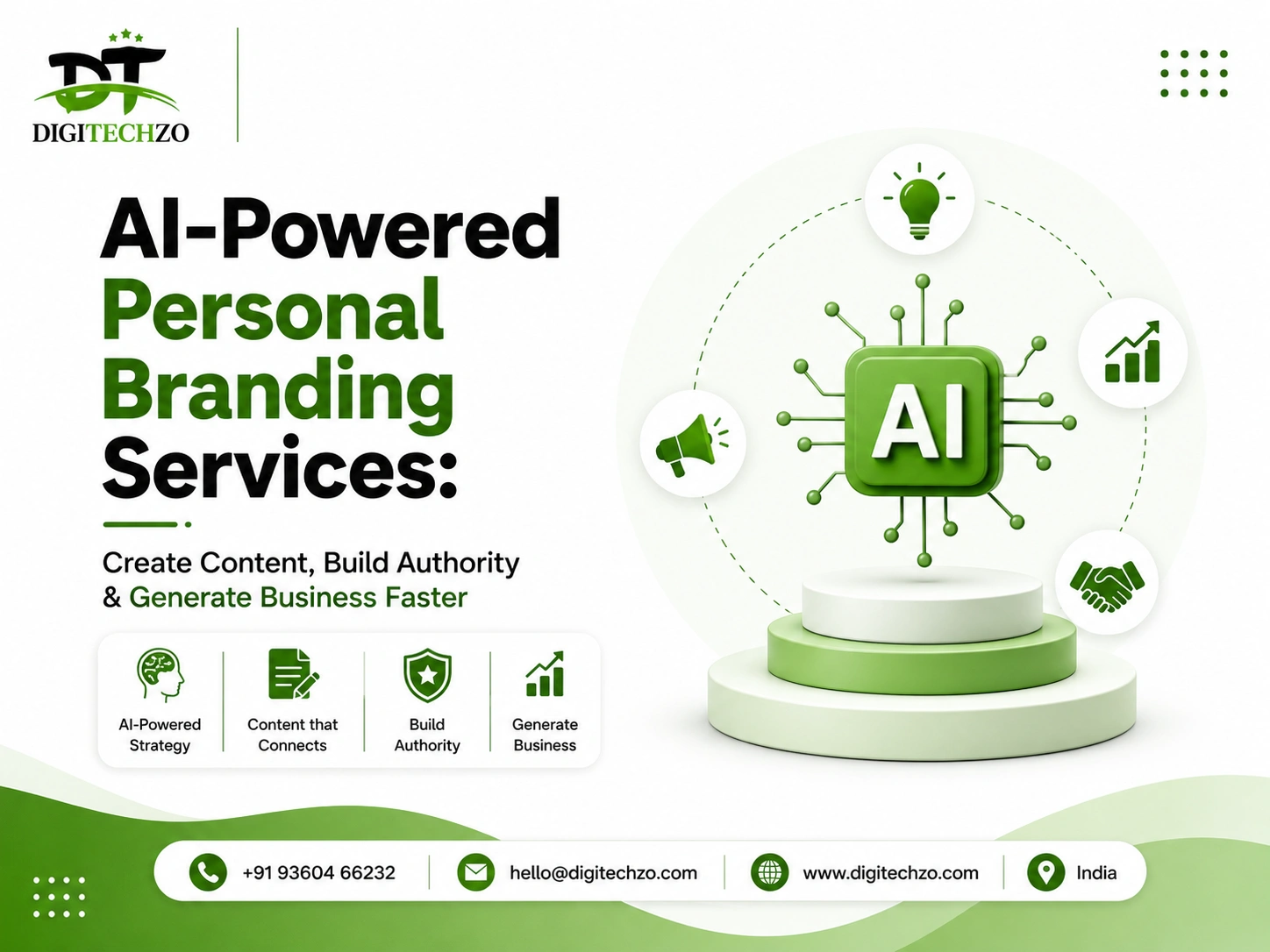
This is exactly why AI personal branding services have become one of the fastest-growing categories in the branding and marketing space. At Digitechzo, we’ve integrated AI directly into how we research, draft, and refine content for founders, coaches, and business owners — and the results are consistent: the same strategic depth as traditional branding, produced in a fraction of the time, without sounding robotic or generic. This guide breaks down what AI personal branding services actually do, where AI genuinely helps versus where it can quietly damage your credibility, and how to evaluate a provider that uses AI responsibly rather than as a shortcut for lazy content.
Quick Answer
AI personal branding services combine artificial intelligence tools with human strategy to research, draft, and distribute content faster than traditional methods — while keeping your authentic voice and expertise intact. Done correctly, this approach cuts content production time significantly while maintaining (or improving) the quality and consistency that builds real trust and inbound business.
Why AI Has Changed Personal Branding, Not Just Content Creation
Personal branding has always required three things: consistency, quality, and authentic voice. Historically, achieving all three simultaneously was nearly impossible without significant time or budget — you could be consistent and cheap (posting generic content constantly) or authentic and expensive (a ghostwriter capturing your real voice, but slowly).
AI has broken that trade-off. Modern AI systems can now analyze your existing writing, calls, or voice notes to learn your specific tone and vocabulary, then generate drafts that sound like you — not like a template. This means the old bottleneck (needing a human to sit with you for hours to “get your voice”) has been dramatically reduced, without eliminating the human judgment needed to keep content strategic and accurate.
Speed as a Competitive Advantage
In fast-moving industries — SaaS, finance, e-commerce — the professionals who comment on trends and news within hours, not weeks, capture significantly more visibility and engagement than those who publish after the conversation has moved on. AI-powered workflows make this kind of responsive thought leadership realistic for busy professionals who can’t personally draft content on a moment’s notice.
The Data Layer Most Competitors Ignore
Beyond content creation, AI also enables something most branding content overlooks entirely: pattern recognition across your own performance data. AI-powered services can analyze which topics, formats, and hooks consistently drive engagement and inquiries specifically for you — rather than relying on generic “best practices” that may not apply to your audience or industry.
What AI Personal Branding Services Actually Include
A genuine AI-powered service goes far beyond typing a prompt into a chatbot. It typically includes:
Voice Modeling & Style Training
AI systems are trained on your existing content, transcripts, or voice notes to replicate your specific vocabulary, sentence rhythm, and tone — so output doesn’t sound like generic AI writing.
AI-Assisted Research & Ideation
Using AI to scan trending topics, competitor content, and audience questions to generate a constant stream of relevant content ideas, rather than relying on the founder or owner to constantly think of what to post.
Rapid Drafting & Repurposing
Turning one long-form idea (a podcast appearance, a client call, a voice memo) into multiple content formats — LinkedIn posts, X threads, short video scripts — within hours instead of days.
Human Strategic Review
This is the critical layer separating professional AI branding services from raw AI tools: a human strategist reviews every piece for accuracy, positioning, and brand safety before it’s ever published.
Performance Analytics & Iteration
AI-powered dashboards track which content drives engagement, profile visits, and inbound inquiries — allowing continuous refinement based on real data rather than guesswork.
Where AI Genuinely Helps vs. Where It Can Hurt Your Brand
This is the section most competing articles skip entirely — and it’s the most important one for making a smart decision.
Where AI Helps
- Speed: Drafting first versions of content in minutes instead of hours
- Consistency: Removing the “I don’t know what to post” bottleneck that kills momentum
- Repurposing: Turning one piece of content into many formats efficiently
- Pattern recognition: Identifying what’s actually working from your performance data
Where AI Can Hurt Your Brand
- Generic-sounding content: Unedited AI output often uses the same phrasing patterns as millions of other AI-generated posts, which audiences increasingly recognize and distrust
- Factual errors: AI can confidently state inaccurate information, which is especially damaging for expertise-based personal brands
- Loss of specific insight: AI tends to generalize, while the content that actually builds authority requires your specific, non-obvious point of view
- Over-automation: Fully automating engagement (like AI-generated comments or DMs) can damage trust if audiences sense the interaction isn’t genuinely from you
The takeaway: AI should accelerate your voice, not replace your judgment. Services that use AI purely to mass-produce content without human oversight often produce brands that look active but feel hollow.
AI-Only Tools vs. AI-Powered Branding Agencies vs. Fully Manual Branding
| Factor | AI-Only Tools (self-serve) | AI-Powered Branding Agency | Fully Manual Branding |
|---|---|---|---|
| Speed | Very fast | Fast | Slow |
| Voice authenticity | Often generic unless heavily edited | High (human-reviewed) | High (fully human) |
| Strategic direction | None (you self-manage) | Included | Included |
| Cost | Low | Moderate | High |
| Time required from you | Moderate (prompting, editing) | Low (input sessions only) | High (writing yourself or long ghostwriting cycles) |
| Risk of factual/tonal errors | Higher | Lower (human review) | Lowest |
Pros of AI-Only Tools
- Lowest cost option
- Full control and immediate output
- Good for quick drafts or brainstorming
Cons of AI-Only Tools
- Requires you to catch factual errors and generic phrasing yourself
- No strategic positioning or performance analysis included
- Easy to unintentionally sound like everyone else using the same tools
Pros of AI-Powered Branding Agencies
- Combines AI speed with human strategic oversight
- Voice modeling trained specifically on you, not generic prompts
- Includes performance tracking and iteration built into the service
Cons of AI-Powered Branding Agencies
- Higher cost than self-serve AI tools
- Requires initial onboarding time to train the voice model accurately
Pros of Fully Manual Branding
- Deepest authenticity and nuance
- No risk of AI-related factual or tonal issues
Cons of Fully Manual Branding
- Slowest turnaround time
- Most expensive per piece of content
- Harder to scale content volume consistently
Real Scenarios: How AI-Powered Branding Changes Output and Results
Scenario 1: The Consultant Who Couldn’t Keep Up With Content A management consultant wanted to post three times a week but could only manage one post every two weeks due to time constraints. Using an AI-assisted workflow trained on his past talks and client emails, his content output increased significantly while maintaining his specific analytical tone — because the AI drafted from his real material rather than generating generic advice.
Scenario 2: The Founder Who Almost Published an Inaccurate Claim A SaaS founder used a self-serve AI tool to draft a post citing an industry statistic that turned out to be outdated and incorrect. Because there was no human review layer, the error nearly went live under his name — a clear example of why human strategic review remains essential even in AI-powered workflows.
Scenario 3: The Coach Whose Content Started Sounding Like Everyone Else A business coach using generic AI prompts noticed her content increasingly resembled dozens of other coaches using the same tools, with similar phrasing and structure. After switching to a voice-modeling approach trained specifically on her past client calls and writing, her content regained a distinct tone that reconnected with her existing audience.
How to Choose an AI Personal Branding Service Without Sacrificing Authenticity
Ask How Voice Training Actually Works
A credible service should explain specifically how they train AI on your existing content or voice — not just “we use AI to write for you.”
Confirm Human Review Is Built Into the Process
Ask directly whether every piece of content is reviewed by a strategist before publishing, especially for factual accuracy and brand-safe positioning.
Request Sample Output Trained on Your Own Material
Legitimate services can produce a sample draft using your actual past content or a short interview, demonstrating real voice-matching rather than generic AI writing.
Understand the Analytics Layer
Ask what specific data the service tracks and how it informs content decisions — vague answers here often indicate the “AI” claim is more marketing than substance.
Clarify Data Privacy Practices
Since voice modeling involves training AI on your personal writing and materials, confirm how your data is stored, used, and whether it’s kept private to your account.
Common Mistakes People Make With AI Personal Branding
- Publishing AI content without editing — unreviewed AI drafts often contain generic phrasing or factual inaccuracies that damage credibility.
- Using AI tools not trained on your specific voice — generic prompts produce generic content that blends in rather than differentiates.
- Automating engagement entirely — audiences often notice when comments or DMs feel automated, undermining the personal trust that branding is meant to build.
- Ignoring the strategy layer — using AI purely for drafting without a positioning strategy results in consistent but directionless content.
- Failing to fact-check AI-generated claims — especially damaging for expertise-based brands where credibility depends on accuracy.
Expert Tips for Getting the Best Results From AI-Powered Branding
- Feed AI your real material, not just prompts. Voice modeling works best when trained on your actual calls, emails, or past writing — not generic instructions.
- Always keep a human review step before publishing. Even the best AI models can produce confidently incorrect information.
- Use AI for repurposing, not just original drafts. Turning one strong piece of content into multiple formats is one of the highest-ROI uses of AI in branding.
- Let performance data guide topic selection. Use AI-powered analytics to identify what’s actually resonating with your specific audience, rather than guessing.
- Preserve your specific point of view. The goal of AI is to speed up expressing your unique insight — not to replace it with generalized industry commentary.
FAQs
What exactly are AI personal branding services?
AI personal branding services combine artificial intelligence tools — for research, drafting, and analytics — with human strategic oversight to build your visibility and credibility online faster than fully manual methods, while keeping your authentic voice intact.
Will AI-generated content sound robotic or generic?
It can, if the AI isn’t specifically trained on your voice and reviewed by a human before publishing. Services that use proper voice modeling and editorial review typically produce content indistinguishable from fully human-written work.
Is it risky to use AI for personal branding as an expert or professional?
The main risk is factual inaccuracy or generic phrasing if content is published without human review. This is why credible AI-powered services always include a human strategist checking content before it goes live.
How much faster is AI-powered branding compared to traditional methods?
While results vary by scope, AI-assisted workflows can significantly reduce the time needed for research, drafting, and repurposing compared to fully manual content creation — often turning one long-form input into multiple pieces of content within the same day.
Does AI personal branding replace the need for a content strategist?
No. AI accelerates execution, but strategic decisions — positioning, topic selection, and brand safety — still require human judgment to ensure content builds real authority rather than just increasing output volume.
Conclusion
AI hasn’t replaced the fundamentals of personal branding — consistency, authenticity, and strategic positioning still matter as much as ever. What AI has changed is how fast and efficiently those fundamentals can be executed, removing the old trade-off between quality and speed that held so many professionals back from showing up consistently online.
At Digitechzo, our AI personal branding services combine voice-modeling technology with hands-on strategic review, so you get the speed of AI without losing the authentic expertise that actually builds trust and generates business. If you’re ready to build serious authority without spending your own hours drafting content, book a free AI branding strategy call with our team today and see exactly how much faster — and more consistent — your online presence could be.
About The Author