Most DAOs don’t fail because of bad tokenomics or weak governance models. They fail because nobody outside the founding team’s Twitter circle ever hears about them. You can have the most elegant treasury structure and the fairest voting mechanism in Web3, but if your Discord has 40 active members and your proposals get 2% quorum, none of that matters.
This is the exact problem a DAO growth marketing agency is built to solve — and it’s a very different job from running ads for a SaaS product or an e-commerce brand. DAO growth sits at the intersection of community psychology, tokenized incentives, governance participation, and old-fashioned demand generation. Get the mix wrong and you end up with mercenary token farmers who vanish the moment incentives dry up. Get it right and you build a self-sustaining community that markets itself.
At Digitechzo, we’ve worked with DAOs across DeFi, SocialFi, and NFT- based governance models, and one pattern shows up again and again: growth isn’t a marketing problem you bolt on later — it’s a system you design alongside your governance structure from day one. This guide breaks down exactly how that system works, what separates a real DAO growth partner from a generic Web3 marketing shop, and how to avoid the mistakes that quietly kill community momentum.
Quick Answer
A DAO growth marketing agency helps decentralized organizations acquire, activate, and retain contributors and token holders through community-led strategies — combining tokenized incentives, governance participation campaigns, content, and on-chain analytics instead of traditional paid-ad funnels. The best agencies focus on retention and governance participation, not just wallet count or Discord size, because vanity metrics don’t translate into a functioning DAO.
What a DAO Growth Marketing Agency Actually Does
A DAO growth marketing agency isn’t a PR firm that tweets about your token launch. It’s a specialized partner that treats your DAO like a two-sided network: contributors who create value, and stakeholders who fund and govern it. Both sides need distinct acquisition and retention strategies.
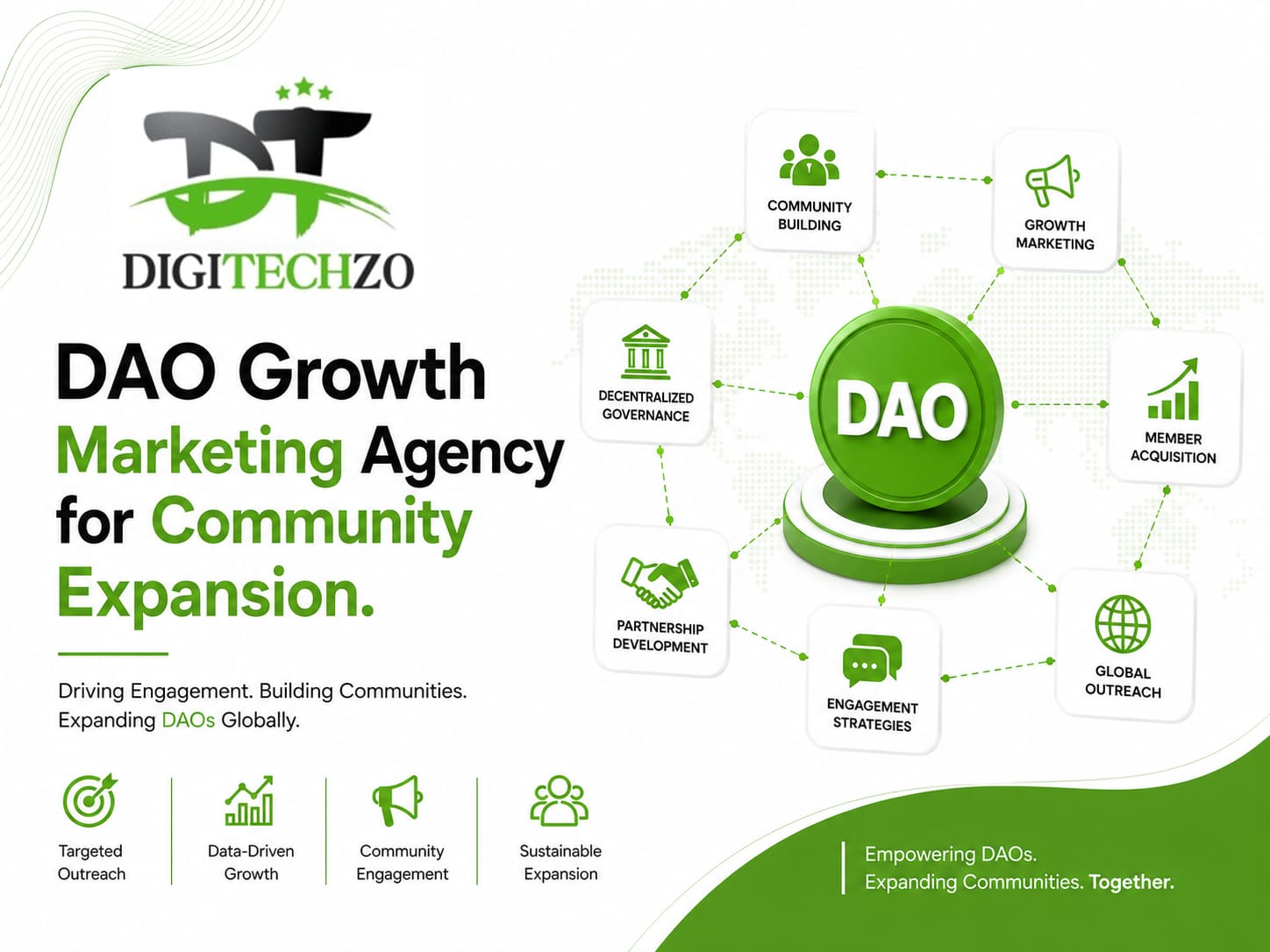
Core services typically include:
- Community architecture — structuring Discord/Telegram roles, contributor tiers, and onboarding flows so new members have a clear path from lurker to active participant
- Governance participation campaigns — designing incentives (not just token rewards) that get holders to actually vote on proposals
- Contributor acquisition — sourcing developers, designers, and moderators through bounty platforms, hackathons, and targeted outreach
- Narrative and content strategy — building the DAO’s public story across X (Twitter), Mirror, governance forums, and podcasts
- On-chain analytics — tracking wallet cohorts, voting behavior, and treasury flow to tie marketing spend to real engagement, not just impressions
- Cross-DAO partnerships — arranging collaborations, joint airdrops, or shared quests with complementary protocols
The distinguishing factor is that everything ties back to governance health, not just top-of-funnel awareness.
Why Traditional Marketing Agencies Fail DAOs
A generic digital marketing agency will default to what it knows: paid social, SEO, email nurture sequences. These aren’t useless in Web3, but applied without context they backfire.
Here’s the friction point: DAOs don’t have a single “customer.” They have contributors, token holders, delegates, and lurking observers — each with different motivations. A campaign optimized purely for sign-ups can flood a Discord with wallets that never vote, never contribute, and quietly tank your governance participation rate, which is often the metric investors and partners actually scrutinize.
Example scenario: A mid-sized DeFi DAO ran a standard influencer-marketing campaign and grew its Discord from 8,000 to 22,000 members in six weeks. Six months later, active proposal voters had barely moved past 300 wallets. The campaign generated noise, not governance capacity — and the DAO’s next funding round stalled because due diligence teams flagged the disconnect between community size and participation.
That’s the core reason DAOs need agencies fluent in tokenomics, quorum mechanics, and contributor incentive design — not just impressions and click-through rates.
Core Pillars of DAO Community Expansion
1. Contributor-Led Growth
The strongest DAOs grow through their existing contributors, not paid acquisition. Bounty boards (De work, Layer 3, Question) and structured onboarding turn one-time task-doers into repeat contributors. Agencies that specialize in DAO growth build “contributor funnels” — a mapped path from a $50 bounty task to a recurring working-group role.
2. Governance-First Incentive Design
Instead of rewarding people simply for holding tokens, mature DAOs reward participation: voting, proposal drafting, delegate work. Retroactive public goods funding (a model popularized by Optimism and Bitcoin) is a strong example — contributors get compensated after demonstrated impact, which filters out mercenary behavior.
3. Narrative and Positioning
DAOs compete for attention in a crowded governance-token landscape. A clear narrative — what problem this DAO solves, who it’s for, why it’s structured this way — needs to be repeated consistently across governance forums, X threads, and long-form content. Vague “decentralization for decentralization sake” messaging doesn’t convert skeptical crypto-native audiences.
4. Retention Infrastructure
Growth agencies too often obsess over top-of-funnel and ignore what happens after someone joins. Structured onboarding docs, mentor-buddy systems for new contributors, and recurring town halls significantly reduce the drop-off that kills most DAOs within their first year.
DAO Growth Marketing Agency vs. In-House Community Team
| Factor | Agency | In-House Team |
|---|---|---|
| Speed to launch campaigns | Fast — existing playbooks and tooling | Slower — needs hiring and ramp-up |
| Cross-DAO network access | Strong — existing relationships across protocols | Limited to founder’s personal network |
| Cost predictability | Fixed retainer or milestone-based | Variable — salaries, tools, benefits |
| Institutional knowledge of your DAO | Builds over time, some ramp-up needed | Immediate, deep, built-in |
| Governance-specific expertise | Varies by agency — vet carefully | Depends on hire quality |
| Long-term community trust | Can feel outsourced if not integrated well | Native to the community |
Practical takeaway: Most well-run DAOs use a hybrid model — an internal community lead who owns culture and relationships, paired with an agency that handles scaled execution, paid growth channels, and analytics infrastructure the internal team doesn’t have bandwidth to build.
A Real-World Framework: The 4-Stage DAO Growth Funnel
This is the framework we use at Digitechzo when auditing a DAO’s growth motion:
Stage 1: Discovery
Where do potential contributors and holders first encounter the DAO? This includes governance forum mentions, X threads, podcast appearances, and listings on DAO discovery platforms like Deep DAO or Tally.
Stage 2: Activation
The first meaningful action — joining Discord, completing an onboarding quest, delegating tokens, or submitting a first proposal comment. Agencies should measure time-to-first-action, not just sign-up count.
Stage 3: Contribution
The member takes on a bounty, joins a working group, or begins voting regularly. This is where most DAOs leak the most people, usually due to unclear roles or overwhelming documentation.
Stage 4: Advocacy
The contributor becomes a delegate, writes public content about the DAO, or actively recruits others. This stage compounds — advocates cost nothing to acquire new members through and carry far more credibility than paid campaigns.
Mapping your funnel this way exposes exactly where growth spend should go — and just as importantly, where it’s currently being wasted.
DAO Growth Metrics That Actually Matter
Skip vanity metrics. Track these instead:
- Quorum rate — percentage of eligible voting power actually cast on proposals
- Contributor retention at 90 days — how many new contributors are still active three months in
- Delegate concentration — whether voting power is dangerously centralized among a few wallets
- Bounty completion rate — proposed vs. completed tasks, a signal of contributor engagement quality
- Treasury-to-engagement ratio — how much value the DAO generates per dollar of incentive spend
Common Mistakes DAOs Make With Growth Marketing
- Chasing Discord size over governance participation — a large server with low quorum signals a marketing problem, not a community
- Over-relying on token incentives — token rewards attract mercenaries who leave once emissions slow; sustainable growth needs non-token incentives too (reputation, access, career capital)
- No onboarding funnel — dropping new members into a 40-channel Discord with no clear next step guarantees churn
- Ignoring delegate health — a handful of whale wallets controlling votes undermines the DAO’s legitimacy and scares off serious partners
- Treating growth as a one-time campaign — DAO growth is a continuous system, not a launch-week sprint
- Copying Web2 KPIs directly — impressions and follower counts don’t map cleanly to governance outcomes
Expert Tips for Sustainable Community Expansion
- Run quarterly “governance health audits” alongside growth campaigns — a DAO with rising membership but falling quorum is a warning sign, not a win
- Build a public leaderboard for non-financial contribution (writing, moderation, mentorship) — recognition drives retention as much as payment does
- Use retroactive funding rounds instead of upfront bounty payments for high-trust roles — it self-selects for genuine contributors
- Pair every growth campaign with a documentation sprint — new members churn fastest when they can’t find answers without asking in chat
- Treat your governance forum (not Discord) as the top-of-funnel content engine — search engines index forums like Discourse and Commonwealth far better than chat platforms
How to Choose the Right DAO Growth Marketing Agency
Ask any agency you’re evaluating:
- Can they show governance participation data from past clients, not just follower growth?
- Do they understand your specific token model and quorum mechanics?
- Do they have relationships across the broader DAO ecosystem for partnerships and cross-promotion?
- Will they build retention infrastructure, or only run acquisition campaigns?
- Do they report on-chain metrics (wallet cohorts, voting behavior) alongside social metrics?
If an agency’s pitch is entirely about Discord growth and influencer posts with no mention of governance health, that’s a red flag.
FAQs
Q:What does a DAO growth marketing agency actually charge?
Pricing typically ranges from milestone-based bounty-style engagements for smaller DAOs to monthly retainers (commonly $5,000–$25,000+) for full-service growth, community management, and analytics for larger treasuries. Costs scale with treasury size and campaign complexity.
Q:Is DAO marketing the same as crypto marketing?
Not exactly. Crypto marketing often focuses on token price awareness and exchange listings. DAO marketing focuses on governance participation, contributor acquisition, and community decision-making — a narrower and more specialized discipline.
Q:How long does it take to see real community growth results?
Meaningful, retained growth (not just sign-up spikes) typically takes 3–6 months, since it depends on onboarding systems, contributor trust-building, and governance cycles rather than a single campaign push.
Q:Can a small DAO afford professional growth marketing?
Yes — many agencies offer scaled engagements, from a single onboarding-funnel audit to full retainers, so early-stage DAOs can start with a focused project before committing to ongoing support.
Q:What’s the biggest red flag when hiring a DAO marketing agency?
An agency that can’t explain how it will measure governance participation, contributor retention, or delegate health — and instead only pitches follower counts and Discord size.
Final Thoughts
A DAO’s biggest growth lever isn’t a bigger marketing budget — it’s building a system where discovery, activation, contribution, and advocacy reinforce each other. Agencies that understand tokenized incentive design, governance mechanics, and contributor psychology will always outperform generic Web3 marketing shops chasing vanity metrics.
If you’re building or scaling a DAO and want a growth partner that thinks in quorum rates and contributor retention — not just impressions — Digitechzo works alongside DAO teams to design exactly this kind of system, from onboarding architecture to governance-participation campaigns. Reach out to talk through where your community currently leaks engagement and what a realistic 90-day growth plan looks like for your specific token model.
About The Author