
Enterprise blockchain projects rarely fail because the technology doesn’t work. They fail because the market never understands why it matters. A Layer- 1 protocol can post flawless benchmarks, a custody platform can pass every audit, and an enterprise DLT solution can outperform its competitors on paper — yet still struggle to close institutional deals, attract validator networks, or win developer mindshare. That gap between technical excellence and market recognition is exactly where a blockchain infrastructure marketing company earns its keep.
At Digitechzo, we’ve sat across the table from infrastructure teams who spent 18 months building a genuinely superior consensus mechanism, only to watch a less technical competitor dominate search results, conference stages, and enterprise RFP’s. This guide breaks down what enterprise-grade blockchain infrastructure marketing actually involves, how it differs from typical crypto marketing, and how to evaluate an agency before you sign a retainer.
Quick Answer
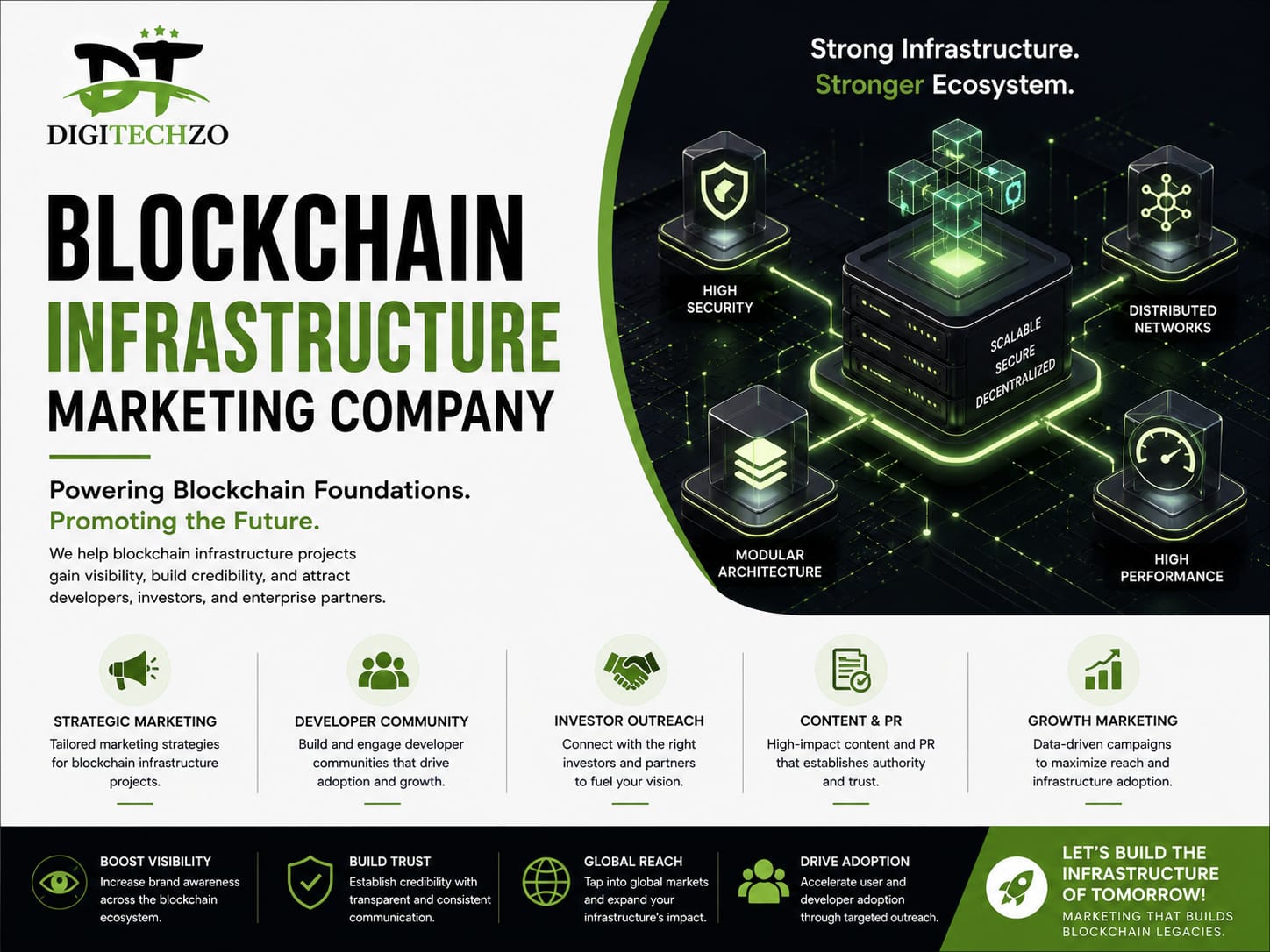
A blockchain infrastructure marketing company helps enterprise-focused Web3 projects — Layer- 1s, Layer- 2s, oracles, custody platforms, RPC providers, and DLT solutions — build credibility with technical buyers, institutional partners, and developer communities through content, PR, developer relations, and demand generation tailored to long, multi-stakeholder sales cycles. Unlike consumer crypto marketing, it prioritizes trust signals and technical proof over hype and short-term token speculation.
What Is Blockchain Infrastructure Marketing?
Blockchain infrastructure marketing is the practice of building awareness, trust, and adoption for the foundational layer of Web3 — protocols, node networks, validator infrastructure, bridges, oracles, custody solutions, and enterprise DLT platforms — rather than consumer-facing apps or tokens.
It sits at the intersection of three disciplines:
- B2B technology marketing — long sales cycles, multiple stakeholders, procurement teams
- Developer relations (DevRel) — the people writing code against your SDK are often your real buyers
- Institutional trust-building — banks, governments, and Fortune 500 companies won’t touch infrastructure that reads like a meme coin
A good way to understand the distinction: consumer crypto marketing sells excitement. Infrastructure marketing sells reliability. Nobody migrates a bank’s settlement layer because an influencer posted a hype thread.
Why Enterprise Blockchain Projects Need a Different Marketing Playbook
Most marketing agencies default to the playbook that works for consumer crypto: Twitter/X threads, influencer shilling, airdrop campaigns, and Telegram growth hacks. That playbook actively damages enterprise credibility.
1.The Enterprise Buyer Journey Is Longer and More Skeptical
An enterprise blockchain buying decision — say, a bank evaluating a settlement network, or a supply chain company choosing a permissioned ledger — typically involves:
- A technical evaluation team (architects, security engineers)
- A legal and compliance review
- Procurement and vendor risk assessment
- Executive sponsorship and budget approval
This can take six to eighteen months, compared to a consumer crypto purchase decision that can happen in minutes. Marketing has to nurture every one of those stakeholders differently, not blast the same message to all of them.
2.Trust Signals Matter More Than Virality
Enterprise buyers Google your project name alongside words like “audit,” “security incident,” “team,” and “SEC.” If your search results are dominated by speculative price-prediction content and forum arguments, you’ve already lost the deal before the first call. Infrastructure marketing has to control that narrative through owned content, third-party validation, and genuine thought leadership.
3.Developers Are a Distinct, Skeptical Audience
If your infrastructure requires developer adoption (SDK , APIs, smart contract frameworks), your real top-of-funnel audience is engineers who are allergic to marketing speak. Reaching them requires technical documentation, GitHub presence, hackathons, and genuinely useful content — not banner ads.
Core Services a Blockchain Infrastructure Marketing Company Should Offer
A capable agency in this niche should be able to execute across all of the following, not just one or two:
1. Technical Content Marketing
Deep-dive articles, whitepapers, architecture explainers, and comparison content that demonstrate real understanding of consensus mechanisms, cross-chain interoperability, throughput trade-offs, and security models. This content should be written by people who can actually explain the difference between optimistic and zero-knowledge roll ups — not generalist copywriters.
2. Developer Relations & Community Growth
- Documentation support and tutorial creation
- Hackathon sponsorship and grant program promotion
- GitHub and Discord community management
- SDK/API adoption campaigns
3. PR and Analyst Relations
Placement in tier – 1 crypto and mainstream tech media (CoinDesk, The Block, TechCrunch, Forbes), plus briefings with analyst firms like Messari, Gartner, or Electric Capital, who influence how institutional buyers perceive credibility.
4. SEO for High-Intent, Technical Search Terms
Enterprise buyers search differently than retail investors. Terms like “enterprise blockchain node infrastructure,” “institutional custody solution comparison,” or “Layer -2 scaling for financial services” convert at a completely different rate than “best crypto to buy.” A specialized agency builds topical authority around these terms rather than chasing broad volume.
5. Account-Based Marketing (ABM) for Institutional Targets
When your total addressable market is 200 banks or 50 telecom companies, you don’t need mass-market ads — you need targeted campaigns aimed at named accounts, decision-makers, and their specific pain points.
6. Event and Conference Strategy
Presence at Consensus, Token2049, EDCON, or vertical-specific events (Sibos for finance, GITEX for government) where enterprise decision-makers actually show up.
In-House vs. Agency vs. Hybrid: A Comparison
| Factor | In-House Team | Specialized Agency | Hybrid Model |
|---|---|---|---|
| Speed to launch | Slow (hiring takes months) | Fast (existing team + playbooks) | Moderate |
| Domain expertise | Deep on your product, shallow on market | Broad market/PR expertise, needs onboarding | Best of both, if managed well |
| Cost predictability | High fixed cost (salaries, benefits) | Retainer-based, scalable | Variable |
| Technical credibility with devs | Strong if team has engineers | Depends heavily on agency’s crypto-native writers | Strong if roles split correctly |
| Institutional PR relationships | Usually weak initially | Often strong, pre-built media contacts | Strong |
| Best for | Post-Series B teams with budget for 4+ hires | Early-to-growth stage projects needing speed | Scaling projects with an internal marketing lead |
How to Evaluate an Agency Before You Sign
Ask these questions before any contract:
- Can they explain your technology back to you accurately? If they can’t articulate your consensus mechanism or use case correctly in the pitch call, they can’t write about it credibly either.
- Do they have case studies with infrastructure — not just consumer apps or NFT drops? Infrastructure marketing and NFT hype marketing are different disciplines entirely.
- Who writes the actual content? Agency-side subject matter expertise matters more than headcount. Ask to see writing samples on technical topics.
- How do they measure success? If the only KPI offered is “Twitter followers” or “impressions,” walk away. Enterprise infrastructure marketing should track qualified pipeline, developer adoption metrics, and share-of-voice on high-intent technical keywords.
- Do they understand compliance sensitivities? Enterprise and institutional marketing often intersects with securities law, especially around token-related messaging. An agency without this awareness creates legal risk.
Pros and Cons of Outsourcing Infrastructure Marketing
Pros:
- Faster time-to-market than building an internal team from scratch
- Access to established media and analyst relationships
- Cross-project pattern recognition (agencies see what’s worked across multiple protocols)
- Easier to scale up or down based on funding stage
Cons:
- Onboarding curve — no external team understands your architecture on day one
- Risk of generic execution if the agency isn’t infrastructure-specialized
- Requires strong internal point of contact to keep messaging technically accurate
- Quality varies enormously; the crypto marketing space has many generalist agencies posing as specialists
Common Mistakes Enterprise Blockchain Teams Make
- Treating infrastructure marketing like token marketing. Hype-driven messaging that works for a meme coin actively repels institutional buyers evaluating settlement infrastructure.
- Skipping developer-first content. If engineers can’t find clear technical documentation and use-case content, they won’t recommend your protocol internally, no matter how good your PR is.
- Ignoring SEO until it’s too late. Ranking for enterprise-intent keywords takes months of consistent authority-building. Teams that start SEO only after a funding round has already burned half their runway.
- Over-indexing on Twitter/X. Enterprise decision-makers are on LinkedIn, in analyst reports, and reading Gartner or Messari research — not scrolling crypto Twitter.
- No consistent narrative across PR, content, and sales collateral. When your press releases, blog, and sales deck tell three different stories about your value proposition, buyers lose trust fast.
- Measuring vanity metrics. Follower counts and impressions don’t correlate with enterprise pipeline. Teams that optimize for these end up with loud but empty communities.
Expert Tips for Getting More From Your Marketing Partner
- Give your agency direct access to engineers, not just the founder or CMO. The best infrastructure content comes from interviews with the people who built the consensus layer.
- Build a shared glossary of terms on day one so PR, content, and sales all describe your architecture identically — inconsistency is one of the fastest ways to lose enterprise trust.
- Prioritize owned content (blog, documentation) before paid amplification. Paid traffic to a weak technical narrative wastes budget; a strong content foundation compounds in organic search over 12–24 months.
- Track “share of technical voice” — how often your project is cited in comparison articles, analyst reports, and developer forums relative to direct competitors — as a leading indicator of enterprise credibility.
- Review case studies quarterly, not just launch announcements. Enterprise buyers trust proof of production usage far more than roadmap promises.
FAQs
Q:What makes blockchain infrastructure marketing different from regular crypto marketing?
Infrastructure marketing targets enterprise buyers, developers, and institutional partners through long, trust-based sales cycles, while typical crypto marketing targets retail investors through fast, hype-driven campaigns focused on token price action.
Q:How long does it take to see results from infrastructure marketing?
Meaningful SEO and thought-leadership results typically take 3–6 months to show early traction and 9–12 months to build real topical authority, given how research-heavy enterprise buying cycles are.
Q:Do we still need developer relations if our infrastructure is enterprise-only?
Yes. Even permissioned or enterprise-only blockchain infrastructure often needs internal developer buy-in at the client organization, and DevRel content builds the technical credibility procurement teams look for during vendor evaluation.
Q:How much should an enterprise blockchain project budget for marketing?
Budgets vary by funding stage, but growth-stage infrastructure projects commonly allocate 10–20% of overall operating budget to marketing, split across content, PR, DevRel, and targeted demand generation.
Q:Can a generalist B2B marketing agency handle blockchain infrastructure?
Only partially. General B2B marketing skills transfer well for account-based marketing and PR, but technical content, developer relations, and blockchain-specific SEO usually require agencies with genuine Web3 subject matter expertise.
Final thought
Enterprise blockchain infrastructure doesn’t sell itself on technical merit alone — it sells on trust, clarity, and consistent proof across every channel a buyer touches, from search results to sales decks to developer documentation. The projects that win institutional deals aren’t always the most technically advanced; they’re the ones whose market presence matches their engineering quality.
If your infrastructure is ready but your market visibility isn’t, that’s the gap worth closing next. Digitechzo works with Layer-1’s, Layer-2’s, custody platforms, and enterprise DLT teams to build exactly this kind of credibility — through technical content, developer relations, and SEO built for high-intent enterprise search. If you’d like a second opinion on your current marketing approach, reach out for a strategy review.
About The Author