
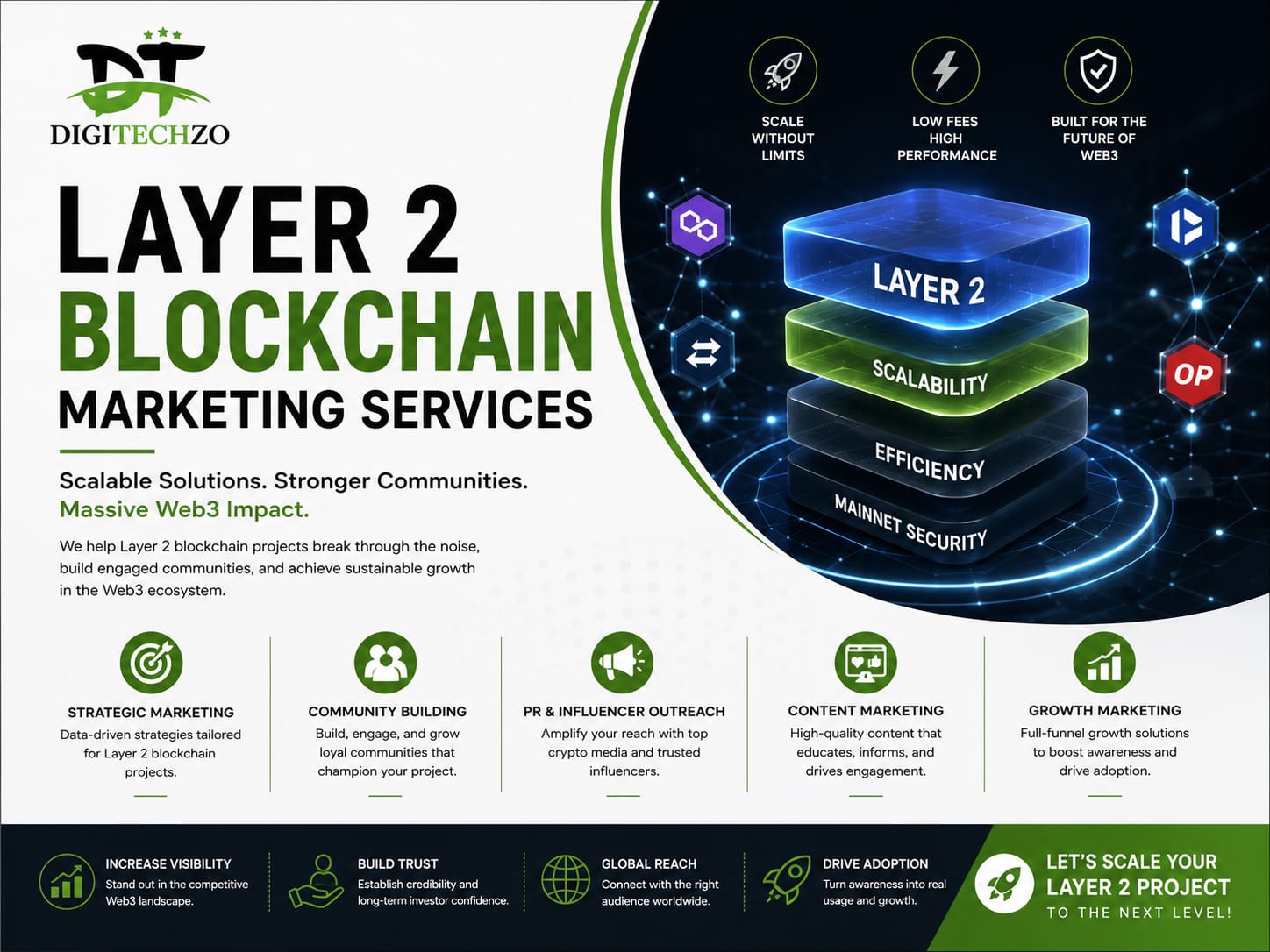
Most Layer 2 teams don’t fail because their tech is weak. They fail because nobody outside their Discord knows they exist.
You’ve optimized for throughput. You’ve cut gas fees. You’ve built a rollup, a validation or an optimistic chain that genuinely solves Ethereum scaling problem. And yet — TVL is flat, your token launch got a fraction of the wallets you projected, and your competitors with a “worse” technical stack are pulling ahead in mindshare. That gap isn’t a product problem. It’s a go-to-market problem, and it’s the exact reason Layer 2 blockchain marketing services exist as a distinct discipline, separate from generic crypto marketing.
At Digitechzo, we’ve spent the last few years sitting inside this exact problem — working alongside L2 and infrastructure teams to translate deep technical differentiation (sequencer design, data availability choices, fraud-proof vs. validity-proof architecture) into narratives that developers, validators, and retail users actually act on. This guide is built from that experience, not from a generic marketing playbook repurposed for crypto.
Quick Answer
Layer 2 blockchain marketing services combine technical positioning, developer-relations content, ecosystem partnership PR, and performance-driven acquisition (SEO, paid, community) to help scaling networks attract builders, liquidity, and users. Unlike general crypto marketing, it requires deep protocol literacy — you’re marketing infrastructure, not a consumer product, and your buyer is often another engineer.
What Are Layer 2 Blockchain Marketing Services?
Layer 2 blockchain marketing services are specialized growth and positioning strategies built specifically for scaling solutions — roll ups (optimistic and zk), side chains, state channels, and validiums — that sit on top of a base layer like Ethereum, Bitcoin, or Solana.
Unlike marketing a consumer dApp or a meme coin, L2 marketing has to serve three very different audiences at once:
- Developers deciding where to deploy smart contracts
- Validators/node operators deciding where to commit infrastructure
- End users and liquidity providers deciding where to bridge assets
A single campaign rarely reaches all three effectively. This is why L2 marketing services typically bundle several disciplines — technical content, developer relations, ecosystem PR, SEO, and community — rather than treating marketing as a single paid-ads function.
Why Layer 2 Networks Need Specialized Marketing
Generic crypto marketing agencies optimize for hype cycles: influencer shoutouts, giveaway campaigns, Twitter Spaces. That works for token speculation. It does not work for infrastructure, because infrastructure decisions are made on trust and technical merit, not FOMO.
Three structural realities make L2 marketing different:
1. The sales cycle is longer and more technical. A developer choosing between two roll ups is evaluating finality time, sequencer decentralization roadmap, EVM equivalence, and fee structure — often over weeks, reading docs and GitHub activity before ever clicking a marketing asset.
2. Trust is the actual currency. Bridges get exploited. Sequencers go down. A single security incident can undo months of growth. Marketing for an L2 is inseparable from communicating security posture, audit history, and decentralization progress honestly.
3. Network effects compound — or stall — publicly. TVL, active addresses, and deployed contracts are visible on-chain in real time. Your marketing claims are constantly fact-checked against dashboards like L2 BEAT, Defi Llama, and Dune. Overpromising is self-defeating.
Core Components of an Effective L2 Marketing Strategy
1. Technical Positioning & Narrative
Before any campaign, the fundamental question is: why should a builder choose this chain over the other 40 roll ups live today? This requires translating architecture into a clear, defensible claim — cost per transaction, proof type, decentralization timeline — not vague words like “fast” and “secure.”
2. Developer Relations (Dev Rel) Content
- Technical documentation and tutorials
- SDK/API guides and sample dApps
- Hackathon sponsorships and grants programs
- Conference talks and technical AMAs
3. SEO & Organic Discovery
Developers and researchers search before they build. Ranking for terms like “cheapest L2 for NFT minting” or “[chain] vs [chain] gas fees” captures high-intent traffic at the exact decision moment — this is where content marketing directly influences deployment decisions.
4. Ecosystem & Partnership PR
Getting covered on The Block, DL News, or CoinDesk matters less than being adopted by protocols users already trust — a major DEX, lending market, or wallet integrating your chain is worth more than ten press mentions.
5. Community & Retention
Airdrop farmers are not community. Real retention comes from builder grants, governance participation, and consistent technical communication — not just Discord activity metrics.
Layer 2 Marketing vs. General Crypto Marketing
| Factor | General Crypto Marketing | Layer 2 Marketing |
|---|---|---|
| Primary audience | Retail investors/traders | Developers, validators, LPs, then users |
| Success metric | Token price, followers | TVL, active contracts, sequencer uptime, real users |
| Content depth | Light, hype-driven | Technical, documentation-heavy |
| Sales cycle | Hours to days | Weeks to months |
| Trust signal | Influencer endorsement | Audits, GitHub activity, uptime history |
| Channel mix | Twitter/X, Telegram, influencers | Technical blogs, SEO, Dev Rel, ecosystem PR |
Pros of specialized L2 marketing: higher-quality, stickier users; credibility with builders; compounding organic traffic. Cons: slower visible results; requires marketers with genuine protocol literacy, which is a smaller talent pool.
A Practical Framework: The 4-Layer L2 Growth Stack
Based on running growth programs for infrastructure and scaling projects, we use a four-layer framework instead of a single “campaign”:
- Foundation Layer – Docs, technical SEO, audit transparency, brand narrative. Nothing else works if this is weak.
- Builder Layer – Grants, hackathons, Dev Rel content, SDK marketing. This drives contract deployments.
- Liquidity Layer – DeFi partnerships, bridge incentives, market-maker relationships. This drives TVL.
- Demand Layer – SEO, paid acquisition, community, PR. This drives end-user volume once builders and liquidity exist.
Most teams start at layer 4 (ads, influencers) with nothing built on layers 1–3. It looks active but doesn’t convert, because there’s nothing yet for users to actually do on the chain.
Real-World Use Cases
Scenario A — New zk-Rollup Pre Mainnet: Focus almost entirely on Foundation and Builder layers: technical white paper explainer content, testnet documentation, developer grants, and SEO content targeting “zkEVM vs optimistic rollup” comparison searches — capturing developers researching before mainnet even launches.
Scenario B — Established L2 Losing Ground to Newer Chains: The problem is usually narrative fatigue, not lack of awareness. The fix is often a repositioning campaign around a genuine differentiator (e.g., lowest finality time, native account abstraction) paired with case studies from protocols already thriving on the chain — social proof outperforms fresh claims.
Scenario C — App-Specific Rollup Targeting a Niche: Instead of broad crypto marketing, hyper-targeted content for the specific vertical (gaming, RWA, payments) works better — ranking for “best blockchain for on-chain gaming” beats competing for generic “Layer 2” terms.
Common Mistakes Layer 2 Teams Make
- Marketing the tech stack, not the outcome. Nobody outside engineering cares about “optimistic rollup with 7-day challenge period” — they care about “cheaper, faster transactions with Ethereum- level security.”
- Buying TVL with unsustainable incentives. Mercenary liquidity leaves the moment incentives end, and the TVL chart crash becomes its own negative marketing event.
- Ignoring technical SEO. Docs sites and blogs are frequently unindexed or poorly structured, losing high-intent organic traffic to competitors with worse tech but better content.
- Treating community size as a KPI. A 200k-member Discord with 40 daily active users signals inflated, low-trust growth to sophisticated builders evaluating the chain.
- Announcing partnerships without proof. “Partnered with X” headlines that aren’t backed by live integrations erode credibility fast in a space that checks on-chain data.
- No security-incident communication plan. When something goes wrong — and in this space, eventually something will — silence or delayed response does more damage than the incident itself.
Expert Tips for Scaling Network Marketing
- Publish uptime and incident data proactively. Radical transparency on sequencer performance builds more trust than any campaign.
- Treat your documentation as a marketing asset, not just an engineering afterthought. Well-structured, SEO-optimized docs are often a developer’s first and last touchpoint.
- Co-market with your top 5 ecosystem protocols, not just your own brand — their users become your users.
- Segment content by funnel stage: technical deep-dives for developers researching, comparison content for teams deciding, and simple explainers for end users bridging assets.
- Track “developer intent” metrics — GitHub stars, docs traffic, testnet faucet requests — as leading indicators, since TVL and price lag actual builder interest by weeks or months.
How to Choose a Layer 2 Marketing Agency
Look for a partner that can demonstrate:
- Prior work with actual L1/L2 protocols, not just consumer crypto brands
- A team that understands rollup architecture well enough to write about it accurately
- A content and SEO process built for long sales cycles, not just paid-ad sprints
- Willingness to say no to unsustainable incentive-driven growth tactics
This is precisely the gap Digitechzo was built to close — a team that pairs protocol-level technical understanding with performance marketing execution, rather than treating blockchain clients as another vertical for generic playbooks.
FAQs
Q:What makes Layer 2 blockchain marketing different from regular crypto marketing?
Layer 2 marketing targets developers, validators, and liquidity providers first, with end users coming later — it relies on technical content, documentation, and trust signals like audits and uptime rather than hype-driven campaigns aimed purely at retail traders.
Q:How long does it take to see results from L2 marketing?
Meaningful traction typically takes three to six months, since developer decisions, contract deployments, and organic SEO growth compound gradually rather than spiking immediately like a paid campaign.
Q:Do Layer 2 projects need SEO if most of their audience is on Twitter/X and Discord?
Yes — developers and researchers actively search comparison and cost-related queries before deploying, and ranking for that intent captures high-value traffic that social platforms can’t reliably reach.
Q:What KPIs should a Layer 2 network track beyond TVL?
Active daily contracts, developer documentation traffic, GitHub activity, sequencer uptime, and retained (non-incentivized) wallet addresses are stronger indicators of real health than TVL alone.
Q:Can incentive programs replace marketing for a new L2?
No — incentives can bootstrap initial liquidity, but without genuine positioning and developer relations, that liquidity typically exits once rewards end, leaving no durable growth behind.
Final thought
Layer 2 networks compete on more than throughput and fees now — dozens of chains offer similar technical specs, which means the networks that win are the ones that communicate their differentiation clearly, build trust with developers first, and treat marketing as infrastructure, not decoration. Real growth for a scaling network is layered: foundation, builders, liquidity, then demand — skip a layer, and the rest doesn’t hold.
If your Layer 2 has the technology but not the traction, that’s a positioning and go-to-market gap, not a product one. Digitechzo works with scaling networks to close that exact gap — from technical narrative and DevRel content to SEO and ecosystem growth built for how developers and users actually make decisions.
Ready to turn your technical edge into measurable adoption? Get in touch with Digitechzo to scope a growth strategy built for your network.
About The Author