
Most founders find out too late that a great product isn’t enough. Investors pass because they can’t find any public signal that the founder understands the market deeply. Enterprise buyers stall a deal because a quick Google search turns up nothing. Top candidates take a competing offer because the founder’s LinkedIn hasn’t been touched in eight months.
None of these are product problems. They’re visibility problems — and they’re exactly what founder branding services are built to solve.
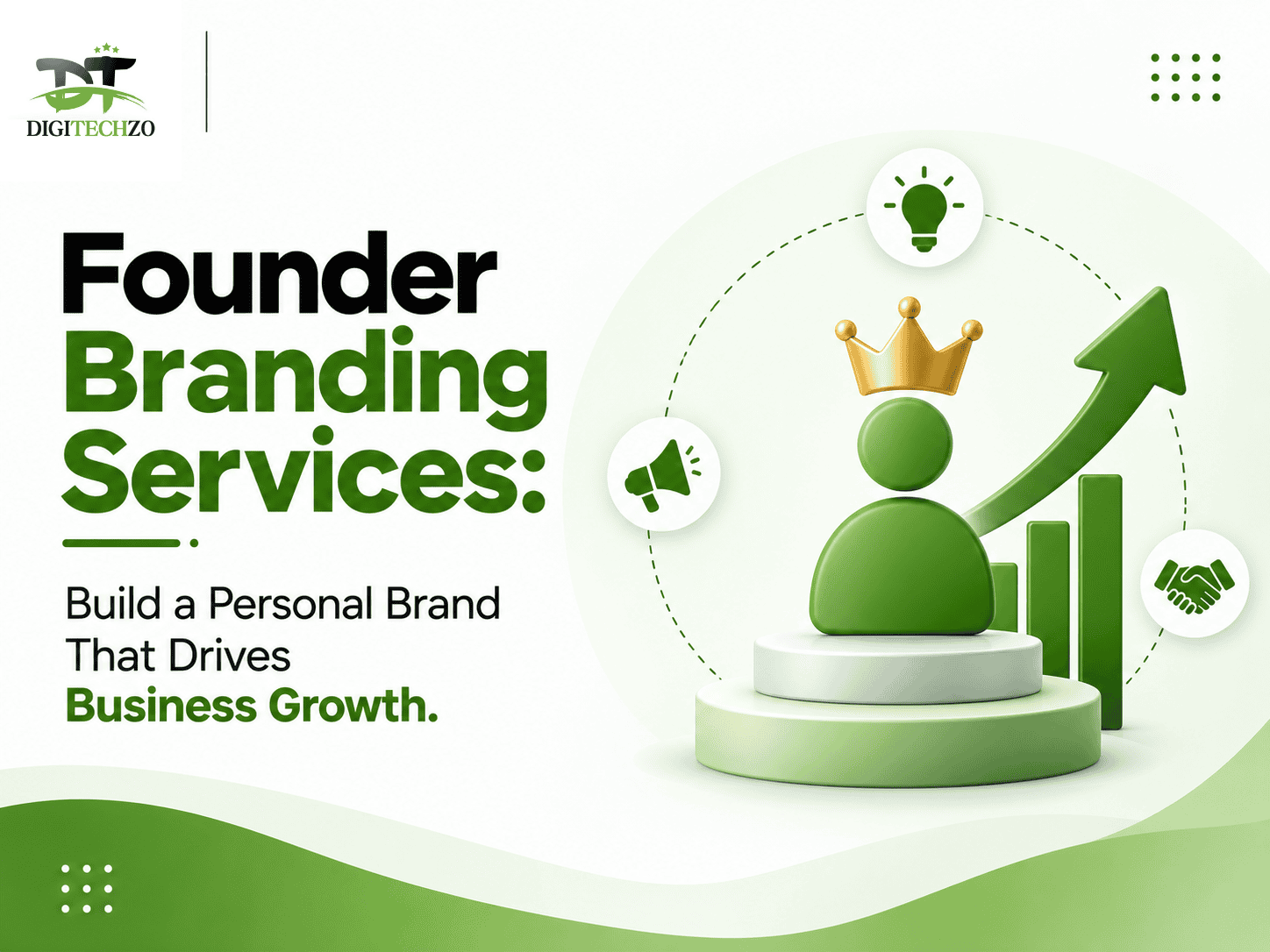
A founder branding service isn’t a vanity project or a PR stunt. It’s a structured system for turning a founder’s expertise, story, and point of view into a public asset that actively drives leads, hiring, and fundraising outcomes. At Digitechzo, we’ve built these systems for founders across SaaS, fintech, and services businesses — and this guide breaks down exactly what these services involve, what they cost, and how to choose one that actually moves the business, not just the follower count.
Quick Answer
Founder branding services are done-for-you or done-with-you programs that build a founder’s public reputation and thought leadership — typically through LinkedIn content, PR, and speaking strategy — to drive measurable business outcomes like leads, funding, and hiring. Pricing generally ranges from $1,000–$8,000+/month depending on scope, and the best services combine strategy, ghostwriting, and distribution rather than content alone.
What Are Founder Branding Services?
Founder branding services are professional programs that build and manage a founder’s public presence — primarily their expertise, opinions, and visibility — with the explicit goal of driving business results.
Unlike generic “personal branding coaching,” these services are typically outcome-driven and hands-on. A real founder branding service usually includes:
- Strategy — defining what the founder should be known for, and to whom
- Content production — writing, ghostwriting, or content coaching
- Distribution — publishing cadence, platform selection, sometimes PR and media outreach
- Measurement — tracking whether the effort is translating into leads, hires, or investor interest
Who Actually Uses These Services
- Early-stage founders raising a Series A who need investor-facing credibility fast
- B2B SaaS founders trying to shorten enterprise sales cycles
- Agency and consultancy founders whose personal reputation is the sales funnel
- Second-time founders launching a new company who want to leverage existing credibility faster
Why Founder Branding Has Become a Growth Channel
A decade ago, founder visibility was a nice-to-have — something reserved for founders who happened to enjoy writing or public speaking. That’s changed structurally.
B2B buyers now routinely research the people behind a company before making a purchase decision, particularly in software and services categories where trust in leadership judgment is a major factor in a deal moving forward. LinkedIn has become one of the primary places this research happens, with decision-makers checking a founder’s profile before booking a first sales call.
This shift means founder content isn’t competing with other content marketing — it’s competing with the sales page and the pitch deck for attention and trust. A founder who consistently demonstrates expertise publicly effectively pre-sells their credibility before a prospect, investor, or candidate ever has a direct conversation.
The Compounding Effect
Founder branding also behaves differently from paid acquisition channels. Paid ads stop producing the moment spend stops. A well-built founder brand keeps generating inbound interest from old posts, media mentions, and podcast appearances for months or years after they were published — because that content keeps getting discovered through search, shares, and profile visits.
What’s Actually Included in Founder Branding Services
Quality varies enormously in this space, so it’s worth knowing what a comprehensive service should cover.
1. Positioning & Narrative Strategy
Before any content gets written, a proper service defines:
- The founder’s core expertise angle (not “leadership” — something specific like “usage-based pricing for dev tools”)
- The target audience (investors? enterprise buyers? talent? all three, sequenced)
- The founder’s authentic voice and non-negotiable opinions
2. Content Creation
This usually means LinkedIn ghostwriting or coaching, but stronger services extend to:
- Long-form articles or newsletters for SEO and owned audience building
- Talking points for podcast guesting
- Byline article placement in industry publications
3. Distribution & Amplification
- Optimal posting cadence and timing based on audience data
- Comment engagement strategy to build relationships with target accounts
- PR outreach for media mentions and speaking opportunities
4. Analytics & Reporting
A results-oriented service tracks more than likes and impressions — it should tie content performance back to pipeline: inbound DMs, meeting requests, and mentions in sales or investor conversations.
5. Crisis & Reputation Guidance
More mature founder branding partners also help navigate what to say (and not say) publicly during layoffs, funding announcements, or controversy — since a founder’s public voice becomes a company asset that needs protecting, not just building.
Founder Branding Services vs. DIY vs. Marketing Agencies
| Factor | DIY | Traditional Marketing Agency | Founder Branding Service |
|---|---|---|---|
| Focus | Founder’s own time and skill | Company/product marketing | Founder’s individual reputation |
| Strategic depth | Depends entirely on founder | Usually campaign-based | Ongoing positioning + narrative |
| Voice authenticity | High if founder writes well | Low — brand voice, not personal | High, built specifically around the founder |
| Time required from founder | High (3-5 hrs/week) | Low | Low-Medium (review + input calls) |
| Typical cost | Free (time cost only) | $3,000–$15,000+/month | $1,000–$8,000+/month |
| Best for | Founders who enjoy writing | Product launches, demand gen campaigns | Founders serious about trust-driven growth |
Where founder branding services differ most from marketing agencies: agencies build campaigns around the product. Founder branding services build ongoing credibility around the person — an asset that survives rebrands, pivots, and even company changes.
How Much Do Founder Branding Services Cost?
Pricing depends heavily on scope. Here’s a realistic breakdown:
- Content-only services (ghostwriting/coaching): $800–$2,500/month
- Strategy + content + light distribution: $2,500–$5,000/month
- Full-service (strategy, content, PR, speaking prep, analytics): $5,000–$8,000+/month
What Actually Moves the Price
- Number of channels — LinkedIn-only is cheaper than LinkedIn + PR + podcast booking combined
- Research and interview depth — original insights and data cost more to produce than opinion posts
- PR and media relationships — services with existing journalist relationships charge a premium, but often earn it back in placement quality
- Reporting sophistication — services that tie content to pipeline data require more setup than those reporting only engagement metrics
A useful gut-check: if pricing is unusually low for daily, multi-channel output, ask exactly who is producing the strategy and writing — low prices at high volume usually mean minimal customization.
How to Evaluate a Founder Branding Service
Questions Worth Asking
- Can you show a case study connecting your work to a measurable business outcome (leads, funding, hires) — not just engagement?
- How do you capture my voice, and how many rounds of calibration does that typically take?
- What’s your process if a draft doesn’t sound like me?
- How do you decide what to prioritize: LinkedIn, PR, speaking, or a mix?
- Who specifically will be working on my account — a senior strategist or a junior writer?
Pros of Hiring a Founder Branding Service
- Frees up significant founder time compared to DIY
- Brings strategic frameworks and distribution knowledge founders often lack
- Provides accountability and consistency that’s hard to self-enforce
Cons / Trade-offs
- Requires meaningful founder input regardless of service quality — it can’t be fully hands-off
- Takes months to show compounding results, which can frustrate founders expecting immediate ROI
- Quality varies widely; vetting takes real diligence
A Framework for Measuring ROI on Founder Branding
Most founders either measure nothing or measure the wrong things (likes, follower count). Here’s a better framework, organized by funnel stage:
Awareness Metrics (Leading Indicators)
- Impressions and reach trend over 90 days
- Follower growth rate among target audience (title/industry match, not just raw count)
Engagement Metrics (Mid-Funnel Signal)
- Comments from ICP-matching accounts, not just peers
- Profile visits following high-performing posts
Business Outcome Metrics (What Actually Matters)
- Inbound DMs or meeting requests referencing specific content
- Sales cycle length for deals where the prospect mentions following the founder
- Investor meetings where the founder’s public content came up
- Candidate applications citing the founder’s visibility as a reason for applying
Tracking the third category is what separates founders who treat branding as a real growth channel from those treating it as a hobby.
Common Mistakes Founders Make
1. Hiring for content volume instead of strategy. Posting daily with no clear positioning produces noise, not authority. Volume without a point of view rarely converts.
2. Disappearing after the initial excitement fades. The biggest driver of failed founder branding engagements isn’t bad content — it’s founders who stop providing input (stories, opinions, feedback) once the novelty wears off.
3. Optimizing for virality instead of relevance. A post that reaches the wrong audience at scale is far less valuable than one that reaches 500 of the right decision-makers.
4. Skipping the positioning phase to “just start posting.” Without clear positioning, content tends to drift topic to topic, which weakens recognition instead of building it.
5. Not connecting branding efforts to sales and recruiting teams. Sales reps who don’t know a founder’s content exists can’t use it in outreach; recruiters who don’t reference it in offers miss a trust-building opportunity.
Expert Tips for Getting Real Business Results
- Feed your service real material weekly. Customer calls, hard decisions, and internal debates make far better content than generic industry commentary.
- Loop in sales and recruiting early. Give both teams a simple way to share founder content in outreach — it multiplies the value of every post.
- Set a 90-day expectation, not a 2-week one. Recognition and inbound interest compound; the first month is almost always quieter than founders expect.
- Keep one non-negotiable opinion per content pillar. Content that never takes a clear stance rarely gets remembered or shared.
- Review analytics against business outcomes monthly, not engagement daily — daily numbers are noisy and can mislead strategy decisions.
FAQs
What do founder branding services actually include?
Most services combine positioning strategy, content creation (often LinkedIn ghostwriting), distribution planning, and performance reporting — with more comprehensive services adding PR outreach and speaking opportunity sourcing.
How is founder branding different from company marketing?
Company marketing promotes the product or service; founder branding builds trust in the individual leading the company, which in turn makes buyers, investors, and candidates more willing to engage with the business itself.
How long before founder branding services show results?
Most founders see meaningful engagement and recognition within 60–90 days, with tangible business outcomes like inbound leads or investor interest typically emerging around the 3–6 month mark as trust compounds.
Do founder branding services write everything, or does the founder still need to be involved?
Founders still need to provide raw input — stories, opinions, and reactions to industry events — even when a service handles writing and strategy. The most successful engagements treat it as a collaboration, not a hands-off outsourcing.
Is founder branding worth it for early-stage startups with limited budget?
It can be, especially for fundraising and early hiring, where founder credibility often substitutes for the case studies and brand recognition an early company hasn’t built yet. Many early-stage founders start with a lighter, content-only engagement before scaling up.
Final Thoughts
A great product with an invisible founder is a slower path to growth than it needs to be. Buyers, investors, and candidates are all researching the person behind the business before they commit — and founders who show up consistently with real expertise are winning that trust before a single sales call happens.
Founder branding services exist to make that visibility sustainable, strategic, and tied to actual business outcomes — not just another content treadmill. At Digitechzo, we build founder branding programs around real positioning, authentic voice, and measurable pipeline impact, so the time you invest in visibility comes back as leads, hires, and trust. If you’re ready to turn your expertise into a growth channel, reach out to Digitechzo for a free founder brand audit.
About The Author