
Two CEOs run nearly identical companies. Same market, same funding stage, same product quality. One gets quoted in industry publications, has investors reaching out unprompted, and closes enterprise deals faster because prospects already trust him before the first call. The other is invisible outside his own company’s walls.
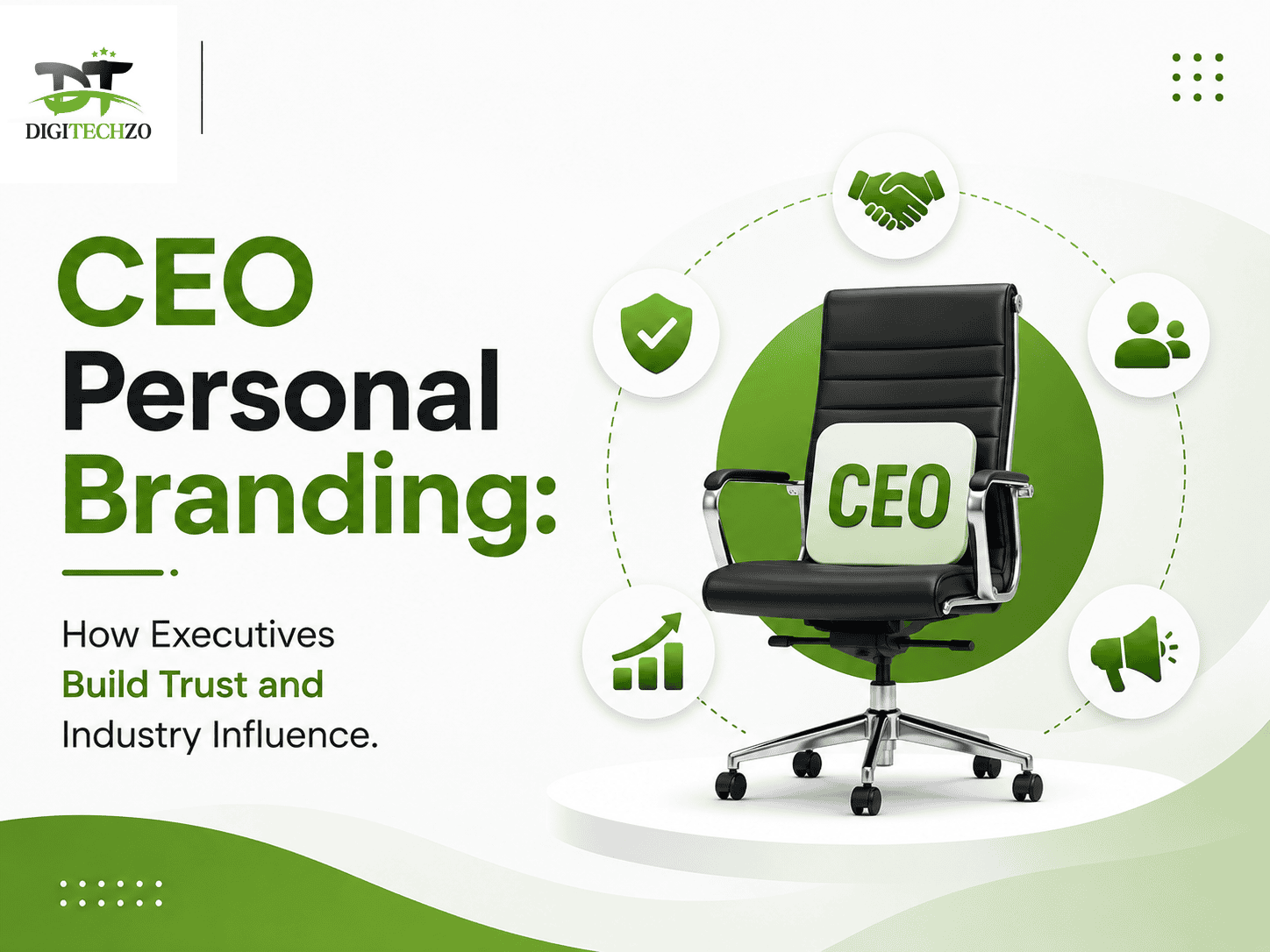
The difference usually isn’t talent. It’s CEO personal branding — the deliberate, consistent practice of building public trust and recognition as an industry voice, not just a company figurehead.
This isn’t vanity work. A strong executive brand shortens sales cycles, attracts better talent, and gives a company credibility that outlasts any single funding round or product launch. At Digitechzo, we’ve helped founders and C-suite leaders build exactly this kind of visibility — and this guide reflects what actually works, based on running that process for real executives, not generic advice recycled from other blogs.
Quick Answer
CEO personal branding is the strategic process of building an executive’s public reputation, expertise, and trust through consistent thought leadership — primarily on platforms like LinkedIn, media, and speaking engagements. Done well, it drives measurable business outcomes: inbound leads, easier fundraising, faster hiring, and stronger customer trust — not just follower counts.
What Is CEO Personal Branding, Exactly?
CEO personal branding is the intentional cultivation of an executive’s reputation, expertise, and voice in the public eye — separate from, but connected to, the company they run.
It’s not a logo or a tagline. It’s the answer to a specific question: when someone in your industry hears your name, what do they immediately think you’re an expert in?
A well-defined CEO brand typically includes:
- A clear point of view on trends, challenges, or debates in the industry
- Consistent visibility across platforms where the target audience actually pays attention
- Recognizable positioning — being known for something specific, not “everything”
- Trust signals — media mentions, speaking credits, case studies, endorsements
What CEO Branding Is Not
It’s not self-promotion for its own sake, and it’s not the same as company marketing. A company brand sells a product. A CEO brand sells credibility — and credibility is what makes people willing to buy the product, invest in the company, or join the team in the first place.
Why Personal Branding Matters More Than Ever for Executives
Buyer behavior has shifted. B2B buyers increasingly research the people behind a company — not just the company itself — before making high-stakes decisions like enterprise purchases, partnerships, or investments. A founder’s public track record and visible expertise now function as a trust shortcut in decisions that used to rely purely on sales collateral.
This shift is amplified by a few structural changes:
- LinkedIn has become a primary B2B research channel, with executives and decision-makers checking a founder’s profile before a first sales call almost as a default step
- Media and journalists increasingly source quotes from LinkedIn, not press releases, making an active executive presence a real earned-media advantage
- Employees research leadership visibility before accepting offers, treating an invisible or inactive founder as a mild red flag about company transparency
In short: the executives who show up publicly are winning trust that invisible executives simply can’t access, no matter how good their product is.
The Business Case: What a Strong CEO Brand Actually Delivers
This is where most articles on this topic stay vague. Here’s the concrete breakdown of what a functioning executive brand produces:
1. Shorter Sales Cycles
When a prospect already trusts the founder’s expertise from public content, sales conversations start further along — objections around credibility are pre-answered.
2. Warmer Fundraising Conversations
Investors research founders extensively before meetings. A founder with visible, coherent public thinking gives investors more confidence in judgment and market understanding than a cold pitch deck alone can.
3. Higher-Quality Inbound Talent
Candidates increasingly evaluate leadership visibility as a proxy for company culture and stability. A credible, active CEO brand reduces recruiting costs over time.
4. Resilience During Crises
Companies with a trusted, visible CEO tend to weather negative press or public missteps better — because the audience has existing trust to draw on, rather than judging the company on a single incident.
5. Category Positioning
A CEO known for a specific point of view can effectively define how a market talks about a problem — a significant advantage in competitive or emerging categories.
The Core Pillars of CEO Personal Branding
Pillar 1: Positioning — What Are You Known For?
Before any content strategy, positioning has to be nailed down. Vague positioning (“I talk about business and leadership”) gets ignored. Specific positioning (“I talk about how B2B SaaS founders should price during a downturn”) gets remembered.
Pillar 2: Consistent Content
Sporadic posting doesn’t build recognition. Platforms and audiences both reward consistency — irregular executives get forgotten between appearances, while consistent ones compound recognition over time.
Pillar 3: Proof and Credibility Signals
- Case studies and outcomes, not just opinions
- Media mentions and guest appearances
- Speaking engagements at relevant industry events
- Endorsements or collaborations with recognized peers
Pillar 4: Distribution Channels
| Channel | Best For | Effort Level |
|---|---|---|
| B2B trust-building, daily visibility | Medium (with consistency) | |
| Podcasts (guesting) | Deep-dive credibility, long-form authority | Low (per appearance) |
| Industry press/media | Third-party validation | High (requires PR relationships) |
| Speaking engagements | High-trust, in-person authority | High (prep + travel) |
| Newsletter/blog | Owned audience, SEO value | Medium-High (writing-intensive) |
Pillar 5: Authentic Voice
The biggest differentiator between a CEO brand that resonates and one that reads like corporate marketing is voice. Audiences can tell the difference between a real opinion and a polished non-answer within seconds.
Company Brand vs. Personal Brand: How They Work Together
A common misconception is that CEO branding competes with company branding. In practice, they’re complementary — and the strongest B2B companies deliberately run both in parallel.
Company brand answers: What does this business do, and why should I buy it? CEO brand answers: Why should I trust the people behind it?
Pros of Investing in CEO Branding Alongside Company Branding
- Personal content often outperforms company content on engagement, since audiences connect with people more than logos
- CEO visibility gives the company a “face” during fundraising, PR, and crisis moments
- It creates a durable asset — a CEO’s reputation and network outlast any single company
Cons / Trade-offs to Consider
- It requires real time investment from a already time-constrained executive
- Poorly executed personal branding (inconsistent, inauthentic, or overly promotional) can do more harm than staying quiet
- A CEO’s personal brand sometimes outlives their tenure at a specific company, which requires thoughtful transition planning if they leave
How to Build a CEO Personal Brand: A Step-by-Step Framework
Step 1: Define Your Positioning Statement
Write one sentence: “I help [audience] understand/solve [specific problem] through [unique angle].” This becomes the filter for every piece of content going forward.
Step 2: Audit Your Current Presence
Look at existing LinkedIn history, past interviews, and any public mentions. Identify what’s already resonating versus what’s noise.
Step 3: Choose 2–3 Primary Channels
Don’t try to be everywhere. A founder targeting enterprise buyers might prioritize LinkedIn and industry press; a founder targeting developers might prioritize technical blogs and podcast guesting instead.
Step 4: Build a Repeatable Content System
This might mean a weekly writing block, a ghostwriting partnership, or a content calendar built around recurring themes (lessons learned, industry commentary, customer stories, contrarian takes).
Step 5: Track Business Outcomes, Not Just Engagement
Set up simple tracking for what actually matters: inbound leads mentioning content, investor meetings that reference posts, hires who cite the CEO’s visibility as a reason they applied.
Step 6: Iterate Based on What Resonates
Review performance monthly. Double down on topics and formats that consistently drive comments, shares, or DMs — not just likes.
Common Mistakes Executives Make
1. Trying to appeal to everyone. Broad, safe content gets ignored. Specific, opinionated content — even if it alienates a fraction of the audience — builds stronger recognition.
2. Treating it as a side project with no system. Without a repeatable process (writing block, ghostwriter, content calendar), personal branding dies the first busy week — which is most weeks for a CEO.
3. Confusing visibility with credibility. Posting often without substance builds an audience that doesn’t convert. Credibility comes from specific, defensible expertise, not volume alone.
4. Ignoring engagement and only broadcasting. Executives who never reply to comments or engage with others’ content build weaker relationships than those who treat LinkedIn as a two-way conversation.
5. Waiting for “the right time” to start. Personal brand equity compounds over years, not weeks. Executives who wait until they “have more time” consistently regret the delay once a competitor with an active presence starts winning deals they should have won.
Expert Tips for Sustainable Executive Branding
- Start with stories, not statements. Specific, slightly uncomfortable stories about mistakes or hard decisions consistently outperform generic advice posts.
- Repurpose ruthlessly. A single strong customer conversation or team meeting insight can become a week’s worth of content across formats.
- Build a swipe file of your own best lines. Keep a running doc of phrases, analogies, and opinions that land well in conversation — they’re often your best raw content material.
- Delegate the writing, not the thinking. A ghostwriter or content partner can handle execution, but the ideas and opinions should still originate from the executive.
- Protect a fixed weekly time block. Even 30 minutes a week for voice memos or a quick review call keeps a content system alive long-term.
FAQs
What is CEO personal branding in simple terms?
CEO personal branding is the deliberate process of building an executive’s public reputation and expertise so they’re recognized as a trusted authority in their industry, separate from their company’s marketing.
Do CEOs really need a personal brand if the company already has strong marketing?
Yes. Company marketing sells the product; CEO branding builds the trust that makes people willing to buy, invest, or work for that company in the first place — especially in high-stakes B2B decisions.
How long does it take to build a recognizable CEO brand?
Most executives see meaningful recognition within 6–12 months of consistent activity, though real authority and inbound opportunities typically compound significantly after 12–18 months.
Should a CEO write their own content or use a ghostwriter?
Either can work, as long as the ideas and voice remain authentically the executive’s own. Many time-constrained CEOs use a ghostwriter for execution while providing raw material through calls or voice notes.
What’s the biggest risk of CEO personal branding?
Inconsistency and inauthenticity. A brand that starts strong and goes silent, or one that feels overly polished and impersonal, can damage trust more than having no public presence at all.
Final Thoughts
CEO personal branding isn’t a nice-to-have anymore — it’s becoming a default expectation from investors, customers, and candidates who all research the people behind a company before deciding to trust it. The executives who build this intentionally are compounding an asset that pays off in every direction: sales, hiring, fundraising, and resilience.
The hardest part isn’t strategy — it’s consistency under a busy schedule. That’s exactly the gap Digitechzo helps executives close, building personal branding systems around real positioning, authentic voice, and measurable business outcomes rather than vanity metrics. If you’re ready to turn your expertise into visible industry influence, reach out to Digitechzo for a free brand audit.
About The Author