
Most companies publish content. Very few companies build trust with it.
Walk through any B2B website today and you’ll find the same recycled blog posts, the same generic “5 tips” listicles, and the same hollow thought-leadership pieces that say nothing and convince no one. Meanwhile, buyers are more skeptical than ever — they research longer, compare more vendors, and trust brands less before they ever fill out a contact form.
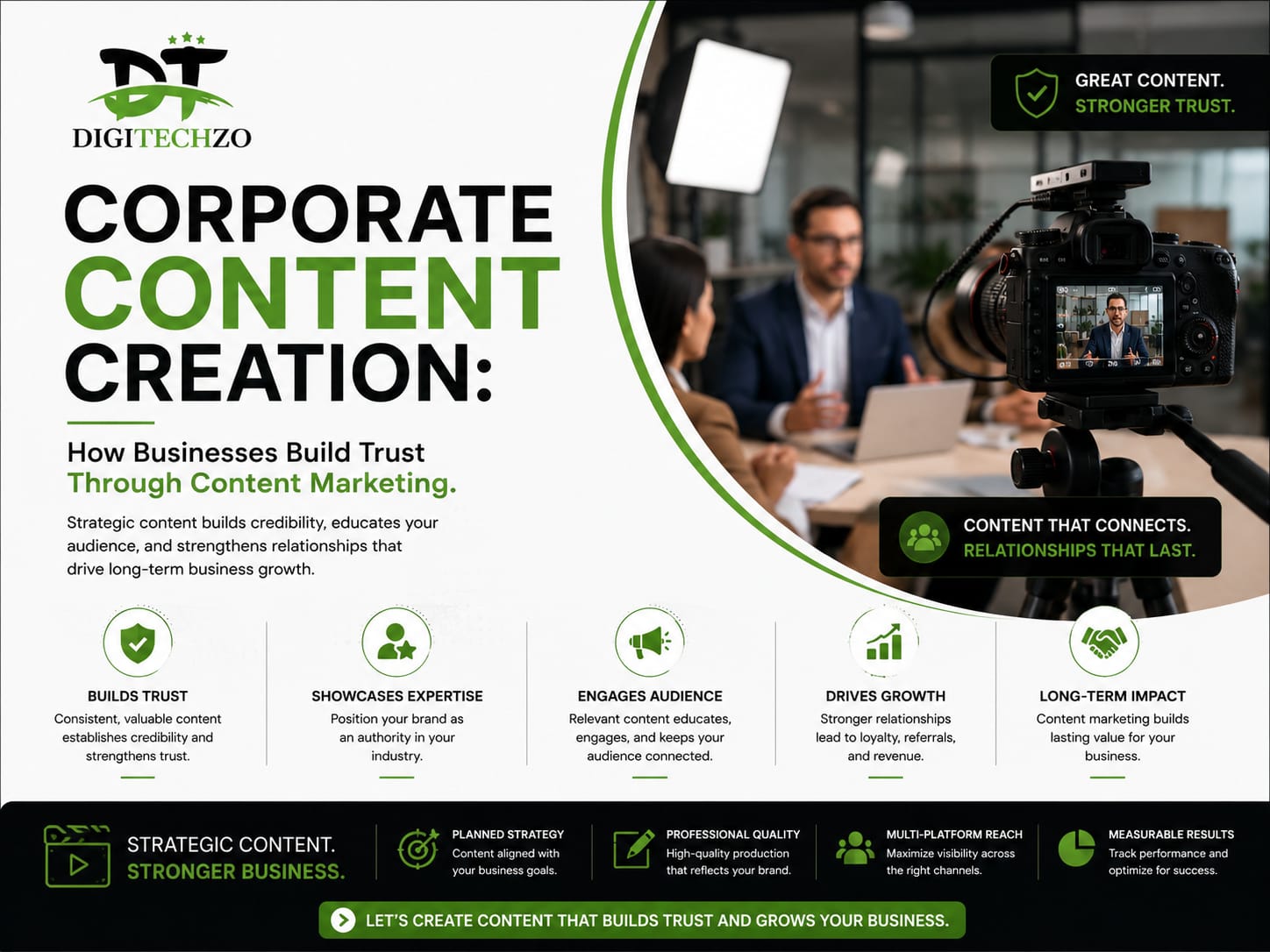
This is exactly the gap corporate content creation is meant to close. Done right, it’s not about publishing more — it’s about publishing content that proves you understand your customer’s problem better than anyone else in the room.
At Digitechzo, we’ve worked with mid-size and enterprise teams who came to us after years of “content marketing” that produced traffic but no pipeline. The fix was rarely more content. It was better-built content — content engineered around trust signals, not just keywords.
This guide breaks down exactly what corporate content creation is, how it differs from regular content marketing, what actually builds trust with today’s buyers, and the mistakes that quietly sabotage most corporate content programs.
Quick Answer
Corporate content creation is the strategic process businesses use to plan, produce, and distribute branded content — blogs, case studies, white paper, video, and social content — that establishes authority and builds buyer trust across the customer journey. It works when it’s grounded in real expertise, backed by data, and structured around what your buyer needs to know before they’ll trust you with their business.
What Is Corporate Content Creation?
Corporate content creation is the structured process of developing content on behalf of a business to achieve specific commercial goals — brand authority, lead generation, customer education, and sales enablement. Unlike personal or entertainment content, it’s built around a company’s positioning, products, and audience research, and it’s usually governed by brand guidelines, compliance requirements, and a defined content calendar.
It typically spans:
- Written content — blog articles, white papers, case studies, ebooks
- Visual content — infographics, product explainer graphics, branded decks
- Video content — demos, customer testimonials, founder-led thought leadership
- Interactive content — calculators, assessments, comparison tools
The distinguishing feature isn’t the format — it’s the intent. Every piece is created to move a specific business metric, not just to “stay active” on a blog.
Why Trust Is the Real Currency of Content Marketing
Here’s the uncomfortable truth: buyers don’t remember most of the content they read. What they remember is how a brand made them feel about a decision — confident, informed, or reassured.
Research from Edelman’s Trust Barometer has consistently shown that buyers are far more likely to purchase from brands they perceive as competent and principled, even over brands with lower prices. In B2B specifically, buying committees now complete a large share of their research before ever speaking to sales — which means your content is doing the selling long before your sales team gets a call.
This is why corporate content creation has shifted from a “top of funnel awareness” tactic to a full-funnel trust-building system. Consider three moments in a buyer’s journey:
- Discovery stage: A buyer searches a problem, not your brand name. If your article genuinely solves the problem, you earn credibility instantly.
- Evaluation stage: They compare vendors. A detailed case study with real numbers beats a generic “why choose us” page every time.
- Decision stage: They need reassurance. A well-documented process, security white paper, or client testimonial reduces perceived risk.
Trust isn’t built in one blog post. It’s built through consistent proof, repeated across every stage of the funnel.
Core Components of a Corporate Content Strategy
A trust-driven corporate content strategy usually includes these building blocks:
1. Audience and Buyer Persona Research
Not surface-level demographics — actual buying triggers, objections, and the exact language your buyers use when describing their problem.
2. Topic and Keyword Mapping
Aligning content topics to search intent (informational, commercial, transactional) so each piece serves a clear purpose in the funnel rather than competing with your own pages.
3. Subject Matter Expert (SME) Involvement
The single biggest differentiator between generic content and authoritative content. When a real practitioner — not just a writer — contributes insight, it shows.
4. Editorial and Brand Governance
Style guides, tone rules, and compliance checks that keep content consistent as teams and vendors scale.
5. Distribution and Repurposing
A single well-researched piece should be repurposed into LinkedIn posts, email sequences, and sales enablement material — not published once and forgotten.
Corporate Content Creation vs. Traditional Marketing Content
| Aspect | Corporate Content Creation | Traditional Marketing Content |
|---|---|---|
| Goal | Build authority + trust across funnel | Promote a specific offer or campaign |
| Timeframe | Long-term, compounding | Short-term, campaign-based |
| Voice | Brand + expert-driven | Sales-driven |
| Format depth | In-depth, research-backed | Lightweight, promotional |
| Success metric | Trust signals, organic authority, pipeline influence | Clicks, conversions on a single offer |
Both have a place — but businesses that only invest in promotional content typically plateau because they’re not building the long-term authority that reduces customer acquisition cost over time.
Content Formats That Build the Most Trust (With Examples)
- Case studies with real numbers — “Reduced onboarding time by 40% in 6 weeks” is more persuasive than any tagline.
- Original research or survey data — Even a simple internal survey of 50 customers, presented well, outperforms recycled statistics.
- Founder or executive-led video — Buyers trust faces, not just logos.
- Process transparency content — Explaining exactly how you deliver results (a methodology page, a “how we work” breakdown) removes ambiguity.
- Comparison and alternative pages — Buyers actively search “X vs Y” and “best alternatives to X.” Honest, balanced comparisons build enormous credibility.
Pros and Cons of In-House vs. Outsourced Content Creation
In-House Content Team
- Pros: Deep product knowledge, faster internal alignment, stronger brand voice consistency
- Cons: Higher fixed cost, slower to scale, can lack outside-in perspective on SEO and positioning
Outsourced / Agency Content Team
- Pros: SEO and content strategy expertise, faster scaling, fresh market perspective
- Cons: Requires onboarding to understand product depth, ongoing brand alignment needed
Most mature content programs land on a hybrid: internal SMEs supply the expertise, while a specialized team (in-house or agency) handles strategy, structure, and distribution.
Common Mistakes Businesses Make
- Writing for algorithms, not readers. Keyword-stuffed content ranks worse today than genuinely useful content — search engines have gotten better at detecting this.
- Skipping subject matter expert input. Generic AI-written or freelancer-written content without internal review often reads as shallow.
- No consistent publishing cadence. Sporadic publishing signals an inactive, less trustworthy brand.
- Ignoring search intent. Writing a sales-heavy page for an informational keyword — or vice versa — kills conversion rates and rankings.
- Treating content as a one-time project instead of a system. One-off blog sprints rarely compound into authority.
- No internal linking or content architecture. Isolated articles with no topic clusters struggle to establish topical authority.
Expert Tips for Building Trust Through Content
- Interview an internal expert for every major piece — even a 15-minute call adds insight a generic writer can’t fabricate.
- Publish your methodology, not just your results. Buyers trust brands that show their work.
- Update older content regularly instead of only publishing new posts — freshness signals matter for both readers and search engines.
- Use specific numbers over vague claims. “Increased conversions” says nothing; “increased conversions by 22% in 90 days” says everything.
- Build content clusters around core topics instead of isolated, disconnected articles.
How to Measure Whether Your Content Is Actually Building Trust
Trust isn’t purely a “soft” metric — it shows up in measurable signals:
- Branded search volume growth — More people searching your company name over time
- Return visitor rate — Readers coming back signals credibility
- Time on page and scroll depth — Genuine engagement, not just a bounce
- Assisted conversions — Content that’s viewed before a demo request or purchase, even if it wasn’t the last touchpoint
- Sales team feedback — Are prospects referencing your content on sales calls?
FAQs
Q1:What is corporate content creation in simple terms?
It’s the process of planning and producing branded content — blogs, videos, case studies, and more — designed to build a business’s authority and trust with its target audience.
Q2:How is corporate content creation different from content marketing?
Content marketing is the broader discipline of using content to reach marketing goals. Corporate content creation refers specifically to the structured, brand-governed production process behind that content, often including compliance, SME input, and editorial standards.
Q3:How long does it take to see results from corporate content?
Most businesses see meaningful organic traction within 4–6 months of consistent publishing, with compounding results typically appearing after 9–12 months.
Q4:Does AI-generated content hurt trust and rankings?
AI can assist with drafting, but content lacking real expertise, original insight, or human review tends to underperform — both with readers and with search engines that increasingly reward demonstrated experience.
Q5:What’s the fastest way to improve an existing content program?
Audit for search intent mismatches and missing subject matter expertise first — these two fixes typically produce the fastest measurable improvement.
Final Thoughts
Corporate content creation isn’t about publishing volume — it’s about publishing proof. Every case study, every data point, every honest comparison page is a small deposit into your brand’s trust account with future buyers.
The businesses winning with content in 2026 aren’t the ones publishing the most. They’re the ones whose content actually answers the question a skeptical buyer is asking before they’ll hand over their business.
If you’re ready to build a content program that does more than rank — one built on real expertise, data, and a system designed to earn trust at every stage — that’s exactly the kind of work we do at Digitechzo. Reach out to talk through what a trust-first content strategy could look like for your business.
About The Author