
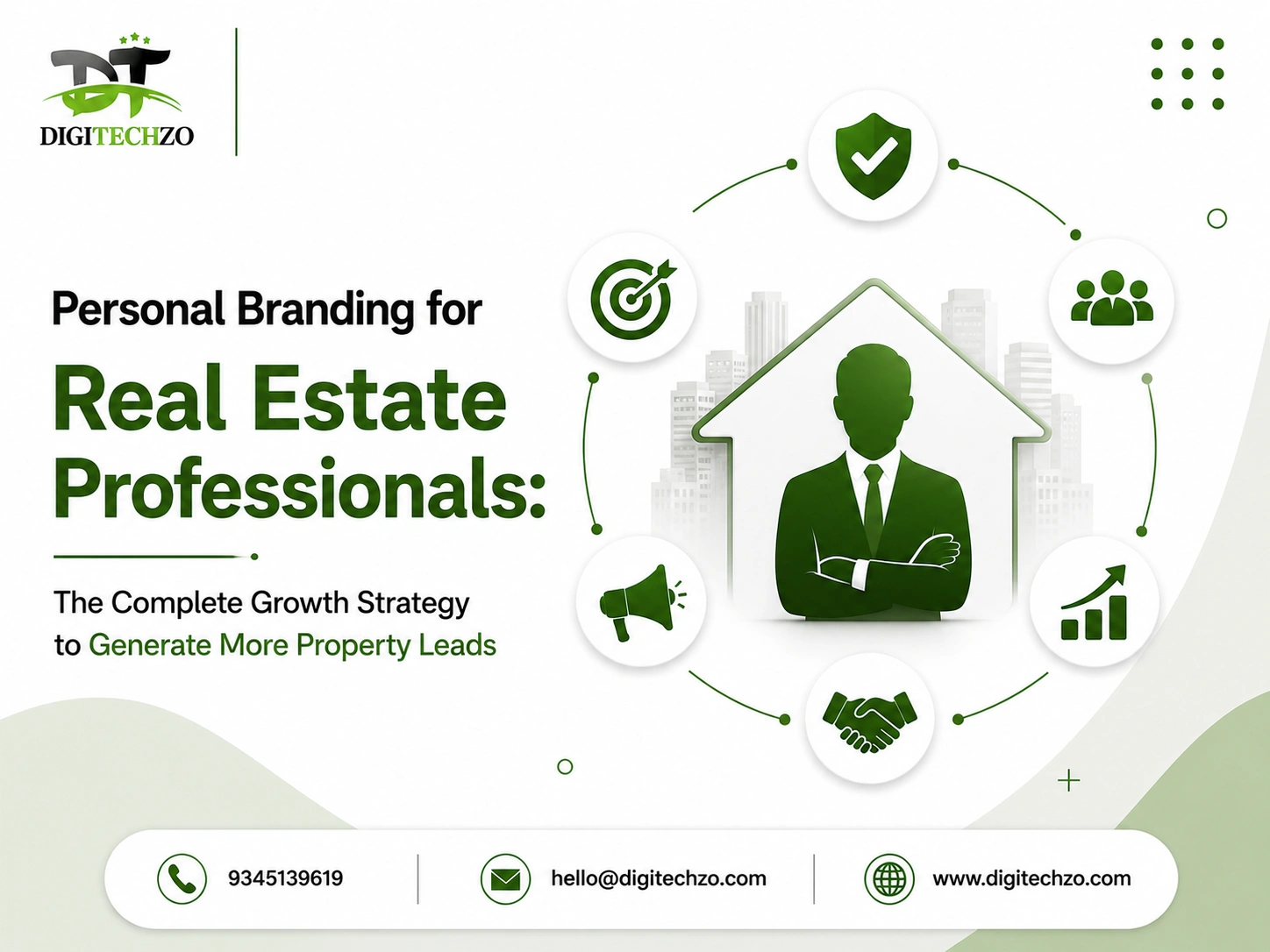
Most real estate agents are invisible online — not because they lack talent, but because they look and sound exactly like every other agent in their market. Same headshot in front of a car. Same “Just Listed / Just Sold” post. Same generic bio. In a market where buyers and sellers scroll past dozens of agents before they ever pick up the phone, blending in is the single biggest reason good agents lose good leads.
Personal branding for real estate professionals isn’t about vanity — it’s about becoming the obvious, trusted choice before a prospect even talks to you. Agents who build a real, recognizable brand consistently close more listings, command better referral fees, and spend less on cold outreach because leads come to them already convinced.
We’ve spent years helping service-based professionals — including agents, brokers, and real estate teams — build digital presences that actually convert, and this guide (brought to you by the team at DigiTechzo, a growth marketing partner for real estate and local businesses) distills what genuinely moves the needle, not just what looks good on a moodboard.
Quick Answer
Personal branding for real estate professionals is the deliberate process of positioning yourself — not just your listings — as a recognizable, trustworthy authority in a specific market or niche. It combines a consistent visual identity, a clear content strategy, social proof, and local authority signals so that when someone thinks “real estate agent,” they think of you first. Done right, it shortens the sales cycle and increases referral volume without additional ad spend.
Why Personal Branding Matters More Than Ever in Real Estate
The National Association of Realtors has repeatedly found that a large majority of buyers and sellers start their search online and choose an agent based on referrals, reviews, or reputation rather than brokerage size. In practice, this means the individual agent’s brand — not the franchise logo on the yard sign — is what actually closes deals.
Three shifts have made this unavoidable:
- Buyers vet agents like they vet products. They check Google, Instagram, and Zillow reviews before ever calling.
- The market is saturated. Most metro areas have thousands of licensed agents competing for the same listings.
- Referrals travel further digitally. A single well-produced video or client testimonial can reach hundreds of potential leads outside your immediate sphere.
An agent with a strong personal brand doesn’t need to “sell” as hard — the brand pre-sells trust, so the sales conversation starts from a position of credibility rather than a cold pitch.
The 5 Pillars of a Winning Real Estate Personal Brand
Every strong real estate brand we’ve seen succeed rests on the same five pillars. Skip one, and the brand feels hollow or inconsistent.
Niche Clarity
“I help everyone buy and sell homes” is not a brand — it’s a job description. Agents who dominate a niche (luxury waterfront, first-time buyers, military relocations, downtown condos) become the default referral for that segment.
Visual and Verbal Consistency
Same colors, same tone of voice, same photography style across your website, listings, business cards, and social profiles. Consistency is what makes a brand recognizable — not just present.
Content That Educates, Not Just Advertises
Listings alone don’t build trust. Market breakdowns, neighborhood guides, and buyer/seller education do.
Social Proof
Reviews, testimonials, video case studies, and visible transaction history. Trust is transferred, not claimed.
Local Authority
Being known as the agent for a specific neighborhood or building type — reinforced through local SEO, community involvement, and hyperlocal content.
Building Your Brand Foundation
Before touching social media or ads, get these fundamentals right. This is the step most agents skip, and it’s why their content never compounds.
Define Your Positioning Statement
A simple formula works well:
“I help [specific audience] [achieve specific outcome] in [specific area] through [your unique approach].”
Example: “I help first-generation homebuyers in the Denver metro area navigate the process with zero jargon and full transparency.”
Audit Your Current Digital Footprint
Search your own name. What comes up? Old listings, outdated headshots, inconsistent bios across platforms — these all dilute trust. Clean this up before building anything new.
Invest in Professional Photography and a Signature Look
This doesn’t mean a stiff studio headshot. It means photography and design that reflects the niche you serve — a luxury agent’s visuals should look different from a starter-home specialist’s.
Content Strategy That Actually Generates Leads
Content is where most agents either build momentum or waste months posting into the void. The difference comes down to intent, not volume.
High-Intent Content Formats
| Content Type | Purpose | Lead Intent |
|---|---|---|
| Neighborhood guides | Establish local authority | Medium-high |
| Buyer/seller FAQs | Answer objections before the call | High |
| Video walkthroughs | Build familiarity and trust | Medium |
| Client success stories | Social proof | High |
| Market update posts | Position as the local expert | Medium |
| Behind-the-scenes/day-in-the-life | Humanize the brand | Low-medium |
Pros and Cons of the Main Content Channels
Instagram/Reels
- Pros: Strong for visual storytelling, younger buyer demographics, fast growth potential
- Cons: Short shelf life, algorithm-dependent reach
YouTube
- Pros: Long-term SEO value, builds deep trust through longer content, ranks in Google search
- Cons: Higher production effort, slower initial growth
- Pros: Excellent for referral partnerships (lenders, attorneys, investors), high-trust B2B audience
- Cons: Lower volume of direct consumer leads
Local Blog/Website
- Pros: Compounding SEO value, owns the traffic (not rented from a platform)
- Cons: Requires consistency and keyword research to work
Practical example: An agent specializing in relocation clients built a simple content pillar of “moving to [city] guides” answering cost-of-living, school district, and commute questions. Within several months, that content became the top organic traffic source to their site — because it matched exactly what relocating buyers were searching for, long before those buyers were ready to talk to any agent.
Local SEO and Online Authority for Agents
Personal branding and local SEO are inseparable in real estate — your brand only compounds if people can find it when searching.
Core Local SEO Actions
- Fully optimize your Google Business Profile with service areas, reviews, and photos
- Get listed and consistent across real estate directories (Zillow, Realtor.com, Redfin agent profiles)
- Build local backlinks through community partnerships, sponsorships, and guest posts
- Publish neighborhood-specific landing pages, not just a generic “About Me” page
- Actively request and respond to reviews — response rate and recency both influence local ranking
Featured Snippet Opportunity
Google frequently surfaces short, direct definitions for branding and real estate marketing queries. Structuring key sections (like the Quick Answer above) as a clear 2–3 sentence definition increases your odds of capturing that snippet position.
Personal Brand vs. Brokerage Brand: Finding the Balance
A common tension: brokerages want agents to reinforce the company brand, while agents need individual recognition to build a portable, long-term business.
The healthiest approach:
- Use the brokerage’s credibility (name recognition, MLS access, training) as a trust signal
- Keep your personal name, voice, and content ownership independent of the brokerage
- Own your website domain, email list, and social handles — never build your brand entirely on rented brokerage infrastructure
Agents who build brand equity independent of their brokerage retain that value if they ever change companies or go independent. Those who rely solely on the brokerage’s marketing start from zero every time they move.
Common Mistakes Agents Make With Personal Branding
- Posting only listings. Feeds full of “Just Listed” posts read as advertising, not authority. Aim for roughly 80% value/education content and 20% direct promotion.
- Inconsistent visual identity. Different logos, fonts, and photo styles across platforms make the brand forgettable.
- Trying to serve everyone. A brand that speaks to “anyone buying or selling” resonates with no one specifically.
- Ignoring reviews and testimonials. Word-of-mouth trust doesn’t transfer online unless it’s visibly documented.
- Treating branding as a one-time project. A logo and a bio update are not a brand strategy — branding requires ongoing content and reputation management.
- No clear call-to-action. Beautiful content that doesn’t guide the viewer to book a call, download a guide, or message you wastes the trust it built.
Expert Tips to Accelerate Your Brand Growth
- Batch-create content monthly. Film or write four weeks of content in a single session to maintain consistency without daily pressure.
- Repurpose one piece of content five ways. A single neighborhood guide can become a blog post, a Reel script, an email newsletter, a LinkedIn post, and a Google Business Profile update.
- Build a referral loop, not just a lead funnel. Ask happy clients for a video testimonial within a week of closing, while the experience is fresh.
- Track brand-driven leads separately. Tag leads that mention “I’ve been following you” or “saw your video” so you can measure branding ROI distinctly from paid ads.
- Partner with local businesses for content collaborations (mortgage brokers, interior designers, moving companies) to expand reach into adjacent trusted audiences.
FAQs
How long does it take to build a real estate personal brand?
Most agents see measurable traction — inbound messages, increased profile visits, referral mentions — within 3 to 6 months of consistent effort. Compounding SEO and reputation benefits typically build meaningfully over 12+ months.
Do I need a personal website separate from my brokerage page?
Yes, if you want to own your traffic and SEO value long-term. A brokerage profile page is rented space; a personal site is an owned asset that keeps working even if you switch brokerages.
What’s the difference between personal branding and marketing in real estate?
Marketing promotes a specific offer or listing. Personal branding builds the underlying trust and recognition that makes all future marketing more effective and less expensive.
Should new agents focus on personal branding before they have many sales?
Yes. New agents can build authority through education-focused content (market updates, buyer guides, FAQs) even before they have a large transaction history — expertise can be demonstrated before volume is proven.
What’s the single highest-leverage branding activity for a busy agent?
Consistent, niche-specific content published on owned channels (blog, YouTube, email list) tends to outperform sporadic activity across many platforms, because it compounds in search rankings over time.
Final Thoughts
Personal branding isn’t a side project for real estate professionals — it’s the infrastructure that determines whether leads seek you out or whether you’re stuck chasing every one of them manually. Agents who commit to niche clarity, consistent content, visible social proof, and local search authority build a business that keeps generating leads long after any single ad campaign ends.
If you’re ready to turn your personal brand into a consistent, measurable lead-generation engine rather than a scattered social media habit, DigiTechzo works with real estate professionals to build exactly this kind of system — from local SEO and content strategy to lead tracking that shows what’s actually driving your business. Reach out to start mapping your brand growth strategy today.
About The Author