
You need content. Consistently good content. The kind that ranks, converts, and doesn’t fall apart the moment your one freelance writer goes on vacation or ghosts you mid-project.
So you’re stuck at a fork in the road: hire a content creation agency, or bring on a freelancer.
Both options get pitched as “the smart choice” depending on who you ask. Agencies will tell you freelancers are unreliable. Freelancers will tell you agencies are bloated and slow. The truth, as usual, sits somewhere in the messy middle — and it depends entirely on your budget, timeline, and how much content you actually need to move the needle.
At Digitechzo, we’ve sat on both sides of this decision — as a team that’s built content engines for brands scaling from a few blog posts a month to full-scale content operations across blogs, video, and social. We’ve also seen the exact moments where a freelancer setup breaks down and a business quietly bleeds money trying to patch it together. This guide is built from that experience, not from a generic listicle.
Quick Answer
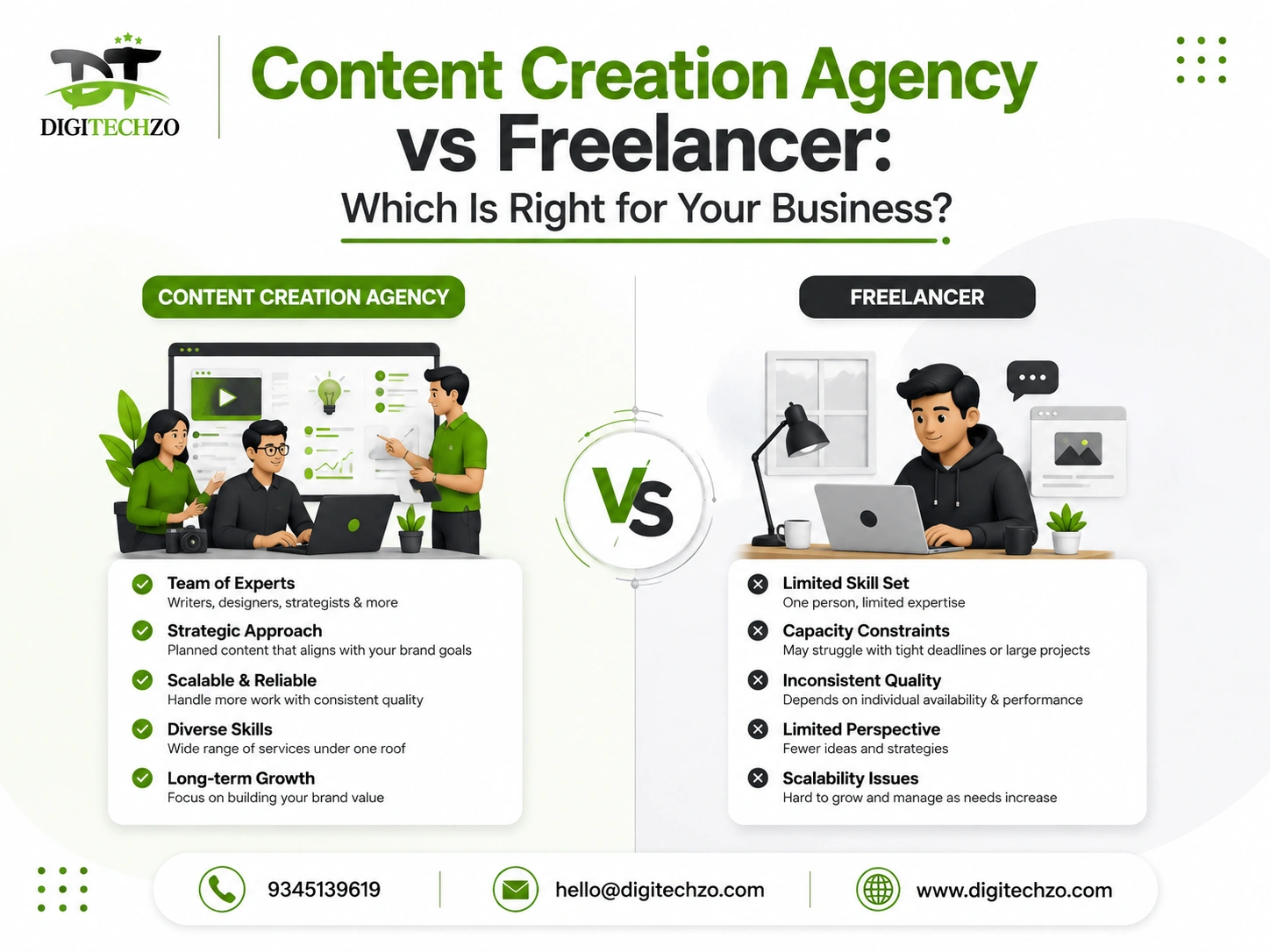
A content creation agency is the better fit if you need consistent output, multiple content formats, strategy, and scalability without managing people yourself. A freelancer works well for single-format needs, tight budgets, or short-term projects where you can manage the process directly. Most businesses outgrow freelancers once content becomes a core growth channel rather than a one-off task.
What Is a Content Creation Agency?
A content creation agency is a full team — usually made up of strategists, writers, editors, SEO specialists, and sometimes designers or video producers — built to handle content as a system, not a series of one-off tasks.
The key word is system. A good agency doesn’t just write. It:
- Builds a content strategy tied to business goals (leads, rankings, brand authority)
- Manages editorial calendars and publishing cadence
- Handles SEO research, keyword mapping, and internal linking
- Has redundancy built in — if one writer is out, the work still ships
- Reports on performance, not just deliverables
Think of it less like hiring a writer and more like plugging in a content department without the overhead of hiring one internally.
What Does Hiring a Freelancer Actually Look Like?
A freelancer is a single professional — a writer, designer, or content specialist — working independently, usually across multiple clients at once.
In practice, this means:
- You’re the strategist. The freelancer executes what you brief them.
- Output is tied to one person’s bandwidth, skill set, and availability.
- Quality can be excellent — but it’s dependent on finding the right individual, which often takes several trial hires.
- There’s no built-in backup if they’re sick, busy, or move on to another client.
This isn’t a knock on freelancers. Many are exceptional at their craft. The limitation isn’t skill — it’s capacity and structure.
Content Creation Agency vs Freelancer: Head-to-Head Comparison
| Factor | Content Creation Agency | Freelancer |
|---|---|---|
| Strategy included | Yes, usually built-in | Rarely — you provide direction |
| Scalability | High — can ramp up quickly | Limited to one person’s output |
| Cost | Higher upfront, lower cost-per-piece at scale | Lower upfront, cost rises with quality/scale |
| Reliability | Backup systems in place | Single point of failure |
| Content formats | Blog, video, social, design — often bundled | Usually one specialty |
| Management effort | Low — agency manages workflow | High — you manage the process |
| Turnaround for bulk content | Fast, parallelized | Slower, sequential |
| Best for | Ongoing growth, multi-channel content | Single projects, tight budgets |
Pros and Cons of Each Option
Content Creation Agency
Pros:
- Consistent quality and delivery, even during team changes
- Access to strategy, SEO, and multi-format production in one place
- Scales with you as content needs grow
- Less time spent managing individual contributors
Cons:
- Higher monthly investment than a single freelancer
- Onboarding takes slightly longer as the team learns your brand
- Less flexibility for extremely niche, highly personal writing styles
Freelancer
Pros:
- Lower cost for small, defined projects
- Direct, one-on-one communication
- Can be a great fit for a very specific voice or niche expertise
Cons:
- Output capped by one person’s time and energy
- No safety net if they’re unavailable or underdeliver
- You carry the strategic and quality-control burden
- Harder to scale without hiring more freelancers (and managing all of them)
When a Freelancer Is the Right Call
A freelancer makes sense when:
- You need one blog post a month, not twelve
- You already have a content strategy and just need execution
- Budget is the primary constraint, not speed or scale
- The project is short-term (a launch, a campaign, a one-time whitepaper)
Example scenario: A solo consultant launching a personal newsletter needs 2 articles a month in their own voice. A freelance writer familiar with their niche is often the more cost-effective, personal fit here — an agency would be overkill.
When a Content Creation Agency Makes More Sense
An agency becomes the smarter investment when:
- Content is a core part of your growth or SEO strategy, not an afterthought
- You need multiple formats — blogs, landing pages, social, video scripts — working together
- You’ve been burned by freelancer inconsistency (missed deadlines, disappearing writers, uneven quality)
- You want to focus on running your business, not managing a roster of contractors
Example scenario: A SaaS company aiming to publish 8–10 SEO-optimized articles a month, alongside case studies and LinkedIn content, needs coordinated output across formats. Managing four different freelancers for this creates more overhead than it saves. This is exactly the gap agencies like Digitechzo are built to close — treating content as a growth channel with strategy, production, and reporting under one roof.
Cost Breakdown: What You’re Really Paying For
Pricing varies widely, but here’s a realistic range based on current market norms:
- Freelance blog post (1,000–1,500 words): roughly $50–$400 depending on experience and niche depth
- Agency retainer (4–8 articles/month + strategy): typically $1,500–$6,000+ per month depending on scope and formats included
- One-off freelance project (e-book, whitepaper): $300–$2,000+
The mistake most businesses make is comparing a single freelance invoice to an agency retainer and calling the freelancer “cheaper.” That’s only true if you ignore the cost of your own time spent briefing, editing, chasing revisions, and managing quality control — hours that add up fast and rarely get counted as a real cost.
Common Mistakes Businesses Make
- Choosing based on price alone. The cheapest option often costs more in revisions, missed deadlines, and lost momentum.
- Hiring a freelancer for a job that needs a system. If you need 15 pieces of content a month across formats, one person can’t realistically sustain quality at that volume.
- Hiring an agency without a strategy conversation. If an agency starts writing before understanding your audience and goals, you’re paying for content, not results.
- Not vetting for SEO competency. Great writing that ignores search intent and on-page SEO won’t rank, no matter how well it reads.
- Treating content as a one-time project instead of a channel. Both freelancers and agencies perform best when content is treated as an ongoing investment, not a single sprint.
Expert Tips Before You Decide
- Ask for a sample tied to your industry, not just a generic portfolio. Relevant experience beats general writing skill.
- Clarify who owns strategy. If you’re paying for execution only, make sure you (or someone) is driving keyword and content strategy — otherwise output becomes directionless.
- Test before committing long-term. A paid trial piece or short-term contract reveals more about fit than any pitch call.
- Check for built-in redundancy. Ask what happens if your main point of contact is unavailable — the answer tells you a lot about reliability.
- Match the format to the need. If you only need long-form blogs, a specialist freelance writer may outperform a generalist agency. If you need blogs, social, and video working together, an agency’s coordination advantage matters more.
FAQs
Is a content creation agency more expensive than a freelancer?
Usually yes, on a monthly basis. But per-piece cost often evens out or drops at scale, since agencies parallelize work and remove the hidden time cost of managing individual freelancers yourself.
Can a freelancer handle SEO content as well as an agency?
A skilled, SEO-trained freelancer can absolutely produce strong search-optimized content. The limitation isn’t skill — it’s capacity. One person can only research, write, and optimize so much content per month.
How do I know when to switch from freelancers to an agency?
The clearest signal is when managing your freelancers takes more time and stress than the content itself is worth — or when you need more volume and consistency than one person can reliably deliver.
Do agencies offer more reliable quality control?
Generally yes. Agencies typically have editorial review layers — editors and strategists checking work before it reaches you — while freelance quality depends entirely on that individual’s own review process.
What’s the biggest risk of relying on a single freelancer?
Single point of failure. If they get sick, get busy with another client, or simply move on, your content pipeline stops until you find a replacement.
Final Verdict
There’s no universally “right” answer here — only the right answer for where your business is right now. If you need one voice, one format, and manageable volume, a freelancer is a smart, cost-effective choice. If content is meant to drive real, compounding growth across formats and channels, a content creation agency removes the operational weight and gives you a system that scales instead of a single person you’re hoping doesn’t burn out.
If you’re leaning toward the agency route and want a team that treats your content like a growth channel — not just a to-do list — Digitechzo can help you map out exactly what a scalable content system would look like for your business. Reach out for a free content strategy consultation and see what consistent, compounding content growth actually looks like for you.
About The Author