Two founders launch nearly identical products in the same month. One ends the year with a waitlist and inbound press requests. The other is still cold-emailing prospects who’ve never heard their name. The product wasn’t the difference — the person behind it was.
That’s the uncomfortable truth most businesses discover too late: in 2026, buyers don’t just evaluate what you sell. They evaluate who you are, what you stand for, and whether they trust you enough to hand over their money. This is exactly why personal branding services have moved from a “nice-to-have” for influencers to a core growth lever for founders, consultants, coaches, and B2B leaders alike.
At Digitechzo, we’ve worked with founders and executives who had strong offers but invisible reputations — and watched their pipelines change once their personal brand caught up with their expertise. This guide breaks down exactly why personal branding services matter for business growth in 2026, what they actually include, how to avoid the mistakes that waste budget, and how to choose a service that delivers measurable results, not just vanity metrics.
Quick Answer
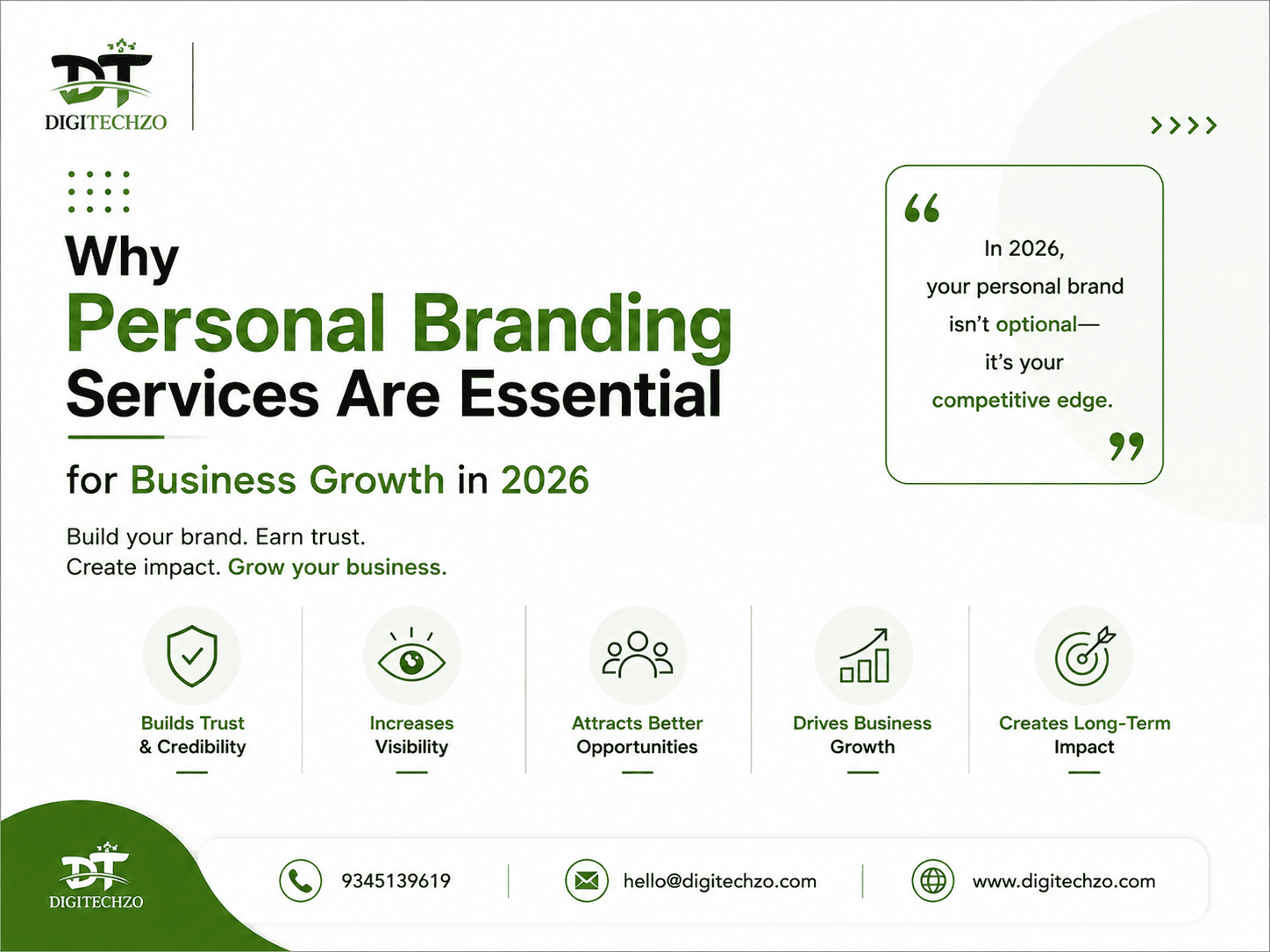
Personal branding services help individuals build a recognizable, trustworthy, and commercially valuable reputation online through strategic positioning, content, and visibility. In 2026, they’re essential because buyers research the person before the product, LinkedIn and search have become primary trust-building channels, and a strong personal brand shortens sales cycles, attracts inbound leads, and commands premium pricing — something a generic company page can rarely achieve alone.
What Are Personal Branding Services?
Personal branding services are structured programs — typically delivered by agencies or specialized consultants — that help an individual define, build, and consistently communicate a distinct professional identity across digital platforms.
Unlike a one-off logo design or a single LinkedIn makeover, genuine personal branding services combine strategy, content production, design, and distribution into a repeatable system. The goal isn’t just “looking good online.” It’s building a recognizable reputation that generates trust at scale, so opportunities — clients, partnerships, speaking invitations, funding, hires — come to you instead of you chasing them.
At its core, personal branding answers three questions for your audience:
- Who are you? (positioning and story)
- What do you know that others don’t? (expertise and point of view)
- Why should I trust you with my time or money? (proof and consistency)
Why Personal Branding Matters More in 2026 Than Ever Before
Buyers Research People, Not Just Companies
B2B and B2C buying behavior has shifted permanently toward researching individuals before making decisions. Edelman’s Trust Barometer research has repeatedly shown that people trust “a person like themselves” and company experts far more than they trust corporate spokespeople or brand advertising. In practice, this means a prospect is more likely to check the founder’s LinkedIn profile than the company’s “About Us” page before booking a call.
AI Search Rewards Recognized Expertise
With AI-generated search summaries and answer engines becoming the default discovery layer, platforms increasingly favor content tied to identifiable, credible authors over anonymous corporate copy. A well-documented personal brand — with consistent authorship, a clear expertise footprint, and third-party mentions — signals authenticity that algorithms and readers both reward.
The Creator Economy Has Normalized Founder Visibility
Founders like those behind fast-scaling SaaS and DTC brands routinely attribute significant pipeline growth to founder-led content on LinkedIn and X. When the person becomes the top of the marketing funnel, customer acquisition cost often drops because trust is pre-built before the sales conversation even starts.
Hiring, Fundraising, and Partnerships Now Start With a Search
Investors Google founders before term sheets. Candidates check leadership profiles before accepting offers. Partners vet decision-makers before signing contracts. A thin or inconsistent digital footprint quietly disqualifies you in rooms you’re never invited into.
What’s Included in Professional Personal Branding Services
Not all personal branding services are equal. A comprehensive package typically includes:
1. Brand Strategy & Positioning
- Audience and competitor research
- Niche and message clarity (what you’re known for)
- Tone of voice and visual identity guidelines
2. Digital Presence Optimization
- LinkedIn profile and banner optimization
- Website/portfolio bio and headline copy
- Google search result management (what shows up when someone searches your name)
3. Content Strategy & Creation
- Thought-leadership articles and LinkedIn posts
- Short-form video scripting or repurposing
- SEO-optimized personal blog or newsletter content
4. Authority Building
- PR placements, podcast guesting, and expert roundups
- Speaking opportunity outreach
- Testimonials and case study production
5. Analytics & Iteration
- Engagement and reach tracking
- Lead attribution from personal content
- Quarterly strategy refreshes based on data
Personal Branding vs. Business Branding: Key Differences
| Aspect | Personal Branding | Business Branding |
|---|---|---|
| Core asset | An individual’s reputation and expertise | A company’s name, logo, and offerings |
| Trust driver | Relatability and authenticity | Consistency and scale |
| Longevity | Follows the person across ventures | Tied to the company’s lifespan |
| Content style | Opinion-driven, story-led | Product- and feature-led |
| Best for | Founders, consultants, coaches, executives | Established companies with broad audiences |
The two aren’t competitors — they’re complementary. The strongest go-to-market strategies in 2026 pair a trusted personal brand (the founder or expert) with a credible business brand (the company delivering the product).
Real-World Impact: How Personal Branding Drives Business Growth
Consider a B2B consulting founder who, before investing in personal branding, relied entirely on referrals and had an unpredictable pipeline. After six months of consistent LinkedIn thought-leadership content built around a documented framework, inbound discovery calls increased because prospects arrived already familiar with the founder’s point of view — meaning sales calls shifted from “convince me you’re credible” to “let’s discuss fit.” This is a common pattern we’ve observed at Digitechzo: personal branding doesn’t just build awareness, it pre-qualifies leads before the first conversation even happens.
Another common scenario: a solo coach with strong client results but no visibility struggles to charge premium rates because prospects have no way to verify expertise beyond a testimonial page. Once a documented personal brand exists — search results, published articles, video content, and public case studies — price objections drop because trust has already been established before pricing is discussed.
Pros and Cons of Investing in Personal Branding Services
Pros:
- Builds compounding, owned trust that doesn’t disappear when ad spend stops
- Shortens sales cycles by pre-qualifying leads
- Creates leverage for pricing, partnerships, hiring, and fundraising
- Improves visibility in both traditional search and AI-driven search
- Outlasts any single company or product
Cons:
- Requires consistent effort over months, not days
- Results compound slowly at first — early ROI can be hard to measure
- Public visibility invites scrutiny and requires message discipline
- Poor execution (generic content, inconsistent posting) can waste budget
How to Choose the Right Personal Branding Agency
Look for a provider that:
- Asks about your business goals before touching your profile or content — branding without strategy is decoration, not growth
- Shows a documented process, not just “we’ll make you go viral” promises
- Provides examples of measurable outcomes such as lead volume, inbound inquiries, or media placements
- Offers a content system you can eventually run independently, rather than permanent dependency
- Understands your industry’s buying behavior, not a one-size-fits-all template
Common Mistakes in Personal Branding
- Chasing virality instead of relevance. A viral post that attracts the wrong audience does nothing for revenue.
- Inconsistent posting. Sporadic content resets algorithmic trust and audience recall every time.
- Copying someone else’s voice. Audiences can tell when content isn’t authentic, which erodes trust faster than silence would.
- Ignoring search visibility. Many people optimize LinkedIn but never check what appears when their name is Googled.
- No clear call-to-action. Building an audience without a path to inquiry or booking wastes the attention generated.
- Treating it as a one-time project. Personal branding is a system, not a one-time redesign — it needs ongoing iteration.
Expert Tips for Building a Personal Brand That Converts
- Pick one core narrative and repeat it. Audiences need repetition to remember what you stand for — resist the urge to cover a new topic every week.
- Document, don’t just create. Sharing real processes, decisions, and lessons builds more trust than polished, generic advice.
- Optimize for the searcher, not just the scroller. Make sure your bio, headline, and pinned content answer “what do you do and who do you help” within three seconds.
- Turn testimonials into proof content. A client result explained in a short case-study post outperforms a plain quote graphic.
- Track leads, not just likes. Reach is a vanity metric; inbound messages and booked calls are the metrics that matter for business growth.
FAQs
Q1: What exactly do personal branding services include?
Personal branding services typically include brand strategy, digital profile optimization (LinkedIn, website, search results), content creation, authority-building activities like PR and podcast guesting, and performance tracking — all designed to build a consistent, trustworthy professional identity.
Q2: How long does it take to see results from personal branding?
Most clients begin seeing engagement and inbound interest within 60–90 days of consistent execution, while stronger business outcomes like inbound leads and premium pricing typically compound over 6–12 months.
Q3: Is personal branding only for influencers and coaches?
No. Founders, consultants, B2B executives, freelancers, and even job seekers benefit, since personal branding influences hiring decisions, partnership opportunities, and buyer trust across virtually every industry.
Q4: How is personal branding different from personal PR?
Personal branding is the ongoing strategy and content system that defines who you are and what you’re known for; PR is one tactic within that system used to earn third-party visibility like media features or podcast appearances.
Q5: Do personal branding services guarantee more clients or sales?
No credible provider can guarantee sales, since outcomes depend on offer quality, market fit, and consistency. What personal branding services can reliably deliver is increased visibility, trust, and inbound interest, which historically improve conversion rates when paired with a strong offer.
Final Thoughts
Personal branding is no longer optional positioning for business growth in 2026 — it’s infrastructure. Buyers, investors, partners, and even employers now vet the individual before the institution, and a strong personal brand is what turns that scrutiny into an advantage instead of a liability.
If your expertise is strong but your visibility isn’t matching it yet, that gap is costing you leads, pricing power, and opportunities you’ll never even see. At Digitechzo, we help founders and professionals close that gap with personal branding services built around real business outcomes — not just aesthetics.
Ready to turn your expertise into your biggest growth channel? Reach out to Digitechzo for a personal branding strategy session and see what a documented, trustworthy online presence can do for your pipeline.
About The Author